Act I
The dog reached the dumpster before anyone understood there was a reason to run.
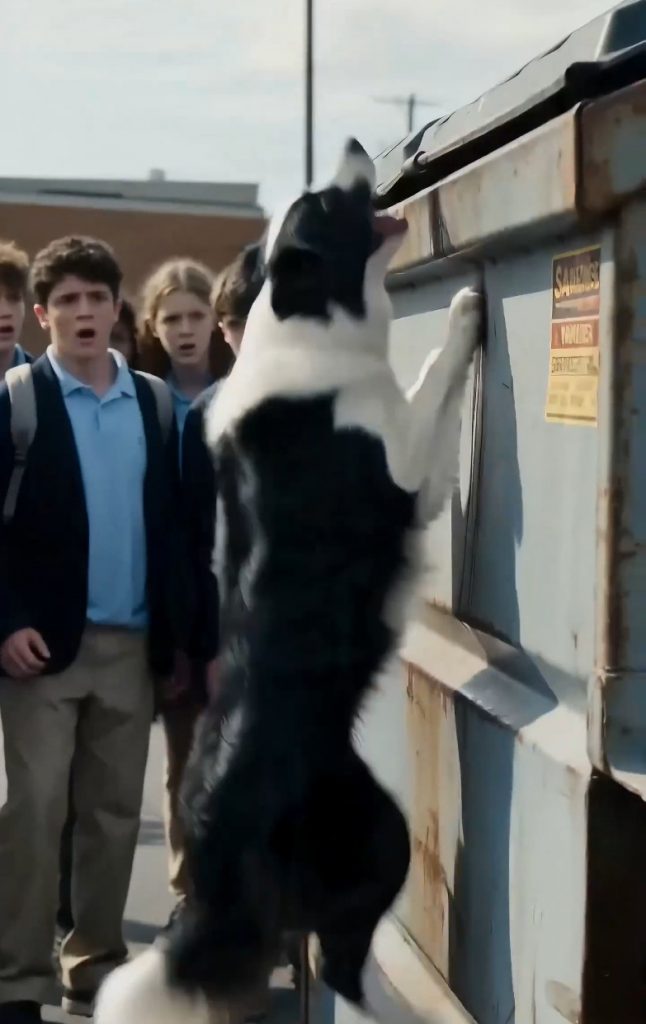
He tore across the school parking lot, black-and-white fur flashing beneath the gray afternoon sun, paws striking the pavement in frantic bursts. Behind him, students in varsity jackets and backpacks stopped near the brick wall and watched as the Border Collie circled the weathered metal container like it was alive.
“Scout!” someone shouted. “Scout, come back!”
The dog ignored them.
He shoved his nose into the dirt and grit near the dumpster’s wheels, sniffing hard, then began to scrape at the ground. His claws scratched against pavement. Pebbles scattered. Leaves jumped. A thin, panicked bark burst from his chest.
A group of students gathered in a loose semicircle.
“What’s wrong with him?”
“He found something.”
“Don’t touch it.”
Scout pawed harder.
Then a small object slid free from the dirt.
A ring.
It was silver, scratched, and partly bent, with a tiny blue stone set into the center. The dog nosed it once, then barked toward the dumpster lid with such urgency that the students stepped back.
That was when the black sedan came screaming into the parking lot.
It braked too sharply near the curb. The driver’s door flew open, and an older man in an elegant dark suit stumbled out, face pale, tie crooked, shoes striking the asphalt as he hurried toward the crowd.
“Wait!” he shouted. “Don’t open that!”
Everyone turned.
The dog barked louder.
Officer Paul Mercer, the school resource officer, ran in from the far side of the lot with one hand near his radio and the other raised toward the students.
“Back up,” he ordered. “All of you, back up now.”
The suited man pushed closer, eyes fixed on the dumpster lid.
“Officer, listen to me. Do not open it.”
Mercer stopped and looked at him.
“Why?”
The man’s mouth worked once.
No answer came.
Scout leapt against the metal side, front paws striking beneath the rim. His claws scraped down the weathered green paint. That was when Mercer saw the dark red streak trailing from the lid down the side panel.
His face hardened.
“Nobody leave,” he shouted.
The parking lot froze.
The suited man whispered, “Please.”
Mercer gripped the edge of the heavy lid and lifted.
The metal creaked.
Scout stopped barking and whined.
The officer looked inside.
For one terrible second, he did not move.
Then all the color drained from his face.
And when he finally spoke, his voice was no longer commanding.
It was shaken.
“Get medical here. Now.”
Act II
An hour earlier, the school had been trying very hard to look normal.
Millbrook Academy always looked normal from the outside.
Fresh banners on the brick walls. Clean sidewalks. A front office that smelled faintly of lemon polish. Trophy cases full of gold cups and smiling team photos. A motto painted above the cafeteria entrance:
Character When No One Is Watching.
The students joked about that motto.
Mia Torres did not.
Mia was fifteen, a scholarship student, and the kind of girl adults called “promising” when they wanted her grateful but not too loud. Her mother cleaned offices at night. Her father had died when she was nine. Mia earned her place at Millbrook by writing essays so sharp the admissions board could not ignore her, though some parents tried.
She did not belong to the world of dark sedans and private tutors.
She knew that.
But she also knew how to notice things.
For three months, Mia had been working on an article for the student paper about the Wren Fund, a charity account meant to pay for uniforms, tutoring, and college prep for low-income students. The fund looked generous in school brochures.
On paper, it served dozens.
In real life, Mia knew three scholarship students who had been told there was “no money available this semester.”
Then she found the invoices.
Charged to the Wren Fund were hotel rooms for athletic recruiters, new equipment for the lacrosse team, donor dinners, and a consultant hired by the school board chair.
The board chair was Richard Vale.
The suited man in the parking lot.
He had a perfect reputation. He donated to hospitals, posed with students at fundraisers, and told reporters Millbrook was “a family committed to every child’s future.”
Mia learned that people who said every child often meant every child who mattered to them.
She made copies.
She hid them in her locker.
Then she made one mistake.
She told Eli Vale.
Eli was Richard’s son, a senior, and the kind of boy teachers trusted because his parents funded half the new science wing. Mia thought Eli might care that scholarship money had been stolen. She thought maybe having his family name attached to the fund would make him angry enough to help.
Instead, Eli stared at her phone screen and said, “You need to delete that.”
Mia did not.
By lunch, three boys followed her out toward the parking lot.
Scout saw them.
The Border Collie belonged to Ms. Reyes, the school counselor, who had adopted him after he retired from a volunteer search-and-rescue group. Scout was supposed to spend afternoons in the counseling office, lying under the window while anxious students pretended they had only come for candy.
But Scout loved Mia.
She brought him apple slices from the cafeteria. She brushed burrs from his tail after outdoor assemblies. She was the only student who knew he hated thunder and loved being scratched under the collar.
When Mia did not come back after lunch, Scout became restless.
When the final bell rang and her backpack still sat in the counseling office, he began pacing.
When Ms. Reyes opened the office door to ask a passing teacher whether Mia had gone home, Scout slipped past her and ran.
Straight to the dumpster.
Straight to the ring he knew by scent.
The silver ring was Mia’s.
Her mother had given it to her after eighth-grade graduation, saying, “Wear something pretty in rooms where people expect you to feel small.”
Mia wore it every day.
Until the dog dug it out of the dirt.
Act III
The students could not see inside the dumpster.
Officer Mercer made sure of that.
He slammed one hand up toward the crowd and barked, “Turn around. Now.”
Most obeyed.
A few stood frozen until teachers ran from the building and pulled them back. Someone began crying. Someone else whispered, “Is it Mia?” and the whisper spread faster than the wind.
Scout refused to move.
He pressed himself against Mercer’s leg, trembling, eyes fixed on the open lid.
Inside, behind flattened cardboard and torn black bags, Mia Torres was alive.
Barely conscious.
Her face was dusty. Her school jacket was twisted beneath her shoulder. One hand moved weakly when Mercer called her name.
“Mia? Can you hear me?”
Her lips parted.
“Scout.”
The dog whined.
Mercer’s throat tightened.
“Stay with me. Help is coming.”
The suited man took one step forward.
Mercer turned on him so sharply Richard Vale stopped mid-stride.
“Back up.”
Richard lifted both hands.
“I was trying to prevent a scene.”
Mercer’s voice dropped.
“There is a child in there.”
Richard’s eyes flicked toward the students.
Not Mia.
The students.
That was the first thing Mercer noticed.
The second was that Richard Vale did not ask whether she was alive.
Paramedics arrived with a stretcher and moved quickly. They lifted Mia with care, speaking to her in gentle, steady voices. Scout tried to follow until Ms. Reyes wrapped both arms around him and whispered, “Let them help her.”
Mia’s eyes opened again as they lowered her onto the stretcher.
Mercer leaned close.
“Who did this?”
Her gaze drifted past him.
To Richard Vale.
Then to a cluster of boys near the school doors.
Eli Vale stood among them, no longer smirking, his face gray beneath his tan.
Mia swallowed.
“They took my phone,” she whispered. “But not the copies.”
Richard’s jaw clenched.
Mercer heard enough.
He turned to his radio.
“Lock down the campus. I need units at Millbrook Academy. Possible assault, child endangerment, evidence tampering. Nobody leaves the property.”
Richard stepped closer, voice low.
“Officer, be careful with accusations.”
Mercer looked at him.
“You came here shouting not to open a dumpster with a missing student inside.”
The suited man’s face tightened.
“I had been called about a disturbance.”
“By who?”
Richard did not answer.
The silence did.
Scout barked once, sharp and accusing, toward Eli Vale.
And the boy flinched.
Act IV
The truth came out in pieces.
First came the ring.
Then the stain.
Then the security footage from the auto shop across the street, because Millbrook’s own cameras near the dumpster had mysteriously gone dark for seven minutes after lunch.
The auto shop camera was old, grainy, and mounted above a garage bay, but it saw enough.
Mia walking toward the parking lot.
Eli and two other boys following.
An argument.
Mia backing away.
One boy grabbing for her phone.
The dumpster lid opening.
The image did not show everything, and that mercy mattered. But it showed enough to prove the story Richard Vale wanted to tell would never survive.
Then came the student witnesses.
At first, no one wanted to speak.
Millbrook had trained them well. Not officially. Not in classrooms. But in the quiet lessons private schools teach without writing down.
Protect the donors.
Protect the athletes.
Protect the reputation.
Do not be the one who makes things ugly.
Then a freshman named Grace Liu stepped forward, shaking so badly her teacher had to sit beside her.
“I saw Eli take her phone,” she said. “He said his dad would fix it.”
Another student raised his hand.
Then another.
By evening, there were six statements.
Mia had been shoved toward the dumpster after threatening to publish the Wren Fund story. The boys thought humiliation would scare her. Then the lid closed too hard. Panic replaced cruelty. One of them wanted to call for help. Eli called his father instead.
Richard Vale arrived not to rescue Mia.
To control the damage.
He had told his son to keep people away until he got there.
He had not counted on Scout.
He had not counted on an old search dog who understood scent better than reputation.
He had not counted on a silver ring falling where truth could find it.
Mia’s mother, Elena Torres, arrived at the hospital still wearing her cleaning company polo. She ran through the emergency entrance with her hair falling loose, breathless from fear and from having no idea which desk to approach first.
When she saw Mia awake in a hospital bed, she nearly collapsed.
“Mija.”
Mia cried then.
Not when the paramedics lifted her.
Not when the officer asked questions.
Not when doctors checked her.
Only when her mother touched her face and whispered, “I’m here.”
Mercer stood outside the room, giving them privacy.
Scout lay at his feet in the hallway, refusing food, water, and every attempt to move him farther than the door.
Ms. Reyes sat beside him on the floor.
“He won’t leave until he sees her,” she said.
Mercer looked through the glass at Mia and Elena.
“He earned that.”
Hours later, Mia asked for the dog.
The nurses made an exception.
Scout entered carefully, as if he understood hospitals had rules, then rested his head on the edge of Mia’s bed. She touched his ears with trembling fingers.
“You found my ring.”
Scout closed his eyes.
Mia looked at Officer Mercer.
“They stole the phone.”
Mercer nodded.
“We know.”
“But not everything.”
Her mother looked at her.
Mia turned to Elena.
“In my locker. Behind the false bottom in the blue binder.”
Elena gave a broken laugh through tears.
“You made a false bottom in a binder?”
Mia tried to smile.
“You always said be prepared.”
Mercer left the room and called for a warrant.
By morning, the copies were in evidence.
The Wren Fund files did more than explain why Mia had been targeted.
They exposed the reason.
Richard Vale had rerouted scholarship money through vendors connected to his own consulting firm. Athletic perks. Donor events. Family travel disguised as outreach. Every invoice Mia copied became another nail in the polished coffin of his public image.
And at the center of it all was a school that had taught children to fear bad publicity more than bad behavior.
Act V
The dumpster was removed before Mia returned to campus.
Not cleaned.
Not painted.
Removed.
In its place, the school tried to plant a row of decorative shrubs. Elena objected at the board meeting.
“No,” she said. “You do not cover this with landscaping.”
The room went quiet.
Mia sat beside her mother, one hand resting near the silver ring that had been repaired and returned to her. Scout lay under the table, his head on her shoe.
Elena continued.
“My daughter was not saved because your systems worked. She was saved because a dog noticed what adults ignored.”
Nobody argued.
Not after the footage.
Not after the fund records.
Not after Richard Vale resigned, then faced charges. Eli and the two boys involved were removed from campus pending legal proceedings. Several administrators resigned once the investigation revealed how many complaints had been softened, buried, or reworded to protect donors’ children.
The school paper published Mia’s article three weeks later.
Her headline was simple:
The Money Was Never Missing. It Was Taken.
The issue sold out by second period.
Students read it in stairwells, locker rooms, and cafeteria lines. Some looked angry. Some looked ashamed. Some looked relieved that someone had finally said what scholarship students had known for years.
Mia did not return as a symbol.
She refused that.
“I’m not a mascot for courage,” she told the new principal when he suggested an assembly in her honor.
So the school held a different assembly.
Not about Mia.
About listening.
Officer Mercer spoke first. Ms. Reyes spoke next. Then Grace Liu, the freshman witness, stood at the podium with shaking hands and said, “I thought being quiet would keep me safe. It didn’t. It only made me feel alone.”
Mia watched from the third row.
Scout sat at her feet.
When the assembly ended, students did not clap right away.
That was good.
Some truths need silence before applause ruins them.
The patch of asphalt where the dumpster once stood became something else months later.
Not shrubs.
Not a plaque with empty language.
A small outdoor table was installed beneath a young maple tree, with benches wide enough for students to sit with backpacks and lunch trays. Beside it stood a low metal marker shaped like a dog’s paw.
On it were the words:
For Scout, who knew evidence when he smelled it.
Underneath, smaller letters:
And for every student who should have been believed before proof was dragged into the light.
Mia hated the second line at first.
Then she read it again.
And again.
Finally, she said, “Keep it.”
Richard Vale’s trial took longer than anyone wanted. Men like him had lawyers who knew how to slow truth down. But slowing truth is not the same as stopping it.
The ring. The footage. The student statements. The fund records. The call logs showing Eli phoned his father before emergency services. The erased school camera files.
Together, they formed a story too heavy to dismiss.
When Richard Vale was led from the courthouse after sentencing, reporters shouted questions.
He ignored them.
Mia did not attend.
She was at school that day, editing a freshman’s article about broken heating vents in the music wing. Smaller story, maybe. But not to the students who had been practicing in coats for three winters.
“That’s where it starts,” Mia told the freshman. “You write down what they hope nobody notices.”
Scout lived long enough to become the most famous creature Millbrook had ever known.
He was old by then, gray around the muzzle, slower on stairs, deeply unimpressed by applause. Students brought him apple slices. The cafeteria staff kept a water bowl near the side door. Even the football team stepped carefully around him, as if he were a retired judge.
Every year, new students heard the story.
The dog.
The ring.
The dumpster.
The officer’s face when he looked inside.
But Mia told it differently when younger students asked her.
She did not begin with fear.
She began with the ring.
“My mom gave it to me because she wanted me to remember I belonged in any room I entered,” Mia would say. “When it fell, I thought I had lost it.”
Then she would look down at Scout, sleeping beneath the newspaper desk.
“But he found it. And when he found it, he found me.”
Years later, after Mia graduated with honors and a journalism scholarship, Elena framed three things above the kitchen table.
Mia’s first published investigation.
A photograph of Scout with his head on Mia’s knee.
And the silver ring, mounted in a small shadow box after Mia chose a new one for college.
The old ring was bent slightly, even after repair.
Mia liked it that way.
Straight things can look untouched.
Bent things prove they survived.
The parking lot at Millbrook no longer had a dumpster near the student path. The cameras worked. The Wren Fund was placed under independent oversight. Scholarship students sat on the review committee, and nobody laughed at the idea again.
The school motto stayed painted over the cafeteria entrance.
Character When No One Is Watching.
But someone added a second line beneath it during Mia’s senior year.
No one ever proved who.
This time, watch.
And every afternoon, when sunlight hit the paw marker near the maple tree, students remembered the day a Border Collie barked at a locked-away truth until the adults finally came running.
Because Scout did not care about reputations.
He did not care about donors, family names, polished shoes, or dark suits.
He cared about the scent of a girl who fed him apple slices.
He cared about the ring in the dirt.
He cared about the sound nobody else could hear from inside a place nobody wanted to look.
And sometimes, that is how the truth survives.
Not because powerful people confess.
But because something loyal refuses to stop scratching at the metal until someone opens the lid.