Act I
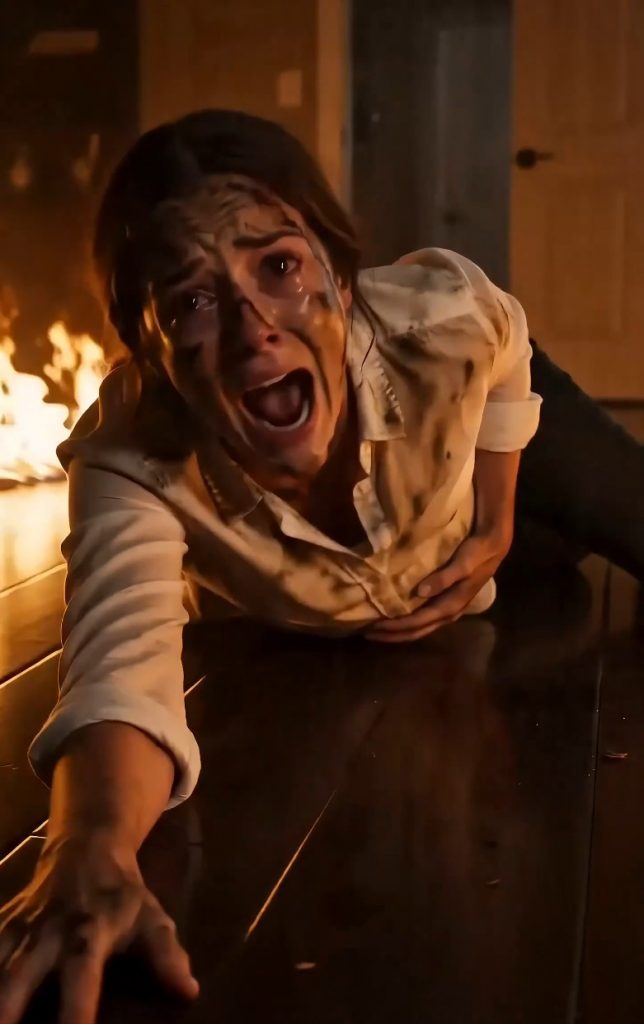
The floor was burning behind Emma Vale when she heard the door open.
For one impossible second, she thought she was saved.
Smoke rolled across the study in dark waves, pressing low over the wooden floor where she dragged herself toward the doorway. The fire had started near the bookshelves, then spread fast, climbing the curtains, licking along the wall, swallowing the room piece by piece.
Emma crawled with one hand pulling her forward and the other pressed over her pregnant belly.
“Somebody help!” she screamed.
Her throat burned. Her white shirt was smeared with ash. Every breath felt stolen.
Then the door slammed open.
A man stood in the doorway, framed by smoke and orange firelight.
Daniel.
Her husband.
Emma’s sob broke into relief.
“Thank God,” she gasped, reaching for him. “You’re here. Get me and the baby out of here.”
Daniel stepped forward.
Only one step.
Then he stopped.
His eyes moved from her face to the flames, then to the heavy desk near the far wall. For a moment, guilt crossed his face so clearly Emma almost mistook it for love.
“Daniel,” she pleaded. “Please.”
His hand gripped the doorframe.
His voice came out low and shaking.
“If you die, the insurance money can pay off all my debts.”
Emma’s reaching hand dropped.
The room seemed to go silent, though the fire roared around her.
“What?”
Daniel looked away.
“I’m sorry.”
Then he turned and ran.
His footsteps pounded down the hall, fading behind the crackle of burning wood.
Emma stared at the empty doorway.
The man who promised to protect her had left her on the floor with their unborn child and a room full of flames.
For a few seconds, shock held her still.
Then a beam above the shelves cracked.
Emma flinched, dragged herself toward the dark wooden desk, and leaned against it with both hands wrapped around her belly.
“I’m sorry, baby,” she whispered.
But somewhere beneath the fire, beneath the terror, beneath the heartbreak, something inside her refused to die quietly.
Act II
Daniel Vale had not always looked like a man capable of leaving his wife in a burning room.
That was what made the betrayal so cruel.
When Emma first met him, he was charming in the exhausted way ambitious men often are. He worked in real estate finance, wore wrinkled shirts after long days, and sent her photos of city skylines with captions like, “One day I’ll buy you a view like this.”
She laughed at him then.
“I don’t need a view,” she told him. “I need someone who answers when I call.”
Daniel answered.
At first.
He answered when her father died and she sat on the kitchen floor unable to open sympathy cards. He answered when her car broke down in the rain. He answered when she woke at three in the morning terrified she would become a mother before she knew how to be a wife.
Their marriage began softly.
A small ceremony.
A little house with creaking floors.
A nursery they painted pale green after the ultrasound because Emma refused to believe girls needed pink and boys needed blue.
For a while, happiness felt ordinary enough to trust.
Then Daniel changed.
Not all at once.
He became secretive with his phone. Irritable over bills. Defensive when she asked why their savings account looked smaller. He stopped laughing in the kitchen. Stopped touching her belly when the baby kicked unless she guided his hand there.
“Work is bad,” he said.
She believed him.
Then the letters came.
Past-due notices.
Loan documents.
A credit card Emma had never opened.
Daniel called it a misunderstanding.
She wanted to believe that too.
One night, she found him in his home office with a glass of whiskey untouched beside him, staring at a spreadsheet as if it were a grave.
“How much do we owe?” she asked.
He closed the laptop.
“We don’t owe anything.”
That was the first time he lied badly enough for her to know.
Two weeks later, he increased her life insurance policy.
He said it was responsible.
“The baby changes things,” he told her. “If anything ever happened to either of us, we should be protected.”
Emma signed because she trusted the man sitting across from her.
She did not notice that his hand shook when he took back the papers.
She did not notice the separate clause.
She did not know Daniel had already lost money he never had, borrowed from people who did not send polite reminders, and used her signature to hold together a life collapsing under secrets.
But Daniel knew.
And every day after that, he looked at Emma less like a wife and more like an answer.
Act III
The fire began on a Thursday afternoon.
Emma was supposed to be at her prenatal appointment.
Daniel knew that.
He had kissed her forehead that morning and told her he was sorry he could not come. Big meeting. Important client. Last chance to fix things.
His words had sounded rehearsed.
Emma almost left on time.
Then she realized she had forgotten the ultrasound envelope she wanted to bring for the doctor, the one with the baby’s measurements and a tiny black-and-white image Daniel had barely looked at.
She went back inside.
That was when she smelled smoke.
At first, it was faint. Like overheated wiring. Then sharper. Chemical. Wrong.
She followed it to Daniel’s study and found the wastebasket burning near the shelves.
Her first thought was accident.
Her second was the locked drawer.
The one Daniel had started keeping beneath the desk.
The fire grew too quickly. A curtain caught. Smoke thickened. Emma backed toward the door, coughing, but the old study door had swollen from heat and would not open properly.
She screamed for help.
No one answered.
Then she heard the front door.
Daniel had returned.
Relief hit her so hard she nearly collapsed.
He opened the study door.
Saw her.
Heard her beg.
And chose money.
That was when the truth finally became complete.
Not because he confessed every detail.
Because his face did.
Daniel did not look surprised by the fire.
He looked disappointed she was still alive.
After he ran, Emma leaned against the wooden desk and fought the pull of despair. Her body wanted to fold inward, to protect the baby from smoke, fear, heartbreak, and the terrible knowledge that the person who should have crossed the flames for her had counted her death before it happened.
She turned her head and saw the corner of Daniel’s laptop bag beneath the desk.
He had forgotten it.
Or dropped it.
Beside it, half-hidden by the chair, lay his old phone.
The one he said he had lost.
Emma reached for it.
Her fingers shook so badly she nearly pushed it farther away. She stretched again, coughing, tears running through ash on her face, until she hooked the edge of the case and dragged it close.
The screen lit up.
No passcode.
A message thread was open.
Unknown number.
Payment due tonight.
Policy clears debts if she’s gone.
Make it look accidental.
Emma stopped breathing.
Then another message.
Make sure she’s at the appointment. No witnesses.
Her hand tightened around the phone.
Outside, sirens wailed.
At first, she thought she imagined them.
Then came shouting.
A voice from beyond the broken window.
“Fire department! Is anyone inside?”
Emma forced herself upright against the desk and screamed with everything she had left.
“In here!”
The smoke swallowed her voice.
So she grabbed Daniel’s phone and threw it toward the window.
It hit the glass with a crack loud enough for someone outside to hear.
Then the world blurred.
Act IV
Firefighter Noah Reyes found Emma under the desk.
That was what the report later said.
It did not say that she was conscious enough to clutch his sleeve.
It did not say she tried to speak before she could breathe.
It did not say the first word she managed was not her own name, but “baby.”
Noah carried her out through the side window while another firefighter cleared the hall. A neighbor, Mrs. Alvarez, stood across the lawn crying into both hands.
She had called 911 after seeing Daniel leave the house without Emma.
Not walk out.
Run.
“He looked back once,” she told the police later. “Then he got in his car and drove away.”
Emma woke in the hospital with oxygen beneath her nose and a nurse checking the monitor beside her bed. Her first instinct was to reach for her belly.
The nurse saw.
“Your baby’s heartbeat is strong,” she said quickly. “You’re both safe.”
Emma closed her eyes and sobbed.
Safe did not mean whole.
But it meant alive.
Daniel arrived two hours later.
He came in with red eyes and a performance ready.
“Oh my God, Emma,” he said, rushing toward her bed. “I’ve been looking everywhere. They told me there was a fire. I thought—”
“Stop,” Emma whispered.
He froze.
A detective stood from the chair near the window.
Daniel’s face changed.
Not enough for strangers.
Enough for Emma.
The detective held up a clear evidence bag.
Inside was Daniel’s old phone, blackened at the corner but intact.
“Mrs. Vale had this with her when she was rescued,” the detective said.
Daniel stared at it.
His mouth opened.
Nothing came out.
Emma looked at him from the hospital bed.
For a moment, she saw every version of him at once.
The man who held an umbrella over her in the rain.
The man who painted the nursery.
The man who lied about debt.
The man in the doorway, choosing insurance money over the family he made.
“You came back,” she said.
Daniel swallowed.
“Yes. I came back and the house was already—”
“No.” Her voice was weak but clear. “You came back while I was still inside.”
The detective watched him.
Daniel looked toward the door.
Too late.
Two officers stood there.
The investigation moved faster after that.
Fire experts found the source near the study shelves and chemical residue where no accident should have left it. Insurance investigators found the recent policy change. Financial records revealed Daniel’s debts, hidden loans, forged credit accounts, and payments to men connected to illegal lending.
The messages on the old phone tied the pieces together.
But the most devastating evidence came from the nursery.
Emma had installed a baby monitor the week before, testing it from different rooms because she wanted to make sure she could hear the baby from the study after the birth.
It had been connected to cloud storage.
It captured Daniel’s voice at the doorway.
If you die, the insurance money can pay off all my debts. I’m sorry.
Emma never listened to the recording.
She did not need to.
She had lived it.
Act V
Daniel pleaded guilty before trial.
His lawyer called it panic.
Debt pressure.
A man who made terrible choices under fear.
Emma sat in the courtroom with both hands resting over her belly and listened to strangers try to make abandonment sound complicated.
When the judge asked whether she wanted to make a statement, Emma stood slowly.
Her voice trembled at first.
Then steadied.
“My husband did not fail to save me,” she said. “He chose not to. There is a difference.”
The courtroom went silent.
“He did not just leave me in that room. He left his child. He left every promise he made. He left because he believed my life had become more useful to him as a payout than as a person.”
Daniel stared down at the table.
Emma did not look at him.
“I survived because a neighbor noticed, because firefighters came, because evidence remained, and because my baby kept moving under my hands when I thought I had lost everything.”
She paused.
“This child will not grow up believing love means being chosen only when it is easy.”
That was all.
She sat down.
Daniel was sentenced for arson, attempted insurance fraud, and related charges tied to his plan and the forged financial documents. The people who had pressured him for repayment were investigated too, though Emma stopped following the details after a while.
She had a nursery to rebuild.
The house was too damaged to save.
At first, that broke her.
Then it freed her.
The study where Daniel had left her became rubble. The desk was hauled out, smoke-darkened but standing. Emma kept one drawer pull from it, a small brass handle her father had once admired when she and Daniel bought the house.
She did not keep it because of Daniel.
She kept it because it reminded her of the moment she reached for proof instead of surrendering to the story he planned to tell about her.
Her daughter was born seven weeks later.
Healthy.
Furious.
Loud enough to make the nurse laugh.
Emma named her Hope, not because everything was suddenly beautiful, but because hope, she had learned, was not softness.
Hope was stubborn.
Hope crawled through smoke.
Hope threw a phone at a window.
Hope screamed even when betrayal tried to silence it.
For the first months, Emma lived with Mrs. Alvarez, the neighbor who called 911. The older woman converted her sewing room into a nursery and insisted on sleeping with her door open in case Hope cried.
“You don’t have to do this,” Emma said one night.
Mrs. Alvarez looked at the baby in her arms.
“I saw him leave,” she said quietly. “I will never again wonder whether something is my business.”
Emma cried then.
Not from fear.
From the strange grief of being saved by someone who owed her nothing after being abandoned by someone who owed her everything.
Years passed.
Hope grew into a child with dark curls, serious eyes, and a habit of asking questions no adult could answer easily. Emma told her the truth carefully, in pieces appropriate for her age.
There had been a fire.
Mommy was scared.
People helped.
Daddy made choices that hurt us, and he could not live with them anymore.
When Hope was five, she asked, “Did I help?”
Emma smiled through tears.
“Yes,” she said. “You did.”
“How?”
Emma placed Hope’s small hand over her heart.
“You made me keep going.”
The new house had no locked study.
No hidden drawers.
No room where Emma felt trapped by another person’s secrets.
It had wide windows, smoke alarms in every hall, and a nursery monitor Emma checked twice every night even after Hope was old enough to tell her she was being silly.
“I’m not silly,” Emma would say.
Hope would roll her eyes.
“You’re careful.”
“Yes.”
“Because of the fire.”
“Because of the fire.”
When Hope started school, Emma began speaking quietly at support events for survivors of domestic betrayal and financial abuse. She never dramatized the flames. She never let reporters turn her worst day into entertainment.
But she spoke plainly.
About debt hidden behind charm.
About documents signed in trust.
About the danger of believing someone’s public tenderness proves private safety.
About neighbors who pay attention.
About how survival does not always feel brave while it is happening.
Sometimes it feels like crawling.
One afternoon, after a small community event, a young pregnant woman approached Emma in the parking lot.
“My husband keeps asking me to sign policies,” the woman whispered. “He says I’m paranoid for wanting a lawyer to read them.”
Emma felt the old smoke in her lungs.
She took the woman’s hands gently.
“Then let the lawyer read them.”
The woman nodded, crying.
Emma watched her leave and thought of all the ways danger enters a life looking like responsibility.
Then she drove home to Hope.
That night, her daughter was building a cardboard castle in the living room. Mrs. Alvarez, now honorary grandmother to a child who adored her, sat on the couch pretending not to notice glue on the rug.
Hope ran to Emma.
“Mommy, we made a castle. But it needs a strong door.”
Emma knelt beside her.
“Why strong?”
“So bad people can’t come in.”
Emma looked at the cardboard walls, the crooked towers, the bright marker drawings covering every side.
Then she kissed her daughter’s forehead.
“Strong doors matter,” she said. “But so do windows.”
Hope frowned.
“Why?”
Emma looked toward the smoke alarm blinking softly in the hallway.
“So if one way closes, you still have another way out.”
Hope considered that with grave importance.
Then she cut a square window into the cardboard with safety scissors.
Emma watched her daughter work and felt the weight of the old room rise and fade.
The fire had taken the house.
Daniel had taken her trust.
But neither had taken the future crawling toward life inside her that day.
The world remembered the story as a husband’s betrayal, an insurance plot, a pregnant woman abandoned in flames.
Emma remembered it differently.
She remembered the doorway opening.
The confession.
The footsteps leaving.
The desk against her back.
Her hands over her belly.
And the words she whispered when she thought she had failed.
I’m sorry, baby.
Years later, when Hope asked what those words meant, Emma finally told her.
“I thought I wasn’t going to be able to save you.”
Hope, eight years old and already fierce, climbed into her lap.
“But you did.”
Emma held her tightly.
“Yes,” she whispered. “We did.”