Act I
The whole gym was laughing when Sophie Lane whispered for her father.
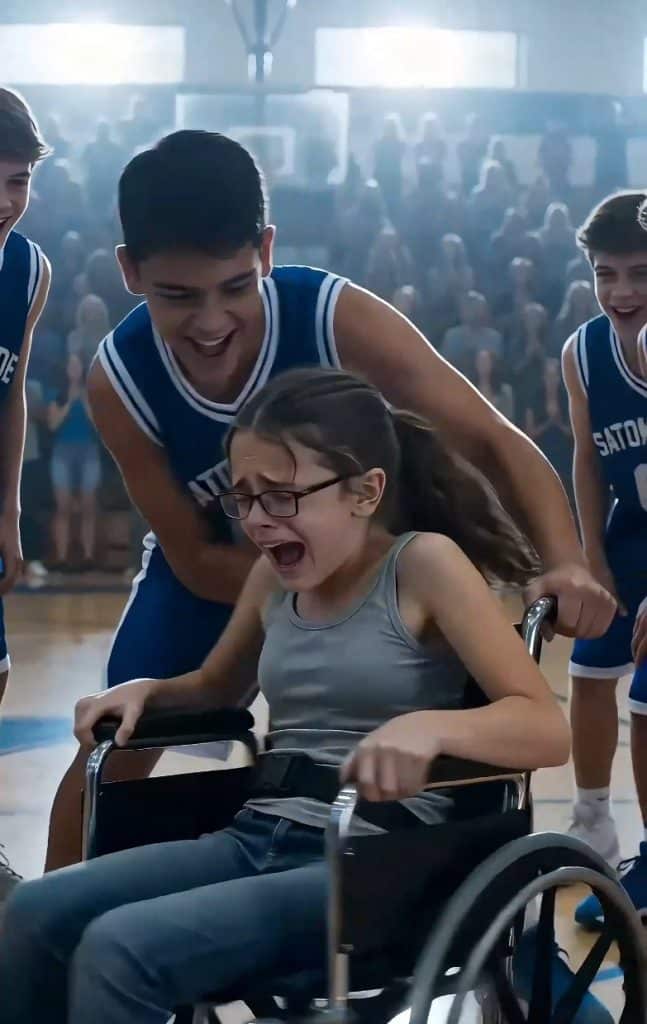
Her wheelchair spun across center court so fast the painted lines blurred beneath the wheels. The boy in jersey number 12 had both hands on the handles, grinning as he forced the chair into another tight circle. His teammates in blue SATOM WIDE jerseys crowded around her, clapping, jeering, feeding on the panic in her face.
Sophie clutched the armrests.
“Stop!” she screamed.
Nobody stopped.
The bleachers were full. Students leaned forward with phones raised. Sneakers squeaked against the hardwood. Someone shouted, “Do it again!”
Number 12 spun her harder.
Sophie’s glasses slipped down her nose.
Then the chair stopped too suddenly.
Her body jerked forward.
The glasses flew from her face, hit the hardwood, and shattered near the free-throw line.
The sound was small.
The humiliation was not.
The boys laughed louder.
One of them, number 4, stepped behind her and grabbed her hair, lifting it cruelly as Sophie gasped and tried to pull away.
“Your hair makes me sick just looking at it,” he said.
The crowd roared.
Sophie’s eyes filled. Without her glasses, the gym became a smear of white lights, blue jerseys, and cruel mouths. She could not see faces clearly anymore. Only shapes. Movement. The circle closing in.
Another boy crouched in front of her chair, number 0 on his jersey, blocking her path like a wall.
“Nobody can help you,” he said.
The words landed harder than the spinning.
Sophie’s hands tightened around the armrests. Her safety harness pressed across her chest. Her broken glasses lay a few feet away, bent and glittering under the fluorescent lights.
She looked toward the gym doors.
“Dad,” she whispered, voice breaking. “Please…”
The laughter began to fade.
Not because anyone felt sorry.
Because a sound cut through it.
A single bootstep.
Heavy.
Controlled.
Thunderous against the hardwood.
Every head turned.
At the sideline stood a man in U.S. military camouflage pants and special-forces-style combat boots. Only his lower body was visible at first, but the gym felt him before it saw his face.
Another boot hit the court.
The bullies froze.
Sophie lifted her tearful, bare eyes toward the sound.
The man stepped forward.
And the gym that had laughed at her suddenly forgot how to breathe.
Act II
Major Ethan Lane had been gone for seven months.
That was what the school liked to say whenever Sophie asked why things were different after her accident.
“Your father is serving overseas.”
“Your father trusts us.”
“Your father would want you to focus on healing.”
People used his absence like a locked door.
Before the wheelchair, Sophie had been a runner.
Not the fastest girl at Ridgeview High, but the most stubborn. She ran laps before school while the basketball team practiced. She ran in cold weather, in heat, after bad days, after good ones. Her father used to stand by the fence with coffee in one hand and a stopwatch in the other, pretending to be a coach even though he knew nothing about track beyond the fact that Sophie loved it.
Her mother had died when Sophie was eight.
After that, running became the place where grief could move instead of sit inside her chest.
Ethan understood that.
He never told her to be brave.
He showed her how to keep going when bravery felt fake.
Then came the gym incident.
That was what Ridgeview called it.
Not assault.
Not hazing.
Not bullying.
An incident.
Three months before the scene on the court, Sophie had stayed late after school to pick up flyers for a veterans’ scholarship fundraiser she had organized. The basketball team was practicing. Tyler Knox, jersey number 12, had been angry that the fundraiser would replace part of the pep rally. His father was the biggest booster in the district, and Tyler believed every gym event belonged to him.
Sophie heard him call the fundraiser “pity theater.”
She told him the money was for children of wounded service members.
He laughed.
Then someone threw a ball at the back of her legs.
She fell near the bleachers.
The official report said she tripped.
Sophie remembered hands.
Laughter.
A shove.
The sharp shock of pain.
Then the ceiling lights.
She woke in the hospital with doctors speaking gently and her aunt crying beside the bed. Her father’s face appeared on a video call from a military base thousands of miles away, trying not to break while she asked whether she would run again.
He said, “You are still my Sophie.”
She said, “That’s not what I asked.”
He closed his eyes.
The school promised an investigation.
The investigation found no wrongdoing.
The camera near the bleachers had “malfunctioned.” The coach said his players were on the other side of the court. Students suddenly forgot what they had seen. Tyler Knox arrived at school the next day wearing his jersey like armor.
Sophie returned in a wheelchair six weeks later.
The boys started small.
A nickname.
A blocked hallway.
A backpack moved out of reach.
Someone loosened the brake on her chair once and called it a joke.
Sophie reported it.
The assistant principal told her grief and adjustment could make ordinary interactions feel hostile.
That sentence followed her home and sat beside her bed.
Ordinary interactions.
Her father returned early from deployment that morning.
He did not tell the school.
He did not tell Sophie.
He wanted to surprise her at the fundraiser game, walk into the gym, and let her see he was finally home.
Instead, he walked in at the exact moment she whispered for him.
Act III
Ethan Lane did not shout at first.
That frightened the boys more.
He walked across the court with the stillness of someone trained to enter dangerous rooms without wasting movement. His combat boots struck the hardwood in measured steps. His uniform pants were dusty from travel. His jaw was set, but his eyes stayed on Sophie.
Not the bullies.
Not the crowd.
His daughter.
When he reached her chair, number 0 scrambled backward so quickly his sneakers squeaked.
Ethan crouched in front of Sophie.
“Soph,” he said softly.
Her face crumpled.
“Dad.”
He reached toward her, then stopped.
“Can I touch your shoulder?”
She nodded.
Only then did he place one hand gently on her arm.
That small question changed the room more than anger would have.
The boys who had grabbed, spun, pulled, and mocked suddenly looked smaller beside a man who understood consent better than an entire gym full of adults.
Ethan picked up the broken glasses from the floor and held them in his palm.
Sophie tried to breathe.
“They said nobody could help me.”
Ethan looked up then.
The gym temperature seemed to drop.
Tyler Knox forced a laugh.
“Sir, it was just messing around.”
Ethan stood.
He did not raise his voice.
“Messing around?”
Tyler swallowed.
“We didn’t hurt her.”
Ethan looked at the shattered glasses.
Then at Sophie’s trembling hands.
Then at the bleachers where students had gone silent, phones still held midair.
“You didn’t hurt her,” he repeated.
Coach Bell pushed through the sideline crowd, red-faced and sweating.
“Major Lane, I can handle this.”
Ethan turned toward him.
“Can you?”
The coach’s mouth opened.
Ethan took one step closer.
“Because from what I saw, you were standing by the equipment cart while three boys put their hands on my daughter’s wheelchair, broke her glasses, pulled her hair, and laughed while the bleachers cheered.”
The coach looked toward the crowd.
“This got out of hand.”
“No,” Ethan said. “It was allowed.”
The assistant principal, Mrs. Harrow, hurried onto the court with a clipboard pressed to her chest.
“Major Lane, emotions are high. Let’s not escalate in front of the students.”
Ethan looked at her for a long moment.
Then he turned toward the bleachers.
“Everyone who recorded what happened,” he said, voice carrying to the top row, “do not delete it.”
A murmur moved through the gym.
Mrs. Harrow stiffened.
“That’s not necessary.”
Ethan faced her again.
“It is now.”
Sophie wiped her cheek with the back of her hand.
“Dad,” she whispered, “it wasn’t the first time.”
The room heard her.
Every word.
Tyler’s face changed.
So did Coach Bell’s.
Ethan looked at his daughter, and the fury in him became something colder than rage.
It became purpose.
Act IV
The first video came from a freshman in the second row.
She stepped down from the bleachers with her phone in both hands, shaking so hard Ethan had to lower his voice when he spoke to her.
“What’s your name?”
“Lena,” she whispered.
“Lena, did you record what happened today?”
She nodded.
“Anything else?”
Her eyes flicked toward Tyler.
Then toward Coach Bell.
“I recorded the day she fell.”
The gym went silent.
Tyler snapped, “No, you didn’t.”
Lena flinched, but she did not step back.
“I was filming my brother’s free throws,” she said. “I didn’t know what I had until later.”
Mrs. Harrow moved quickly.
“Lena, give me that phone.”
Ethan stepped between them.
“No.”
The assistant principal blinked.
“This is a school matter.”
Ethan’s voice was calm.
“My daughter was injured on school property and then targeted again in front of witnesses. This is no longer only a school matter.”
At that moment, two deputies entered the gym.
Ethan had called them from the parking lot before walking inside, after seeing students gathered at the doors laughing and chanting Sophie’s name.
He had learned long ago that when institutions cover themselves, you bring witnesses they cannot supervise.
Lena sent the video directly to the deputies.
They watched it near the sideline.
No one breathed.
The footage showed the earlier day clearly enough.
Sophie walking near the bleachers with flyers in her arms. Tyler saying something as his friends closed in. A basketball striking behind her. A shove. Sophie falling hard. The boys scattering as Coach Bell turned his head away.
Not missing it.
Turning away.
Sophie covered her mouth.
Ethan closed his eyes for one second.
Only one.
Then he opened them and looked at Coach Bell.
“You said she tripped.”
Coach Bell’s face had gone gray.
“I didn’t see the whole thing.”
The deputy holding the phone said, “The video suggests otherwise.”
Tyler’s father, Mr. Knox, came down from the booster section in a navy blazer, already angry.
“My son is a minor,” he said. “You can’t ambush him like this.”
Ethan looked at him.
“My daughter was a minor when your son put her in a chair.”
The sentence hit the gym like a thrown weight.
Mr. Knox stopped.
Tyler’s mouth tightened.
“I didn’t mean for that to happen.”
Sophie turned toward his voice.
For months, she had imagined what it would feel like to hear him admit even that much.
It did not heal anything.
It only proved she had not imagined her own life.
Ethan walked back to Sophie and knelt again.
“Do you want to leave?”
Her breathing shook.
For a moment, she looked toward the doors.
Then she looked at the court.
The broken glasses.
The boys.
The bleachers.
The place where everyone had watched her become smaller.
“No,” she said.
Ethan nodded.
He did not tell her she was brave.
He did not turn her into a symbol before she was ready.
He simply stood beside her chair.
“Then we stay until they hear you.”
Act V
Sophie did not give a speech that day.
People expected one later when they retold it.
They imagined her rising in the wheelchair like a movie heroine, voice steady, bullies defeated by one perfect sentence. But real pain rarely moves that neatly.
Sophie cried.
She shook.
She asked for her spare glasses from her backpack because she hated not being able to see who was staring. Ethan helped her put them on with hands gentle enough to make half the gym look ashamed.
Then she answered the deputies’ questions.
Clearly.
Slowly.
With her father beside her and Lena standing close enough that Sophie could see she was not alone.
More students came down after that.
Not all at once.
Guilt makes cowards move carefully.
One boy admitted he had seen the brake tampering. A girl said Tyler’s friends had called Sophie “the mascot on wheels” for weeks. Another student showed messages from a team chat where the boys joked about “spinning her for the crowd” before the fundraiser game.
Coach Bell was suspended before sunset.
Mrs. Harrow was placed on leave pending investigation.
Tyler Knox and the other boys were removed from the team immediately and faced school discipline, legal consequences, and civil claims from Sophie’s family. The district tried to call it a failure of supervision.
Ethan called it what it was.
A culture.
At the emergency board meeting, he placed Sophie’s broken glasses on the table.
Not dramatically.
Carefully.
“These are not the worst thing that happened to my daughter,” he said. “But they are the easiest thing for you to understand. They were broken in public, under your lights, while your students laughed and your staff hesitated.”
No one interrupted him.
He continued.
“My daughter’s trust was broken before these glasses. Her safety was broken before these glasses. Your duty was broken before these glasses.”
Sophie sat beside him, hands folded in her lap.
When it was her turn, she read from a paper because speaking without one felt impossible.
“I don’t want to be called inspiring because I survived people hurting me,” she said. “I wanted to be a student. I wanted to go to class and the library and games without wondering who would touch my chair. My wheelchair is part of my body. When someone grabs it without permission, they are grabbing me.”
The board room stayed silent.
Good.
She was tired of laughter.
Changes came because evidence forced them to.
The gym cameras were audited. New reporting policies were created. Staff were trained on disability harassment and mobility-device boundaries. Coaches lost authority to bury complaints involving athletes. Students were told, plainly and repeatedly, that recording cruelty for entertainment made them part of it.
Ridgeview also renamed the veterans’ scholarship fundraiser.
Sophie did not want it named after her.
She insisted it be named after Lena.
“People act like filming was bad,” Sophie told her father. “But Lena used it to tell the truth.”
So it became the Lena Hart Witness Fund, supporting students who reported abuse, bullying, or misconduct when adults failed to act.
Lena cried when she heard.
Tyler transferred before the end of the semester.
His father claimed the school had ruined his son’s future.
Sophie heard that and looked down at her own wheels.
For the first time, the anger did not swallow her.
It sharpened her.
Months later, she returned to the gym.
Not for a pep rally.
For physical therapy.
The court was empty that morning except for Ethan, her therapist, and the sound of the ball cart being rolled somewhere far away. Fluorescent lights still glared off the floor. The bleachers still rose like a wall.
Sophie’s hands tightened on her wheels.
Ethan noticed.
“Too much?”
She almost said yes.
Then she looked at the center court where the boys had spun her chair.
“No,” she said. “Just hard.”
He nodded.
“Hard we can do.”
Her therapist set two bright orange cones near the free-throw line. The exercise was simple: wheel forward, turn, stop, breathe. Control the chair. Control the space. Reclaim the lines.
The first time Sophie reached center court, she froze.
Her breath went shallow.
Ethan did not rush her.
He stood at the sideline in jeans and a sweatshirt now, no boots, no uniform, no thunder. Just her dad.
“You’re safe,” he said.
Sophie looked at him.
“I hate that everyone saw.”
“I know.”
“I hate that you saw.”
His face softened.
“I hate that I wasn’t there sooner.”
She swallowed.
“You came.”
“Yes,” he said. “And next time, I hope you won’t need boots to make a room listen.”
That made her smile a little.
Small, but real.
By spring, Sophie joined the adaptive athletics club at a nearby community center. At first, she went only because Ethan bribed her with strawberry milkshakes afterward. Then she discovered wheelchair racing.
Not the same as running.
Not a replacement.
Something different.
Something hers.
The first time she raced, she came in last and laughed so hard at the finish line that Ethan cried behind his sunglasses.
She pretended not to notice.
One year after the gym incident, Ridgeview held an assembly on bystander courage. Sophie agreed to speak, but only under one condition: no sad music, no dramatic slideshow, no using her wheelchair as a symbol for the school’s redemption.
She rolled onto the stage wearing a navy jacket and new glasses with dark blue frames.
The gym was full again.
This time, no one laughed.
She looked out at the bleachers.
“I used to think the worst part was what the bullies did,” she said. “It wasn’t.”
Her voice echoed across the hardwood.
“The worst part was how many people waited for someone else to stop it.”
Students shifted in their seats.
Sophie continued.
“My dad’s boots got quiet because people were afraid of him. But fear is not the lesson. You shouldn’t need a soldier to walk into a gym before you remember someone in a wheelchair is a person.”
Ethan stood in the back near the doors, arms folded, eyes wet.
Sophie saw him.
This time, she did not need to whisper for help.
She already had the room.
After the assembly, a freshman boy approached her near the hallway.
“My brother gets picked on,” he said. “Not like… not like that. But enough.”
Sophie looked at him.
“Then don’t wait until it becomes like that.”
He nodded.
“I won’t.”
That was the kind of victory people rarely clapped for.
A quiet one.
The best kind.
At home that night, Ethan placed the broken glasses in a small shadow box. Sophie thought it was weird at first.
“Why would I want to keep those?”
He handed her the frame.
“Because they’re not proof that you were broken,” he said. “They’re proof that what happened was real, and you never have to let anyone call it a joke again.”
Sophie looked at the bent frames and cracked lenses.
For months, she had seen them only as humiliation.
Now she saw something else.
A before and after.
The sound of cruelty hitting the floor.
The moment before the boots.
The last time a gym full of people laughed and got to pretend it meant nothing.
She hung the shadow box above her desk.
Not high.
Not hidden.
Somewhere she could see it when homework was hard, when memories came back, when people called her strong in ways that sounded like they wanted her pain to be useful.
Years later, people at Ridgeview still talked about the day Major Lane walked onto the basketball court.
They remembered the boots.
The silence.
The boys freezing mid-laugh.
But Sophie remembered more.
She remembered the spinning.
The broken glasses.
The girl named Lena shaking with a phone in her hand.
The first adult voice that did not ask her to calm down.
The way her father crouched and asked permission before touching her shoulder.
That was what saved her most.
Not the boots.
Not the uniform.
Not fear.
Respect.
The bullies had said nobody could help her.
They were wrong.
But help did not begin when her father entered the gym.
It began the moment Sophie whispered his name and still believed, somewhere beneath all that laughter, that she deserved to be heard.