Act I
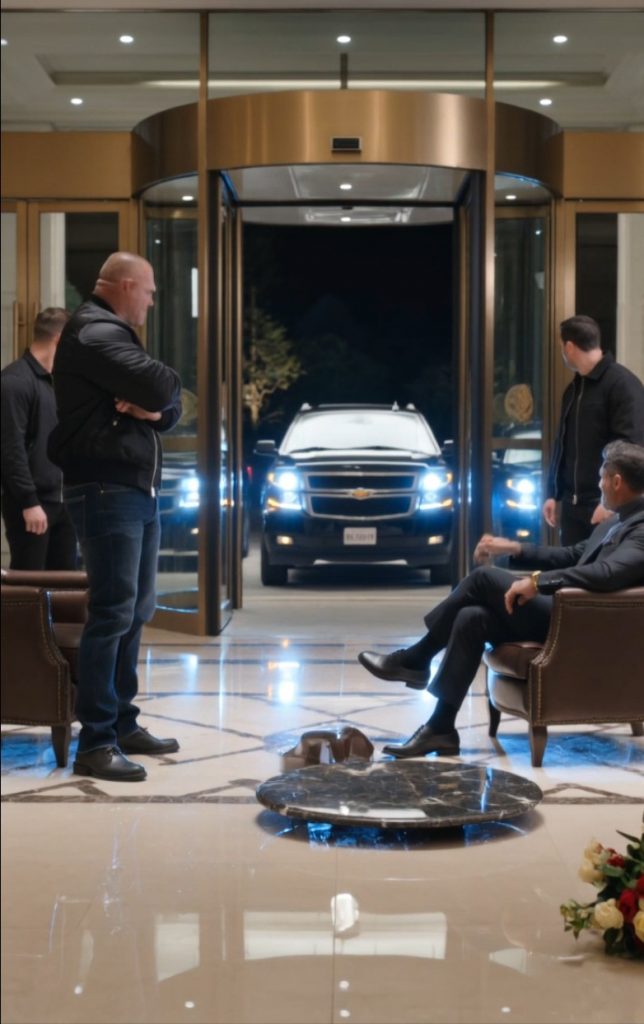
The marble table hit the floor hard enough to make the whole lobby jump.
Glass shattered across polished stone. A vase of white orchids tipped sideways and spilled water in a bright, trembling sheet. Champagne flutes bounced once, broke apart, and scattered beneath the leather armchairs where guests had been sitting only seconds earlier.
The man who flipped it laughed.
He was large, shaved-headed, broad in a black bomber jacket, with the kind of grin men wear when they confuse fear with respect. Two men behind him laughed too, loud and eager, feeding off the destruction like it proved something about them.
Hotel staff froze near the reception desk.
Guests stepped back.
Nobody wanted to be the first person to speak.
The only person who did not move was the elderly gentleman sitting in the armchair nearest the window.
He had a gray beard, neatly trimmed. A charcoal blazer. A gray turtleneck. His hands rested calmly on the arms of the chair, as if marble tables were overturned in front of him every afternoon.
The bully turned toward him.
“What?” he barked, still laughing. “You got something to say, old man?”
The gentleman looked at the broken glass.
Then at the crushed flowers.
Then at the bully.
He said nothing.
That made the bully angrier.
He stepped closer, boots crunching over the pieces of glass.
“You deaf?”
The gentleman reached into his blazer pocket and removed a small silver clamshell flip phone.
The room seemed to notice the phone before the bully did.
It looked old. Out of place among the polished marble, designer luggage, and glowing smartphones held by guests pretending not to record. The gentleman opened it with a crisp mechanical click.
He lifted it to his ear.
His voice was low and perfectly steady.
“It’s me,” he said. “Bring them.”
The bully laughed again, but this time it came half a second too late.
The gentleman closed the phone.
Click.
Outside the glass doors, tires screamed against the hotel driveway.
Three black SUVs pulled into view, headlights cutting across the lobby floor. Their engines rumbled low behind the glass, synchronized and immediate, as if the entire city had been waiting for one sentence from the old man.
The bully stopped smiling.
The gentleman looked at him with eyes cold enough to quiet the lobby.
“You should have left when you had the chance.”
Act II
The man in the bomber jacket was named Travis Kroll, and he had built a career out of making people smaller in public.
He was not famous enough to be untouchable, but he was loud enough to make ordinary people hesitate. He owned a chain of private boxing gyms, posted videos of himself humiliating employees, and liked to arrive in expensive places with two men behind him so the world understood he had an audience before it had a choice.
That morning, he came to the Ashford Grand Hotel looking for a scene.
He had been told the hotel was changing ownership.
He had been told an old investor was meeting with the board.
He had been told the man had no security visible, no family nearby, and a reputation for avoiding conflict.
Travis heard all that and thought weakness.
He did not know the difference between quiet and powerless.
The elderly gentleman’s name was Jonathan Ashford.
Once, every doorman in the city knew him.
Once, his family name had been written in gold letters above five hotels, two charitable foundations, and a scholarship program that sent hundreds of working-class students to college. Jonathan had inherited money, yes, but he had spent most of his life trying to prove inheritance did not have to become arrogance.
Then his son died.
After that, he left the public side of the business to others.
Board members spoke for him. Lawyers signed for him. Managers handled the hotels. Jonathan retreated into a quieter life, carrying an old flip phone because smartphones felt like too many voices at once.
People began treating him like a memory.
That was a mistake.
The Ashford Grand was the last hotel his late wife had designed before she became ill. She chose the white orchids in the lobby. She chose the leather armchairs by the window because, she said, travelers needed somewhere to sit that felt less like waiting and more like being welcomed.
Jonathan came there every Thursday.
He sat in the same chair.
He drank tea without sugar.
He watched the staff.
Not to judge them.
To remember why the place mattered.
That day, Travis Kroll entered with noise before he entered with purpose. He insulted the valet. Mocked a junior receptionist’s accent. Slapped his hand on the marble counter and demanded to know why his suite had not been upgraded.
The suite was not under his name.
It belonged to his father, Leonard Kroll, a developer who had been trying for months to force a sale of the Ashford Grand through pressure, debt manipulation, and threats disguised as business proposals.
Jonathan knew the name.
He had been waiting for the son.
Travis did not know that either.
So when the receptionist told him the hotel could not release a room without proper authorization, he turned to the lobby and made a performance out of rage.
Then he flipped the table.
The same table Jonathan’s wife had chosen in Florence thirty years earlier.
The same table she once rested her hand on and said, “This lobby should make people feel safe before anyone asks their name.”
That was when Jonathan reached for the phone.
Act III
The SUVs did not bring criminals.
That was what Travis expected.
Men like him thought power always arrived looking like violence because that was the only kind of power they trusted.
Instead, the first SUV door opened and out stepped a woman in a navy suit, silver hair pinned neatly at the back of her head. Behind her came two hotel security officers, a private investigator, and a city police lieutenant who looked like he had been having a very long week.
The woman in the navy suit walked through the glass doors first.
“Mr. Ashford,” she said.
Jonathan nodded once.
“Elaine.”
Travis looked between them.
“What is this?”
Elaine Mercer did not answer him immediately. She turned to the nearest staff member.
“Is anyone hurt?”
The receptionist shook her head, though her eyes were wet.
“Good,” Elaine said. “Please move guests away from the glass and preserve the recording.”
Travis’s confidence returned in fragments.
“You people are insane. I’ll sue this place.”
Jonathan stood slowly.
The lobby seemed to rise with him.
He was not tall in the way Travis was tall. Not broad. Not physically threatening. But when he stood, every employee in the lobby straightened, as if some old structure had returned to the room.
“You destroyed private property,” Jonathan said. “Threatened staff. Endangered guests.”
Travis scoffed.
“It’s a table.”
Jonathan’s gaze moved to the shattered orchids.
“No,” he said. “It’s a pattern.”
Elaine opened a folder.
Travis’s expression sharpened.
“What pattern?”
The police lieutenant answered.
“Extortion complaints. Harassment. Property damage across three hotels. Witness intimidation connected to your father’s acquisition attempts.”
Travis’s men stopped laughing.
One of them stepped back.
Travis turned on him.
“Don’t move.”
That command told the room more than he meant it to.
Elaine held up a document.
“Your father’s company made its final offer on the Ashford Grand yesterday. This morning, you arrived and attempted to create a public disturbance large enough to support claims that the hotel is poorly managed and unsafe.”
Travis’s mouth tightened.
“That’s ridiculous.”
Jonathan looked toward the phones in the guests’ hands.
“Is it?”
A woman near the armchairs raised her phone slightly.
“I recorded him threatening the receptionist.”
Another guest spoke up.
“He said the place would be sold by Friday.”
The receptionist, pale but steadier now, whispered, “He told me I’d be cleaning rooms for his father by next week.”
Travis looked around.
The room that had feared him minutes earlier had begun to give him back to himself.
Piece by piece.
Witness by witness.
Jonathan picked up the broken orchid stem from the floor.
His voice stayed calm.
“My wife built this lobby so frightened people could sit down and feel human again. You walked in and mistook restraint for permission.”
Travis looked toward the SUVs.
For the first time, he understood they had not arrived to scare him.
They had arrived to document him.
Act IV
Leonard Kroll arrived fifteen minutes later.
He came in a black sedan, not an SUV, and stepped out wearing a tailored coat and the expression of a man already calculating damage.
“Jonathan,” he said as he entered, arms open as if this were an unfortunate misunderstanding between old acquaintances.
Jonathan did not take his hand.
Leonard’s eyes flicked once to the broken table, once to Travis, once to the police lieutenant.
“My son can be impulsive,” Leonard said.
Travis stared at him.
“Dad—”
Leonard cut him off with one look.
Jonathan watched it happen.
The whole relationship was there in that glance. The father who used the son as a blunt instrument, then blamed the instrument for the dent.
Elaine stepped forward.
“Mr. Kroll, we have obtained the injunction.”
Leonard’s smile thinned.
“What injunction?”
Jonathan removed another folded paper from inside his blazer.
Unlike the phone, this document was not old.
It was fresh, stamped, and signed that morning.
“For months,” Jonathan said, “you have tried to force a distressed sale by damaging reputation, pressuring vendors, intimidating employees, and spreading claims that this hotel is financially unstable.”
Leonard adjusted his cuffs.
“Business is pressure.”
“No,” Jonathan said. “Business is agreement. Pressure is what men use when they cannot earn one.”
The police lieutenant handed Leonard a copy of the order.
Elaine continued.
“The court has frozen your acquisition attempt pending investigation. Your communications with Travis and your security contractors are being subpoenaed. Your attempted purchase is suspended.”
Leonard’s face changed.
Only for a second.
But Jonathan saw it.
So did Travis.
That was the moment the son realized his father had not come to save him. He had come to contain him.
Travis’s voice cracked with anger.
“You told me to make them look weak.”
The lobby went silent.
Leonard turned slowly.
“Be quiet.”
Too late.
The private investigator’s camera had already caught it. So had half the lobby.
Jonathan looked at Travis.
“Say it again.”
Travis swallowed.
His bravado was gone now, leaving behind something smaller and meaner. A man who had mistaken cruelty for loyalty and discovered he was disposable.
“He said if people saw chaos here, the board would panic,” Travis muttered.
Leonard’s face hardened.
“You idiot.”
Jonathan’s voice dropped.
“No. Your son is many things. But today, he is also a witness.”
Elaine looked to the lieutenant.
Leonard Kroll was escorted to a private office for questioning. Travis was detained near the lobby doors, his bomber jacket suddenly looking less like armor and more like costume.
The two men who had laughed behind him stood rigid by the wall, trying to become invisible.
Jonathan turned toward the staff.
“I’m sorry,” he said.
The receptionist blinked.
To her, the apology seemed impossible. Owners apologized through statements. Through managers. Through carefully worded emails.
Jonathan Ashford stood in broken glass and said it directly.
“This should not have happened in your workplace,” he continued. “You did nothing wrong.”
The receptionist began to cry.
Not because the table was broken.
Because someone had finally named who was responsible.
Act V
The Ashford Grand closed its lobby for six hours.
Not the hotel.
Just the lobby.
Guests were rerouted through the side entrance, offered tea, dry towels, and honest explanations. By evening, the broken glass was gone. The marble had been cleaned. The overturned table was moved to storage because Jonathan refused to throw it away.
“It can be repaired,” he said.
The florist replaced the orchids with fresh white stems.
For days, the video spread.
At first, people watched for the drama: the crash, the old flip phone, the black SUVs arriving like a scene from a movie.
Then they stayed for the reversal.
The bully’s laugh dying.
The father exposed.
The elderly man standing in the wreckage without ever raising his voice.
Reporters called Jonathan.
He declined every interview.
Elaine told him that silence allowed others to define the story.
Jonathan looked at her over his tea.
“They already did,” he said. “The staff spoke. That is enough.”
But he did make one public change.
The following week, he gathered every employee in the ballroom beneath chandeliers his wife had hated because she said they were too dramatic for breakfast events. Jonathan stood at the front without a podium.
“I have spent too many years loving this hotel from a distance,” he said. “Distance is comfortable. It is also convenient. I allowed people to believe the Ashford Grand could be pressured because I was too tired to be seen defending it.”
Nobody moved.
He looked toward the receptionist from that day, whose name was Amara.
“That ends now.”
He announced a legal defense fund for employees facing harassment from guests, vendors, or ownership disputes. He replaced the outside security contractor with an in-house team trained to de-escalate without ignoring threats. He gave managers authority to remove abusive guests immediately, regardless of status, wealth, or family name.
Then he did something nobody expected.
He placed the repaired marble table back in the lobby.
Not polished smooth.
Not made perfect.
A faint seam remained where the stone had cracked.
Beside it, he added a small brass plaque.
Strength is not noise. It is what remains standing after noise has passed.
Guests took pictures of it.
Jonathan pretended not to notice.
Months later, the court case against Leonard Kroll widened into a larger investigation of coercive acquisition tactics across several properties. Travis accepted a deal that required testimony against his father, community restitution, and anger-management treatment he complained about until the judge reminded him jail remained an alternative.
He never returned to the Ashford Grand.
His two friends sent written apologies.
Amara read hers once, then placed them in a drawer and went back to work.
She did not owe them forgiveness.
One rainy evening, long after the lobby had returned to its soft rhythm of rolling suitcases, low conversations, and piano music near the bar, Jonathan sat again in his armchair by the window.
The silver flip phone rested on the small side table beside his tea.
Amara approached carefully.
“Mr. Ashford?”
“Yes?”
She looked at the phone.
“Can I ask why you still use that?”
Jonathan picked it up.
For a moment, his expression changed.
“My wife bought it for me when she got sick,” he said. “She programmed three numbers into it. Hers. Our son’s. Elaine’s.”
Amara softened.
Jonathan turned the phone in his hand.
“Two of those numbers no longer answer.”
“I’m sorry.”
He nodded.
“So am I.”
Outside, headlights moved across the glass. Inside, the repaired marble table reflected the lobby lights.
Amara glanced toward it.
“I thought you’d replace the table.”
“My wife loved that table.”
“Even cracked?”
Jonathan smiled faintly.
“She would have liked it better cracked. She believed beautiful things should not pretend nothing ever happened to them.”
Amara thought about that.
Then she returned to the front desk, standing a little straighter than she had before.
Jonathan opened the flip phone once.
Click.
He did not call anyone.
He only looked at the small screen, then closed it again.
Click.
The sound no longer felt like a threat.
It felt like a reminder.
That power did not always roar into a room. Sometimes it sat quietly in a leather chair, waiting until cruelty revealed itself completely.
That dignity was not weakness.
That silence was not surrender.
And that a man who laughed while breaking a beautiful thing in front of witnesses should be very careful if the old gentleman watching him reaches calmly into his pocket.