Act I
The silence on the fairway arrived before anyone realized the game had stopped.
Several groups had been waiting patiently for nearly fifteen minutes while one foursome lingered over every shot as if the championship depended on it. Golf carts lined the path. Players exchanged frustrated glances, but no one wanted to confront the club’s wealthiest member.
One man finally stepped forward.
He smiled politely and spoke in a calm voice.
“Please keep the pace. The group behind us is waiting.”
It should have been the most ordinary reminder on any golf course.
Instead, it became the beginning of a humiliation nobody present would ever forget.
The wealthy golfer slowly turned toward him, adjusted the expensive watch on his wrist, and looked him up and down as though he were speaking to an employee instead of another member.
Then he laughed.
“Trash. You don’t rush members like me.”
The nearby conversations died instantly.
Nobody moved.
Nobody interrupted.
The man who had offered the reminder remained composed despite the growing hostility.
He wasn’t trying to win an argument.
He simply wanted everyone to enjoy the course fairly.
The bully interpreted courtesy as disrespect.
And that mistake would soon cost him far more than a delayed round of golf.
Act II
The injured golfer wasn’t loud.
He wasn’t famous.
Many members barely knew his name.
But the staff greeted him warmly every weekend because he always thanked them, repaired his divots, and respected the pace-of-play rules that kept the course enjoyable for everyone.
He believed golf revealed character more than talent.
Anyone could buy premium clubs.
Respect couldn’t be purchased.
The wealthy member believed exactly the opposite.
His influence had convinced him that rules existed for everyone else.
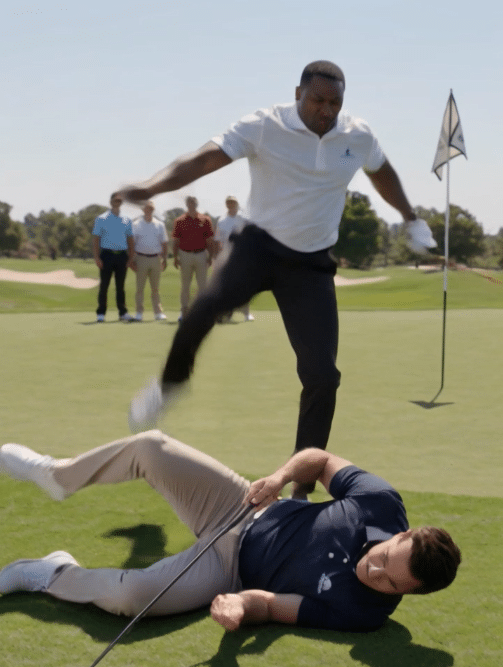
As the confrontation escalated, nearby players froze in disbelief.
A golf towel slipped into the grass.
Plastic cart-path markers rattled as startled members stepped backward.
The man who had only asked for basic courtesy found himself on the ground, winded and struggling to recover.
Even then, he refused to answer anger with anger.
He simply looked toward the waiting groups.
Almost apologetically.
That quiet dignity unsettled several witnesses far more than shouting ever could.
None of them realized that another convoy of carts had already entered the course.
Act III
The club chairman rarely announced his inspections.
He preferred arriving unexpectedly because genuine service couldn’t be rehearsed.
That afternoon, he had been meeting with course managers about upcoming renovations when security radioed that something serious had happened near the fairway.
Within moments, several black golf carts rolled down the cart path.
Their arrival immediately drew every eye on the course.
The chairman stepped out before the carts had completely stopped.
He ignored the expensive clubs.
Ignored the wealthy member.
Ignored everyone trying to explain what had happened.
He walked directly to the injured man.
Kneeling beside him, he offered a hand and quietly helped him to his feet before gently wiping the thin streak of blood from his forehead with a towel.
Only after making sure his brother was steady did he slowly turn around.
The entire atmosphere shifted.
The wealthy golfer’s confident smile disappeared.
For the first time all afternoon, uncertainty crossed his face.
Then the chairman asked a question that echoed across the fairway.
Act IV
“Who hit my brother?”
The words weren’t shouted.
They didn’t need to be.
Course security immediately stepped forward.
Members who had remained silent finally began describing exactly what they had witnessed.
Every account matched.
No exaggeration.
No confusion.
The wealthy golfer searched the crowd for support.
There was none.
People who had laughed nervously only minutes earlier now avoided looking in his direction.
The chairman remained remarkably calm.
He wasn’t interested in revenge.
He cared about accountability.
Turning toward the assembled members, he spoke clearly enough for everyone nearby to hear.
“A golf club teaches etiquette before competition. If someone believes status excuses disrespect, they misunderstand everything this game represents.”
The statement landed harder than any raised voice could have.
The expensive watch.
The designer clubs.
The luxury golf cart.
None of them carried the authority they had only moments before.
Act V
Security escorted the wealthy member away while management gathered statements from witnesses and reviewed course procedures.
The chairman stayed beside his brother until he was certain he was all right.
“You did exactly what every responsible member should do,” he said quietly. “Courtesy keeps this course running.”
Those words restored something more valuable than pride.
They restored dignity.
The waiting golfers eventually resumed their rounds.
The flags still fluttered in the afternoon breeze.
Golf carts continued along the winding paths.
The game moved forward once again.
But everyone who had witnessed the confrontation left with the same lesson.
True class is never measured by membership fees, luxury equipment, or influence.
It is measured by how someone treats others when they believe no one important is watching.
Standing alone beneath the open sky, the wealthy golfer stared across the empty fairway.
His confidence had vanished.
His voice barely escaped above a whisper.
“Your brother…?”