Act I
The morning crowd froze before anyone fully understood what had happened.
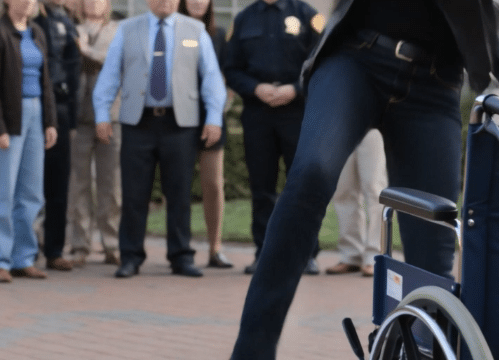
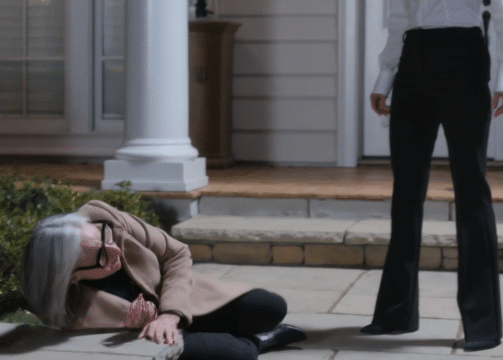
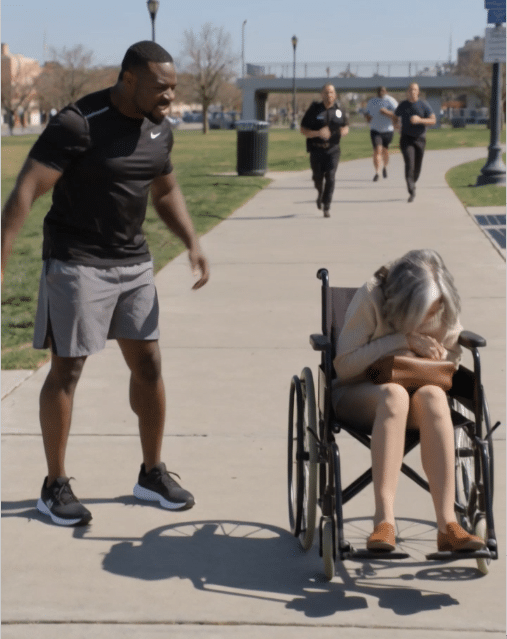
A wheelchair sat overturned near the edge of the running path, one wheel still spinning as groceries rolled across the concrete. An elderly woman struggled to steady herself, her palm scraped against the pavement, her breathing shallow but composed.
Standing over her was a sharply dressed businessman in expensive running gear.
His expression held no concern—only irritation.
“Trash,” he snapped loudly enough for every jogger to hear. “Stay off the running path.”
People exchanged uneasy glances, but nobody stepped forward.
The old woman didn’t argue.
She simply looked up at him with quiet dignity, as though she had seen this kind of arrogance before.
The businessman laughed once more.
“Roll somewhere else.”
He turned away, convinced the moment was over.
It wasn’t.
Because the sound that echoed through the park next wasn’t another insult.
It was the sharp squeal of tires.
Act II
Margaret Lawson visited the park every morning.
Few people knew her name.
To most runners, she was simply the elderly woman who smiled at children, fed birds near the pond, and thanked every gardener she passed.
Years earlier, after losing her husband, she had found peace beneath those same trees.
The park had become her second home.
Even after illness forced her into a wheelchair, she refused to stay inside.
She believed fresh air healed wounds medicine never could.
What almost no one knew was that this park existed because of her family.
Decades ago, when the city planned to replace the green space with luxury apartments, one family quietly donated millions to preserve it.
Their names never appeared on monuments.
That was exactly how Margaret wanted it.
“Good deeds don’t need applause,” she often said.
Her son had inherited that same belief.
But this morning, everything was about to change.
Act III
A black SUV pulled sharply to the entrance of the park.
Plastic safety bollards tipped aside as two security officers rushed out, followed by a man in a navy suit.
The moment he saw the elderly woman on the ground, he stopped running.
His face turned pale.
“Mom…”
He knelt beside her immediately, helping her sit upright before carefully checking her injured hand.
Only after he knew she was safe did he slowly stand.
The crowd recognized him instantly.
Daniel Lawson.
Executive Director of the city’s Park Foundation.
The man responsible for every renovation, every playground, every tree restoration project in the county.
His voice remained calm.
Too calm.
He looked directly at the businessman.
“Who pushed my mother?”
The silence that followed was louder than any shout.
Act IV
The jogger’s confidence disappeared almost instantly.
He had seen Daniel Lawson on television dozens of times.
Fundraising events.
City council meetings.
Environmental campaigns.
He suddenly realized the woman he had mocked wasn’t simply another stranger on the path.
She was Margaret Lawson.
The quiet philanthropist whose family had funded the very park where he trained every morning.
Witnesses began speaking all at once.
Several people had recorded the confrontation on their phones.
Others described exactly what they had seen.
The businessman tried to explain himself.
“It was just an accident…”
But even he no longer sounded convinced.
Daniel never raised his voice.
Instead, he asked a single question.
“When someone is vulnerable, do you see a human being—or an inconvenience?”
The businessman couldn’t answer.
Because everyone already knew the truth.
Act V
Margaret accepted help back into her wheelchair.
Despite the pain in her hand and the dust on her sweater, she carried herself with quiet grace.
She looked at the businessman for a long moment.
“I’ve spent my life believing kindness is contagious,” she said softly.
“I hope today proves arrogance is, too.”
No one applauded.
The words didn’t need applause.
Security escorted the shaken businessman away as park staff helped gather the groceries scattered across the path.
Around them, the morning slowly returned to normal.
Joggers resumed their routes.
Children laughed near the playground.
Birds settled back into the trees.
Before leaving, Daniel gently adjusted the blanket over his mother’s lap.
“You never wanted people to know what you’ve done for this place.”
Margaret smiled.
“I still don’t.”
She glanced across the park one last time.
“The trees don’t care who planted them.
They simply give shade to everyone.”
And for many who witnessed that morning, the lesson stayed with them far longer than the confrontation itself.
Because real status is never measured by expensive clothes, powerful titles, or public recognition.
It’s measured by how you treat someone when you believe they have nothing to offer you.