Act I
The cash had barely reached her hands before someone tore it away.
She had spent the entire day beneath the late-afternoon sun, climbing ladders, filling crate after crate with apples until her shoulders burned and her gloves were stained with dirt and juice. When the weighing station finally closed, the folded bills in her hand represented more than a day’s wages.
They were a promise.
A promise that her child would walk into school wearing clothes that actually fit.
She never even had the chance to fold the money into her pocket.
A man appeared from between the stacked apple crates and snatched the cash with practiced speed.
Her husband.
He had been waiting for the exact moment she got paid.
She reached for the money instinctively.
“This is for our child’s school clothes.“
Her voice cracked from exhaustion.
Around the weighing station, workers paused with baskets still balanced on their shoulders.
No one needed an explanation.
They had seen him before.
The man glanced at the money, then back at his wife with open contempt.
“Trash. I need it more.“
The words echoed across the quiet orchard.
A few workers exchanged uneasy glances.
They knew where that money was going.
Not to groceries.
Not to bills.
Not to family.
Straight to another gambling table.
The afternoon suddenly felt colder.
And the worst had only just begun.
Act II
He clenched the bills tightly in one fist.
Then, without warning, he charged.
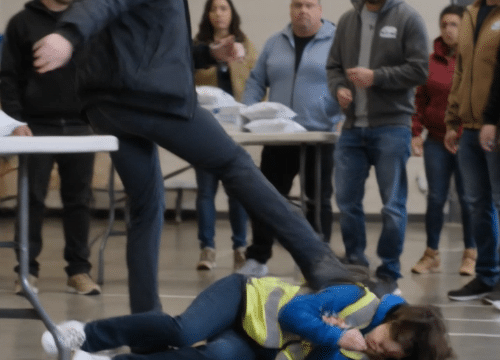
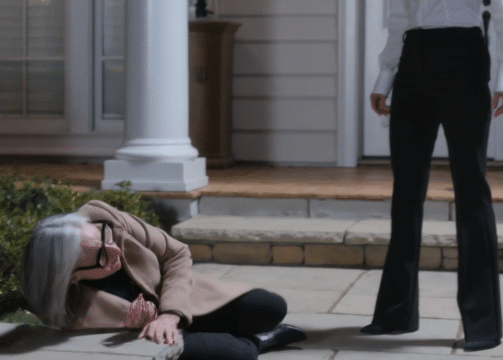
The forceful kick struck her squarely in the chest, throwing her backward into a stack of wooden apple crates before she collapsed onto the packed dirt below.
Her palm scraped against the rough ground, leaving only a small red mark.
The pain radiated through her body, but she hardly reacted.
Her eyes searched only for her child.
Near the weighing station, a frightened young voice cried out.
Her child ran toward her without hesitation, dropping beside her in the dirt and wrapping trembling arms around her while sobbing uncontrollably.
She pulled the child close, shielding them as best she could.
The child remained unharmed, clinging only to the one person who had always protected them.
The husband wasn’t finished.
He stepped closer and delivered two more forceful kicks to her back and side while workers stood frozen around the station, unable to believe the cruelty unfolding in broad daylight.
No one cheered.
No one looked away.
The silence itself became a judgment.
Towering over his wife, still gripping the stolen money, he sneered,
“You don’t decide where money goes.“
For years, those words had ruled their home.
He believed they would rule this orchard too.
He was wrong.
Because someone had just arrived who answered to no fear he could create.
Act III
The rumble of an engine rolled across the orchard.
Heads turned toward the entrance road.
A pickup truck braked sharply beside the weighing station, dust rising around its tires.
The driver’s door opened.
An older man stepped out.
He wore faded work boots instead of polished shoes, yet every laborer on the property immediately stopped what they were doing.
Conversations ended.
Hands lowered.
Even the supervisors straightened instinctively.
Authority announced itself without a single introduction.
The older man surveyed the scene only once.
The woman on the ground.
The frightened child.
The husband clutching someone else’s wages.
That was all he needed.
He walked directly toward them with calm, measured steps until he stood between the fallen mother and the man looming over her.
Every worker watched.
His voice carried across the orchard with quiet certainty.
“Give her back the money.“
The husband hesitated.
Behind the older man, workers slowly formed a line.
Not because anyone ordered them to.
Because they had already made their choice.
The man who had walked in believing he controlled everything suddenly found himself facing dozens of people standing together.
For the first time, uncertainty flickered across his face.
But the truth behind the older man’s arrival ran even deeper than anyone realized.
Act IV
The orchard owner had built the farm over four decades.
He knew nearly every seasonal worker by name.
He noticed who skipped lunch to save money.
Who stayed late without complaint.
Who quietly mended worn gloves instead of asking for new ones.
He had watched this woman work through blazing summers and freezing autumn mornings without ever hearing her complain.
He also noticed something else.
Every payday, she seemed anxious.
Sometimes she left smiling.
Other times she disappeared before reaching the parking area, returning the following Monday with empty eyes and another excuse.
He understood more than she realized.
That afternoon, he personally handed her wages over after hearing rumors that someone had been waiting outside the orchard every payday.
He hoped the rumors were wrong.
Instead, they unfolded right in front of him.
Now every worker had witnessed the truth.
No explanations were necessary.
The husband looked around desperately.
The line of laborers behind the older man stretched farther than he expected.
Men and women who had harvested apples beside the victim all season now stood shoulder to shoulder.
Not one stepped aside.
Not one lowered their eyes.
Power built on intimidation collapses the moment fear disappears.
The husband finally understood that he was standing completely alone.
Act V
The orchard grew quiet again.
Only the breeze moved through the rows of apple trees.
The older man bent down and gently helped the mother to her feet while another worker comforted the frightened child.
Someone brushed the dirt from her worn flannel shirt.
Another brought water.
Without ceremony, the older man recovered the stolen cash and placed it back into her hands.
She looked down at the folded bills.
For a moment, she couldn’t speak.
Not because of the amount.
Because those dollars still carried the future she had spent weeks protecting.
New school clothes.
A little dignity.
One less burden for her child.
Around them, workers quietly returned to stacking crates.
Not because the moment was unimportant.
Because helping someone stand up was simply what decent people did.
Across the weighing station, the husband stared at the older man.
His confidence had vanished.
He searched the faces surrounding him, hoping someone would break ranks.
No one did.
The child stood safely beside the mother now, still holding her hand.
The older man remained calm, saying nothing more.
He didn’t need to.
His presence had already changed everything.
The gambler who believed he could take whatever he wanted finally realized there was one thing he could never steal.
The respect of people willing to protect one another.
His breathing grew uneven.
The arrogance drained from his face.
Confusion replaced certainty.
Looking directly at the older man, he whispered,
“Who are you?“
The older man never answered.
He simply nodded toward the recovered wages still resting safely in the mother’s hands.
The workers already knew who he was.
The child only knew someone had protected their mother.
And in that moment, that was the only identity that truly mattered.