Act I
The ambulance’s lights were already flashing when the traffic coordinator stepped into the Emergency Drop-Off lane.
“Sir, the ambulance needs this lane.”
Her voice was steady despite the urgency.
Behind the luxury sedan, the ambulance remained trapped, its warning lights reflecting off the hospital’s glass entrance while precious seconds slipped away. Patients and visitors instinctively moved aside, expecting the expensive car to pull forward.
Instead, its driver slowly climbed out.
His tailored black suit looked untouched by the rain that had fallen earlier that afternoon. An expensive watch gleamed beneath the hospital lights as he glanced first at the ambulance, then at the woman standing in front of him.
There wasn’t even a hint of concern in his expression.
Only irritation.
“Trash. I’m important.”
The words silenced everyone standing near the entrance.
The coordinator didn’t argue.
She had directed traffic outside emergency departments for nearly a decade. She had learned that panic solved nothing and that professionalism often calmed situations before they became dangerous.
She simply pointed once more toward the flashing ambulance.
“Please, sir. Someone inside needs immediate access.”
She never had the chance to finish.
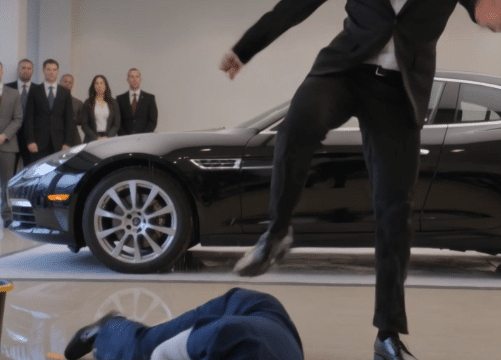
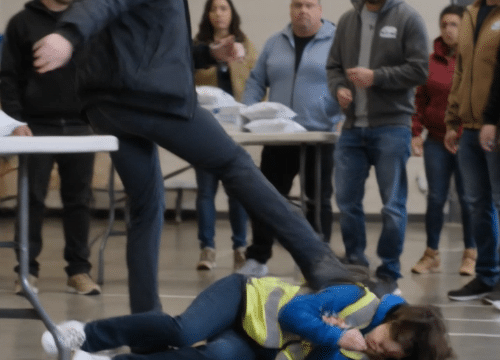
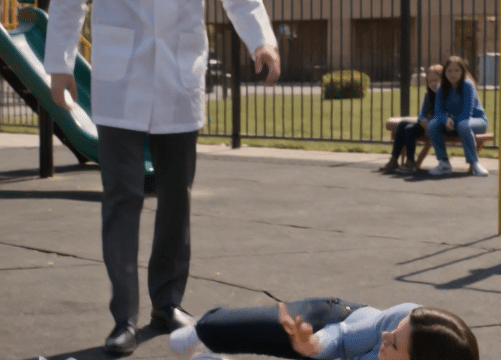
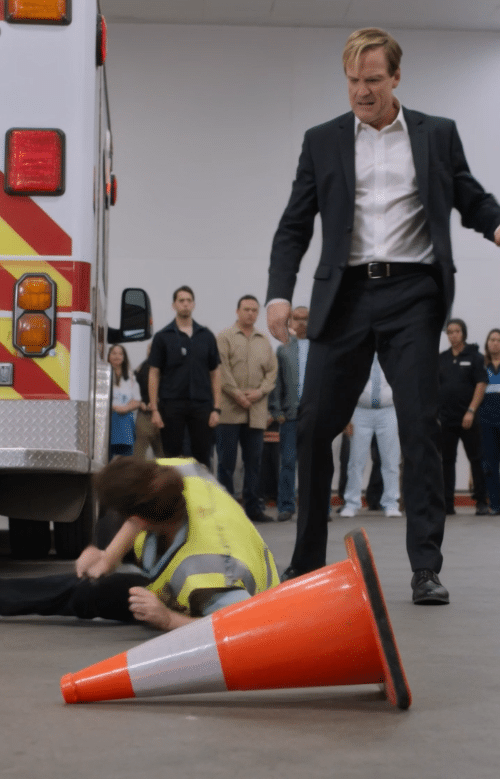
The man drove a brutal kick straight into her chest.
She was thrown backward into an orange traffic cone near the hospital doors.
The cone folded beneath the impact.
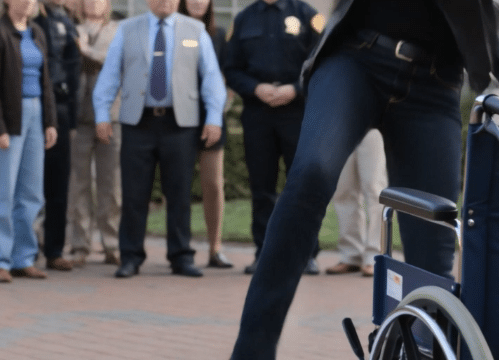
Her shoulder radio flew across the concrete, skidding several feet before coming to rest beneath a parked wheelchair.
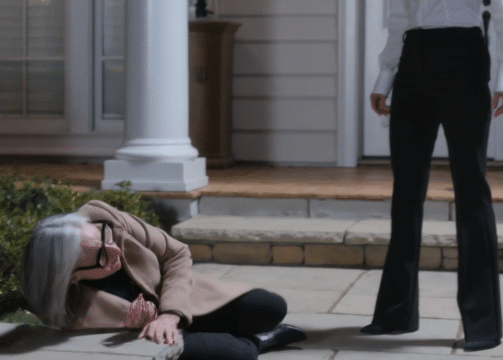
As she hit the pavement, her forearm scraped against the rough concrete, leaving only a small streak of blood before she instinctively pulled her arm close.
Pain stole her breath.
She struggled to lift herself.
Before she could…
The man stepped closer.
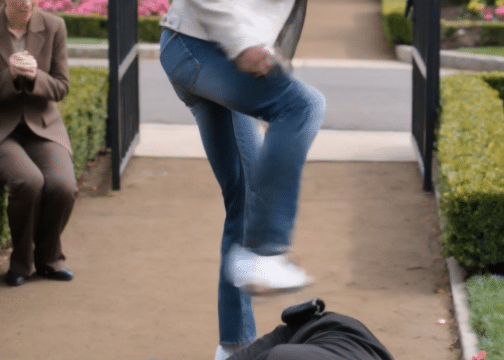
Two more hard kicks struck her side and back while she curled on the pavement.
Even through the pain, her eyes never left the ambulance still trapped behind his luxury car.
She wasn’t thinking about herself.
She was thinking about whoever was waiting inside.
No one dared move.
Not yet.
But inside the hospital…
Someone had already seen everything.
Act II
The luxury car owner had spent years believing rules were written for other people.
Business meetings started when he arrived.
Reservations were held until he appeared.
Employees rushed to satisfy every demand before he finished speaking.
Waiting had become something other people did.
Hospitals, in his mind, should work the same way.
He looked down at the injured coordinator without the slightest trace of regret.
“Make the ambulance wait.”
Even the words sounded impossible.
Visitors standing nearby exchanged horrified glances.
Parents instinctively pulled their children closer.
Hospital security officers at the far entrance reached for their radios, but protocol required authorization before escalating a confrontation at the emergency entrance crowded with vulnerable patients.
The coordinator fought through the pain.
Her breathing was shallow, but her attention remained fixed on the flashing ambulance.
She silently prayed the patient inside could hold on just a little longer.
Few people outside that hospital knew how many lives she had quietly protected over the years.
She wasn’t a nurse.
She wasn’t a physician.
Yet every day she made sure ambulances reached the doors without delay.
She had memorized emergency traffic patterns better than most GPS systems.
She recognized panic before families spoke a single word.
She knew that thirty seconds could mean everything.
Most people never noticed her.
That was exactly how she liked it.
Her job wasn’t to be remembered.
Her job was to make sure someone else survived.
Then the hospital’s glass entrance exploded open.
Every head turned.
Something had just changed.
Act III
The hospital’s automatic doors slid apart with unusual force.
Doctors appeared first.
Then security officers.
Then senior administrators.
Walking calmly through the center of them all came the hospital’s executive leader.
He wore no white coat.
No stethoscope.
Only a dark overcoat over a perfectly tailored suit, his executive identification badge visible beneath the lapel.
His expression never changed.
Years spent making impossible decisions had taught him that authority didn’t require shouting.
The luxury car owner frowned.
He expected arguments.
He expected negotiations.
Instead, the executive looked only once toward the injured traffic coordinator.
Then his eyes shifted to the blocked ambulance.
His voice was calm.
“Clear that lane.”
Four words.
Nothing more.
Security officers moved instantly.
The ambulance became the center of every person’s attention.
Doctors hurried toward the waiting emergency vehicle while security positioned themselves between the injured coordinator and the attacker.
For the first time…
The wealthy driver’s confidence disappeared.
He looked around in disbelief.
No one was listening to him anymore.
Every employee.
Every physician.
Every security officer.
Every administrator.
Their attention belonged to someone else.
The executive hadn’t raised his voice.
He hadn’t threatened anyone.
Yet the entire hospital moved as one.
The driver still didn’t understand why.
He believed he had assaulted an ordinary traffic worker.
He had no idea who she really was to that hospital.
Act IV
Years earlier, before becoming the hospital’s executive leader, the man had overseen one of the institution’s darkest internal reviews.
An investigation revealed that ambulance delays caused by poor traffic management had nearly cost several patients their lives.
Policies changed.
Infrastructure improved.
But one recommendation came from someone without executive authority.
The traffic coordinator.
She spent months documenting bottlenecks, redesigning ambulance flow, and proposing emergency access procedures that many administrators initially dismissed as unnecessary.
She persisted anyway.
Eventually, her system became the hospital’s standard.
Average emergency arrival times dropped dramatically.
Other hospitals later adopted similar procedures.
Hundreds—perhaps thousands—of patients reached treatment faster because one woman standing outside refused to believe that traffic control was “just parking.”
The executive never forgot that.
Whenever new administrators toured the campus, he pointed toward the Emergency Drop-Off lane.
“Medicine begins before the patient reaches the operating room,” he often reminded them.
“It begins the moment the ambulance arrives.”
That’s why his controlled expression concealed something deeper than anger.
This wasn’t simply an assault.
Someone had attacked the person responsible for protecting the first step of emergency care itself.
The wealthy driver finally found his voice.
“Who are you?”
The question sounded hollow.
Almost desperate.
The executive never answered directly.
He didn’t need to.
Every employee standing silently behind him already had.
Real authority wasn’t purchased with expensive watches or luxury cars.
It was earned by protecting lives.
And the woman lying on the pavement had been doing exactly that for years.
The balance of power shifted in an instant.
But the greatest lesson had yet to arrive.
Act V
As the lane finally cleared, the ambulance surged forward.
Doctors met it before the wheels had completely stopped.
Stretchers rolled through the entrance.
Medical teams disappeared inside with practiced urgency.
Only after the ambulance was safely inside did the injured coordinator allow herself to exhale.
A nurse knelt beside her.
“Are you alright?”
She managed a faint smile.
“Did they get through?”
The nurse looked toward the emergency doors.
“They did.”
Only then did she close her eyes for a brief moment, relieved not for herself, but for the patient she had never even met.
The hospital executive quietly removed his overcoat and draped it over her shoulders while waiting for medical staff to examine her.
No speeches followed.
No cameras appeared.
No dramatic announcement echoed through the entrance.
Work simply resumed.
Because hospitals exist for one purpose.
Saving lives.
Visitors standing nearby would later remember many things about that afternoon.
They remembered the flashing ambulance.
The woman who refused to stop protecting the emergency lane, even after being knocked to the ground.
The executive whose four calm words restored order without raising his voice.
But most of all…
They remembered the wealthy man.
Not because of his expensive car.
Not because of his tailored suit.
Not because he claimed to be important.
They remembered the expression on his face when he realized something money could never buy.
Respect.
Because influence may open doors.
Wealth may command attention.
But inside a hospital, there is only one measure that truly matters.
The people who make sure someone else gets a second chance to live.
And on that day, the woman directing traffic had proven herself far more important than the man who believed the world should always wait for him.