Act I
The batteries were already sitting in the regular trash bin when the boy raised a cautious hand.
“Sir, batteries go in that box.”
His voice was quiet enough that most people almost missed it.
Just a few feet away, volunteers sorted plastic bottles beneath a green community banner while families carried old electronics and recyclables across the school parking lot. Near the entrance, a clearly marked battery collection box waited for hazardous waste that couldn’t safely go into ordinary trash.
The thirteen-year-old wasn’t trying to embarrass anyone.
He was simply doing the job he had volunteered to do.
The well-dressed man looked down at him with open disdain.
“Trash. Don’t correct adults.”
Conversations around the recycling station faded into silence.
The boy swallowed nervously but pointed once more toward the labeled collection box.
“My mom said batteries can hurt the environment if they’re thrown away with regular trash.”
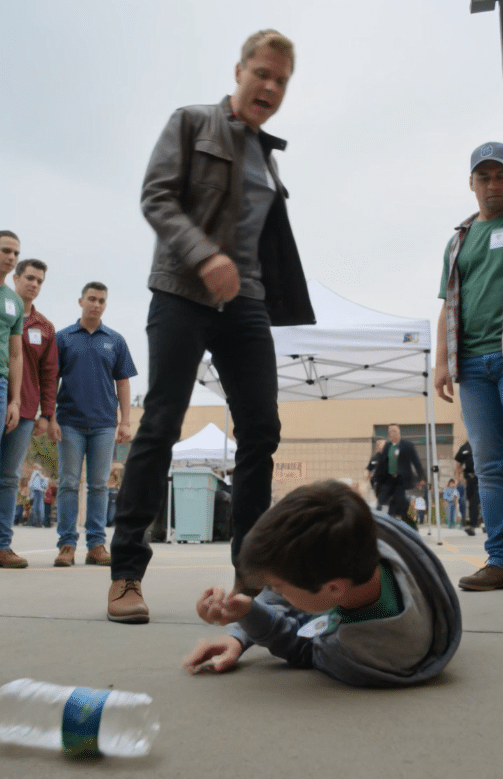
He barely finished speaking before the man lashed out, knocking the boy backward into a plastic recycling bin.
Plastic bottles spilled across the pavement.
His volunteer badge snapped from its lanyard as he fell, scraping an elbow against the concrete.
The child instinctively curled up, frightened more than anything else.
The crowd gasped.
No one expected a simple safety reminder from a young volunteer to end like this.
Then the man stood over him with cold contempt.
“Recycle your attitude.”
For one long moment, the entire event seemed frozen.
But someone at the official tent had already seen what happened.
Act II
The wealthy attendee believed respect belonged only to adults with money and influence.
Being corrected by a child bruised his pride more than breaking the rules ever could.
Around him, families stood in stunned silence.
Parents instinctively moved closer to their own children.
The boy’s mother, busy helping another volunteer nearby, heard the commotion and turned just in time to see her son on the ground.
She started running.
Other volunteers gently stopped her for a moment as they waited for security to secure the area, fearful that the confrontation could become even more dangerous.
The boy fought back tears.
Even while frightened, his eyes searched for the battery collection box.
Few people attending the event knew why recycling mattered so much to him.
The previous year, his science class had visited a local stream polluted by improperly discarded household waste.
That trip changed him.
He began volunteering on weekends, helping his mother at community clean-up events and teaching younger children simple ways to recycle safely.
He never wanted recognition.
He only wanted to help.
That simple kindness had just made him the target of someone’s anger.
Then movement rippled through the crowd.
Officials were approaching.
Act III
The Event Organizer emerged from the official tent with local government representatives and event security close behind.
Their pace was calm but unmistakably urgent.
Volunteers stepped aside.
Families parted without being asked.
The organizer looked once toward the frightened boy before turning his attention to the man responsible.
His expression became cold.
Then came the command.
“Step away from the child.”
Nobody questioned it.
Security personnel immediately positioned themselves between the man and the young volunteer while other volunteers knelt beside the boy to comfort him and ensure he was safe.
The atmosphere changed instantly.
Only moments earlier, the wealthy attendee had controlled the confrontation.
Now every eye in the parking lot followed the organizer.
The man’s confidence began to crumble.
He looked around in confusion.
Why was everyone suddenly listening to this one person?
He didn’t yet realize how closely the organizer knew the child he had just humiliated.
Act IV
Months before the event, the organizer had launched a youth environmental leadership program after noticing that children often became the strongest advocates for recycling within their own families.
The thirteen-year-old had been among the very first volunteers to join.
He never missed a weekend.
He patiently explained recycling rules to visitors.
He stayed late to clean the parking lot after every event.
When storms damaged the community garden earlier that year, he spent his school vacation helping restore it alongside dozens of adult volunteers.
The organizer often told new volunteers that leadership wasn’t measured by age.
It was measured by the willingness to serve.
That was why the sight of the frightened boy on the pavement struck him so deeply.
This wasn’t merely an argument.
It was an attack on the very spirit of the community event.
The wealthy attendee finally found his voice.
“Who are you?”
The organizer didn’t answer immediately.
He simply looked around at the volunteers, local officials, and families standing together behind him.
Their silence answered the question better than words ever could.
Respect cannot be demanded.
It has to be earned.
And that afternoon, a thirteen-year-old volunteer had earned far more respect than the man who believed he deserved it automatically.
Act V
Medical staff checked the boy’s minor scrape while his mother finally reached his side and wrapped him in a careful embrace.
After a few moments, the organizer crouched beside him.
“You did the right thing.”
The boy looked toward the battery collection box.
“Did someone move the batteries?”
A volunteer smiled.
“They’re exactly where they belong now.”
Only then did the boy return a small smile of his own.
The recycling event resumed.
Families carefully sorted electronics, bottles, and batteries into the proper containers.
Parents used the moment to explain to their children why small actions matter—and why kindness matters even more.
The wealthy attendee stood alone, his earlier confidence replaced by uneasy silence.
He had believed that being older, wealthier, and louder made him right.
Instead, he learned that real character isn’t measured by status.
It’s revealed by how someone treats those with the least power.
People would later remember many things about that community event.
They remembered the organizer’s calm authority.
They remembered neighbors standing together when it mattered.
But most of all, they remembered a thirteen-year-old volunteer who politely corrected a mistake—not to prove someone wrong, but to protect the community he cared about.
Because real leadership doesn’t always wear a suit or carry a title.
Sometimes it wears a green volunteer T-shirt, a worn pair of sneakers, and the quiet courage to speak up when doing the right thing would have been much easier to avoid.