Act I
The handful of bread had already landed beside the marsh when the elderly volunteer raised a gentle hand.
“Please don’t feed the wildlife.”
Her voice wasn’t confrontational. It carried the calm certainty of someone who had spent years protecting the fragile balance of the refuge.
Only a few feet away stood a large sign that read: Do Not Feed Wildlife.
The woman in the designer coat barely glanced at it.
Instead, she smiled with open contempt.
“Trash. I paid to be here.”
Visitors along the wooden boardwalk stopped talking.
The volunteer didn’t raise her voice.
She simply explained that feeding wild birds could make them dependent on people, spread disease, and threaten the very habitat everyone had come to enjoy.
For a split second, it looked as though the visitor might simply walk away.
Instead, anger replaced embarrassment.
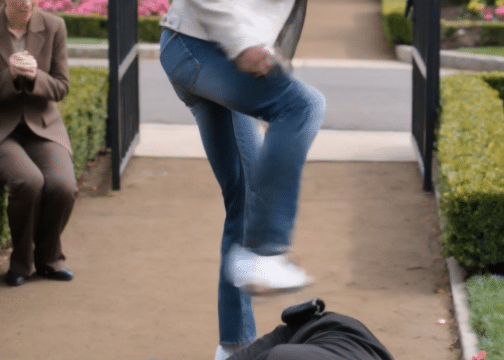
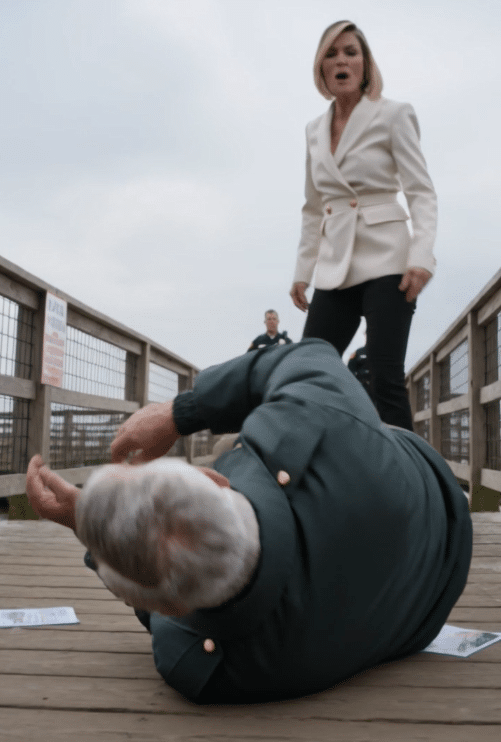
In the tense confrontation that followed, the elderly volunteer was knocked into the wooden railing. Refuge brochures scattered across the boardwalk, and a small pair of binoculars slipped from her hands onto the weathered planks.
The crowd gasped.
The volunteer steadied herself, shaken but still trying to keep her attention on the frightened birds fluttering away from the shoreline.
The wealthy tourist looked down with cold superiority.
“I do what I want.”
No one moved.
Then the unmistakable sound of tires braking echoed from the entrance to the refuge.
Act II
Most visitors assumed the elderly woman was simply another volunteer spending retirement outdoors.
Few knew how much of the refuge existed because of people like her.
For nearly two decades, she had dedicated thousands of unpaid hours to restoring wetlands, educating school groups, removing invasive plants, and protecting nesting birds.
Children visiting the refuge often remembered her before they remembered the exhibits.
She knew the names of injured owls she had helped rescue.
She could identify migrating birds by sound alone.
She believed conservation began with simple conversations rather than punishment.
That was why she had approached the tourist politely.
Not to shame her.
Not to prove authority.
Simply to protect wildlife that could never defend itself.
Unfortunately, entitlement rarely listens to kindness.
The wealthy visitor believed paying an admission fee meant every rule became optional.
To her, the refuge was a destination.
To the volunteer, it was home.
The difference was about to become painfully clear.
Act III
A wildlife patrol vehicle rolled to a sharp stop near the entrance to the boardwalk.
Doors opened before the engine had fully settled.
A uniformed wildlife officer stepped out beside the Refuge Director, followed closely by security staff.
Visitors instinctively stepped aside.
Conversations vanished.
The director took in the entire scene in seconds.
The scattered brochures.
The dropped binoculars.
The food lying near protected habitat.
The shaken volunteer.
His expression hardened immediately.
“Back away from her.”
The order was calm.
It didn’t need to be louder.
Security moved between the tourist and the volunteer without hesitation.
For the first time, confidence disappeared from the visitor’s face.
She had expected people to stay silent.
Instead, the entire refuge now answered to someone she clearly hadn’t anticipated.
Act IV
The Refuge Director walked slowly toward the elderly volunteer.
“Are you alright?”
She nodded before asking the question that surprised everyone nearby.
“What about the birds?”
Even after everything that had happened, her first concern wasn’t herself.
It was the wildlife.
The director smiled sadly.
“That’s exactly why this refuge trusts you.”
Many visitors had no idea that the volunteer had helped design educational programs now used across multiple conservation sites in the state.
She had trained hundreds of new volunteers.
She had personally organized countless habitat restoration weekends.
Her quiet leadership had inspired an entire generation of young conservationists.
The wealthy tourist looked around in confusion.
She finally asked the question everyone knew was coming.
“Who are you?”
The director answered without raising his voice.
“I’m the person responsible for protecting everyone—and everything—in this refuge.”
The silence that followed carried more weight than any argument.
Act V
Refuge staff carefully gathered the scattered brochures while visitors respectfully kept their distance.
The wildlife officer ensured the feeding area was cleaned before birds returned to the shoreline.
Nearby families watched the scene unfold with thoughtful expressions.
Several parents quietly pointed toward the conservation sign, using the moment to explain to their children why seemingly small rules exist.
The elderly volunteer picked up her binoculars and smiled faintly.
“They’ll come back,” she whispered, watching the marsh.
“They always do if we give them space.”
The director later thanked her in front of volunteers and visitors alike.
He reminded everyone that protecting nature often depends on ordinary people who choose patience over recognition and responsibility over convenience.
The wealthy tourist arrived believing money could purchase exceptions.
She left having discovered that respect for nature cannot be bought.
It has to be practiced.
Long after the boardwalk returned to its usual peaceful rhythm, visitors remembered the encounter.
Not because someone tried to intimidate an elderly volunteer.
But because one quiet woman proved that real strength isn’t measured by status, wealth, or volume.
Sometimes it is measured by the courage to defend creatures that cannot speak for themselves—and by the unwavering conviction to protect what belongs to everyone.