Act I
The first pitch hadn’t even been thrown when an entire section fell silent.
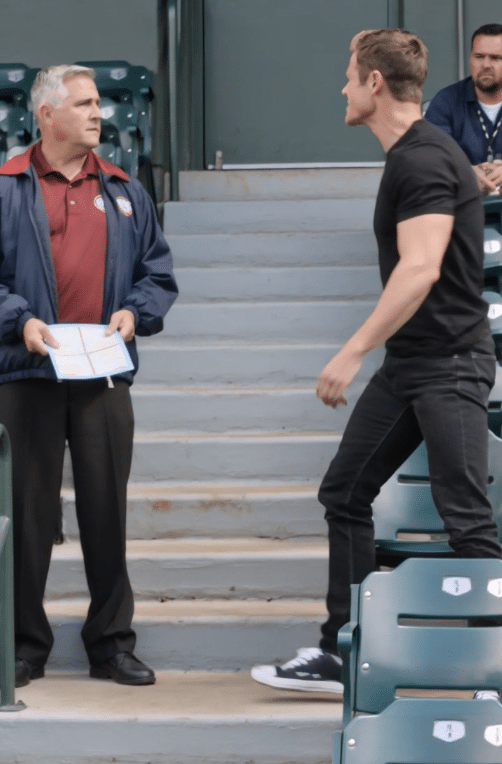
An elderly stadium usher stood calmly in the aisle, one hand holding a worn seat map while balancing carefully on his prosthetic leg. Years of military service had taught him patience, and years of volunteering had taught him kindness. Neither prepared him for the man glaring back at him.
“Sir, your seat is two rows down.”
The spectator barely looked at the ticket in his hand.
Instead, he leaned back comfortably in the premium seat and laughed loud enough for nearby fans to hear.
“Trash. VIP sits anywhere.”
Several people exchanged uncomfortable glances. A family with young children stopped unpacking their snacks. An older couple looked away, hoping the argument would simply end.
The veteran didn’t argue.
He simply pointed to the seat map again.
“Those seats belong to another family. I’d appreciate your cooperation.”
For a moment, it looked like the wealthy spectator might finally stand.
Instead, he exploded.
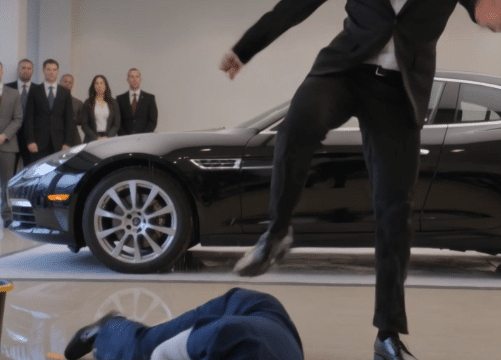
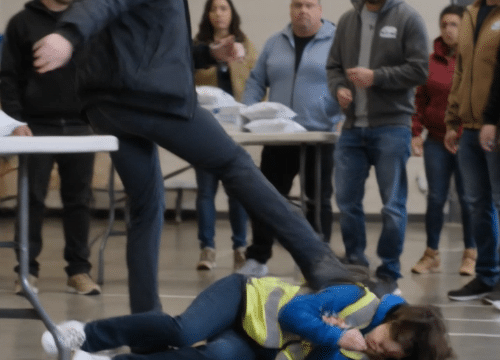
He jumped to his feet and, in a burst of reckless anger, shoved the situation into something no one expected. The elderly volunteer stumbled backward into the row of metal seats. The seat map slipped from his hand, a soda toppled onto the concrete steps, and he landed hard against the aisle.
Gasps echoed across the section.
The veteran grimaced in pain but tried to push himself upright.
He wasn’t worried about himself.
He was worried the confrontation would ruin the day for hundreds of families who had only come to enjoy a baseball game.
What nobody realized was that someone had witnessed every second from above.
And that person owned the stadium.
Act II
The veteran wasn’t just another usher.
His name was Thomas Carter, a retired Army sergeant who had lost part of his leg decades earlier during military service. After retirement, he refused to spend his days sitting at home. Instead, he volunteered at community events, youth baseball games, and eventually became one of the most beloved ushers in the stadium.
Children knew him by name.
Season-ticket holders brought him coffee before games.
Players often waved to him as they walked toward the dugout.
He remembered birthdays, congratulated graduates, and quietly helped veterans find accessible seating without ever asking for recognition.
His volunteer badge wasn’t simply plastic.
It represented years of quiet service.
The wealthy spectator, however, saw none of that.
All he saw was someone wearing a uniform he believed placed beneath him.
As Thomas slowly tried to steady himself, the man towered over him with contempt.
“Stay out of my section.”
The words landed almost as heavily as the humiliation.
Around them, no one moved.
Not because they didn’t care.
Because everything had happened so quickly that disbelief froze the crowd in place.
Then a heavy suite door slammed open above the seating bowl.
Every head turned.
Something had changed.
Act III
The man descending from the luxury suite wasn’t another guest.
He was the stadium owner.
His expression wasn’t loud.
It was controlled.
The kind of expression that made security begin moving before a single instruction was spoken.
Several members of the security team followed him down the steps while conversations throughout the section faded into silence.
The owner didn’t look at the angry spectator first.
He looked directly at Thomas.
His eyes fell to the veteran’s volunteer badge lying on the concrete beside the soaked seat map.
His jaw tightened.
Only then did he turn toward the wealthy man.
“Remove him from my stadium.”
The command echoed through the section.
The arrogant smile disappeared instantly.
The spectator blinked.
“Who are you?”
The question hung in the air.
No one answered.
No one needed to.
Every employee nearby had already straightened instinctively.
Security quietly formed a line between Thomas and the man who had attacked him.
The balance of power had shifted in a heartbeat.
But the owner wasn’t finished.
Act IV
The owner knelt beside Thomas first.
“Are you all right?”
Thomas gave a small nod despite the obvious pain.
“I’m more worried about everyone else’s game.”
That answer alone seemed to harden the owner’s resolve.
He stood again and faced the stunned crowd.
“This man has volunteered here for years.”
“He has helped thousands of families enjoy this stadium.”
“He has never asked for recognition.”
The section grew quieter with every sentence.
The owner continued.
“He served this country.”
“He serves this community.”
“And today he was assaulted simply for doing the job we asked him to do.”
The wealthy spectator suddenly looked much smaller than he had moments earlier.
He tried to explain.
He claimed it had been an accident.
He insisted Thomas had provoked him.
Unfortunately for him, dozens of witnesses had watched everything.
Security had already begun collecting statements.
Several nearby spectators quietly offered cellphone footage that had captured the confrontation from multiple angles.
The confidence that had fueled his arrogance disappeared.
For the first time all afternoon, he understood that status couldn’t erase evidence.
Act V
As medical staff checked Thomas’s injuries, the crowd remained unusually quiet.
Then someone started clapping.
Another joined.
Then another.
Within seconds, the applause spread through the entire section.
Not for the stadium owner.
Not for security.
For Thomas.
Embarrassed, he smiled modestly and tried to wave everyone back to their seats.
The owner helped him stand.
“You’ve taken care of this stadium for years,” he said quietly. “Today it’s our turn to take care of you.”
The wealthy spectator was escorted from the stadium as security completed their investigation. His expensive ticket, designer clothing, and self-importance had earned him nothing.
Meanwhile, Thomas received something far more valuable than any VIP pass.
Respect.
In the days that followed, word of the incident spread throughout the community. Fans wrote letters praising the veteran usher’s dignity under pressure. Local organizations recognized his years of volunteer service, and the stadium announced a new community appreciation program in his honor, celebrating volunteers who quietly made every game day possible.
Thomas never considered himself a hero.
He insisted he had only asked someone to sit in the correct seat.
But everyone who witnessed that afternoon remembered something much bigger than a seating dispute.
They remembered that true character isn’t revealed when life is easy.
It’s revealed in the moment someone with power believes they can treat another person as less than human—and in the moment an entire community chooses to stand for dignity instead.
By the time the first pitch was finally thrown, the loudest cheer of the day had already happened.
It wasn’t for baseball.
It was for the quiet veteran who never stopped serving others, even when the world failed to show him the same kindness.