Act I
The charging station fell strangely quiet the moment she pointed to the blue accessibility sign.
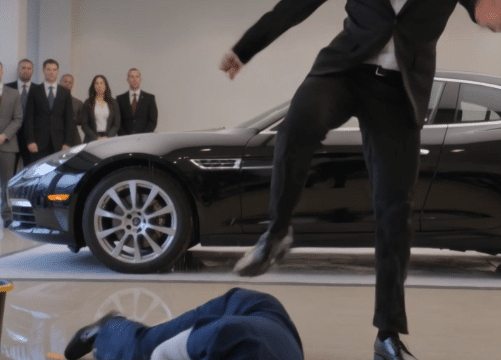
A luxury electric car sat squarely in the reserved charging space, its polished finish reflecting the afternoon sun. The woman responsible for maintaining the charging stations stood beside the pedestal with a diagnostic tester in one hand, her expression calm despite the growing line of waiting drivers.
“Sir, this space is reserved.”
The driver looked at the sign, then at her, and smiled as though the rules had been written for everyone except him.
“Trash. My car costs more than yours.”
Nearby motorists exchanged uneasy glances but remained silent.
The maintenance worker didn’t raise her voice. She simply explained that the reserved charger existed for drivers with qualifying accessibility permits and that another charger was available only a few spaces away.
Instead of moving his vehicle, the man stepped closer.
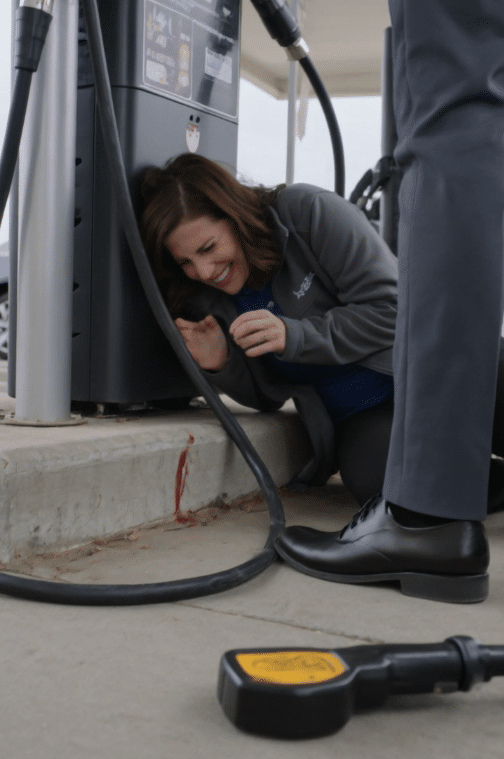
In a sudden burst of anger, he lashed out, knocking her backward into the charging pedestal. Her maintenance tester clattered across the concrete while the charging cable swung against its mount. She crumpled to the ground, shaken and in pain, trying to gather herself as stunned bystanders froze.
Yet even then, her first instinct wasn’t to argue.
It was to make sure no one accidentally approached the damaged equipment.
She pointed weakly toward the charger and warned everyone to stay back until it could be inspected.
The wealthy driver only sneered.
“Move the sign, not my car.”
He had no idea someone had just witnessed everything.
And that person had the authority to change his day in an instant.
Act II
Emily Dawson had worked highway service facilities for nearly two decades.
She knew every charger, every maintenance schedule, and every safety protocol. Travelers rarely remembered her name, but thousands relied on her work without ever realizing it.
She had seen stranded families, exhausted nurses, disabled veterans, and parents driving children through the night.
Accessibility wasn’t simply another policy.
Sometimes it meant the difference between someone continuing their journey or being left stranded for hours.
That was why she never ignored violations.
Not because she enjoyed confrontation.
Because someone else might desperately need that charger only minutes later.
As she struggled to sit upright, several waiting drivers looked ready to intervene.
Shock held them in place.
Then the sound of hard braking echoed beneath the charging canopy.
Every head turned.
Act III
A highway service management vehicle rolled to a stop beside the charging area.
Before the engine even shut off, the area manager stepped out, followed by security personnel already moving with purpose.
His eyes didn’t go to the luxury vehicle first.
They went directly to Emily.
He saw the fallen tester.
The reserved-space sign.
The disturbed charging equipment.
Then he looked at the driver.
His expression hardened.
Only four words broke the silence.
“Tow his car.”
The arrogant driver’s confidence faltered immediately.
He laughed nervously.
“You can’t be serious.”
No one answered.
Security calmly positioned themselves between him and the injured worker.
The manager approached the reserved charging space, examined the clearly posted accessibility sign, then turned back toward the driver.
“Who are you?” the man demanded.
The manager answered with remarkable composure.
“I’m the person responsible for this entire service area.”
The atmosphere shifted instantly.
Act IV
The manager knelt beside Emily before saying another word.
“Are you hurt?”
“I’m okay,” she replied quietly. “Please make sure the charger is safe before anyone plugs in.”
Even after everything that had happened, she was still thinking about the public.
The manager stood again.
“She wasn’t protecting a parking space,” he said firmly.
“She was protecting access for people who depend on these facilities.”
He gestured toward the accessibility sign.
“Those rules exist because someone may arrive with no alternative.”
Meanwhile, security had already begun documenting the scene.
Several witnesses volunteered statements.
One driver quietly mentioned having recorded part of the confrontation on a dashboard camera.
The wealthy driver’s confident posture began to disappear.
Status.
Money.
An expensive vehicle.
None of it changed what dozens of people had witnessed.
For the first time that afternoon, he looked genuinely worried.
Act V
Medical personnel arrived to examine Emily while another crew temporarily closed the affected charger for inspection.
The reserved charging space remained empty until everything had been verified safe.
The luxury EV was loaded onto a tow truck under the manager’s direction, and the driver faced the consequences of both the accessibility violation and the alleged assault.
As traffic slowly returned to normal, one elderly driver approached Emily.
“I needed that charger,” he said softly, showing the accessibility placard displayed in his vehicle.
“Thank you for standing your ground.”
Emily smiled despite the soreness.
“It wasn’t about me,” she replied.
“It was about making sure the space was there for the person who truly needed it.”
The manager later announced additional recognition for employees who upheld safety and accessibility standards under difficult circumstances, praising Emily’s professionalism and dedication.
The incident quickly became a reminder throughout the service network that rules protecting accessibility are not inconveniences—they are commitments to fairness, safety, and respect.
The man who believed an expensive car placed him above everyone else left with a damaged reputation and an empty parking space.
The woman he dismissed walked away with something far more valuable.
The respect of everyone who had watched her choose responsibility over fear.
And long after the tow truck disappeared down the highway, travelers remembered one simple truth:
Character isn’t measured by what you drive.
It’s measured by how you treat the people whose job is to protect everyone else.