Act I
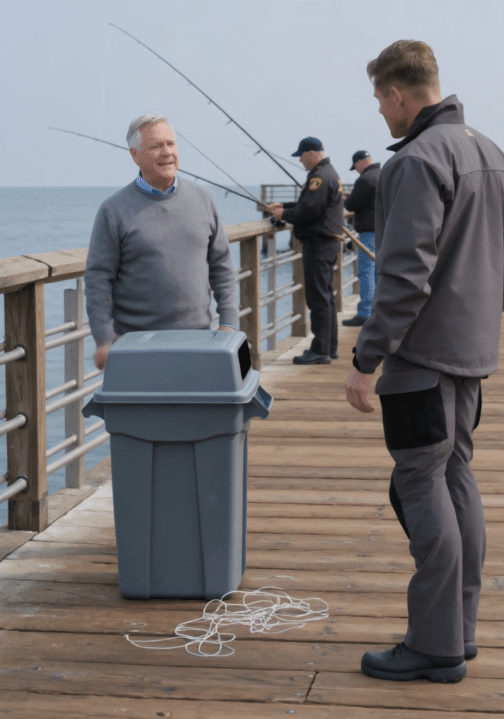
The damaged fishing line was already tangled across the weathered boards when the elderly volunteer bent down and pointed toward the bright recycling tube mounted beside the railing.
“Please use the line bin.”
The wealthy fisherman barely glanced at it.
He adjusted one of his expensive rods, looked the older man up and down, and smirked as though the request itself were insulting.
“Trash. You’re just an old fisherman.”
A hush settled over the public pier.
Families paused their conversations. Children holding bait buckets looked toward the growing argument while gulls circled overhead, their cries mixing with the steady rhythm of waves beneath the dock.
The volunteer didn’t argue.
For years he had spent nearly every morning walking the pier, collecting discarded hooks and fishing line before seabirds or marine animals became trapped. He knew most visitors simply forgot.
So he smiled gently.
“Please. It helps protect the wildlife.”
Instead of listening, the man exploded in anger.
In one reckless burst of rage, he shoved the volunteer backward. The older man stumbled into the mounted disposal bin, a folding fishing stool tipped over, and loose fishing line scattered across the boards. He fell hard, scraping his palm against the rough wood as nearby visitors gasped.
Even while struggling to catch his breath, his eyes weren’t on himself.
They were fixed on the fishing line now drifting toward the edge of the pier.
Then the fisherman sneered.
“Clean it yourself.”
He believed he’d just put an old volunteer in his place.
He didn’t realize someone important had just arrived at the entrance to the pier.
Act II
Harold Bennett wasn’t employed by the state.
He wasn’t paid.
At seventy-six years old, he volunteered because he had seen what discarded fishing line could do.
Years earlier, he had rescued an injured pelican wrapped so tightly in abandoned monofilament that it could barely move its wings. The memory never left him.
After retiring, he dedicated thousands of volunteer hours to educating anglers, installing recycling tubes, and keeping the public pier safe for wildlife.
Regular visitors knew him well.
Children proudly showed him their first catches.
Experienced anglers often handed him tangled line before leaving.
He never demanded respect.
He simply asked people to leave the pier cleaner than they found it.
As Harold slowly tried to sit up, no one moved.
The crowd stood frozen between disbelief and fear.
Then the unmistakable sound of heavy brakes echoed across the parking lot.
Every head turned.
Act III
A state wildlife truck rolled to a stop at the entrance to the pier.
Before the engine even went quiet, uniformed rangers stepped out alongside a senior wildlife officer.
They moved quickly but without panic.
The officer’s attention immediately fell on the elderly volunteer sitting against the disposal bin.
Then he noticed the discarded fishing line stretched across the boards.
Finally, he looked directly at the fisherman.
His expression became ice cold.
“Step away from him.”
The words carried across the entire pier.
The fisherman scoffed.
“Who are you?”
No one answered immediately.
The rangers already had.
They calmly positioned themselves between Harold and the angry man while other staff secured the area to prevent anyone from tripping over the loose fishing line.
Only then did the officer speak again.
“I’m the state officer responsible for protecting this refuge and enforcing its wildlife regulations.”
The confidence drained from the fisherman’s face.
For the first time that afternoon, he understood this wasn’t just a disagreement with an elderly volunteer.
Act IV
The officer knelt beside Harold first.
“Are you injured?”
Harold managed a tired smile.
“I’ll be alright.”
Then he quietly pointed toward the loose fishing line.
“Please don’t let the birds reach that.”
The officer looked at him for a long moment.
Even after being knocked to the ground, the volunteer’s greatest concern remained the wildlife.
That spoke louder than any witness ever could.
Standing once again, the officer addressed the growing crowd.
“This man has protected this pier for years.”
“He has prevented countless birds and marine animals from becoming trapped.”
“He volunteers because he believes every visitor shares responsibility for this coastline.”
The crowd listened in complete silence.
Several fishermen lowered their eyes.
Others nodded quietly.
Nearby visitors offered statements describing exactly what they had witnessed, while one family mentioned they had captured part of the confrontation on video.
The wealthy fisherman attempted to interrupt.
“It wasn’t that serious.”
The officer looked directly at him.
“You assaulted a volunteer who was protecting public wildlife.”
“There is nothing minor about that.”
For the first time all afternoon, the expensive fishing gear, designer clothing, and confident posture meant absolutely nothing.
Act V
Medical personnel checked Harold’s injuries while rangers gathered the discarded fishing line and reopened the pier once it was safe.
The fisherman was escorted away as the investigation continued, no longer surrounded by admiration but by silence.
Harold slowly stood with assistance.
A young boy approached holding a small handful of tangled fishing line he had collected from beneath the railing.
“I’ll use the bin,” he said quietly.
Harold smiled.
“That’s exactly how we protect them.”
The officer later announced a statewide recognition program honoring long-serving conservation volunteers, using Harold’s decades of dedication as an example of the quiet work that often goes unnoticed.
In the weeks that followed, more recycling bins appeared along nearby fishing piers, and local fishing clubs organized volunteer cleanup days inspired by Harold’s example.
The incident faded from the headlines, but one image remained with everyone who had witnessed it.
An elderly volunteer lying on the wooden boards, still pointing toward a pile of discarded fishing line—not because he cared about winning an argument, but because he cared about the birds that might never understand the danger humans leave behind.
The man who believed kindness was weakness left with only embarrassment.
The volunteer everyone underestimated left with something far greater.
The gratitude of an entire community—and the quiet knowledge that protecting nature is never a small job, no matter who is doing it.