Act I
The rejection tone from the ticket scanner echoed across the busy ferry terminal before anyone had time to look up.
The middle-aged ticket controller calmly held her position in front of the gate, keeping her voice steady despite the impatient crowd gathering behind.
“Ma’am, this ticket is expired.”
For a brief moment, it looked like an ordinary customer service problem.
Then the woman’s expression hardened.
She glanced at the flashing scanner as though it had personally insulted her.
“Trash. Nobody checks me.”
People nearby exchanged uncomfortable looks.
Designer handbag over one shoulder, expensive coat perfectly pressed, she carried herself with the confidence of someone who had spent years believing rules existed only for other people.
The controller didn’t argue.
She simply pointed toward the customer service counter.
“If there’s been a mistake, they’ll be happy to help.”
That simple sentence was apparently too much.
The next few seconds would leave the entire terminal in stunned silence.
Act II
The wealthy passenger stepped closer, invading the controller’s space.
Passengers instinctively backed away.
Some reached for their phones.
Others simply froze.
The controller never raised her voice.
She had worked the terminal long enough to recognize anger before it exploded.
Her job wasn’t glamorous.
She spent every day explaining delayed departures, damaged tickets, canceled sailings, and forgotten reservations.
Most people eventually understood.
A few never did.
Unfortunately, this woman belonged to the second group.
“Open the gate.”
When the controller refused to bypass the security system, the confrontation escalated.
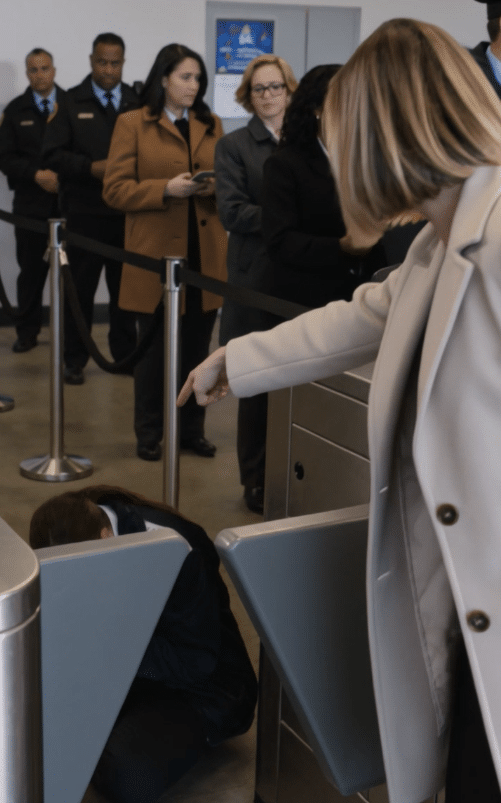
The passenger lashed out, knocking the employee hard into the metal gate.
The scanner clattered across the floor as queue ropes swayed and several travelers gasped.
The controller remained conscious but clearly shaken, struggling to regain her balance while keeping the gate closed.
No one moved.
Fear had frozen the crowd.
But someone else had already heard the commotion.
And he wasn’t coming alone.
Act III
The operations office door burst open.
Conversation throughout the terminal stopped almost instantly.
Several supervisors emerged first.
Behind them walked the Ferry Operations Director.
He wasn’t running.
He didn’t need to.
The authority in his stride cleared a path before him.
Terminal security followed close behind.
His eyes immediately took in everything.
The fallen scanner.
The broken queue rope.
The expired ticket still clutched tightly in the passenger’s hand.
The employee trying to stand.
Then he spoke only four words.
“Close this gate.”
Every member of staff moved without hesitation.
Security stepped between the passenger and the injured controller.
The boarding process stopped completely.
Hundreds of travelers watched in complete silence.
For the first time, uncertainty crossed the wealthy passenger’s face.
“Who are you?”
Several employees looked at one another in disbelief.
She truly had no idea.
And that mistake would change everything.
Act IV
The director calmly removed his identification badge from beneath his coat.
“I oversee every operation in this terminal.”
His voice never rose.
“It appears you’ve mistaken professionalism for weakness.”
The security supervisor quietly handed him the incident reports already beginning to arrive over the radio.
Witness statements.
Security camera confirmations.
The rejected ticket log.
Everything matched.
The controller had done exactly what she had been trained to do.
Nothing more.
Nothing less.
The director looked toward the crowd.
“Every employee here has my full support when enforcing safety and boarding regulations.”
Several passengers nodded.
Others applauded softly.
The atmosphere shifted.
Moments earlier, the wealthy traveler had controlled the confrontation through intimidation.
Now she stood completely alone.
Security informed her that law enforcement had been requested to investigate the alleged assault and disturbance.
Her confidence disappeared almost instantly.
Act V
Paramedics examined the ticket controller while fellow employees helped her to a nearby chair.
Despite everything that had happened, her first concern wasn’t herself.
She quietly asked whether boarding had resumed for the waiting families.
The director smiled with genuine respect.
“That’s exactly why you’re one of our best employees.”
He assured her the terminal would handle the situation from there.
Meanwhile, security escorted the passenger away from the gate as dozens of witnesses watched in silence.
Nobody defended her.
Nobody protested.
The privilege she had relied upon moments earlier had vanished the instant accountability arrived.
Before normal boarding resumed, the director addressed the waiting crowd.
“Rules aren’t obstacles,” he said. “They’re promises that everyone will be treated equally.”
The controller looked around at the passengers who had begun thanking her for simply doing her job.
For years, she had been almost invisible.
One ordinary employee among hundreds.
But that afternoon reminded everyone in the terminal that the people enforcing the rules are often the very ones protecting everyone else.
And sometimes, the greatest authority doesn’t announce itself until the moment it’s needed most.