Act I
The visitor’s hand was already inches from the protected artifact.
An elderly museum guide stepped calmly between him and the glass display, gently pointing toward the sign beside it.
“Please don’t touch the display.”
The request was polite. Almost apologetic.
The wealthy visitor barely glanced at the sign before scoffing.
“Trash. I donated here.”
Conversations throughout the exhibit hall faded into uneasy silence.
The guide didn’t argue.
He simply explained that every artifact—regardless of who funded the museum—was protected by the same rules. These relics had survived wars, generations, and countless sacrifices. They deserved respect.
The visitor’s pride flared.
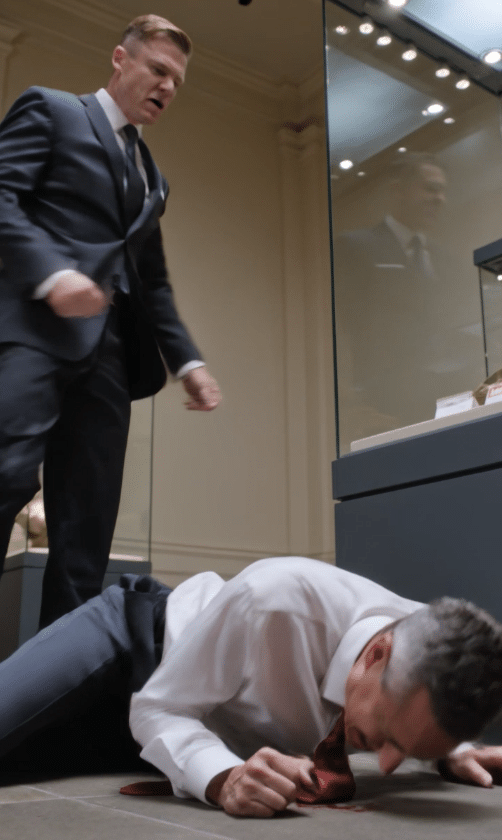
He shoved the guide aside with enough force to send brochures scattering across the polished floor and the rope barrier trembling. The elderly veteran stumbled near the display case, careful even in that painful moment not to strike the glass that protected the priceless artifact.
Visitors gasped.
No one moved.
Standing over the older man, the donor sneered.
“Your rules don’t apply to donors.”
He believed money had purchased authority.
He couldn’t have been more mistaken.
Something had just happened that would change the entire room.
Act II
Most visitors never learned much about the quiet volunteer who welcomed them each morning.
They noticed his neat blazer.
His veteran pin.
His calm voice.
Few knew he had spent decades serving his country before dedicating his retirement to preserving its history.
Every artifact inside the museum represented someone who had sacrificed far more than comfort.
To him, each display carried a name, a face, a memory.
That was why he guarded every exhibit with unwavering patience.
Not because it was his job.
Because he believed history deserved caretakers.
The wealthy donor saw none of that.
He saw only an old man standing in his way.
Around them, families quietly gathered their children closer.
The silence became almost unbearable.
Then an office door slammed open across the hall.
Every head turned.
Act III
The museum director hurried into the gallery with security close behind.
His expression carried obvious concern.
But halfway across the room, he suddenly slowed.
The instant he recognized the elderly guide, his posture changed completely.
He straightened instinctively.
Respect replaced urgency.
Without hesitation, he spoke.
“Sir, I’m here.”
The entire gallery froze.
The single word echoed louder than any shouted command.
Sir.
Not because the guide worked for him.
Not because he was elderly.
But because the director regarded him with profound respect earned long before either man had entered the museum.
The donor frowned in confusion.
“Sir?”
He looked from the director to the volunteer, unable to understand what everyone else had just realized.
The old guide wasn’t simply another museum volunteer.
He was someone whose service and character commanded quiet admiration throughout the institution.
Act IV
Security positioned themselves between the visitor and the veteran.
The director knelt briefly to make sure the older man was all right before helping him to a nearby chair.
Only then did he face the donor.
His voice remained calm.
“You ignored museum policy.”
A pause.
“You disrespected our collection.”
Another.
“And you laid hands on a man who has spent years protecting this place and the history it preserves.”
No one in the gallery spoke.
The donor attempted to defend himself.
“I gave this museum a lot of money.”
The director nodded once.
“We appreciate every lawful donation.”
His expression never changed.
“But generosity does not exempt anyone from our rules.”
He gestured toward the exhibit.
“Those artifacts belong to history—not to donors.”
Security informed the visitor that he was being escorted from the museum while the incident was documented and reported through the appropriate channels.
For the first time all afternoon, the man’s confidence disappeared.
Money could buy recognition.
It could not purchase respect.
Act V
After the gallery settled, staff quietly collected the scattered brochures and reset the rope barrier.
Visitors who had witnessed the confrontation returned to the displays with a different perspective.
Several paused to thank the veteran guide personally before continuing their tour.
The director remained beside him for a moment.
“I learned more from you than any textbook ever taught me,” he said quietly.
The old veteran smiled.
“I just try to take care of the stories.”
That was all he had ever wanted.
Because museums were never merely buildings filled with old objects.
They were places where sacrifice, courage, and memory continued to speak.
The artifacts behind the glass reminded people of the past.
The elderly volunteer reminded them how to honor it.
And everyone who left the museum that day carried home the same lesson:
True honor is never measured by wealth, influence, or donations.
It is earned through a lifetime of service—and shown in the respect others freely choose to give.