Act I
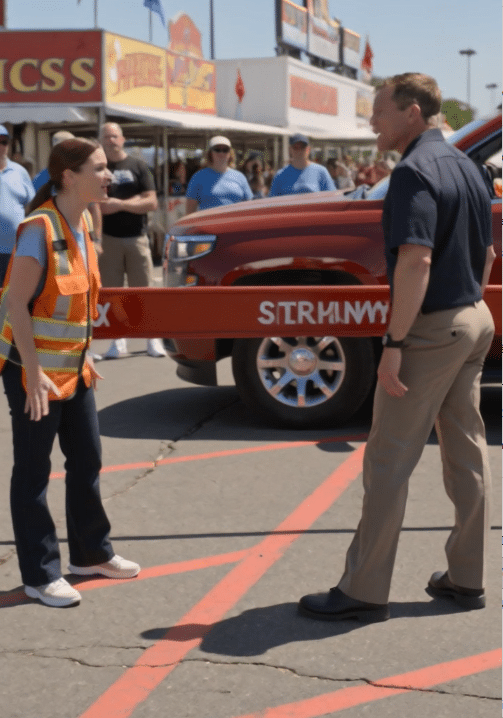
The SUV was already blocking the bright red fire lane.
With a radio in one hand, the county fair’s fire lane coordinator pointed calmly toward the sign standing only a few feet away.
“Sir, this fire lane must stay clear.”
Families carrying cotton candy slowed as they passed. Carnival music drifted through the evening air, but the tension near the emergency lane was impossible to ignore.
The driver looked at the sign.
Then at the woman.
Finally, he smiled as if the rules simply didn’t apply to him.
“Trash. I’m not moving.”
She didn’t argue.
She explained that emergency vehicles could need the lane at any moment. Seconds mattered during fires, medical emergencies, or rescues inside a crowded fair.
The explanation only irritated him more.
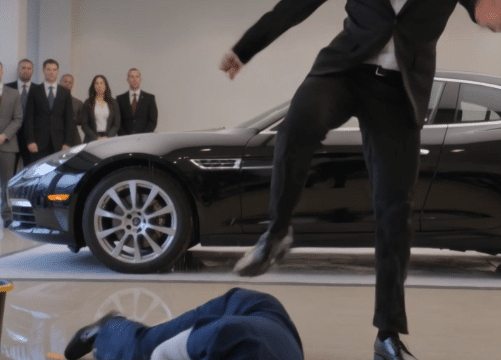
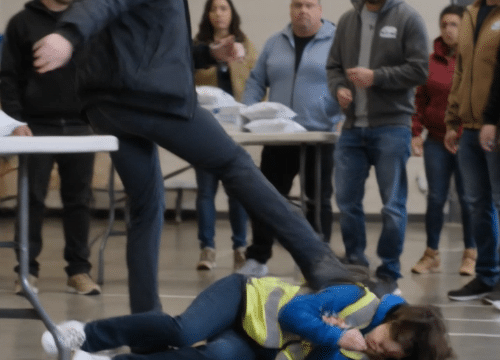
In a burst of anger, he shoved her aside, knocking her into a temporary safety barrier. Her radio slipped from her hand and clattered across the pavement as nearby visitors gasped and backed away.
Ignoring her attempts to reach the radio, he stood over it with cold confidence.
“Call whoever you want.”
He believed no one important would actually come.
He was about to discover how wrong he was.
Act II
The county fair welcomed thousands of visitors every day.
Most people noticed the rides.
The food.
The music.
Almost nobody noticed the emergency lanes kept clear between attractions.
That was exactly how the coordinator preferred it.
If people never thought about the fire lane, it meant everyone had stayed safe.
She had worked enough public events to know that one blocked emergency route could delay firefighters when every second mattered.
Rules weren’t inconveniences.
They were contingency plans written after real tragedies.
The wealthy driver saw only an empty stretch of pavement convenient for parking.
He mistook patience for weakness.
Around them, vendors stopped serving customers.
Parents quietly guided children farther back.
Everyone sensed the situation had become far more serious than a parking dispute.
Then the unmistakable sound echoed across the fairgrounds.
Air brakes.
Heavy diesel.
A fire truck.
Act III
The engine stopped directly at the entrance to the blocked lane.
Its emergency lights reflected across the polished SUV.
Firefighters climbed down immediately.
Then one more figure stepped onto the pavement.
The Fire Chief.
He took one look at the blocked lane.
One look at the coordinator being helped to her feet.
Then fixed his eyes on the driver.
The fairgrounds seemed to fall silent.
His voice never rose.
“Clear my lane.”
It wasn’t shouted.
It didn’t need to be.
Firefighters moved with practiced precision, securing the area and checking on the coordinator while ensuring the emergency route could be reopened.
Only then did the Chief continue walking toward the SUV.
The driver’s confidence began to disappear.
Act IV
Only moments earlier, he had mocked the coordinator for reaching toward her radio.
Now he found himself surrounded by professionals whose entire purpose was protecting lives.
The Chief spoke evenly.
“That lane exists so we can reach people on the worst day of their lives.”
Another step.
“When someone blocks it, they’re gambling with time.”
He looked directly at the SUV.
“And time is the one thing firefighters can never recover.”
The driver’s expression changed.
The crowd that had watched in silence was no longer looking at an important customer.
They were looking at someone who had chosen ego over public safety.
The Chief instructed personnel to have the vehicle removed from the emergency access route and directed that the incident be documented and referred to the appropriate authorities.
No one argued.
The rules were the rules.
Act V
Within minutes, the fire lane stood open again.
Visitors resumed walking between attractions.
Children laughed as rides started once more.
The coordinator, after being checked by emergency personnel, thanked the firefighters before insisting they return to protecting the fair.
The Chief paused beside her.
“You did exactly what you were supposed to do.”
She smiled tiredly.
“I was just protecting the lane.”
He nodded.
“Which means you were protecting everyone here.”
Nearby, several fairgoers quietly applauded.
Not because someone had been embarrassed.
But because the emergency route was once again ready for the people who might someday depend on it without ever realizing it.
As the fire truck rolled slowly through the now-clear lane, one lesson lingered long after the engine noise faded:
Real authority isn’t about refusing to follow the rules.
It’s about understanding that some rules exist because lives may one day depend on them.