Act I
“All rooms are fully booked…”
The clerk had barely finished the sentence when the guest kicked her.
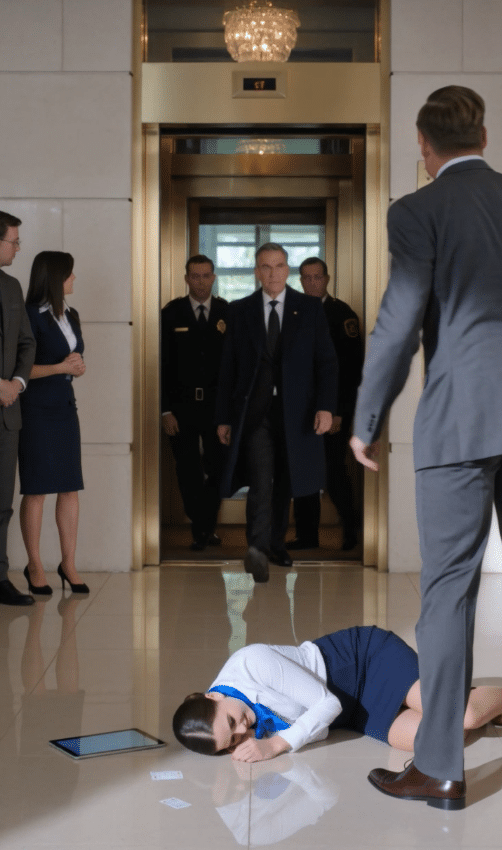
The 29-year-old woman was standing in front of the white stone reception desk, tablet still in her hand, when the man’s polished shoe struck her chest.
She flew backward into the counter.
The tablet slipped from her fingers and skidded across the polished floor. Room key cards scattered in every direction as her forearm caught the edge of the stone desk before she collapsed.
A thin trace of blood appeared along her arm.
For a moment, nobody moved.
Guests near the luggage carts froze.
Someone covered their mouth.
Another person stepped away from the reception desk as the man in the expensive gray suit stood over the fallen clerk.
She grimaced and curled slightly onto her side, struggling to breathe.
Her blue silk scarf had shifted loose from her collar.
Her neat bun was still intact, but the professional composure she’d carried through the evening had disappeared from her face.
The man looked down at her.
“Trash. Make one available.”
Then he stepped forward.
Two more kicks struck her back and side as she remained on the lobby floor.
The chandelier above them continued to glow.
The glass elevators moved silently behind the crowd.
Everything about the luxury hotel looked elegant.
Everything except the scene at the reception desk.
The clerk drew her arms close and breathed hard, pain and humiliation written across her face.
The man adjusted his expensive watch.
“People like me don’t get refused.”
That sentence hung in the lobby.
Then the glass elevator opened.
A man in a long navy coat stepped out with a regional director and two hotel security guards.
He looked first at the woman on the floor.
Then at the scattered key cards.
Then at the guest.
His expression didn’t change.
But the entire lobby seemed to understand that something had just shifted.
Because the man who had been screaming at the front desk wasn’t standing in front of an employee anymore.
He was standing in front of the person who owned the hotel group.
And the first thing that owner did wasn’t punish the guest.
It was protect the clerk.
Act II
Her name was Claire Bennett.
At twenty-nine, Claire had already learned that working a luxury hotel reception desk required more than knowing how to check someone in.
It required patience.
It required restraint.
And, above all, it required the ability to tell wealthy people “no” without making them feel as though they had been denied anything.
That night, the hotel was completely booked.
Every room.
Every suite.
Every last-minute cancellation.
The booking system on Claire’s tablet showed no availability.
She had checked it twice.
Then three times.
There was nothing she could offer the man standing across from her.
He hadn’t accepted that answer.
He had arrived carrying an expensive laptop bag, wearing a perfectly tailored gray suit and a gold watch that caught the chandelier light whenever he moved his hand.
He had expected a room.
Not because the hotel had promised him one.
Because he believed someone would make one appear.
His reservation request had come through earlier in the evening, but the property was already at capacity.
Claire had explained that.
Calmly.
Professionally.
She had even checked for cancellations.
There were none.
The man had interpreted every attempt to help him as an invitation to push harder.
He demanded an exception.
Claire couldn’t give him one.
He demanded that another reservation be moved.
She couldn’t do that either.
Eventually, she stepped out from behind the desk to explain that there simply wasn’t an available room.
That was when his anger turned physical.
The guests watching from the lobby couldn’t understand it.
Neither could Claire.
She had spent the entire evening helping strangers with luggage, directions, room keys, restaurant reservations, and travel problems.
She had dealt with exhausted families and impatient business travelers.
She had learned to absorb frustration without returning it.
But nothing in her training had prepared her for being attacked because a computer screen said “fully booked.”
What the angry guest didn’t know was that Claire had been carefully following the hotel’s occupancy policy.
The system existed for a reason.
Emergency rooms had to remain accounted for.
Housekeeping needed accurate numbers.
Fire and safety regulations placed limits on occupancy.
Reservations couldn’t simply be erased because a powerful guest demanded it.
Claire hadn’t refused him personally.
She had refused to falsify reality.
And that distinction would soon become important.
Because the man had made one assumption that powerful people sometimes make when they walk into places where everyone knows their money matters.
He assumed the person behind the desk had no one behind her.
He was wrong.
The hotel group had a strict policy concerning employee safety.
And the owner had personally insisted on it after an incident years earlier involving a young employee who had been publicly humiliated by a guest and then pressured into staying quiet.
Since then, the company had installed security protocols designed to escalate serious incidents quickly.
The employee elevator wasn’t just an elevator.
It connected the lobby to the administrative offices above.
And that evening, the regional director had been meeting with the owner upstairs.
The sound from the lobby had reached them.
The owner came down immediately.
He didn’t need anyone to tell him what had happened.
The room key cards were scattered across the floor.
The tablet was several feet away.
Claire was injured.
And the guest was still standing over her.
The owner had seen enough.
But the guest had no idea whose hotel he had just turned into a crime scene.
And he was about to find out.
Act III
The man in the navy coat was named Richard Morgan.
He was sixty-one.
He had built his hotel group over three decades, beginning with a single roadside property and eventually acquiring a portfolio of luxury hotels across the country.
But the employees didn’t know him because of his wealth.
They knew him because of one rule.
No guest was more important than the people who worked there.
Richard rarely appeared on the lobby floor without warning.
He preferred to let managers manage.
He believed ownership should be invisible when everything was working properly.
But when the glass elevator opened that night, he knew something had gone badly wrong.
His regional director followed behind him.
Two security guards came with them.
The guards immediately moved toward Claire.
They positioned themselves between her and the guest, creating space around the injured clerk.
Richard didn’t look at the guest first.
He looked at Claire.
Then he looked at the security footage monitor mounted behind the reception area.
The cameras had recorded everything.
There would be no argument about what happened.
No question about whether the kick had been accidental.
No debate about whether Claire had provoked the confrontation.
The evidence was already preserved.
The guest seemed to sense the change.
His aggressive posture remained, but his eyes began moving around the room.
The guests were still watching.
The security guards were now standing between him and the clerk.
The regional director had gone silent.
And Richard Morgan was staring at him.
The guest didn’t know who he was.
That was the first irony.
The second was even bigger.
The reservation the guest had been demanding was not the only thing connected to his name.
The hotel’s internal system contained years of reservation records.
And the man’s history with the hotel group was not as impressive as he apparently believed.
Repeated cancellations.
Unpaid incident charges.
Complaints from staff.
Complaints from other guests.
Previous confrontations at two properties.
Nothing had been enough to permanently bar him.
The company had repeatedly given him another chance.
Management had treated each incident separately.
That night changed everything.
Because this wasn’t a complaint anymore.
This was an assault.
And Richard understood exactly what it meant for the company to continue treating the man’s behavior as the cost of doing business.
The guest’s arrogance had been built on a misunderstanding.
He believed his money made him valuable.
Richard believed his employees made the company valuable.
Those two ideas were about to collide.
Richard finally turned toward the regional director.
Then toward the guest.
He didn’t raise his voice.
He didn’t insult him.
He gave a single instruction.
“Cancel his reservation history.”
The guest stared at him.
The words didn’t immediately register.
Then his expression changed.
The man who had demanded a room suddenly looked as though someone had removed the floor beneath him.
Because he still didn’t understand.
Cancel his reservation history?
What did that even mean?
And why was the hotel owner speaking as though the guest’s entire relationship with the company could disappear with one order?
The answer was waiting in the hotel’s records.
And it was about to become very personal.
Act IV
The lobby fell into a silence so deep that the elevator cables seemed audible.
Richard Morgan remained beside the security guards.
Claire was protected behind them.
The guest stood several feet away.
The same man who had demanded special treatment minutes earlier now looked uncertain about what would happen next.
He glanced at his laptop bag.
Then his watch.
Then the reception desk.
The room key cards he had scattered were still lying across the floor.
Everything he had treated as disposable suddenly looked like evidence.
Richard’s order wasn’t about erasing history.
It meant ending the privilege the guest thought he had earned.
His reservations.
His VIP status.
His preferred treatment.
The assumption that another hotel in the same group would always welcome him regardless of how he behaved.
For years, the guest had treated luxury hospitality like a transaction in which money bought obedience.
But Richard had built his company around a different principle.
Hospitality meant serving guests.
It did not mean surrendering employees.
The regional director already understood what the order meant.
The guest didn’t.
Not yet.
He looked toward the owner as though waiting for someone to correct a misunderstanding.
Nobody did.
The security guards remained firmly between him and Claire.
One of them glanced toward the scattered tablet.
Another looked toward the camera system.
The lobby guests had gone completely silent.
A woman near the elevators lowered her phone without taking her eyes off the scene.
A businessman beside the luggage carts stood perfectly still.
Nobody needed to say what everyone was thinking.
The man in the gray suit had believed he was the most important person in the room.
He had mistaken a reception desk for a place where he could command people.
He had mistaken a young clerk for someone who couldn’t push back.
And he had mistaken the hotel’s willingness to serve him for an obligation to tolerate anything he did.
Richard’s decision exposed the difference.
The clerk had followed the rules.
The guest had broken them.
The hotel owner had chosen whose side the company would stand on.
Not the person with the expensive watch.
The person who had been doing her job.
Claire slowly pushed herself into a seated position.
Her breathing was still uneven.
Her arm still hurt.
Her face was pale.
But she was no longer looking at the guest.
She was looking at the security guards standing between them.
For the first time since the attack, she felt the room changing around her.
The humiliation was still there.
The pain was still there.
But something else had arrived.
Protection.
The guest noticed it too.
His eyes narrowed.
Then widened.
The confidence that had filled his face when he first walked into the hotel was disappearing.
He finally seemed to understand that Richard wasn’t a manager.
He wasn’t a security supervisor.
He wasn’t someone who could be talked into making an exception.
He was the owner.
And the reservation history the guest had been so proud of was now something the owner could decide to terminate.
The man swallowed.
His mouth opened.
For a second, he seemed unable to find the arrogance he had been using only moments earlier.
Then he finally spoke.
“Cancel my what?”
And the silence that followed was heavier than anything he could have said.
Act V
The hotel lobby looked almost exactly as it had before.
The chandelier still illuminated the white stone desk.
The glass elevators still rose behind the reception area.
The luggage carts still waited near the entrance.
But the balance of power had completely changed.
Claire sat safely behind the security barrier, still shaken but no longer exposed.
Her tablet lay on the floor several feet away.
The room key cards were being collected.
The evidence was preserved.
And the guest who had believed the hotel existed to satisfy his demands was finally facing a consequence he couldn’t negotiate away.
Richard Morgan didn’t need to embarrass him.
He didn’t need to shout.
He didn’t need to make a spectacle.
The decision spoke for itself.
The man had entered the hotel expecting a room.
He left the reception desk having lost something much more valuable to him: access.
Not because he had asked for an exception.
Not because he had been difficult.
Because he had crossed a line that money couldn’t erase.
Claire had done exactly what she was supposed to do.
She checked the system.
She explained the situation.
She remained professional.
When the guest became aggressive, she still didn’t retaliate.
She simply tried to do her job.
The person who attacked her had believed that being refused was an insult.
But the real humiliation came from discovering that the person he had considered powerless had an entire organization standing behind her.
And that organization had a memory.
Every reservation.
Every complaint.
Every previous warning.
Every incident he had assumed would be forgotten.
His history had been working in his favor only because the company had chosen patience.
That patience was now over.
The guests slowly began moving again.
The station-like stillness of the lobby broke apart.
An elevator opened.
A luggage cart rolled softly across the polished floor.
Someone picked up the last scattered key card.
But nobody forgot what had happened.
Claire looked down at her blue scarf and straightened it with trembling fingers.
She had walked into the evening expecting to tell one guest that there were no rooms available.
She never imagined that the answer would expose something far larger.
The man had believed wealth made refusal impossible.
Instead, his behavior had made his entire relationship with the hotel impossible.
And perhaps that was the real lesson of the night.
Power isn’t always the person demanding something.
Sometimes power is the person who can calmly say no.
Sometimes it belongs to the person standing behind the desk, following the rules while everyone else is watching.
And sometimes, when someone mistakes kindness for weakness, the quietest person in the room turns out to be protected by someone much more powerful.
The guest had asked for a room.
He had demanded an exception.
He had insisted that people like him never got refused.
But the last thing he received wasn’t a key card.
It was an answer.
One he had never imagined he would hear.
His reservation history was no longer a privilege.
It was the end of the relationship.
And as the lobby slowly returned to normal, the man finally understood the question he should have asked before he ever raised his foot.
Not, “How much can I get away with?”
But, “Who owns the building I’m standing in?”