Act I
“There are patients waiting before you…”
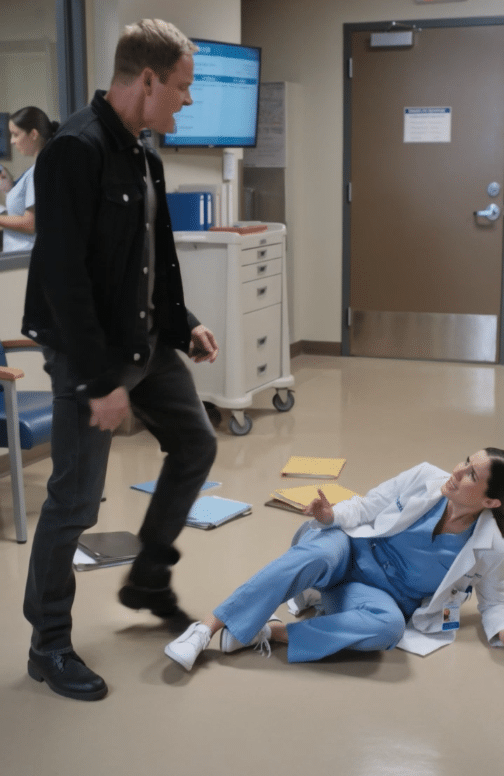
The doctor had barely finished the sentence when the man in the black jacket kicked her.
The blow caught her squarely in the chest and sent her backward into the medical record cart.
Files exploded across the hallway.
The number screen flickered above the waiting area as the cart rattled violently against the wall.
Her elbow struck the edge of the metal frame, leaving a thin trace of blood.
Then she hit the floor.
The 36-year-old doctor curled instinctively, grimacing as she struggled to breathe. Her white coat had twisted beneath her, one hand pressed against her side while the other remained close to her chest.
Patients stared.
A mother pulled her child closer.
An elderly man covered his mouth.
Someone near the nurses’ station stepped backward.
Nobody moved toward her.
The man who had attacked her stood over her with a clenched jaw.
“Trash. My family goes first.”
The doctor looked up at him, stunned.
She had been trying to protect the order of a crowded clinic.
He had decided that order didn’t apply to him.
Then he stepped forward again.
Two forceful kicks struck her back and side while she remained on the floor.
A gasp traveled through the waiting room.
The doctor recoiled, her face tightening with pain and humiliation.
The bully stared down at her.
“Treat us now.”
The words were almost absurd.
A doctor had been knocked to the floor for refusing to let one family jump ahead of patients who had already been waiting.
And still, the man expected her to serve him.
Then the administration door opened.
Hard.
Hospital security moved into the hallway.
Behind them came the head nurse.
And between them walked the hospital director.
His eyes went immediately to the doctor on the floor.
Then to the man standing over her.
His expression hardened.
Security stepped between them.
The waiting room fell silent.
The director looked at the attacker and delivered four words that changed the entire atmosphere.
“Remove him from the clinic.”
The man’s rage disappeared.
His eyes widened.
“Remove me?”
He had no idea that the person giving the order had been watching the hospital’s operations long before he ever walked through those doors.
And he was about to discover exactly how little his family’s privilege mattered inside that building.
Act II
Dr. Emily Carter had spent most of her career learning how to say no without sounding cruel.
It was harder than it looked.
In a busy clinic, every patient believed their situation was urgent.
Some were frightened.
Some were in pain.
Some had waited for hours.
And some arrived believing that their money, connections, or demands should move them ahead of everyone else.
Emily understood the pressure.
She had seen families panic when a loved one was sick.
She had watched exhausted parents stare at the number screen.
She had sat with patients who were terrified of what a test might reveal.
That was why she believed fairness mattered.
Not because every patient had the same problem.
Because every patient deserved to be assessed according to medical need rather than social status.
That afternoon, the waiting area was crowded.
The chairs were nearly full.
The number display kept changing.
Nurses moved between the exam rooms and the station.
Medical records were being transported down the hallway.
It was the kind of environment where one person forcing their way ahead could disrupt everything.
Then the 44-year-old man arrived with members of his family.
He didn’t like waiting.
He didn’t like the chairs.
And he certainly didn’t like being told that other patients would be seen first.
He approached the clinic staff demanding immediate attention.
Emily came out to explain the situation.
There were patients already waiting.
The medical team was working through the queue.
His family would be seen according to the appropriate clinical order.
It wasn’t personal.
It wasn’t punishment.
It was how the clinic functioned.
But the man’s reaction suggested he didn’t recognize the difference between fairness and disrespect.
To him, being told to wait meant being told he wasn’t important.
And that was unacceptable.
He began demanding immediate treatment.
Emily remained calm.
She had handled angry relatives before.
She knew that emotions could run high in medical settings.
But there was a point where frustration became intimidation.
And then there was a point where intimidation became violence.
When Emily repeated that other patients were already waiting, the man snapped.
He kicked her.
The hallway transformed instantly.
The files scattered across the floor.
The medical cart shook.
The number screen continued flashing as though the hospital itself hadn’t yet caught up with what had happened.
Emily lay beside the cart, stunned.
Her first thought wasn’t about herself.
It was about the patients.
They were still sitting there.
Still waiting.
Still watching.
And the man who had attacked her was still demanding to be treated first.
What he didn’t know was that the hospital had strict procedures for violent incidents.
Security wasn’t merely there to protect equipment.
It existed to protect patients and staff.
And the administration corridor connected directly to the waiting area.
The hospital director had been in a meeting only a short distance away.
He heard the disturbance.
The head nurse heard it too.
Within moments, they were moving toward the waiting room.
But the director didn’t arrive as a distant administrator.
He arrived as someone who had spent years building a culture around one principle.
No patient’s influence justified putting another patient or employee in danger.
The attacker had assumed the doctor was the end of the chain of authority.
He was about to learn that she wasn’t.
She was the person who had been trying to enforce it.
Act III
The hospital director’s name was Daniel Reeves.
At fifty-eight, Daniel had spent decades working his way through hospital administration.
He had started in operations.
He had worked nights.
He had watched emergency rooms overflow.
He had seen doctors make impossible decisions under pressure.
And he had learned something that never appeared on a hospital brochure.
The most dangerous moments weren’t always caused by medical emergencies.
Sometimes they came from people who believed the rules should bend for them.
Daniel had made that lesson part of the hospital’s security policy.
Patients were never guaranteed immediate treatment simply because they demanded it.
Relatives could not intimidate staff into changing medical priorities.
And nobody was allowed to turn a waiting room into a private kingdom.
The 44-year-old man had managed to violate all three principles in less than a minute.
When Daniel entered the hallway, security immediately shielded Emily.
The head nurse moved toward the scattered medical files.
Daniel stopped several feet away from the attacker.
He didn’t shout.
He didn’t need to.
The man still looked angry.
He seemed almost offended that security had entered the situation.
His family remained nearby.
The waiting patients watched silently.
For the first time, the man appeared to realize that the room was no longer responding to his demands.
The director looked toward Emily.
She was still on the floor, breathing hard.
Then he looked at the security officers.
The order came immediately.
“Remove him from the clinic.”
The man froze.
The words didn’t make sense to him.
Remove him?
He had expected the hospital to accommodate him.
He had expected the doctor to apologize.
He had expected someone to tell the other patients to wait.
Instead, the entire system had turned in the opposite direction.
And there was another layer to the story.
Daniel knew the family.
Not personally.
But through the hospital’s records.
They had used the clinic before.
Their name appeared in previous administrative disputes involving demands for preferential treatment.
Nothing had previously reached the level of violence.
Management had repeatedly tried to resolve complaints quietly.
Daniel had believed patience was better than confrontation.
That policy had now ended.
Because the incident wasn’t simply about a difficult patient.
A doctor had been assaulted while performing her duties.
And the attack had happened in front of a room full of witnesses.
There was security footage.
There were medical records.
There were scattered files.
There were staff members who had heard the confrontation.
And there were patients who had watched it unfold.
The attacker had believed the clinic was a place where his family could go first.
Instead, his actions had placed his own access to the clinic in jeopardy.
The director’s decision wasn’t retaliation.
It was a boundary.
One that had been crossed in front of everyone.
And now the man was beginning to understand that the white coat he had just knocked down was not the symbol of weakness he thought it was.
It was the symbol of a system.
A system that had just decided to stand behind its doctor.
Act IV
The waiting room became completely silent.
No number-screen beep seemed loud enough to break the tension.
No one wanted to move.
Security stood between Emily and the attacker.
The head nurse gathered the medical files from the floor.
Daniel remained in the center of the hallway.
The man in the black jacket looked around as though searching for someone willing to challenge the director’s decision.
Nobody did.
A few patients lowered their eyes.
Others watched him openly.
The same people who had been afraid to intervene when Emily was attacked now understood that the hospital had taken control.
The bully’s confidence began to fracture.
He had assumed the doctor could be intimidated because she was standing alone.
But she hadn’t been alone.
She had simply been the first person he encountered.
Behind her were nurses.
Security.
Hospital administrators.
And hundreds of patients whose safety depended on the rules being enforced.
His demand that his family “go first” suddenly sounded different.
It wasn’t privilege anymore.
It was the reason he had created the confrontation.
Emily slowly pushed herself upright.
Her face remained tense with pain.
Her white coat was wrinkled.
A strand of hair had come loose.
But she was looking at the patients again.
The same patients she had been trying to protect when she was attacked.
That detail mattered.
She hadn’t been arguing for herself.
She had been arguing for everyone sitting in those chairs.
The hospital’s triage system existed precisely because medical care couldn’t be organized according to who shouted the loudest.
A patient with a more urgent condition might need to be seen immediately.
Another might safely wait.
A relative’s frustration couldn’t change that.
Money couldn’t change that.
And anger certainly couldn’t change it.
The bully had mistaken the doctor’s authority for personal power.
But Emily’s authority had never been about herself.
It came from her responsibility to the patients.
Daniel understood that.
That’s why his first action had been to protect her.
Not because she was an executive.
Not because she was famous.
Because she was a member of his medical staff who had been attacked while doing her job.
The man in the black jacket stared at the security officers.
Then at the administration corridor.
Then at Daniel.
His breathing became heavier.
The anger in his face was still there.
But underneath it was something new.
Uncertainty.
He had entered the clinic expecting everyone else to move around him.
Now everyone else was standing still while he was the one being moved out.
And the difference was enormous.
The director didn’t need to explain himself.
He had already made the decision.
The security team began guiding the situation toward the exit.
The waiting patients remained silent.
Emily stayed near the medical cart.
And the man finally realized that the person he had tried to humiliate had not lost her authority when she fell.
If anything, his attack had exposed just how much authority stood behind her.
His jaw tightened.
His eyes widened.
Then the question escaped him.
“Remove me?”
Act V
The irony was almost impossible to miss.
The man had walked into the clinic demanding that his family be treated first.
He had believed everyone else should wait because his needs mattered more.
Then he attacked the doctor who told him otherwise.
And in doing so, he lost the privilege he had been trying to force upon the hospital.
The waiting room slowly began to breathe again.
Patients shifted in their chairs.
The number screen continued its routine cycle.
A nurse carried the last of the fallen files back toward the station.
The clinic had not collapsed.
It had not surrendered.
It had simply enforced its boundaries.
Emily remained shaken.
She was still in pain.
But she looked toward the waiting patients and saw something that mattered more than the attack.
They were still there.
The people she had been trying to protect had watched everything.
They had seen her stand up for fairness.
They had seen her fall.
And they had seen the hospital stand back up for her.
That was the part the bully had never understood.
He thought authority came from demanding.
The hospital director knew authority came from responsibility.
The doctor had used hers to protect a crowded waiting room.
Daniel had used his to protect her.
And security had used theirs to make sure the confrontation ended before anyone else could be harmed.
No one had needed to become cruel in return.
No one needed revenge.
The consequences were already clear.
The man’s own behavior had forced the hospital to remove him from the environment where he had demanded special treatment.
His family would not become more important because he shouted.
They would not move ahead because he threatened.
And they certainly would not be rewarded for attacking the person responsible for keeping the clinic orderly.
The most revealing moment wasn’t the kick.
It wasn’t the scattered files.
It wasn’t even the director’s arrival.
It was the look on the man’s face after hearing the order.
For several seconds, he couldn’t understand how the situation had reversed so completely.
He had thought the doctor was powerless because she couldn’t give him what he wanted.
He had been wrong.
Her refusal was evidence that the system was working.
And the moment he attacked her, the system stopped negotiating.
The clinic would continue.
Patients would continue being evaluated.
Doctors would continue treating people according to medical need.
Nurses would continue moving through those corridors.
But one man would no longer be allowed to dictate the rules simply because he believed his family deserved more.
The doctor had started the confrontation with a simple truth:
There were patients waiting before him.
The bully had answered as though that truth didn’t matter.
In the end, it mattered more than anything else.
Because a hospital could not function if every angry relative could force their way to the front.
And a doctor could not care for patients if she had to fear being attacked for enforcing basic order.
The director’s decision restored both.
The waiting room remained quiet as the bully was taken away.
Emily straightened her white coat.
Then she looked toward the number screen.
Another patient was waiting.
And another.
The clinic had a line to work through.
For the first time that day, nobody was asking to go first.
Except the people whose medical needs truly required it.
And that was exactly how it should have been all along.