Act I
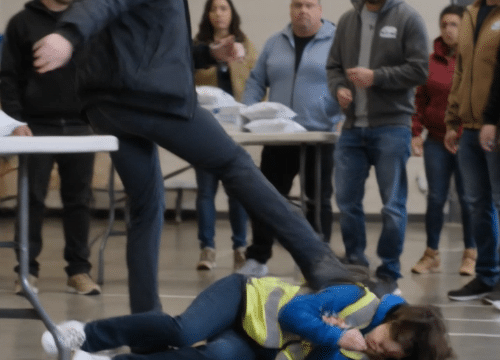
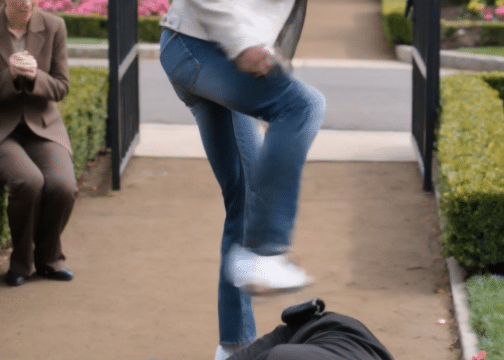
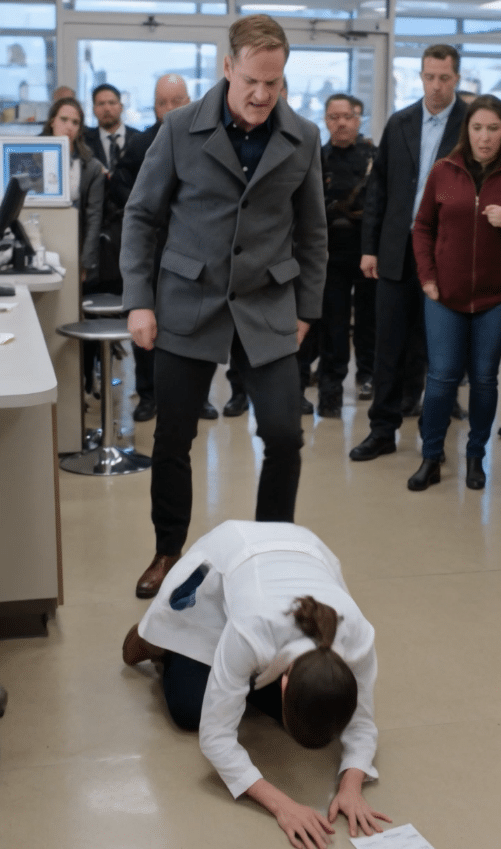
The prescription bag had barely touched the counter when the man kicked her.
One second, the pharmacist was standing behind the pickup counter, trying to keep a crowded line moving in the right order. The next, the 34-year-old woman was thrown backward into the counter as the barcode scanner rattled violently beneath her hand.
The labeled prescription bag slipped from her fingers and hit the floor.
A number flashed across the screen above the pickup window.
Then the entire pharmacy seemed to stop breathing.
She had only asked him to wait.
The man in the gray cashmere coat had arrived with the kind of confidence that made people move aside before he even asked. His expensive watch caught the fluorescent light every time he gestured toward the counter, and his voice had already carried across the pharmacy several times.
He wanted his prescription immediately.
There were other customers waiting.
There were elderly patients holding numbered tickets. A mother stood with a child beside her. Two people were checking their phones while watching the number screen.
The pharmacist had been doing what she was trained to do: keeping the line orderly, protecting patient privacy, and making sure prescriptions were handed to the right people.
But the man apparently considered those rules optional.
She tried to steady herself against the counter.
Her forearm had struck the edge when she fell, leaving only a thin trace of blood. Her glasses had shifted, and her breathing came in short, painful bursts.
Still, she looked toward him.
“Please wait your turn…”
The man stared down at her.
There was no apology.
No hesitation.
“Trash. I don’t wait in lines.”
A few customers covered their mouths.
Nobody moved.
The pharmacist remained on the floor beside the fallen prescription bag, trying to understand how a simple request to wait had turned into this.
Then the man stepped closer.
Two more kicks landed while she was down beside the counter.
The scanner rattled again.
Someone gasped.
The pharmacist curled inward instinctively, grimacing as she struggled to breathe through the pain. Her face showed something worse than fear.
Humiliation.
She had spent years learning how to remain calm when customers were angry. She had dealt with complaints, insurance disputes, missing prescriptions, long waits, and people who believed shouting louder could change a policy.
But she had never imagined someone would attack her because she refused to put his prescription ahead of everyone else’s.
The man looked at the prescription bag on the floor as though it were an inconvenience.
Then he looked back at her.
“Fill it from the floor.”
And that was the moment someone behind the back-office door heard everything.
Because the man had no idea whose pharmacy he was standing in.
And he was about to find out.
Act II
For years, the pharmacist had believed that the hardest part of her job was not medicine.
It was people.
She had learned that patients rarely arrived at a pharmacy carrying only a prescription. They carried fear about a diagnosis, frustration over an insurance denial, exhaustion from caring for someone else, and sometimes the quiet desperation of not knowing how they would afford the next refill.
That was why she took the line seriously.
Every number on the screen represented a person waiting.
Every prescription bag represented someone’s health information.
And every time she called a number, she knew there was another person behind that customer who deserved the same respect.
She had built her reputation on that principle.
She was calm even when the pharmacy was packed.
She spoke quietly when customers became loud.
She never embarrassed people who couldn’t afford a medication.
And when someone demanded special treatment, she used the same sentence every time.
Everyone waits their turn.
The man in the cashmere coat had heard that sentence as an insult.
He had arrived already irritated, demanding that his prescription be handed over immediately. When the pharmacist explained that several customers were ahead of him, he had laughed.
He asked whether she knew who he was.
She said it didn’t matter.
The line was still the line.
That answer had apparently offended him more than anything else.
What she didn’t know was that his anger had been building for several minutes before the attack.
He had watched other customers receive their prescriptions.
He had watched the pharmacist calmly refuse his demands.
And with every passing second, his frustration had turned into something more dangerous.
The customers around them sensed it.
But nobody expected violence.
Not in a pharmacy.
Not in broad daylight.
Not over a place in line.
Then the kick came.
Now the man stood over the woman who had been doing nothing more than enforcing a basic rule.
The strangest part was the silence afterward.
No one cheered.
No one argued with him.
The customers simply watched.
Some stared at the floor.
Some looked toward the security camera mounted high in the corner.
Others looked toward the back-office door.
The pharmacist slowly tried to push herself upright.
Her hand trembled.
She reached toward the fallen prescription bag but stopped when pain shot through her side.
The man didn’t care.
He wanted his medication.
He wanted someone to make an exception.
And he believed his money gave him the right to demand one.
What he didn’t understand was that the pharmacy had been watching him too.
The security camera had captured the entire confrontation.
Every gesture.
Every step.
Every kick.
And behind the closed back-office door, someone was already moving.
Someone who had spent decades building the chain from a single neighborhood pharmacy into a regional business.
Someone who had one rule about employees being mistreated:
Never ignore it.
The door handle suddenly turned.
And the man was seconds away from discovering that the person coming through it was not another employee.
Act III
The back-office door slammed open.
Three people stepped into the pharmacy.
First came security.
Then the regional manager.
And behind them walked the pharmacy chain’s owner.
The man in the gray coat barely looked at them.
At first, he seemed annoyed by the interruption.
Then he noticed the security guard moving directly toward the pharmacist.
The guard positioned himself between the injured woman and the customer.
The regional manager stood beside him.
The owner said nothing for a moment.
He looked at the pharmacist.
Then at the prescription bag lying on the floor.
Then at the man who had been standing over her.
His expression changed.
Not dramatically.
Not loudly.
It became still.
The kind of stillness that made everyone else in the room realize that something had just shifted.
The pharmacist recognized him immediately.
She had met him once before during a staff meeting several years earlier.
He had told the employees something she never forgot.
A pharmacy was not a place where customers bought power.
It was a place where people came because they needed help.
The owner had built his company around that idea.
He knew that employees could make mistakes. He knew that customers could be impatient. He knew that difficult days were inevitable.
But violence was different.
Humiliation was different.
And attacking someone who was simply doing her job was a line he would not allow anyone to cross.
The owner looked toward the pharmacist again.
Security remained between them and the bully.
Only then did the owner turn his attention to the man in the cashmere coat.
The crowd became completely silent.
The bully’s confidence had begun to disappear.
He had expected employees to obey him.
He had expected his money to matter.
He had expected the pharmacist to bend.
He had never expected the owner to walk out of the back office at the exact moment his behavior was being recorded.
The owner finally spoke.
“Void his prescription pickup.”
The sentence landed harder than a shout.
The bully blinked.
For the first time since he had entered the pharmacy, he looked genuinely confused.
The medication bag he had been demanding was no longer a prize waiting behind the counter.
It had become evidence of the confrontation.
The crowd parted slightly.
Security remained beside the pharmacist.
The regional manager stood with the owner.
And the man who had seemed untouchable only moments earlier suddenly looked very small beneath the pharmacy’s fluorescent lights.
Still, he didn’t understand.
Not yet.
Because he had spent his entire life assuming that money opened doors.
He hadn’t considered what happened when the person controlling the door decided to close it.
And then the owner looked at the prescription bag one more time.
The man’s face tightened.
His shortcut had disappeared.
But he still couldn’t believe it.
Act IV
The pharmacy became unnaturally quiet.
The number screen continued to glow above the counter, displaying the next customer number as if nothing had happened.
That ordinary little screen made the scene feel even more surreal.
People were still holding their phones.
Prescription bags were still lined up behind the counter.
The scanner still sat where it had been moments earlier.
Everything looked normal.
Except for the woman sitting on the floor.
And the security guard standing protectively between her and the man who had attacked her.
The bully looked from the owner to the security guard.
Then to the prescription bag.
His jaw tightened.
For the first time, he seemed to understand that he wasn’t dealing with an employee he could intimidate.
He was dealing with the person who could decide whether the transaction happened at all.
More importantly, the owner had seen enough.
There would be no negotiation.
No special treatment.
No argument about status.
The same rule the pharmacist had tried to enforce now applied to him in a much bigger way.
Actions had consequences.
The regional manager quietly signaled for another employee to secure the prescription and preserve the transaction records. Security remained focused on maintaining distance between the two men and the injured pharmacist.
The customers watched without speaking.
Some looked ashamed that they had frozen earlier.
But fear had paralyzed them.
The attack had happened so quickly that instinct had told them to step away.
Now there was no need for anyone to intervene.
The person with authority had finally arrived.
And he wasn’t protecting the customer’s pride.
He was protecting the employee.
The pharmacist slowly raised her eyes.
She didn’t look triumphant.
She didn’t look satisfied.
She looked exhausted.
Pain still tightened her expression.
But underneath it was something else.
Relief.
For several minutes, she had believed that she was completely alone.
She had been knocked down in front of strangers while the man who attacked her continued demanding service.
Now someone had finally stood between them.
The owner glanced toward her once more.
Then he turned back to the bully.
No speech was necessary.
No dramatic threat.
The decision had already been made.
The prescription would not be handed over.
The customer’s demands would not change it.
And the security footage would tell the rest of the story.
The bully’s eyes dropped toward the medication bag.
His entire posture changed.
A few minutes earlier, he had treated the prescription as something he was entitled to possess.
Now it represented something else.
A privilege he had just lost.
He stared at it as though the words the owner had spoken couldn’t possibly apply to him.
Then his eyes widened.
The owner didn’t move.
Security didn’t move.
The crowd didn’t move.
The man finally realized that the person he had humiliated was the employee the owner had chosen to protect.
And the person he had tried to intimidate was standing behind the authority of the entire company.
Still, one question remained.
One question that would reveal just how completely he had misunderstood the situation.
Act V
The man looked down at the prescription bag.
For once, there was no shouting.
No insults.
No demand to see a manager.
Just disbelief.
The pharmacy owner had not raised his voice.
He had not needed to.
The order was enough.
The pharmacist would receive medical attention. The security footage would be preserved. The incident would be formally documented, and the man would no longer be treated as an ordinary customer entitled to simply walk back into the same transaction as though nothing had happened.
But the most important thing had already happened.
The pharmacist had been believed.
The line had mattered.
The rule had mattered.
And so had she.
The customers who had watched from the line slowly began moving again, but the atmosphere had changed.
Nobody complained about waiting anymore.
Nobody demanded to be served first.
Nobody looked at the pharmacist as though she had caused the delay.
Because now everyone understood what her refusal had actually protected.
Fairness.
Privacy.
And the dignity of every person standing in that line.
The man in the cashmere coat had believed that waiting was beneath him.
He had believed that wealth could turn a public pharmacy into a private counter.
He had believed that intimidation would make an employee surrender.
Instead, his behavior had cost him the one thing he had been demanding most.
His prescription pickup.
And somewhere above the counter, the number screen continued advancing.
One customer at a time.
Exactly as it should.
The pharmacist eventually stood with assistance from her colleagues, still shaken but no longer alone. She glanced once toward the fallen prescription bag.
Then toward the owner.
She didn’t need to say anything.
Neither did he.
The entire pharmacy had already heard the message.
Rules were not only for people without money.
Respect was not something customers could purchase.
And authority did not belong to the loudest person in the room.
The man stared at the medication bag.
His face tightened.
The confidence that had carried him into the pharmacy was gone.
He finally looked toward the owner, then back at the bag.
His lips parted.
“Void what?”
The question hung in the silence.
And for the first time that afternoon, everyone knew exactly who had lost his privilege to skip the line.