Act I
The slap echoed across the police station lobby.
The officer never saw it coming.
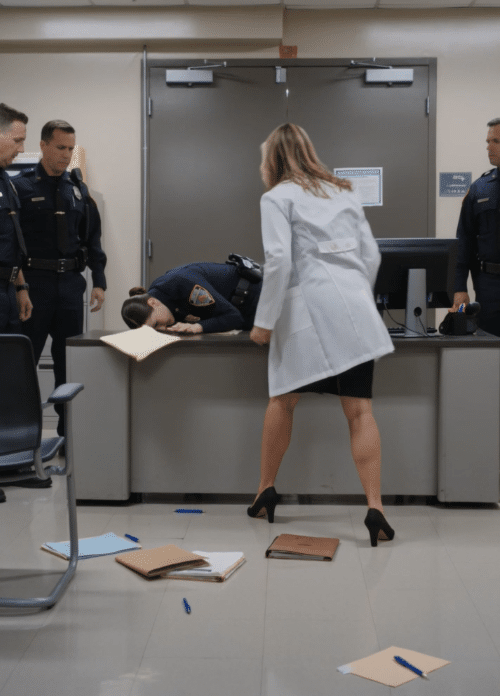
One moment, the 32-year-old police officer was holding a case file behind the front desk, calmly explaining why a teenager had been brought into the station. The next, a wealthy mother in a white coat swung her hand across the officer’s face with enough force to send her sideways into the desk.
Files crashed onto the floor.
Pens scattered beneath the chairs.
The officer’s elbow struck the metal leg of the desk, leaving a thin trace of blood as she fell beside it.
For a moment, nobody moved.
The mother stood there in high heels, expensive handbag hanging from one arm, breathing hard as though she had just won an argument instead of attacked a police officer inside a police station.
The officer grimaced and curled slightly toward herself.
Her breathing was uneven.
Pain flashed across her face, but so did something else.
Disbelief.
She had spent the last several minutes trying to explain the same simple fact.
The woman’s son had been brought in because another student had been assaulted.
That was it.
No personal vendetta.
No attempt to embarrass the family.
Just procedure.
The officer slowly lifted her head.
“Your son assaulted another student…”
The mother looked down at her with open contempt.
“Trash. You don’t touch my child.”
Then she stepped closer.
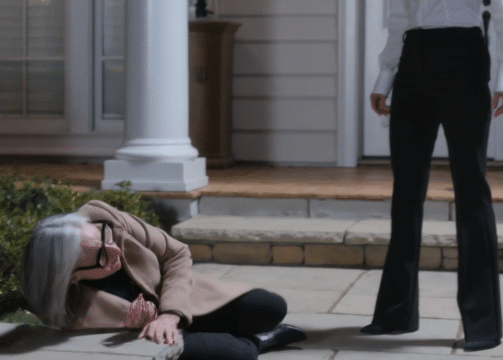
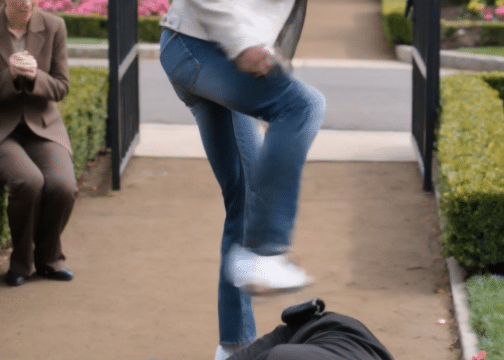
The first kick came while the officer was still down.
A second followed into her side.
The witnesses around the lobby gasped and backed away, covering their mouths. Nobody intervened. Nobody dared step forward.
The officer pressed an arm against her side, grimacing as she fought for breath.
The woman wasn’t finished.
She leaned toward the fallen officer, her expression cold and furious.
“I’ll end your badge.”
She believed those words were a threat.
She didn’t realize they were about to become evidence.
Because behind the conference room door, people had heard the commotion.
And when that door opened, the woman would discover that the officer’s badge was not nearly as vulnerable as she thought.
Act II
The officer had dealt with angry parents before.
It came with the territory.
Whenever juveniles were brought into the station after fights at school, parents often arrived frightened, defensive, or furious. Some immediately demanded answers. Others insisted their child had been misunderstood.
The officer understood that instinct.
A parent was supposed to protect a child.
But protecting a child did not mean pretending the child had done nothing wrong.
That distinction was the reason she had remained calm.
The boy had not been accused of some mysterious crime.
There had been another student.
There had been an altercation.
There were statements from witnesses.
There was a case file.
And there were procedures that applied regardless of how wealthy the family was.
The officer had handled the case exactly as she would have handled any other juvenile incident.
That was what enraged the mother.
She was accustomed to problems disappearing when she made a phone call.
She knew influential people.
She was wealthy enough to hire attorneys without checking the bill.
She had spent years moving through rooms where people adjusted their behavior when she entered.
But the police station was different.
The officer behind the desk wasn’t impressed by the handbag.
She wasn’t intimidated by the expensive clothes.
And she certainly wasn’t going to release a juvenile simply because his mother demanded it.
The mother interpreted that professionalism as disrespect.
Her anger grew each time the officer repeated the same answer.
The boy would be treated according to procedure.
The case would be documented.
The other student’s complaint would not simply disappear.
The mother had come expecting the station to bend.
Instead, she found one young officer who refused to bend at all.
That was when the argument crossed a line.
The officer’s case file had been knocked onto the floor.
Her glasses were slightly crooked.
She remained beside the desk, trying to gather enough breath to speak.
The mother stood over her as if the entire station belonged to her.
No one in the lobby knew what would happen next.
But one thing was already clear.
The security camera had seen everything.
The slap.
The fall.
The kicks.
The threats.
And the camera wasn’t the only witness.
Behind the conference room door, the police chief and a local prosecutor had been reviewing another case when the sound of the impact reached them.
The chief knew immediately that something was wrong.
He pushed back his chair.
The conference room door opened.
And the woman who had just threatened to destroy an officer’s career was about to meet the person who could determine what happened next.
Act III
The conference room door burst open.
The police chief stepped out first.
Behind him came the local prosecutor and two officers.
They stopped.
The lobby seemed to freeze around them.
The chief’s eyes went immediately to the officer on the floor.
Then to the scattered case files.
Then to the woman standing nearby.
He didn’t rush toward the mother.
He didn’t ask what she thought had happened.
His first instinct was the officer.
The two officers moved between the injured woman and the mother, creating a protective barrier.
One crouched near the desk without touching her until it was clear she was safe.
The prosecutor looked toward the security camera.
Then toward the case file on the floor.
Then back at the woman.
Everything that had happened was already documented.
There was no room left for competing stories.
The officer had been doing her job.
The mother had attacked her.
And the threat about the badge had come after the violence, not before.
The mother suddenly seemed less certain.
She had expected the officer to be isolated.
She had expected the station to be intimidated.
Instead, the person responsible for the entire department had walked directly into the aftermath.
The chief’s expression remained controlled.
That somehow made the moment more intimidating.
He had spent decades learning that authority wasn’t demonstrated by shouting.
It was demonstrated by knowing exactly what to do when something went wrong.
And now he knew.
He looked at the prosecutor.
The lobby fell completely silent.
Then the chief delivered a sentence that changed the case.
“Add assaulting an officer.”
The mother’s face changed.
Not all at once.
First, the anger disappeared.
Then came confusion.
Then disbelief.
She had been so focused on protecting her son from consequences that she had created a much more serious problem for herself.
The prosecutor began documenting the new allegation.
The two officers remained between her and the fallen officer.
The crowd stepped farther aside.
Nobody was laughing.
Nobody was celebrating.
The moment was too serious for that.
The woman stared at the chief as if she had just heard a language she didn’t understand.
Only minutes earlier, she had threatened to end the officer’s badge.
Now the department was treating her own actions as part of the case.
But there was more to the story than one angry parent losing control.
Because the officer’s refusal to bend had protected someone else, too.
The student whose complaint had started everything.
And that was when the mother finally began to realize what her rage had actually accomplished.
Act IV
The station felt different after the chief spoke.
The same chairs remained against the wall.
The same files lay scattered across the floor.
The same security camera watched silently from above.
But the balance of power had completely changed.
The mother had entered believing that her money gave her leverage.
She had mistaken influence for immunity.
Now there were officers standing between her and the woman she had attacked.
There was a prosecutor documenting what had happened.
There was surveillance footage.
And there was a police chief who had witnessed the aftermath with his own eyes.
Most importantly, there was the original case.
Her son had still been brought in because another student had been assaulted.
That matter had not disappeared.
If anything, her behavior had made the situation harder to ignore.
The officer remained on the floor for a moment, breathing through the pain.
She looked embarrassed.
Not because she had done anything wrong.
Because being attacked in front of strangers can make even the strongest person feel exposed.
Her uniform was still neat in places, disordered in others.
Her case file was scattered around her.
Her badge was still attached to her belt.
And that small piece of metal suddenly seemed to carry a different meaning.
The mother had threatened to end it.
But the chief had just reminded everyone that a badge wasn’t protected by intimidation.
It was protected by procedure.
The prosecutor continued reviewing the available information.
The chief stayed focused on his officer.
He did not need to deliver a dramatic speech.
The facts were already speaking.
A parent had entered the station demanding special treatment.
An officer had refused.
The parent had responded with violence.
And now the original juvenile case had become only one part of a much larger incident.
The mother looked toward the conference room.
Then toward the officers.
Then at the case file on the floor.
Her expensive handbag suddenly looked strangely out of place in the station lobby.
For the first time, she seemed to understand that nobody here was going to negotiate away what she had done.
Her son’s situation would be handled.
Her own actions would be documented.
And the officer she had tried to humiliate was still wearing the badge she had promised to destroy.
The irony was impossible to miss.
The woman had attacked the officer because she believed the badge represented power she could challenge.
Instead, her attack had triggered the entire department to stand behind it.
The crowd remained silent.
Then the mother looked toward the chief.
Her confidence was gone.
But disbelief remained.
She still couldn’t understand how quickly everything had turned against her.
And then the camera moved closer.
Act V
The woman stared straight ahead.
The arrogance that had filled her face minutes earlier had hardened into disbelief.
She had walked into the police station convinced that the only person in danger was her son.
Now she was confronting a completely different reality.
The officer’s case had not disappeared.
The student’s complaint had not disappeared.
The security footage had not disappeared.
And neither had the assault in the lobby.
The chief had not needed to threaten her.
He had not needed to raise his voice.
He had simply recognized what everyone else had seen.
An officer had been attacked while performing her duty.
The consequences would now be recorded accordingly.
The mother had wanted to teach the officer a lesson about power.
Instead, she had demonstrated exactly why rules existed in the first place.
The officer eventually rose with assistance from her colleagues, still shaken and visibly hurting.
She looked down at the scattered files.
Those papers represented the case she had been trying to explain before everything exploded.
The original complaint was still there.
The facts were still there.
And the badge she had been threatened over was still on her uniform.
Nothing about her professional decision had changed.
She had simply refused to make an exception.
That refusal had cost her a painful moment.
But it had also exposed something far larger.
A parent can fight for a child without attacking the person doing her job.
A family can hire attorneys without buying immunity.
And wealth can open doors, but it cannot erase what happens after someone crosses a legal line.
The woman looked at the officers surrounding her.
Then at the prosecutor.
Then at the chief.
She finally understood that the room was no longer listening to her demands.
Everyone was listening to the facts.
The final seconds seemed to stretch.
Her face tightened.
Her eyes widened.
The words came out almost as a question, as though saying them aloud might somehow make them less real.
“Assaulting an officer?”
The room went silent.
And suddenly, the woman who had walked into the station believing she could end someone else’s badge was forced to face the consequences of her own actions.