Act I
“You shut down my range for that?”
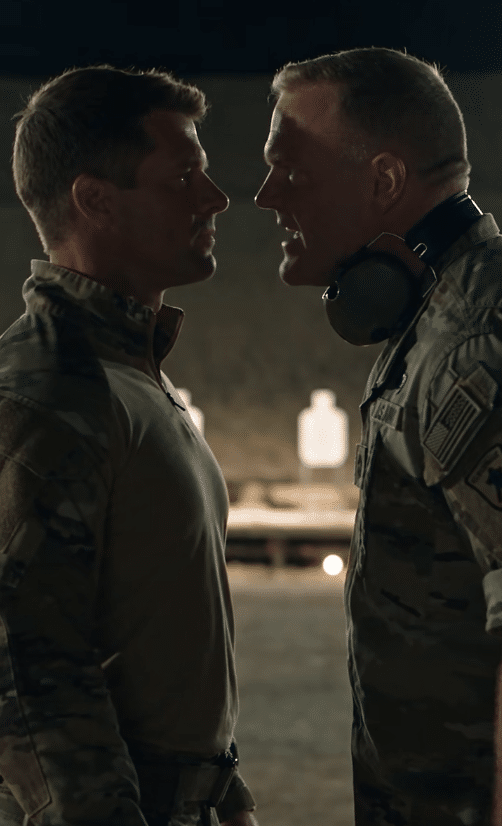
Colonel Marcus Reed’s voice cut through the night air beneath the white floodlights. Beyond the firing line, tactical vehicles sat in the darkness, their silhouettes broken by the glare reflecting off concrete barriers and scattered equipment. Soldiers stood motionless in their hearing protection, watching the argument unfold between their commanding officer and a man they barely knew.
The stranger wore a coyote-colored tactical jacket over an OCP uniform. His short brown hair was neatly cut, his posture controlled, and his rank concealed beneath the outer layer. He looked like another field officer who had wandered into Reed’s exercise, except for one detail: he had ordered the firing sequence stopped after spotting a serious safety error.
Reed had taken the interruption personally.
“For less than that, people die.”
The man’s answer was quiet, factual, and completely without fear.
Reed’s jaw tightened. He was forty-six, heavily built, and accustomed to running the night range without anyone questioning his decisions. He believed that discipline meant immediate obedience, that authority had to be defended at every opportunity, and that a public challenge could not go unanswered.
The stranger had challenged him in front of his own personnel.
Worse, he had done it without raising his voice.
Reed stepped closer, his expression hardening beneath the floodlights. The Range Safety Officer, Chief Warrant Officer Paul Bennett, fifty-eight, watched from several yards away. Bennett had spent decades around weapons training and understood exactly why the sequence had been stopped. He also knew Reed well enough to recognize the danger in the Colonel’s expression.
The safety issue was no longer the only problem.
Reed was about to make it much worse.
Without warning, he punched the stranger hard across the cheek.
The man’s head snapped to the side. His cheek reddened and began to swell, and a thin trace of blood appeared at the corner of his mouth. Before he could recover, Reed took a driving step and kicked him hard in the stomach.
The stranger folded forward, the air knocked from his lungs.
Reed followed with a forceful kick to the side of his ribs, sending him down onto the sand beside the firing lane. The man caught himself against the ground, one arm guarding his torso as he fought to breathe.
He remained conscious.
He did not plead.
Around them, the range personnel froze. One soldier took a half step forward and stopped. Another lowered his hands, staring at Reed as if he could not believe what he had just witnessed. Nobody physically intervened while the assault unfolded.
Reed stood over the fallen man, breathing heavily.
“You’re trash standing in front of real soldiers.”
The stranger looked up at him.
His face was bruised and his breathing guarded, but his eyes remained cold and focused. There was no desperate anger in them, no attempt to bargain for mercy.
Then his jacket shifted where he had fallen.
The coyote fabric pulled aside, revealing an old patch on the inner layer of his uniform. Much of its surface had been burned and blackened. Its design was partially scorched, but what remained was unmistakably distinctive.
Bennett saw it.
The color drained from his face.
He knew that patch. He knew the team it represented, and he knew why almost nobody wore it anymore.
Reed had just beaten a man whose past was written into a piece of burned fabric.
And when the Colonel mocked that man’s team, he would make a decision that brought something far more frightening than a safety inspection to Range Seven.
Act II
Chief Warrant Officer Paul Bennett had learned long ago that military history was not always preserved in official displays or polished photographs.
Some of it survived in briefings that were never repeated outside secure rooms. Some lived in the memories of people who had watched good soldiers disappear into operations that went wrong. And some remained attached to old pieces of equipment that nobody could bring themselves to throw away.
The patch on the stranger’s inner uniform belonged to the last category.
Bennett had seen one before.
Years earlier, he had worked alongside personnel who supported a specialized team known for operating under conditions where ordinary plans had already failed. The team had been small, tightly bonded, and difficult to replace. Its members were known less for ceremonies or public recognition than for what they could accomplish when communications failed, intelligence collapsed, and the people depending on them had no time left.
Their patch had become a symbol of that history.
Then came the operation that changed everything.
The details had never been discussed casually. Bennett remembered fragments: a mission compromised by unexpected conditions, a desperate extraction, and a period of uncertainty during which the team’s survival could not be confirmed. People returned carrying information that was incomplete and painful. Others never returned at all.
Afterward, the patch disappeared from active use.
Officially, the team was no longer what it had been. Its name faded from current rosters, its old markings became relics, and the personnel who remembered it learned to speak about it with care.
Bennett had assumed that chapter was closed.
Now the patch was lying in the sand beneath a floodlight.
The stranger had not deliberately displayed it. Reed’s violence had pulled the jacket aside, exposing the scorched emblem beneath. Its condition suggested that it had survived something more consequential than a training exercise.
Bennett looked from the patch to the man’s face.
He did not recognize every feature. The stranger was older than the person he remembered from old operational photographs, and the years had changed the set of his jaw. But the patch was not a coincidence, and the man’s composure did not look like someone pretending to possess a history he had never lived.
He had corrected a safety error without hesitation.
He had endured a brutal assault without begging.
And even now, his attention seemed fixed on the range itself rather than on the Colonel who had attacked him.
Bennett felt a warning rise inside him.
He knew better than to make assumptions about a person’s rank from a concealed uniform. He also knew that a patch did not automatically prove identity. But the combination of the burned emblem, the man’s behavior, and the circumstances surrounding the range shutdown made it impossible to dismiss what he was seeing.
Reed, meanwhile, was still waiting for the man to show fear.
He expected an angry protest or an attempt to scramble away. He expected the sort of response that would allow him to frame the entire incident as a subordinate losing control.
Instead, the stranger remained on the sand, one hand protecting his ribs, his gaze steady.
That unsettled Reed.
He looked down at the exposed patch and then back at Bennett, whose expression had changed dramatically.
The Colonel knew the Chief Warrant Officer was not easily rattled. Bennett had seen accidents, failed exercises, and officers make decisions they later wished they could undo. He was not a man who went pale because of an old uniform marking.
Reed wanted an explanation.
Bennett could barely believe he was about to give him one.
“Colonel… that patch belonged to one team.”
His voice was low and urgent.
For the first time, Reed’s expression flickered.
But he quickly replaced uncertainty with contempt.
He looked at the burned patch as if it were an embarrassing piece of scrap cloth, something that could not possibly matter more than the rank on his own uniform.
He had no intention of admitting that he might have attacked the wrong man.
And he was about to insult the one thing Bennett feared might still be listening.
Act III
Reed gave a short, dismissive laugh.
He had heard stories about elite teams before. Every military unit seemed to possess a legend about the people who had come before it, and every generation believed its own traditions were more important than those of the generation that followed.
Reed preferred current authority. Current orders. Current rank.
Anything else, he decided, was nostalgia.
He looked down at the man on the sand and then at the scorched patch exposed beneath the open jacket. The fabric was damaged, old, and partially blackened. To Reed, it looked like a relic someone had kept long after it had ceased to mean anything.
He wanted Bennett to stop staring at it.
He wanted the soldiers around the firing lane to return their attention to him.
Most of all, he wanted the stranger to understand that no old story would protect him from the consequences of challenging a Colonel.
“Then his team can come pick up the trash.”
The remark carried across the range.
A few soldiers exchanged uneasy glances. Bennett did not move, but his expression hardened. He had expected Reed to dismiss the warning; he had not expected him to challenge the team itself.
The stranger heard every word.
He remained still for another moment, breathing carefully through the pain in his stomach and ribs. The sand had caught the side of his uniform where he fell. His cheek was swelling, and his jaw tightened as he worked through a guarded breath.
Then he looked at Reed.
There was no anger in his expression that Reed could use to justify another attack. No challenge in his posture that could be mistaken for a threat. The man seemed to have reached a decision, and whatever that decision was, it had nothing to do with winning an argument.
He moved one hand toward his phone.
Reed watched him, suspicious now but still convinced that he held the advantage. He expected a complaint to a supervisor, perhaps a call to someone who would be too junior to challenge his authority.
The stranger made the call.
He gave only a location and a time.
“Range Seven. Three minutes.”
He ended the call.
No explanation followed. No name was offered. He did not announce that he had contacted a senior commander or demand that Reed stand down.
He simply put the phone away.
For the first time, Reed did not know what to say.
The specificity of the message unsettled him. The man had not asked where they were. He had not needed to describe the route, identify the range, or explain why three minutes mattered.
He had spoken as though the person on the other end already understood everything necessary.
Bennett watched the stranger with mounting concern. The old patch had been enough to disturb him, but the call made the situation feel immediate. Whatever history the man carried, he had just activated a response without needing to explain himself to anyone on the range.
Reed glanced toward the access road.
Nothing was visible beyond the floodlights except darkness, the shapes of parked vehicles, and the distant outline of the perimeter. He tried to tell himself that the call was a bluff, a theatrical gesture designed to frighten him after the assault.
But the stranger did not look like a man who was bluffing.
He looked like someone who had made a decision and was now waiting for it to be carried out.
Reed straightened, forcing his shoulders back. His rank remained visible, his uniform intact, and his personnel still stood within the range he commanded.
He had spent years relying on those facts to reassure himself.
Now he watched the access road again.
Somewhere beyond the dark perimeter, engines were about to start.
And the Colonel who had called another man trash was about to discover how quickly a commander’s confidence could collapse when someone else arrived with the authority he had never bothered to imagine.
Act IV
The first headlights appeared before the three minutes were up.
At first, they were only pale points in the darkness beyond the range access road. Then more lights emerged behind them, moving quickly but in disciplined formation.
Bennett turned toward the entrance.
Reed followed his gaze.
A low rumble grew beneath the sound of the generators and the distant night wind. Several command vehicles came into view, their headlights washing across the barriers and sand. They moved with purpose, not like a random group responding to a disturbance, but like a formation that had been given a clear destination and a precise arrival plan.
The lead vehicle slowed.
The others followed, spacing themselves neatly behind the firing line. Brakes hissed. Tires crunched over the access lane. Engines settled into a low idle.
Nobody on the range spoke.
Reed’s expression changed as he counted the vehicles. The arrival was too organized to dismiss as a coincidence, and the timing was too exact to be explained away as routine traffic.
The stranger had said three minutes.
The convoy had arrived.
Reed looked at the man on the sand, then toward the vehicles again. He could no longer tell himself that the call had been an empty threat. Whatever the stranger had requested, someone had treated it as important enough to respond immediately.
Bennett stood rigidly beneath the floodlights. His eyes moved from the burned patch to the center vehicle, and his face took on the grave expression of a man who had begun to understand the scale of what was unfolding.
The center vehicle stopped.
For a moment, its doors remained closed.
Then the rear door opened.
A polished boot touched the ground.
The figure who emerged wore a formal military dress uniform, its surface heavy with decorations. Ribbons lined the chest, and stars marked the shoulders. The camera revealed the uniform from shoulder to waist, then followed the figure down to the polished boots as they moved away from the vehicle.
The face remained hidden.
The senior officer stepped forward with controlled, deliberate movements. There was no rush, no visible agitation, and no need for an escort to clear the path. The surrounding personnel appeared to understand the significance of the arrival without being told.
The figure walked directly toward the injured man.
Reed went pale.
He had spent his career learning the visual language of military authority. He knew the difference between a routine inspection and a visit that could change the course of a command. He recognized the weight of the decorations, the seniority implied by the stars, and the disciplined urgency of the convoy’s arrival.
But he could not see the officer’s face.
That made the moment worse.
He could not read the visitor’s expression, determine whether the arrival was routine, or find some small indication that he had misunderstood the situation. The uniform offered no comfort. Every visible detail suggested that someone with extraordinary standing had come to Range Seven for a reason.
And the man who had made the call was still on the ground, his jacket pulled aside, the burned patch visible beneath the harsh white lights.
Reed looked at the emblem again.
He remembered Bennett’s warning.
That patch belonged to one team.
He remembered his own response.
Then his team can come pick up the trash.
The words now seemed to hang in the air with an ugliness he could no longer ignore.
The convoy had not arrived to inspect his firing lanes. It had not come to observe his exercise or congratulate him on a successful training schedule.
Its center vehicle had stopped, and a decorated senior officer had stepped out to walk directly toward the man Reed had assaulted.
Reed’s rank no longer seemed like armor.
His authority no longer felt secure.
The stranger had not raised his voice, made a threat, or demanded that anyone believe his story. He had given a location and a time, then waited.
Now the consequences of that decision were approaching on polished boots.
The senior officer continued toward him.
Reed’s mouth opened slightly, but no words came. His eyes moved between the faceless figure and the man on the sand, and the realization began to settle into his expression.
The Colonel had believed he was punishing an insignificant outsider.
Instead, he had struck someone whose call could bring a decorated senior officer and an entire convoy to the firing line in three minutes.
And he still did not know the full reason why.
Act V
The convoy’s engines idled behind the firing line.
White headlights cut across the sand, illuminating the concrete barriers, the tactical equipment, and the soldiers who had stood frozen through the entire confrontation. Nobody had returned to the exercise. Nobody had pretended that the assault was an ordinary disciplinary matter.
Reed could feel every pair of eyes on him.
He had spent the evening believing that command meant never allowing a challenge to go unanswered. When the stranger stopped his range, Reed had seen an opportunity to demonstrate control. He had not considered the safety concern on its merits, nor had he asked for a detailed explanation.
He had reacted to being contradicted.
Then he had used violence to make the contradiction disappear.
Now the convoy stood behind him, and the man he had beaten remained on the ground, conscious and composed despite the pain. The burned patch was still visible beneath the open jacket, its scorched design marking a connection that Reed had mocked without understanding.
The Range Safety Officer watched in silence.
Bennett had not physically intervened during the assault, but his expression showed that he understood how serious the situation had become. He had recognized the patch before Reed did. He had warned the Colonel, and the Colonel had chosen to laugh.
The senior officer continued forward.
The camera showed the stars, the rows of ribbons, the immaculate uniform, and the measured steps crossing the sand. The face remained completely hidden. There was no speech, no public announcement, and no dramatic gesture intended to frighten the range personnel.
The figure simply kept walking toward the injured man.
That was enough.
Reed’s gaze darted toward the senior officer, then back to the stranger. His confidence had once depended on the assumption that everyone around him occupied a clearly defined place beneath his command.
But the man on the ground had never behaved like someone seeking approval. He had identified a dangerous mistake, explained the risk, and refused to pretend the problem was harmless merely because a Colonel had made it.
Even after the assault, he had not begged for help.
He had made one call.
Three minutes later, a convoy had arrived.
Reed tried to understand what kind of relationship could produce that response. Was the man connected to a special unit? Was the patch evidence of an operation that had never been fully explained? Was the senior officer a former commander, a colleague, or someone who had spent years waiting for confirmation that the man was still alive?
The answers remained out of reach.
No one explained the patch. No one revealed the senior officer’s identity. The arriving figure’s face remained hidden as the distance between the convoy and the firing lane steadily closed.
Reed realized that the mystery itself was now part of his fear.
He could not negotiate with an explanation he did not possess. He could not dismiss the patch without dismissing the warning Bennett had given him. And he could not claim that the convoy was irrelevant when its arrival matched the stranger’s call with such precision.
The man on the sand lifted his eyes toward the approaching figure.
His expression remained controlled.
He did not look triumphant. He did not seem surprised by the convoy. Whatever the relationship between him and the person arriving, he had apparently known that the call would be answered.
Reed watched the senior officer walk directly toward him and felt the last of his certainty collapse.
The Colonel had wanted the range to prove that he was in control.
Instead, the range had become the place where his judgment, his temper, and his understanding of authority had all been exposed in front of his own soldiers.
The stranger’s cheek was swollen. His breathing remained guarded. Sand clung to his uniform, and the old patch lay exposed beneath the coyote jacket.
Yet he was the only person on the firing line who seemed entirely unsurprised by what was happening.
Reed swallowed.
The senior officer was almost there.
He could not see the face. He could not hear an explanation. He could only watch the decorated figure approach the man he had called trash and recognize that the arrival was not for him.
His voice emerged as a breath-tight whisper, stripped of the contempt that had filled it minutes earlier.
“He came for you…?”