Act I
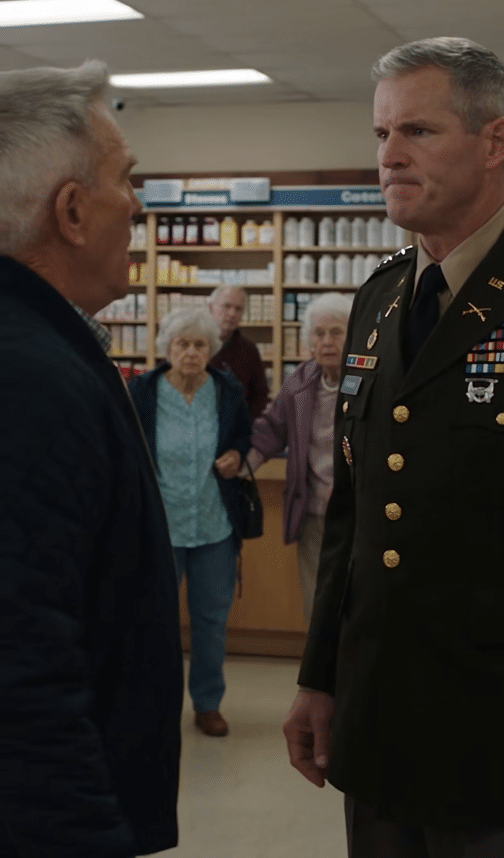
The punch sent the elderly man crashing sideways into a pharmacy display.
A paper bag had slipped from his hand and brushed against the polished shoe of a man standing near the counter. It was an insignificant accident. The kind of thing that normally ended with a quick apology and a few seconds of awkwardness.
But the man in the military uniform wasn’t interested in letting it go.
“Watch what you’re doing.”
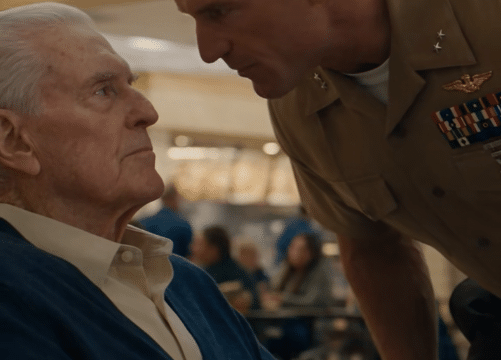
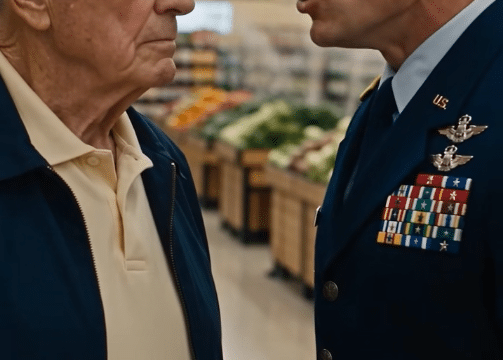
The speaker was a forty-nine-year-old active-duty Army major general, a tall man with salt-and-pepper hair and two stars clearly displayed on his shoulders.
The elderly customer looked down at the paper bag before calmly meeting his eyes.
“It was a paper bag.”
That answer seemed to offend the officer more than the accidental contact itself.
He stepped closer, his expression hardening.
“Then learn to keep your distance.”
Before the elderly man could move away, the officer punched him hard across the face.
The old man’s head snapped sideways. His cheek immediately reddened, and a faint trace of blood appeared at the corner of his mouth.
Then came something even more disturbing.
The officer took a step forward and drove a powerful kick into the man’s abdomen.
The elderly customer folded from the impact and fell heavily onto the pharmacy floor.
His left arm ended above the elbow. The empty sleeve of his dark jacket made it impossible for him to brace himself properly, and his right shoulder and hip struck the floor.
An elderly woman near the greeting cards covered her mouth.
The pharmacist froze behind the counter.
The man on the floor struggled to catch his breath, one hand pressed against his abdomen. He was clearly in pain, but he didn’t beg.
The uniformed officer stood over him, adjusting his posture as though he had just completed an ordinary disciplinary exercise.
Then he delivered his final insult.
“Then learn to keep your distance.”
Nobody answered.
Nobody moved.
And the officer still had no idea that the quiet old man he had just assaulted had spent decades wearing the same uniform he was so proud of.
Worse, someone with considerably more authority was already on the way.
Act II
The pharmacy was a small, family-owned business in a rural American town.
Its wooden shelves were lined with everyday medicines, health products, greeting cards, and neatly arranged household supplies. A modest counter separated the pharmacist from a handful of elderly customers who visited regularly.
It was the kind of place where people knew one another.
The elderly man was named Arthur Bennett.
At seventy, he had short silver hair, a firm face, and a quiet manner that made him easy to overlook if someone judged people by appearance.
He wore a dark jacket over a plaid shirt, dark jeans, and brown leather shoes.
His left sleeve had been carefully tailored above the elbow.
Years earlier, Arthur had lost his left arm in an incident during his military service. The injury had changed his life, but it had never erased his sense of identity.
He had continued serving until retirement, eventually reaching the rank of Major General.
He rarely discussed his military career with strangers.
He didn’t need to.
For Arthur, those years were part of his life, not a permanent invitation to receive special treatment.
After retirement, he had settled in a quiet rural community where he enjoyed simple routines.
He visited the pharmacy, bought groceries, helped neighbors, and occasionally attended local veterans’ gatherings.
He had learned to live independently with one arm, adapting to everyday tasks without making his disability the center of every conversation.
The active-duty officer who attacked him was Major General Daniel Mercer.
At forty-nine, Mercer was known for his confidence and demanding attitude. He wore his two-star insignia proudly and had developed a reputation for expecting immediate deference.
He believed military rank should command respect everywhere.
Unfortunately, he had begun confusing respect with unquestioning obedience.
He had seen Arthur’s civilian clothing, noticed his missing arm, and assumed he was dealing with an ordinary elderly man who would be too intimidated to challenge him.
The paper bag had merely given Mercer an excuse.
Arthur’s calm response had challenged his ego.
And Mercer had reacted with violence.
The customers who witnessed the assault were now beginning to understand that this wasn’t an ordinary argument.
They had watched a decorated officer use his uniform as a shield for behavior that had no place in a pharmacy, much less anywhere else.
But the most important witness had not yet entered the building.
Act III
Arthur remained on the floor for several moments.
His breathing was uneven, and his right hand pressed against his abdomen.
The pharmacist hurried around the counter and crouched nearby, visibly shaken.
Arthur slowly lifted his head.
He looked toward the shattered display, then at the customers standing silently near the shelves.
His expression remained controlled.
He was hurt, but he wasn’t frightened.
Across the room, Mercer stood with his hands near his sides, looking increasingly impatient.
He seemed irritated that the incident had attracted so much attention.
He glanced at his own uniform, straightened his ribbons, and looked toward the pharmacy entrance.
There was no sign of regret.
Then an unfamiliar sound interrupted the silence.
Several vehicles were approaching outside.
A dark command convoy stopped sharply near the entrance.
The doors opened, and a group of military personnel stepped out.
Four officers followed a senior general accompanied by a Command Sergeant Major.
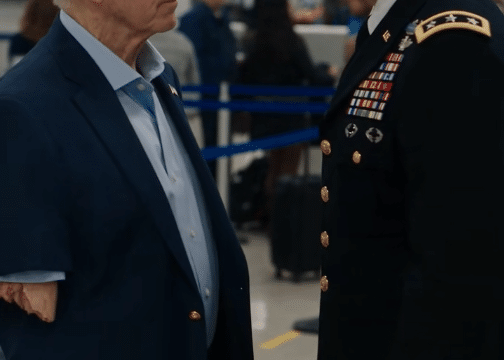
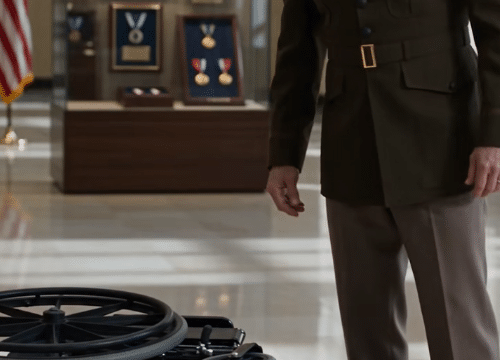
The senior general’s face remained outside the camera’s view. The framing revealed only a decorated uniform, higher-ranking insignia, a dense ribbon rack, polished boots, and the controlled movement of someone accustomed to commanding entire rooms without raising his voice.
The pharmacy customers instinctively moved aside.
Mercer turned toward the entrance.
At first, he appeared confused.
Then he noticed the senior general’s insignia.
His expression changed.
This was not a routine visit from a local commander.
The senior officer entered with his entourage, moving directly toward the injured man.
The Command Sergeant Major followed closely, while the four officers maintained a disciplined formation behind them.
The senior general stopped beside Arthur.
His attention went immediately to the empty left sleeve.
Then to the swollen cheek.
Then to the faint blood at the corner of Arthur’s mouth.
The atmosphere inside the pharmacy became almost unbearable.
Mercer stood motionless.
He was beginning to understand that the arrival had something to do with the man lying on the floor.
But he still didn’t know exactly what.
Then the senior general spoke.
Act IV
“Which hand touched him?”
The question was quiet.
But it carried more authority than anything Mercer had said since entering the pharmacy.
Nobody answered immediately.
The pharmacist looked toward the uniformed officer.
The elderly woman near the greeting cards slowly lowered her hand from her mouth.
Mercer stared at the senior general’s decorated shoulders.
For the first time, his confidence began to fracture.
He looked at Arthur.
Then at the senior general’s insignia.
Then back at Arthur.
The two-star officer was suddenly standing in a situation he could not control.
The senior general had not shouted.
He had not made a threat.
He had simply asked one question.
And somehow, that question made every second of the assault seem much more serious.
Arthur remained seated on the floor, breathing through the pain.
He didn’t try to explain his career.
He didn’t announce his former rank.
He didn’t ask anyone to punish Mercer.
His dignity remained intact even when his body had been thrown against the pharmacy floor.
The senior general’s entourage stood behind him in rigid silence.
The Command Sergeant Major’s expression was especially difficult to read.
Mercer swallowed.
His eyes briefly dropped toward the injured man’s empty sleeve.
Perhaps he was finally seeing something he had ignored from the beginning.
This wasn’t a man who had earned less respect because he had lost an arm.
This was a retired officer who had once carried enormous responsibilities, and who had chosen to live quietly rather than constantly remind people of his accomplishments.
Mercer had seen an elderly civilian.
The senior general had seen someone whose service deserved respect.
And now the difference between those two perspectives was standing directly in front of him.
The major general’s shoulders began to stiffen.
A faint sheen of sweat appeared near his forehead.
He knew that the officer standing before him outranked him.
But the real problem was becoming increasingly clear.
The senior general had arrived to find a retired colleague injured on the floor.
And Mercer was the man responsible.
Act V
The pharmacy became completely silent.
Mercer looked at the senior general’s higher insignia once more.
Then he glanced toward Arthur.
The old man’s cheek was swollen, his breathing remained painful, and his dark jacket was twisted from the fall.
Yet Arthur’s expression had barely changed.
He wasn’t looking at Mercer with satisfaction.
He wasn’t smiling.
He was simply waiting.
That made the situation even more uncomfortable.
Mercer’s jaw loosened.
His posture, previously so commanding, began to collapse. The arrogance that had driven him to attack a defenseless elderly man was disappearing beneath the weight of what he had done.
He had believed his rank made him untouchable.
Now he was standing before someone whose authority was unmistakably greater.
But beyond the insignia and the entourage, there was another reality he could no longer ignore.
The people in the pharmacy had witnessed everything.
They had seen the punch.
They had seen the kick.
They had watched a one-armed elderly man struggle to breathe while a decorated officer stood over him.
No amount of military authority could make those moments disappear.
The senior general remained beside Arthur.
His face was still hidden.
His question had already been asked.
And Mercer had no convincing answer.
The camera moved closer.
His eyes widened.
His forehead glistened with sweat, and his lips parted as he finally understood how badly the situation had turned against him.
Then, in a voice barely above a whisper, he said:
“No… sir.”
His expression collapsed completely.
The final image was not of the senior general, the entourage, or even Arthur.
It was Mercer’s face.
A man who had entered a rural pharmacy believing two stars gave him the right to humiliate anyone now struggling to meet the eyes of someone above him.
Arthur Bennett had lost an arm during his years of service.
But he had never lost his dignity.
And the officer who had attacked him was about to discover that a uniform does not give anyone permission to forget what honor means.
The old man had nothing to prove. The man with two stars had everything to answer for.
Fix the general-rank continuityReduce repeated moral commentary