The yard always went quiet before trouble started.
Not because prison is peaceful, but because men who live inside walls learn to feel danger before it fully arrives. It moves through a space like weather. A dropped weight, a turned head, a laugh that lasts one second too long—those things matter when everyone is waiting to see who will blink first.
That afternoon, no one thought Officer Elena Cruz would be the one still standing still when the noise ended.
Act I: The Dumbbells on the Asphalt
The prison yard smelled like wet concrete, metal, and old anger.
It was late afternoon, overcast, the kind of sky that made the chain-link fence look even colder than usual. Inmates were spread through the recreation area in small islands of routine—weights, cards, pacing, cigarettes traded in whispers. Guards watched from the edges the way men watch fires they think they understand.
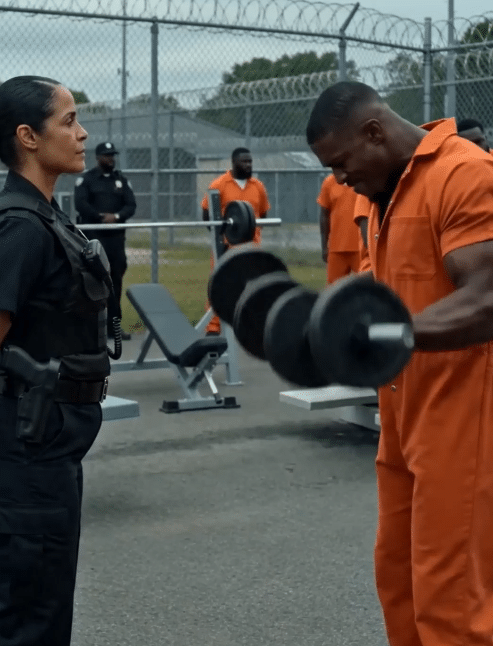
Then Trent Harlow dropped the dumbbells.
The sound cracked across the yard like a warning shot.
He was one of those inmates who had learned to turn his body into a weapon long before prison ever taught him to use it that way. Broad shoulders, buzzed hair, orange jumpsuit stretched tight over muscle, a face made harder by the pleasure he took in making other people uncomfortable.
He stepped away from the weight rack and walked straight toward Officer Cruz.
She didn’t move.
That was the first thing everyone noticed.
She stood with her hands behind her back, tan uniform pressed, badge catching the gray light, expression flat and unreadable. New officers usually looked tense in the yard, especially around men like Harlow. They watched too closely. Shifted their weight too often. Tried too hard to sound in control.
Elena Cruz looked like she had already made up her mind about him before he started walking.
By the time he stopped in front of her, most of the yard had gone still.
“Get back to your place,” she said.
No raised voice. No threat. Just a simple order delivered the way people speak when they expect obedience and have no interest in bargaining.
Harlow smiled.
It was not a friendly smile. It was the kind men wear when they think intimidation is a form of flirting with power. He leaned into her space, close enough that the nearest inmates shifted for a better view.
“Prison is no place for someone like you,” he said.
A couple of men near the bench rack laughed.
Not loudly. Just enough to test how much room the moment had to grow.
Elena kept her eyes on his and said nothing.
That bothered him more than if she had snapped back.
There is something deeply unsettling to men like Harlow about women who refuse the emotional script they’re trying to force. He wanted irritation. Fear. Anger. Something he could point to later and call weakness. Instead, all he got was stillness.
He stayed in her face another second.
Then another.
Then, because the yard was watching and pride is a stupid thing to feed in public, he turned his head just enough to smirk at the other inmates, as if the whole scene had already ended in his favor.
That was when one of the older men by the fence muttered, “He don’t know who she is.”
Nobody answered him.
But Elena heard it.
And for the first time, the smallest change passed over her face.
Not fear.
Recognition.
Which meant this wasn’t the first time her presence in that yard had made the wrong men nervous.
And Harlow, who thought he was humiliating a new officer in front of the whole block, had just stepped into a story he didn’t understand yet.
The problem was, Elena Cruz had not asked for Blackwater State Prison because it was safe.
Act II: The Transfer She Chose on Purpose
Most officers spent years trying to get out of Blackwater.
Elena had spent six months trying to get in.
That alone should have made people suspicious. Blackwater was where careers stalled, marriages cracked, and decent guards either hardened into something meaner or transferred before the place finished teaching them the wrong lessons. It was not a post ambitious officers requested unless ambition had a very specific shape.
Elena’s did.
Three years earlier, her younger brother Mateo had died in county lockup forty miles from Blackwater.
Officially, it was a medical emergency during intake. Unofficially, everyone in Elena’s family knew better. Mateo had gone in with a bruised jaw after a traffic stop and come out in a bag with a report full of phrases that sounded polished enough to be false—noncompliance, escalation, distress response, preexisting complications.
Elena joined corrections after the funeral.
People called it grief, revenge, obsession. Maybe it was all three. But by the time she transferred into state facilities, she had learned something ugly and useful: prisons protect themselves best not through one giant lie, but through layers of small, obedient ones. Missing reports. Friendly signatures. camera failures. Men who remember the wrong thing at the right time.
Blackwater’s name first surfaced in Mateo’s case through a procurement record.
Then through a transport contractor.
Then through a corrections lieutenant whose bank account changed faster than his salary should have allowed.
Elena kept digging.
What she found was worse than she expected.
Blackwater wasn’t just violent. It was profitable.
Certain inmates disappeared into medical isolation too quickly. Certain evidence rooms processed property too slowly. Certain transport logs didn’t match housing counts. There were whispers of an internal crew that moved contraband, cleaned paperwork, and used intimidating inmates to control what staff and prisoners alike were willing to report.
And Trent Harlow’s name sat near the center of it.
He wasn’t the boss. Men like him rarely are. He was the visible part—the threat delivered in flesh. The one who stood too close, laughed too easily, and made weaker men think twice before writing statements that might bring trouble back to their bunks.
That was why Elena had asked for the yard detail.
Not because it was glamorous.
Because Harlow always performed in public before he acted in private.
The first week she arrived, he ignored her.
The second week, he started watching.
By the third, he was looking for a reason to test her.
Elena let him.
Not because she enjoyed it. Because she needed him careless. If he believed she was just another female officer trying to prove herself, he would keep showing her where the real power moved.
And that afternoon, when he dropped the weights and stepped into her face, he gave her exactly what she wanted.
He looked, just once, toward the old maintenance gate behind the yard wall.
It was a tiny glance.
Most people wouldn’t have noticed.
Elena did.
Because for five days, that gate had been opening twenty minutes early before official evening count. Not wide. Not enough to invite questions from the wrong eyes. Just enough for someone with confidence and a clipboard to pass through unnoticed if the rest of the yard was distracted.
She had been waiting for a distraction.
Now she had one.
Harlow thought the standoff was about dominance.
Elena knew it was about timing.
And the second he turned away from her, she understood the real pickup was already on its way.
Act III: The Laugh Behind the Fence
The two inmates near the bench rack laughed again when Harlow finally broke eye contact.
This time the sound carried farther.
That mattered because laughter changes a yard. It tells men whether they are watching discipline or entertainment. If it becomes entertainment, everyone relaxes just enough for the wrong thing to slip past.
Elena let Harlow turn.
She let him take three slow steps away from her.
Then she spoke without raising her voice.
“Stop right there.”
He didn’t.
Neither did the two men laughing by the weights.
Instead, Harlow rolled one shoulder like he was stretching off the confrontation and started walking toward the maintenance gate at the far edge of the yard. The two others drifted just enough to widen the line of bodies between him and the nearest guard.
It was subtle.
Too subtle for a rookie.
Too practiced for coincidence.
The male correctional officer posted near the rec shed saw it and looked away.
That was the moment Elena’s suspicion hardened into something useful.
Corrupt systems rarely fail because the worst men are especially brilliant. They fail because too many ordinary men decide not to see the pattern when it happens the fifth, tenth, or fiftieth time. A blind eye becomes culture faster than anyone admits.
Elena stepped after him.
“Officer on inmate movement,” she said, louder now. “Harlow, halt.”
That got the yard’s attention back.
Heads turned. Conversations stopped. One of the men near the basketball half-court backed up instinctively because he recognized the change in her voice. This was no longer a standard yard correction. This was an officer putting her name on an order in front of witnesses.
Harlow paused then, but only to look over his shoulder.
There was amusement in his face.
And something worse.
Confidence.
He thought whatever waited at that gate mattered more than the command she had just given in public. Men only take that kind of risk when they believe the consequences behind them are weaker than the consequences ahead.
He kept walking.
Elena reached for her radio.
Before she could key it, one of the laughing inmates stepped sideways and let a steel water bottle roll off the bench with a loud crash. Every nearby head snapped toward the sound.
A distraction.
Cheap.
Effective.
And exactly what she had expected.
By the time the eyes around the yard came back to Harlow, the maintenance gate had already opened six inches.
A man in civilian clothes stood just beyond it.
Dark jacket. Clipboard. No badge visible. No prison insignia.
He should not have been there.
Harlow took another step toward him.
Elena started moving faster.
So did the civilian.
That was when the yard understood something bigger than a confrontation had been unfolding in front of them. Even the men who hated authority most could feel it now: this wasn’t a show anymore. Something real had slipped into the open.
“Gate!” Elena shouted. “Seal that gate!”
The officer by the rec shed froze.
Not confused.
Caught.
And in that tiny hesitation, Elena saw the whole shape of it.
Not just Harlow.
Not just the laughing lookouts.
A compromised yard officer too.
The gate opened wider.
The civilian reached inside his jacket.
Harlow grinned.
And the wrong people on that asphalt suddenly believed they were still going to get away with it.
They forgot one thing: Elena Cruz had not come into Blackwater hoping to survive quietly.
Act IV: The Pickup They Thought She Would Miss
Elena drew before the civilian finished clearing his hand.
Not wildly. Not theatrically. Cleanly, the way professionals do when fear is no longer useful. Her sidearm came level with the gate while the yard seemed to inhale around her.
“Hands where I can see them!”
The civilian froze.
So did Harlow.
That one second mattered.
Because it took the scene away from intimidation and turned it into procedure. Once a weapon is drawn properly in front of half the yard, there is a record now, whether anyone wanted one or not. Witnesses matter. Even prison witnesses matter more than corrupt men prefer.
The civilian did not reach farther into his jacket.
Instead, he slowly pulled out a stack of folded transport forms.
Not a gun.
That almost made it worse.
Elena had expected violence. Paper meant bureaucracy, and bureaucracy lasts longer in court.
Harlow took his chance.
He lunged sideways, trying to break for the gate while the yard’s attention was pinned on Elena’s weapon. But she had been waiting for him to make exactly that mistake. She holstered mid-step, caught his shoulder from behind, and drove him hard against the fence before he could clear the opening.
The impact rattled the chain-link.
Gasps broke across the yard.
The male officer by the rec shed started forward too late, shouting for everyone to get down as if the delay itself could be disguised as caution. Elena shoved Harlow off balance, kicked the gate shut with her heel, and snatched the transport forms from the civilian’s hand before he could react.
Three names sat on top.
Three inmates marked for psychiatric transfer at 17:45.
One of them was already dead on paper.
Elena stared at the list.
Then at the civilian.
Then at Harlow, who had gone from smug to dangerous in the space of a breath.
This wasn’t contraband.
It wasn’t drugs.
It wasn’t just a corrupt yard hustle.
It was extraction.
Paperwork ready, gate timed, complicit staff in place, intimidating inmates controlling the yard long enough for the right bodies to disappear behind medical language. Men and women no one powerful expected the public to care about.
The dead inmate’s number on that sheet changed everything. Dead men do not transfer. Unless somebody wants a living one erased without the trouble of a trial.
The compromised officer finally reached them.
“Elena, stand down,” he snapped.
He used her first name.
In front of inmates.
Another mistake.
That stripped his authority more cleanly than any accusation could have.
She turned just enough to face him and held up the transport forms where half the yard could see the state seal across the top.
“You want to tell them what this is?” she asked.
He didn’t answer.
Because he couldn’t. Not truthfully. And every prisoner on that asphalt understood the shape of silence when authority gets caught mid-lie.
The inmates had gone completely still now.
That was what the administration never understood about prison populations: they know systems. They know paperwork. They know when official language starts being used to bury bodies instead of move them. Most of them had spent years at the receiving end of those little translations.
Harlow, realizing the room had turned, spat at the ground and tried one last bluff.
“You don’t know what you found.”
Elena looked him straight in the eye.
“No,” she said. “You just showed me where to dig next.”
Then she keyed her radio and called the one code no corrupt yard likes hearing spoken aloud:
“Central, this is Officer Cruz. Freeze all off-book movement. Call the warden, internal affairs, and state oversight. I have live transfer fraud in progress.”
The entire yard heard every word.
That mattered more than any report that would be filed later.
Because once the prisoners heard it too, the secret stopped being manageable.
Act V: The Place She Was Sent to Break Didn’t Get to Keep Her
Blackwater went into lockdown before sunset.
The yard emptied fast after that, but not before the inmates carried the story with them. Men in orange moved through the gates whispering that Harlow got grabbed at the maintenance fence. That Officer Cruz pulled sealed transfer papers. That one of the numbers belonged to a guy whose memorial meal had already been served in C block two months earlier.
Stories move faster than institutions.
By midnight, state oversight was on-site.
By dawn, the compromised officer was suspended, the civilian contractor was in custody, and the warden was suddenly discovering how many things had apparently happened beneath him without his knowledge. That line never gets less insulting, no matter how often men in authority use it.
Harlow talked on the second day.
Not because he felt guilty.
Because once he understood the operation above him was already cutting deals, loyalty stopped feeling noble and started feeling expensive. He named the transport vendor. He named the psychiatrist who signed emergency transfer certifications without seeing the inmates. He named a lieutenant in records who knew how to make people vanish one form at a time.
And he named the number Elena had been tracing since before she transferred in.
The same contractor tied to her brother’s intake chain.
That hit her harder than she let anyone see.
Not because it solved Mateo’s death. It didn’t. Death never reassembles that neatly. But it did confirm what grief had been telling her for years: he had not simply fallen through a broken system. He had been consumed by one that learned to turn disappearance into paperwork and pain into clerical language.
A week later, the charges against Claire—no, Elena—Cruz’s investigation target at Blackwater expanded into a multi-facility review. Transfers were halted statewide. Old psychiatric removals were reopened. Families who had been told their relatives were moved, unstable, lost, or no longer eligible for contact suddenly had lawyers calling back.
The yard changed too.
Not magically.
Prisons do not become decent because one operation gets exposed. But the first lie had cracked. The men who used to laugh when Harlow stepped into someone’s face now watched him shuffle in shackles toward an interview van with a different kind of silence.
And Elena Cruz kept her post.
That surprised the administration more than anyone else.
Places like Blackwater expect women like her to either bend, leave, or become decorative versions of the same cruelty already in circulation. Instead, she stood through the review in the same tan uniform, same badge, same hands behind her back, while the men who once smirked about prison being no place for someone like her started learning exactly what kind of place it had become for men like them.
Three months later, one of the inmates from that yard stopped beside her during rec movement.
He was older, lifer face, tattooed hands, the sort of man who had watched too much and trusted too little to waste words. He nodded once toward the weights.
“He thought you were fresh meat,” he said.
Elena looked toward the bench rack where the confrontation had started.
“No,” she said. “He thought I was there for him.”
The inmate almost smiled.
Because that was the whole trick, in the end.
Harlow believed he was choosing the moment of humiliation.
The compromised guards believed they were managing routine.
The contractor believed the gate would open and close like it always had.
None of them understood that Officer Elena Cruz had requested that yard because she already knew men like them only show the truth when they think the room belongs to them.