Act I: The Meal He Wouldn’t Surrender
The diner was quiet in the tired way afternoon diners usually are.
Not peaceful. Just worn down. Fluorescent lights humming overhead, ketchup bottles half sticky on the tables, old coffee lingering in the air, and the soft clatter of forks against plates from people too busy or too lonely to linger over lunch. It was the kind of place where everyone noticed trouble before it started and hoped, for one selfish second, it might choose another table.
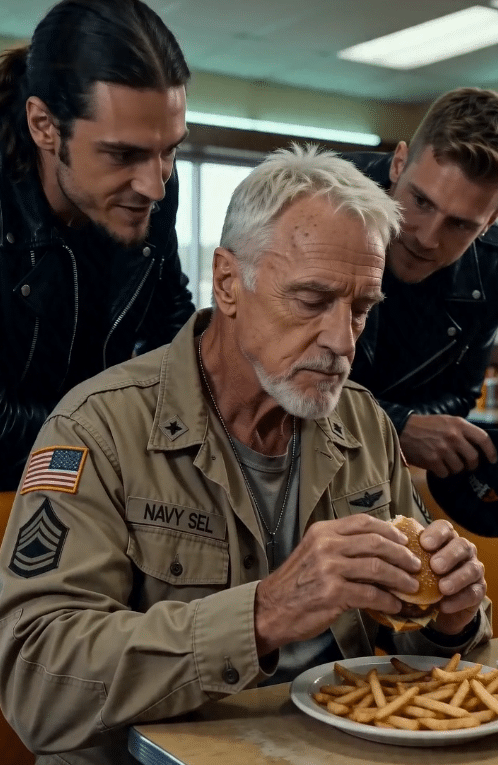
The old man sat alone in a yellow booth near the window.
He ate slowly, with the careful patience of someone who had learned a long time ago not to waste a hot meal. Burger cut in half. Fries pushed into a neat corner. Greens he hadn’t touched yet. His tan jacket hung open just enough to show a gray T-shirt beneath it, and across the chest of the jacket, stitched crooked in black thread, was a patch that read NAVY SEL.
Misspelled.
That was the first thing the younger men noticed.
The one with the long dark hair leaned over his shoulder and smiled the way men smile when they’ve already decided cruelty will be easy. On the other side of the booth, his friend spun a black baseball cap in his hand with the same misspelled words stitched across the front.
“Hey, old man,” the long-haired one said. “Give us some money.”
The old man kept chewing.
That annoyed them immediately.
Bullies hate silence more than anger because silence suggests they have not yet become important enough to affect the room. The short-haired one laughed and lifted the hat higher like a prop in a joke only the two of them understood.
The old man finally looked up.
His face was lined, not weak. White beard. Short white hair. Tired eyes that had seen enough fear in other people not to feel much use for it anymore. He set his fork down, looked directly at the young man leaning into his space, and said one word.
“No.”
The long-haired one grinned.
The short-haired one stopped laughing.
That was the first shift.
Not because the answer was brave. Because of the way he said it. Calmly. Like refusal was a fact and not a negotiation. There was no trembling in it, no plea, no old-man embarrassment at being outnumbered in public.
He stood slowly.
The younger men had expected a flinch, a curse, maybe some frightened fumbling for a wallet. They had not expected him to rise to full height and look at them like he was measuring their posture instead of fearing their youth.
The long-haired one reacted first.
He grabbed the front of the tan jacket and yanked it down hard.
The zipper teeth split open. The cheap fabric pulled apart. And under the gray T-shirt, across the old man’s chest, dark and unmistakable in the diner light, was the tattoo.
A full Navy SEAL Trident.
Not store-bought bravado.
Not costume patriotism.
Not a story.
The room went still.
The old man didn’t blink.
And the thing that changed everything was not the tattoo itself.
It was the name he asked next.
Act II: The Name He Had Been Looking For
“What’s your last name?” he asked.
The long-haired bully smirked as if the question itself was ridiculous.
“Why?”
The old man held his gaze.
“What’s your last name?”
There was something in his face now that neither young man understood yet. Not anger. Not humiliation. Something heavier and older than that. Recognition struggling with disbelief.
The short-haired one rolled his eyes and answered for both of them.
“Mercer.”
The old man stopped moving.
For one brief second, he looked less like a veteran in a diner and more like a man who had just heard a dead language spoken by the wrong mouth after twenty years. His eyes shifted from one face to the other, searching them with a care that made both young men suddenly, visibly uncomfortable.
“Mercer,” he repeated.
The waitress near the counter had gone completely still. A trucker at the back table lowered his coffee cup halfway and forgot to finish the sip. Even the jukebox seemed quieter, as though the whole diner understood it was no longer watching a simple shakedown.
The long-haired one pulled his hand back from the jacket.
“What’s it to you?”
The old man ignored the challenge.
Instead, he reached under his shirt and drew out a silver chain. On it hung a worn military dog tag and a small St. Christopher medal rubbed smooth from years of handling. He held the tags in his palm long enough for the younger men to read the engraved name.
EVAN MERCER
The short-haired one went pale first.
That was because he recognized the name immediately. Not from memory—he had been too young for that—but from the framed photograph their mother used to keep turned face-down in the hall cabinet when she was angry and face-up by the bedside when she was lonely.
Their father’s name.
The man they had been told not to ask about too much.
The man who supposedly drank too hard, fought too often, and disappeared for the last time because men like him always do.
The long-haired one recovered first.
“You stole that.”
The old man gave a tired, joyless little shake of his head.
“No,” he said. “Your father gave it to me in Ramadi after he dragged me out of a burning truck.”
That landed harder than the tattoo.
Because the tattoo proved the old man was real.
The dog tag proved their father had been too.
The younger brothers stared at the chain, then at the old man’s face, then back at the chain again as if maybe one of those glances would make the room behave normally. But normal was gone now.
The old man slipped the tags back beneath his shirt.
Then he said the sentence that turned their whole life sideways.
“I’ve been looking for you boys for eighteen years.”
The long-haired one laughed once.
But there was no mockery left in it.
Only panic.
Because if that was true, then someone had spent eighteen years making sure he never found them.
And that meant their father’s story had been a lie long before it ever became a family legend.
Act III: The Story Their Mother Never Finished
The older brother’s name was Luke.
The younger one was Danny.
Once the names were out in the open, everything about them began to make more sense—the shared jawline, their father’s eyes, the stubborn set of the mouth that came from the Mercer men whether they were fixing engines, keeping secrets, or getting themselves in trouble.
The old man introduced himself as Jack Calloway.
He sat back down only after the waitress silently brought another chair to the table and placed it there like an offering to fate. Luke stayed standing. Danny sat first, not because he trusted Jack, but because his legs had started to shake and sitting felt less obvious than weakness.
Jack looked at the plates in front of him and seemed to remember, only then, that he had been eating lunch before the past walked up and tried to rob him.
“Your father wasn’t what they told you,” he said.
Luke’s face hardened on instinct.
“That’s what everyone says when they want to rewrite a dead man.”
Jack nodded once.
“Fair.”
Then he reached into the inner pocket of the ruined tan jacket and pulled out an envelope so old the fold lines had gone white at the edges. He slid it across the table toward them. On the front, in black ink faded but still steady, was a name.
For my boys — if Jack ever finds you
Danny looked at Luke.
Luke didn’t touch it.
Not yet.
The story came first.
Evan Mercer had not abandoned his family. He had not died in a bar fight in Louisiana the way their mother’s brother used to say whenever he’d had enough whiskey to become sentimental and cruel at the same time. He had not vanished because he was weak. He vanished because he found out the veterans transport fund run through local contracting offices had been robbed for years by men wearing flags on lapels and calling themselves patriots in public.
Jack and Evan had worked together after leaving the teams—private security, freight recovery, ugly jobs for decent money. One of those jobs put them close enough to the fund records to see what was happening. Missing money. False names. survivor benefits rerouted. Death payments delayed until widows gave up fighting.
Evan wanted to go public.
The men above him wanted him quiet.
“They came after his family first,” Jack said.
That part changed Luke’s expression more than anything else.
Because family was the one sore place in the Mercer house no one touched directly. Their mother, Grace, had worked double shifts for years and still flinched whenever black SUVs idled too long outside the apartment complex. Men in suits called twice after Evan disappeared. Then never again. Their rent problems always got strangely easier right when eviction seemed certain. Danny once found their mother crying over a bank envelope she burned before he could read it.
Jack kept talking.
Evan sent Grace and the boys away under another name for a while. He gave Jack the dog tag, the letter, and a list of contacts. Then he went to hand the evidence to a federal investigator in Dallas.
He never made the meeting.
Officially, his truck hit black ice outside Shreveport and burned.
Unofficially, the investigator was reassigned, the file disappeared, and the local paper wrote three paragraphs about a drifter with military tattoos found in the wreckage.
Luke finally picked up the envelope.
His hands were not steady either.
“What do you want from us?” he asked.
Jack’s face changed then, and for the first time all afternoon he looked every bit as old as he was.
“Nothing,” he said. “I came to give your father back.”
Luke opened the letter.
And before he reached the second paragraph, his eyes filled.
Because men can lie about courage, failure, crime, drinking, and shame.
But they cannot fake the way a father writes to his sons when he thinks he is already running out of road.
Act IV: The Hat Was Never the Joke
The first line of the letter was simple.
Luke, Danny — I’m sorry I had to make you hate me to keep you breathing.
Danny read over his brother’s shoulder.
The handwriting matched the Christmas card their mother had kept hidden in the kitchen drawer for years. It matched the only signature either of them had ever seen from their father, on a crumpled photograph from before Danny could remember faces clearly. The truth didn’t arrive like a revelation then. It arrived like recognition.
Jack watched them silently.
He let the words do the work because some things become harder to believe when another man explains them too quickly. The letter said Evan had planned to come back. That he had trusted the wrong officials too long. That if the boys grew up thinking he had run, it was only because that lie might keep them too ashamed to follow him into the trouble he’d uncovered.
There was one line Danny read twice.
I left the old tan field jacket in storage with the fake SEAL patch still on it. If Jack is wearing it when he finds you, it means he knew strangers were watching and needed them to think he was a poser, not a witness.
Danny looked up sharply.
“The jacket?”
Jack gave the smallest nod.
“The real one would’ve gotten me recognized in the wrong places. The fake one got me laughed at instead.”
That, more than anything, broke the last of Luke’s resistance.
The misspelled NAVY SEL had never been a joke.
It had been camouflage.
A way for an old operator to move around the country searching for the sons of a dead teammate without every wannabe patriot, local deputy, and retired contractor clocking him as the real thing. The baseball cap in Danny’s hand suddenly felt disgusting.
He set it on the table as if it had burned him.
Luke folded the letter carefully and stared at the plate in front of Jack.
Burger.
Fries.
Greens.
All going cold.
“Why now?” he asked.
Jack looked toward the diner window.
Because that was when the black truck rolled into the parking lot.
Not county.
Not police.
Not the sort of truck locals drove unless they wanted everyone to know they could afford unnecessary darkness.
Jack’s shoulders tightened.
“I was hoping I’d get to tell you before they found me.”
Luke turned in his seat.
Three men were getting out of the truck. Clean jackets. Hard faces. The kind of men who stand like they’ve spent years waiting to be mistaken for law and have never bothered correcting the error.
Danny looked back at Jack.
“You knew they were coming?”
Jack stood.
“I knew if I opened your father’s file in public long enough, someone would show up to close it.”
The waitress reached under the counter for the phone.
One of the men in the parking lot saw her and changed direction instantly.
That was when Luke, Danny, and everyone else in the diner understood the afternoon was not ending in tears and memory. It was rolling forward into the exact kind of trouble their father had died trying to outrun.
And suddenly the jacket, the tattoo, the fake patch, the dog tag, the letter—it all pointed to the same terrible fact:
Evan Mercer had not died because he lost a fight.
He died because the fight had never ended.
Act V: The Table Where They Finally Sat as Sons
The men made it to the door.
They didn’t get farther.
Not because Jack started some glorious old-warrior brawl in the middle of the diner. Life is usually less cinematic and more embarrassing than that. They were stopped because three things happened at once.
The waitress locked the front register and hit the silent alarm.
The trucker in the back stood up with the calm heaviness of a man who’d broken enough fights in enough truck stops to know when the odds had turned.
And Luke Mercer, who had spent most of his adult life angry at a father he thought had quit on him, stepped in front of Jack before he realized he was doing it.
That was the moment Jack later said Evan would have been proudest of.
Not the punches.
Not the sirens.
Not the arrests that followed once one of the men panicked and pulled a knife too early under three security cameras and fourteen witnesses.
No.
The moment his son chose instinctively to protect the man carrying his father’s truth instead of protecting the lie that had raised him.
The deputies who arrived first knew one of the black-truck men by name. That turned into state investigators. That turned into federal callbacks. It turns out a case can stay dead for eighteen years and still wake up the second the wrong surviving witness opens his mouth in the right public room.
The veterans fund file was real.
The diverted payments were real.
The investigator who vanished in Dallas had not retired voluntarily.
And the crash that killed Evan Mercer had never been a weather event at all.
Grace cried when the brothers brought the letter home that night.
Not because it surprised her.
Because it confirmed what she had spent nearly two decades trying not to let become hope. She admitted she had known enough to suspect, but not enough to keep her sons safe if she said it aloud. So she let them hate their father because hatred was easier to survive than the truth.
Three weeks later, Jack came back to the diner.
Same booth.
Same yellow vinyl seats.
Same fluorescent lights buzzing overhead.
This time he wasn’t alone.
Luke sat on one side of him.
Danny on the other.
They didn’t talk much at first. Men in families like theirs rarely do. There were too many years in the room for easy conversation. But Luke brought the old photograph from the kitchen drawer. Danny brought the fake cap, now washed and folded. Jack brought Evan’s dog tags and set them on the table between the salt shaker and the ketchup bottle like they were finally in the right place.
The waitress brought coffee without asking.
No one bothered them.
Luke looked at the tags for a long time.
Then he asked the question that had probably been waiting under all the others since the diner confrontation began.
“Was he any good?”
Jack smiled then.
Not politely.
Not sadly.
Honestly.
“He was the man you’d want next to you when things got ugly,” he said. “And the idiot you’d want furthest from money because he believed everybody’s story until they gave him a reason not to.”
Danny laughed through tears at that.
Grace, when Jack repeated the line later, cried harder than before.
That became the shape of healing, I think. Not one giant redemption. Just small truthful things set down where everyone could finally see them. A father’s letter. A dog tag. A fake patch that turned out not to be mockery after all. A diner table where three men sat with burgers going cold because grief had finally made room for the truth.
People in town still tell the story wrong.
They tell it like two punks tried to mug an old veteran and got taught a lesson.
That isn’t what happened.
What happened was sadder and better than that.
Two sons walked into the shadow of their father’s lie.
An old man stood up wearing a jacket designed to look ridiculous.
And when the truth finally opened, it didn’t give them vengeance first.
It gave them their father back.