Act I
The courtroom was so quiet that Emma could hear her own shoes against the polished floor.
Tap.
Tap.
Tap.
Every adult in the room watched her walk past the gallery, past the rows of strangers pretending not to stare, past the oak counsel table where her mother sat in a forest green coat dress and matching pillbox hat, looking beautiful in the way people did when they were trying not to fall apart.
Emma held the tablet against her chest with both hands.
It felt heavier than it should have.
At the center table, Martin Hale sat beside Emma’s mother with his tan blazer smooth, his short beard neatly trimmed, and his hands folded as if he had nothing in the world to fear. Their lawyer shuffled papers to his right, whispering something about procedure. The judge watched from above, black robe falling around him, purple sash cutting across his chest like a line of authority.
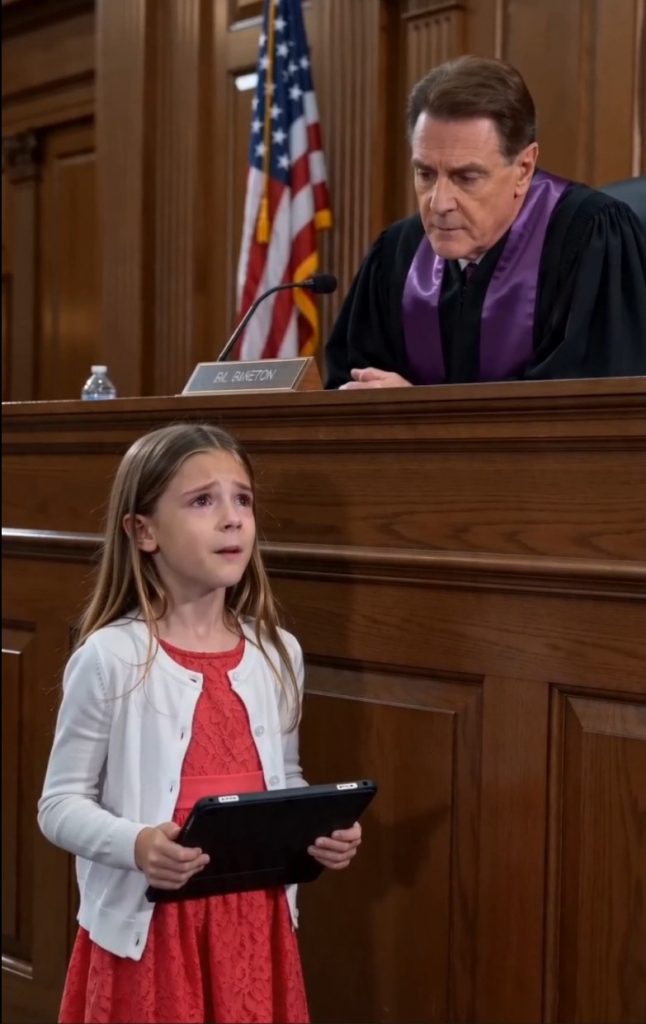
Emma stopped below the bench and looked up.
Her throat hurt. Her eyes burned. But she did not turn back.
“Your Honor,” she said softly, “may I show you something? My mom doesn’t know about it.”
The whispers began instantly.
Her mother stood so fast her chair scraped across the courtroom floor.
“Emma,” she said, sharp with panic, “what are you doing?”
Emma could not look at Martin yet.
Because if she did, she might remember all the times he had tucked a blanket around her shoulders, all the times he had called her kiddo, all the times he had smiled at her mother over breakfast like a man who had saved them both.
The judge leaned forward, studying the little girl at the foot of his bench.
“If this is relevant,” he said, “I’ll allow a brief presentation.”
Martin’s calm face changed.
Only for a second.
But Emma saw it.
She had been watching adults lie for almost a year, and she knew now that fear had a shape. It lived in the eyes before it reached the mouth.
“Emma,” her mother said again, softer now. “Honey, come here.”
Emma turned toward her.
Tears slipped down her cheeks before she could stop them. She hated that. She had promised herself she would be brave, that she would not cry in front of all these people. But bravery, she had learned, did not mean your heart stayed whole.
“I’m sorry, Mom,” she whispered. “But you needed to know.”
Then Emma walked to the counsel table and turned the tablet screen toward her mother.
For one breath, Caroline Reeves only frowned.
Then her body went still.
Her fingers tightened against the edge of the table. Her lips parted. Color drained from her face so quickly that the lawyer beside her reached out as if she might faint.
On the tablet, a video played without needing to be loud.
Caroline saw a dim kitchen.
A familiar marble counter.
Martin’s voice.
Then another voice she had not heard in eight years.
Her first husband.
Emma’s father.
Caroline’s eyes filled with horror.
Martin shot out of his chair.
“Emma, wait!”
He lunged across the space between them, arm outstretched, desperate to snatch the tablet away.
But by then, everyone in the courtroom had seen enough to understand one thing.
Whatever Martin Hale had buried, a child had just brought it back to life.
Act II
Eight years earlier, Caroline Reeves believed grief had a sound.
It was the phone ringing at 2:14 in the morning.
It was a stranger’s careful voice saying there had been an accident outside Denver. It was the sudden absence of David Monroe’s laugh in the house, the silence of his coffee mug beside the sink, the nursery chair where he used to sit with baby Emma asleep against his chest.
David had not been a rich man. He had not come from a powerful family. He was a public defender with worn shoes, a stubborn conscience, and a habit of bringing home stray problems as if the world had personally assigned them to him.
Caroline had loved him for that once.
Then she resented him for it.
Then, after he was gone, she missed it so badly she could barely stand upright.
The official story was simple.
David had driven through a storm after a late meeting. His car was found damaged near a mountain road. His body was never recovered, but the authorities said the river below was brutal that night. His phone was dead. His wallet was gone. After months of searching, the world moved on because the world always did.
Caroline did not.
For years, she lived like someone underwater.
Then Martin Hale arrived.
He was not dramatic. That was part of his gift. He did not sweep into Caroline’s life promising miracles. He appeared quietly at fundraisers, school meetings, charity dinners. He listened. He remembered Emma’s favorite cereal. He knew exactly when to step forward and exactly when to seem like he was holding back.
He told Caroline she had carried too much alone.
He told Emma that every little girl deserved someone at the school play with a camera.
He told them both that love could arrive gently after tragedy.
By the time Caroline married him, people said she had been rescued.
Emma tried to believe that too.
At first, Martin was kind. He made pancakes on Sundays. He drove her to piano lessons. He called her “champ” when she brought home a spelling test with a gold star. He never tried to replace her father, at least not out loud.
But small things changed after the wedding.
The picture of David on the mantel moved to the upstairs hallway.
Then to Emma’s room.
Then one day, it was gone.
When Emma asked, Martin sighed and said, “Your mom needs to heal, sweetheart.”
Caroline agreed.
Not because she wanted to erase David, but because grief made her tired, and Martin was always ready with a reasonable explanation.
Then came the court petition.
Martin wanted to adopt Emma legally.
He said it would protect her. He said it would give her stability. He said David would have wanted someone to step up.
Caroline cried when he said that.
Emma did not.
She was nine years old by then, old enough to know that adults used soft voices when they wanted something difficult to sound kind.
The adoption hearing was supposed to be a formality. David was legally presumed dead. There were documents, declarations, signatures, official stamps. Martin’s lawyer had prepared everything.
Caroline wore green because David had once told her it made her look brave.
Emma wore a red lace dress because her grandmother had bought it for her before she died.
No one asked Emma what she wanted until the judge did.
He asked if she understood that Martin Hale would become her legal father.
Emma stared down at her hands.
She thought of the tablet hidden beneath her cardigan.
She thought of the message she had watched at midnight, shaking under her blanket with headphones pressed hard to her ears.
She thought of the man on the screen.
Her father.
Older. Thinner. Alive.
And begging someone to tell Caroline the truth.
By the time she stepped away from the witness chair, Emma knew there was only one person in that courtroom who could stop the lie.
Herself.
Act III
The tablet had belonged to David.
Emma found it in a locked cedar chest in the attic three nights before the hearing. She was not supposed to be up there. Martin had told her the attic was unsafe, full of dust and broken things.
But Emma had been looking for her father’s photograph.
The one from the mantel.
The one where David was holding her as a baby with his tie crooked and his smile too big for the frame.
Instead, she found the chest behind a stack of Christmas wreaths.
Inside were old files, letters, a cracked leather watch, and the tablet wrapped in a faded blue shirt that still smelled faintly of cedar and time.
The battery was dead.
Emma charged it with an old cord from a drawer in Martin’s office.
She did not know the password, but the hint appeared on the screen.
First word you ever said.
Emma tried mama.
Wrong.
She tried dada.
The tablet opened.
For a moment, she smiled.
Then she saw the folder named For Caroline.
Inside were videos.
Some were old and sweet. David holding baby Emma while Caroline laughed behind the camera. David making terrible pancakes. David reading a picture book in three different voices until baby Emma clapped.
But the final file had a date from after the accident.
Emma clicked it because she thought maybe the date was wrong.
It was not.
Her father appeared on the screen sitting in a room she did not recognize. His face was bruised in places that had healed badly, his beard longer than she remembered from pictures, his eyes bright with exhaustion.
“Caroline,” he said, voice rough, “if this gets to you, don’t trust Martin Hale.”
Emma stopped breathing.
The video continued.
David explained that he had not died in the crash. He had survived, badly injured, confused, and without his wallet. By the time he understood who he was, weeks had passed in a rural clinic that had no idea he had been declared dead in another state.
He tried to call home.
The number was disconnected.
He contacted an attorney.
Letters went unanswered.
Then he discovered that someone had filed papers saying he had abandoned his family before the crash. Someone had produced emails that made him look unstable, cruel, dangerous.
He began digging.
And every road led to Martin.
In the video, David held up printed records. Payments. Messages. A private investigator’s report. A copy of an email sent from David’s account two days after the crash, when he was unconscious in a clinic bed.
“I don’t know how deep this goes,” David said, his voice breaking. “But I know he wanted me gone. I know he had access to my case files. And I know he’s getting close to you.”
Emma watched the video three times before she understood the worst part.
Her father had tried to come home.
He had been stopped.
The last file was not from David.
It was security footage from the Reeves kitchen, recorded by the old nanny camera Caroline had installed when Emma was a baby and forgotten about.
In the video, Martin stood near the counter on the phone.
He looked younger. Less careful. More impatient.
“I don’t care what he remembers,” Martin said. “The papers are already filed. Caroline thinks he abandoned her before he died. By the time he reaches anyone credible, she’ll hate him too much to listen.”
A pause.
Then Martin laughed quietly.
“No. The child was too young. She won’t remember him.”
Emma remembered that sentence most.
Not because it was the cruelest.
Because it was the one he had gotten wrong.
She remembered her father’s voice.
She remembered the song he hummed when she was sick.
She remembered being lifted high above his head and laughing so hard Caroline told him to be careful.
Martin had not erased David.
He had only hidden him.
And now Emma was standing in court with the truth in her hands.
Act IV
The bailiff reached Martin before he reached the tablet.
“Sir, step back.”
Martin froze, chest rising fast, eyes locked on the screen.
The judge’s voice cut through the room.
“Mr. Hale, return to your seat.”
Martin did not move.
His lawyer stood slowly beside him, face pale, already understanding that whatever defense he had prepared that morning had collapsed before lunch.
“Your Honor,” the lawyer said carefully, “we need a recess.”
“No,” Caroline whispered.
Everyone turned toward her.
She was still staring at the tablet, tears sliding silently down her cheeks. She did not look elegant anymore. She looked like a woman whose past had just walked through a wall and found her.
“No recess,” she said.
Martin turned to her with open panic. “Caroline, listen to me. You don’t understand what you’re seeing.”
She looked at him then.
And for the first time in years, she saw him without the soft lighting of gratitude.
She saw the timing. How he had appeared months after David vanished. How he always knew which wound to press. How he never shouted, never raged, never looked cruel enough to suspect.
That was his genius.
He made control feel like shelter.
“You told me David left before the crash,” she said.
Martin’s mouth worked soundlessly.
“You told me he had debts. You told me he wrote those emails. You told me I was lucky he was gone before Emma was old enough to understand.”
The gallery shifted, horrified.
Emma began to cry harder.
Caroline reached for her daughter with trembling hands. Emma went to her immediately, and Caroline pulled her close, holding her so tightly the tablet pressed between them.
“I’m sorry,” Emma sobbed into her coat.
“No,” Caroline whispered. “No, baby. You saved me.”
The judge ordered the tablet submitted to the court clerk for review. The lawyer objected automatically, but his voice had no strength. The judge allowed the objection to be noted and then moved past it as if swatting away smoke.
“Mr. Hale,” the judge said, “given what appears to be potential evidence of fraud, witness manipulation, and interference in a family court matter, this adoption petition is suspended pending investigation.”
Martin’s face hardened.
The mask returned, but badly fitted now.
“You’re all being emotional,” he said. “A child found old files she doesn’t understand. David Monroe was unstable. Caroline knows that.”
Caroline flinched at the old poison in the sentence.
Emma lifted her head.
“My dad isn’t dead,” she said.
The words were soft, but they split the courtroom.
Martin stared at her.
Emma wiped her cheeks with the back of her hand. “There’s another video.”
Caroline looked down at her.
Emma nodded toward the tablet in the clerk’s hands. “The last one. It’s from two weeks ago.”
The judge’s brow tightened. “Two weeks ago?”
Emma nodded.
The clerk, with the judge’s permission, connected the tablet to the courtroom monitor.
For several seconds, the screen stayed black.
Then David Monroe appeared.
Older than Caroline remembered. Silver at his temples. A scar cutting faintly near his eyebrow. But alive.
Very much alive.
Caroline made a sound that seemed to come from the deepest part of her.
David looked into the camera.
“Emma,” he said, “if you found this, then you’re braver than I ever wanted you to have to be.”
Caroline covered her mouth.
David continued, explaining that he had lived under legal confusion and fear for years, trying to untangle the false records that painted him as a man who abandoned his family. Every attempt to reach Caroline had been intercepted or dismissed. His final hope had been an attorney who found the old tablet in storage and got it returned to the Reeves house through David’s sister, hidden among family items Martin would not bother to inspect.
Then David looked away from the camera.
When he looked back, his eyes were wet.
“Caroline, I never left you. I never left our daughter. I came home as far as they would let me.”
The courtroom disappeared for Caroline.
There was only the screen.
Only the man she had buried without a grave.
Only the love she had been trained to hate so she would not look for it.
Then the rear courtroom doors opened.
And a man stepped inside with a cane in one hand and a folded cap in the other.
Act V
Caroline turned slowly.
So did Emma.
David Monroe stood just inside the doors, breathing as if the room itself hurt him. He was thinner than the photographs, older in ways time alone could not explain, but his eyes were exactly the same.
Emma knew them instantly.
She dropped the tablet.
It clattered against the floor, but no one cared.
“Daddy?”
David’s face crumpled.
Emma ran.
The bailiff moved as if to stop her, then stopped himself. Some moments were larger than procedure.
David lowered himself with effort, catching his daughter as she collided with him. He held her like a man clinging to the only proof that the years had not stolen everything.
Caroline stood frozen.
Martin stared at David as if seeing a ghost he had personally buried.
David looked over Emma’s shoulder at Caroline.
“Carrie,” he said.
No one had called her that in eight years.
Not like that.
She tried to walk toward him, but her knees weakened. The lawyer caught the edge of the table. The judge quietly called for order, though his own voice had softened.
Caroline reached David in the aisle.
For a moment, they did not touch.
Too much stood between them. Years. Lies. Grief. The terrible knowledge that love had been alive somewhere, calling out from behind locked doors.
Then Caroline lifted one shaking hand to his face.
David closed his eyes.
“I thought you left us,” she whispered.
“I know.”
“I hated you.”
“I know.”
“I missed you every day.”
His breath broke.
“So did I.”
Emma wrapped one arm around each of them as if she could hold the family together by force.
Behind them, Martin stepped back.
The movement was small, but the bailiff saw it.
“Mr. Hale,” the judge said sharply.
Martin stopped.
His lawyer placed a hand on his arm, no longer as counsel alone, but as a warning.
There was no dramatic escape. No clever speech. No final victory for the man who had built a life out of stolen years.
There was only the ugly shrinking of a lie under bright lights.
The judge suspended the hearing immediately. He ordered the evidence preserved and referred the matter for criminal review. Martin was escorted from the courtroom without the dignity he had spent so long pretending to possess.
He did not look at Emma.
He did not apologize to Caroline.
That told them everything they still needed to know.
Outside the courthouse, cameras waited because powerful families and impossible stories always attracted attention. But Caroline kept Emma tucked beneath her arm, and David walked on Emma’s other side with his cane tapping softly against the stone steps.
For the first time, Emma was not walking alone.
The weeks that followed were not easy.
Truth, Emma discovered, did not magically fix what lies had broken.
Caroline had nightmares about the years she had lost. David struggled with anger he tried not to show around Emma. Lawyers came and went. Investigators asked questions. Papers were signed. Old records were reopened. Martin’s careful world began to collapse one document at a time.
But the house changed.
David’s photograph returned to the mantel.
Not as a memorial.
As a beginning.
Caroline removed every trace of Martin from the rooms he had controlled. His suits left the closet. His framed awards came down. His voice disappeared from the voicemail. Every empty space felt painful at first, then clean.
Emma kept the tablet in a drawer beside her bed.
Sometimes she hated it.
Sometimes she touched it just to remind herself that the truth had been real before anyone believed her.
One evening, months after the courtroom, Caroline found Emma sitting on the back steps in her red dress, now too wrinkled and a little too small, staring at the yard where the autumn leaves had begun to gather.
David was inside making dinner badly.
Caroline sat beside her daughter.
For a while, neither spoke.
Then Emma said, “Are you mad I showed it to everyone?”
Caroline’s eyes filled immediately.
She pulled Emma close, kissing the top of her head.
“I’m mad that you had to be the brave one,” she whispered. “But I will never be mad that you told the truth.”
Emma leaned into her.
Across the kitchen, David dropped something metal. A pan, probably. Then came a muffled apology to no one in particular.
For the first time in a long time, Caroline laughed.
Emma smiled too.
It was small. Careful. But real.
Later that night, after Emma fell asleep, Caroline stood in the hallway looking at the photograph on the mantel.
David came up beside her.
In the picture, he was young and laughing, holding baby Emma high in the air. Caroline stood beside them, one hand reaching up as if to protect the child from falling, though David would never have let her fall.
“I don’t know how to forgive myself,” Caroline said.
David was quiet for a long moment.
Then he took her hand.
“We don’t start there,” he said. “We start with tomorrow.”
In the bedroom upstairs, Emma slept with one hand curled beneath her cheek.
She was still a child.
That was what Caroline promised herself never to forget again.
Emma had carried an adult truth into a courtroom because no adult had found it in time. She had walked past strangers, faced a judge, and broken her own family open so it could stop living inside a lie.
But she would not have to carry it forever.
The next morning, the three of them ate burned pancakes at the kitchen table.
David apologized for the pancakes.
Emma said they tasted like smoke and glue.
Caroline laughed so hard she cried, and when she cried, nobody panicked. David simply reached for her hand. Emma leaned against her shoulder.
The family was not healed.
Not yet.
But healing had finally become possible.
And it had begun with a little girl in a red dress, standing beneath a judge’s bench, holding a tablet that every liar in the room wished had stayed hidden.