Act I
The lawyer did not even try to hide his smile.
“He has no proof,” Graham Pierce said, his voice cutting cleanly across the oak-paneled courtroom. “Not one deed. Not one valid contract. Not one living witness who can confirm the story he has been telling this court.”
At the center of the room stood Samuel Reed.
He looked like a man the world had learned to step around.
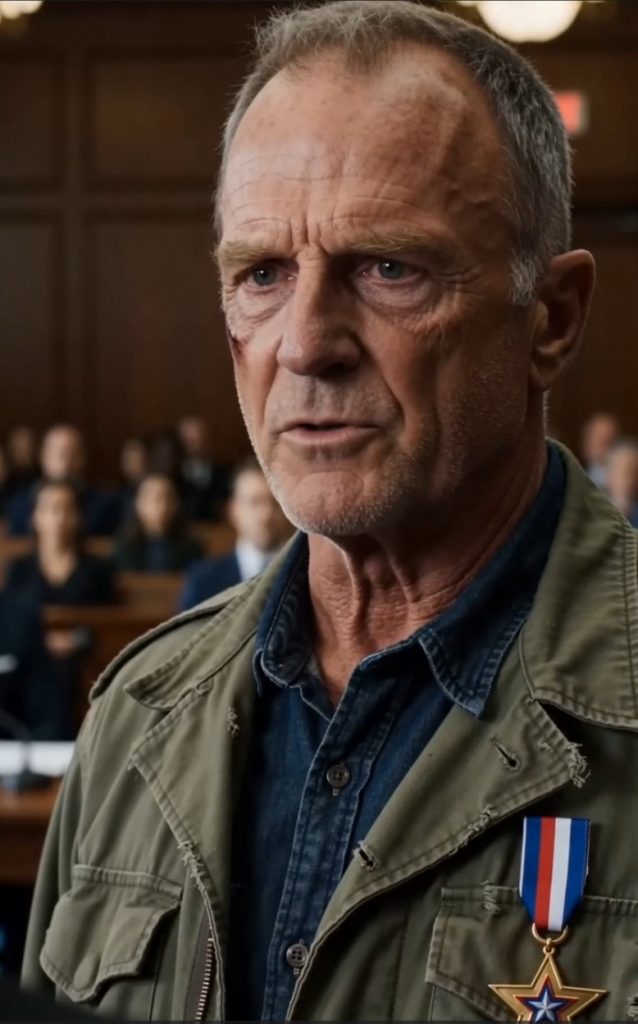
His olive-green military jacket was worn thin at the elbows, frayed at the pockets, and faded from years of weather. Beneath it, a dark denim shirt hung loose over his narrow frame. His face was lined, not with weakness, but with the kind of endurance that made pity feel insulting.
Pinned to his left chest was a small gold star medal on a red, white, and blue ribbon.
It caught the courtroom light every time he breathed.
The gallery was full that morning because the case had become local entertainment. A decorated veteran, or a fraud depending on who was whispering, had been fighting eviction from a neglected brick house on federal-adjacent land for nearly three years.
The property developers called it trespassing.
Samuel called it a promise.
Judge Evelyn Mercer watched him from the bench.
She was young for the robe, barely in her early thirties, with dark hair pulled into a low ponytail and eyes trained by years of discipline not to reveal too much. She had heard every argument. She had reviewed every missing document. She had watched the opposing counsel build a neat little cage from technicalities and wait for Samuel to step inside it.
Graham Pierce turned toward the gallery, making sure everyone could see how reasonable he was being.
“Mr. Reed has had ample opportunity to produce evidence. Instead, he gives us folklore. War stories. Sentimental claims about a dying man’s promise. Your Honor, the law cannot function on emotion.”
Samuel did not look at him.
He looked at the judge.
“I have the truth,” he said.
His voice was low. Gravelly. Firm enough to make the room quiet.
Pierce gave a soft laugh. “Truth is not evidence.”
“No,” Samuel said. “But lies leave marks.”
Something shifted in Judge Mercer’s expression.
Not because of his words.
Because of the medal.
For the first time, she truly saw it.
The star was old, handmade, and imperfect at the edges. Not an official decoration. Not something issued by the military. The ribbon had been replaced more than once, but the medal itself looked like it had survived fire, rain, and hands that refused to let it go.
Evelyn’s gaze narrowed.
There was something carved into the back.
A mark she could not see from the bench.
“Stop,” she said.
Pierce turned, startled. “Your Honor?”
Judge Mercer stood.
The courtroom breathed in at once.
She stepped down from the raised bench, black robe sweeping around her, and walked toward the old veteran. The bailiff moved as if to intervene, then stopped when she lifted one hand.
Evelyn stopped inches from Samuel.
“Show me that medal.”
Samuel’s face changed.
Only slightly.
But enough.
The steady dignity cracked, and beneath it was grief so old it had become part of his bones.
He reached up, fingers rough and calloused, and unclipped the medal with care.
Evelyn took it gently.
The gold was warmer than she expected.
She turned it over.
On the back, engraved by hand, were three Roman numerals.
XIX.
Her breath caught.
The courtroom blurred at the edges.
Samuel’s voice came in a whisper.
“Your father gave it to me.”
And suddenly, Judge Evelyn Mercer was no longer in control of the room.
Act II
Evelyn had spent most of her life trying not to be her father’s daughter in public.
Not because she was ashamed of him.
Because everyone else had been.
Major Thomas Mercer had died when Evelyn was six years old, though the word died had always felt too clean for what happened. There had been no body returned. No final goodbye. No flag-draped certainty. Only a sealed report, a closed-door hearing, and a military chaplain who could not meet her mother’s eyes.
The official story changed depending on who told it.
A failed mission.
A compromised extraction.
A commander who disobeyed orders.
A man who abandoned position and caused the loss of classified materials.
Evelyn had grown up hearing polished adults speak about her father in unfinished sentences. They praised his early career, then lowered their voices at the end. Her mother kept his photograph in a drawer instead of on the mantel because grief was hard enough without visitors asking cruel questions in gentle tones.
But Evelyn remembered him differently.
She remembered broad hands lifting her onto his shoulders.
She remembered the smell of boot polish and wintergreen.
She remembered him kneeling to tie her shoes before deployment, telling her that a Mercer never ran from the hard thing just because the easy thing looked cleaner.
And she remembered nineteen.
Not what it meant.
Only the word.
The last letter he sent her had ended with one strange line.
When you are old enough, ask about nineteen.
Her mother had cried when Evelyn showed it to her years later.
Then she burned the envelope, not the letter, only the envelope with the military forwarding stamp, as if destroying the path it had traveled might keep the past from finding them again.
Evelyn became a judge because evidence was safer than memory.
Evidence could be weighed. Challenged. Preserved. Memory could be poisoned by longing. It could make a child defend a dead man simply because she needed him to be good.
So she built her life on law.
And then Samuel Reed walked into her courtroom.
At first, he was just another difficult case.
A veteran living in a half-collapsed house on the edge of a development zone, refusing to leave because he claimed the property had been entrusted to him and “the others” after a military operation no public record confirmed.
The company suing him, Bradford Urban Holdings, had plans for the land. Condos, retail space, a wellness center with a name designed to sound noble. Their attorney, Graham Pierce, presented the case as simple. Samuel Reed had no title. No lease. No proof.
Samuel insisted the property was never meant to be sold.
He said it had been purchased quietly through a charitable trust by a soldier who never made it home.
A soldier named Thomas Mercer.
The first time Samuel said the name in court, Evelyn nearly called a recess.
But she did not.
There were many Mercers. Many Thomases. Many old soldiers with half-remembered promises.
She told herself that.
She believed it because she had to.
Now she stood in the center of her own courtroom holding a medal engraved with the number her father had left behind like a locked door.
XIX.
Nineteen.
The gallery was silent.
Pierce’s smugness had vanished.
“Your Honor,” he said carefully, “I must object to this irregular handling of an exhibit not entered into evidence.”
Evelyn did not look at him.
“Mr. Reed,” she said, her voice quieter than she intended, “explain.”
Samuel’s eyes glistened, but he did not lower them.
“Your father saved nineteen men,” he said. “And they ruined his name for it.”
The room seemed to tilt.
Pierce snapped, “This is outrageous.”
Samuel turned to him at last.
“No,” he said. “Outrageous was letting his little girl grow up thinking the world had a reason to whisper.”
Evelyn’s fingers closed around the medal.
For the first time in twenty-seven years, the dead had spoken clearly.
And they were not finished.
Act III
Samuel Reed had not always looked like a man who slept in borrowed coats.
At twenty-eight, he had been Staff Sergeant Reed, strong-backed, sharp-eyed, and convinced that courage was mostly a matter of not embarrassing yourself when fear arrived.
He met Major Thomas Mercer in a desert staging camp under a sky so wide it made every man feel smaller than he wanted to admit.
Mercer was not loud. That was the first thing Samuel noticed. Some officers performed authority like theater. Mercer carried his like a tool. He used it only when something needed building, protecting, or stopping.
The mission that changed everything was never supposed to exist on paper.
A convoy had been sent to retrieve contractors and local informants from a region that command insisted was already secure. It was not secure. Everyone on the ground knew it. The maps were wrong, the intelligence was late, and the private company involved had more political protection than accountability.
There were twenty men in the extraction team when the order came to turn back.
Thomas Mercer refused.
Not recklessly. Not for glory.
Because nineteen people were still waiting at the rendezvous point, including translators who had trusted American promises more than their own chances of survival.
Mercer told command he would not leave them.
Command told him he was endangering assets.
He answered, “People are not assets.”
Samuel heard him say it.
So did every man in the truck.
What followed became classified, buried, rewritten, and eventually twisted into a stain on Mercer’s name. The official record claimed Mercer disobeyed orders and caused the loss of sensitive material. The company claimed he went rogue. Certain officers saved their careers by allowing a dead man to absorb the blame.
But Samuel knew the truth.
Thomas Mercer got nineteen people out.
He got Samuel out.
And when it became clear he might not make it home, he took a small gold star from inside his jacket. It had been made from scrap metal by one of the rescued translators during those final hours of waiting. On the back, Mercer had scratched XIX with the point of a field knife.
Nineteen saved.
Nineteen witnesses.
Nineteen reasons not to let the lie win.
“He gave it to me after,” Samuel said in court, his voice roughening. “Told me if anything happened, I should find Evelyn someday. Said you deserved to know your father did not die running from duty.”
Evelyn could not speak.
She was a judge. She knew the room was watching. She knew procedure demanded distance. But there are moments when a title cannot protect the child inside the adult wearing it.
Samuel reached into the inner lining of his tattered jacket.
Pierce took one sharp step forward. “Your Honor, absolutely not.”
The bailiff moved closer.
Samuel froze, slowly lifting both hands.
“I’m not reaching for trouble,” he said. “I’m reaching for what’s left of him.”
Evelyn nodded once to the bailiff.
Samuel carefully removed a folded oilcloth packet, creased and darkened with age. He held it out, not to Evelyn, but to the clerk.
“Been carrying this since I learned the house was being sold,” he said. “Couldn’t get anyone to read it. Couldn’t get anyone to believe I was who I said.”
The clerk opened the packet under the judge’s instruction.
Inside were copies of old field notes, a damaged photograph, and a letter written in Thomas Mercer’s hand.
Evelyn recognized the handwriting before she read a word.
Her knees nearly weakened.
The letter was addressed to her mother.
And beneath the first page was a trust document naming nineteen beneficiaries, including Samuel Reed, tied to a property meant to become a refuge for veterans and displaced allied families.
The same property Bradford Urban Holdings now wanted cleared.
Pierce’s face had gone gray.
Because legal technicalities were powerful only until the missing paper appeared.
And this paper had a dead man’s signature.
Act IV
Evelyn returned to the bench because standing near Samuel any longer felt impossible.
The robe suddenly weighed twice as much.
She looked down at the courtroom, at the gallery, at the lawyer whose entire case had been built on the assumption that an old man in a torn jacket could be humiliated into silence.
“This court will take a recess,” she said.
Pierce stood. “Your Honor, before any recess, I renew my objection. These materials are unauthenticated, emotionally prejudicial, and presented under highly irregular circumstances.”
Evelyn’s eyes settled on him.
“Mr. Pierce, the court is aware of the rules of evidence.”
He stiffened.
She continued, each word controlled. “The court is also aware that your client represented in multiple filings that no trust documents had ever existed, that Mr. Reed’s military service was unverifiable, and that his claim was fabricated in full.”
Pierce said nothing.
“Given what has just been produced,” Evelyn said, “those representations are now in serious question.”
The gallery stirred.
Samuel stood very still.
He looked less victorious than exhausted, as if truth had taken everything from him before finally agreeing to stand beside him.
Evelyn looked at the medal on the bench.
XIX.
Her father had been reduced to a line in sealed files, a cautionary rumor, a photograph hidden in a drawer. And here was the proof that he had done exactly what she had secretly needed to believe.
He had stayed.
He had chosen people over orders.
He had carried honor into a place where men with cleaner hands later buried it.
But Evelyn also knew what had to happen next.
She could not preside over this case anymore.
Not after holding that medal.
Not after hearing her father’s name.
Not after feeling six-year-old Evelyn rise inside her chest and reach for a man who would never lift her again.
“I am disclosing a personal connection to newly presented evidence,” she said, voice steady only because she forced it to be. “Major Thomas Mercer was my father.”
A wave moved through the gallery.
Pierce seized the opening. “Then, Your Honor, you must recuse immediately, and all statements made today—”
“I will recuse,” Evelyn said sharply. “After I issue preservation orders.”
Pierce stopped.
“The documents, medal, and related materials are to be secured by the clerk. Bradford Urban Holdings is ordered not to alter, demolish, transfer, or encumber the disputed property pending reassignment and further review. Any destruction of relevant records after this moment will be treated accordingly.”
Pierce looked as if he had swallowed glass.
Evelyn turned to Samuel.
For one second, courtroom formality vanished.
“Mr. Reed,” she said, “why didn’t you come forward sooner?”
Samuel gave a tired smile with no joy in it.
“I did,” he said. “For twenty years.”
The answer silenced her.
He had written letters. Filed petitions. Called offices. Appeared in waiting rooms where assistants asked him to leave. He had been dismissed as unstable, confused, homeless, bitter. Every time he spoke Thomas Mercer’s name, someone found a reason not to listen.
The truth had not been hidden in a vault.
It had been standing in public, wearing a frayed jacket, waiting for someone important enough to care.
Evelyn lowered her gaze.
Her wedding band flashed under the lights as her hand rested beside the old medal. Gold beside gold. Present beside past.
Samuel saw it and nodded faintly.
“He talked about you,” he said.
Evelyn looked up.
Samuel’s voice softened. “Said you used to steal his toast. Said you asked once if judges got to tell generals what to do.”
A broken laugh escaped her before she could stop it.
Then came the tears.
Not many. Not dramatic. Just enough to reveal that beneath the robe was a daughter who had waited her whole life for one clean memory that no report could take away.
Pierce no longer objected.
Some defeats were too human to interrupt.
And when the judge finally rose from the bench, everyone in the courtroom rose with her.
Not for the robe.
For the truth.
Act V
The case was reassigned within forty-eight hours.
By then, the story had already begun to spread.
At first, Bradford Urban Holdings tried to dismiss the discovery as sentimental confusion. Then forensic review confirmed the age of the papers. Military archives, once pressured by public attention and a federal inquiry, produced sealed references to the extraction mission. Names surfaced. Survivors were found. Old men gave statements with shaking hands and clear eyes.
Nineteen.
The number returned like a drumbeat.
Nineteen people saved.
Nineteen accounts buried.
Nineteen lives that proved Thomas Mercer had not abandoned his duty.
The new judge halted the eviction permanently. The property was restored to the original trust and placed under independent oversight. Bradford’s filings came under investigation. Graham Pierce quietly withdrew from the case, though quiet was no longer enough to protect anyone who had knowingly sharpened lies into legal arguments.
Samuel Reed did not become rich.
He never wanted that.
The old brick house was repaired. Its roof was replaced. Its windows stopped rattling in winter. A sign was placed near the entrance, simple and unpolished.
Mercer House.
A refuge for veterans, interpreters, and families who had been promised they would not be forgotten.
Samuel moved into the first room on the left.
He kept the medal in a glass case near the front door, but only after Evelyn asked him to.
“It belongs with you,” he told her.
She shook her head.
“No,” she said. “It belongs where people can see what he did.”
Months later, after the official correction of Major Thomas Mercer’s record, Evelyn stood beside her mother at a military memorial ceremony.
Her mother was older now, fragile in a way Evelyn had not allowed herself to notice before. For years, grief and shame had made them careful with each other. They had loved around the missing parts instead of touching them.
When the corrected citation was read aloud, Evelyn’s mother gripped her hand.
Not once did she look away.
Thomas Mercer’s name was spoken clearly.
No lowered voices.
No unfinished sentences.
No stain.
After the ceremony, Samuel approached them in his best jacket, which was still old but carefully brushed. He looked uncomfortable with attention, as honorable men often are when the world finally claps too late.
Evelyn’s mother reached for his hands.
“You brought him home,” she whispered.
Samuel bowed his head.
“No, ma’am,” he said. “He brought all of us home. I just took too long returning the favor.”
Evelyn turned away for a moment because the sky had blurred.
That afternoon, she visited Mercer House alone.
The brick walls had been cleaned. The porch repainted. Someone had planted marigolds along the walkway. Inside, a young veteran sat at the kitchen table filling out job applications while an older woman helped translate documents for her husband.
Life had entered the building again.
Not charity.
Dignity.
Samuel found Evelyn in the front room, looking at the medal.
“You ever get tired of carrying everyone’s proof?” she asked him.
He considered that.
“I got tired when no one wanted it,” he said. “Carrying it got easier once somebody finally did.”
Evelyn nodded.
For a long time, they stood together in silence.
Then she reached into her coat pocket and unfolded a copy of her father’s last letter. The same letter she had kept hidden for years. The one with the line that had haunted her childhood.
When you are old enough, ask about nineteen.
“I used to think he left me a question,” she said.
Samuel looked at the medal.
“No,” he said. “He left you a witness.”
Evelyn smiled through tears.
Outside, the late afternoon sun touched the windows of Mercer House, turning them gold. For the first time, she imagined her father not as a shadow at the edge of memory, not as a name trapped inside sealed records, but as a man standing where it mattered most and refusing to walk away.
The law had taught Evelyn that proof mattered.
Her father had taught her, years after his death, that truth mattered first.
And Samuel Reed, the old veteran everyone had dismissed, had carried both in a torn jacket until the world was finally ready to look.