Act I
The dog knew before anyone else did.
His bark cut through the airport terminal like an alarm no one had installed. Sharp. Rhythmic. Relentless.
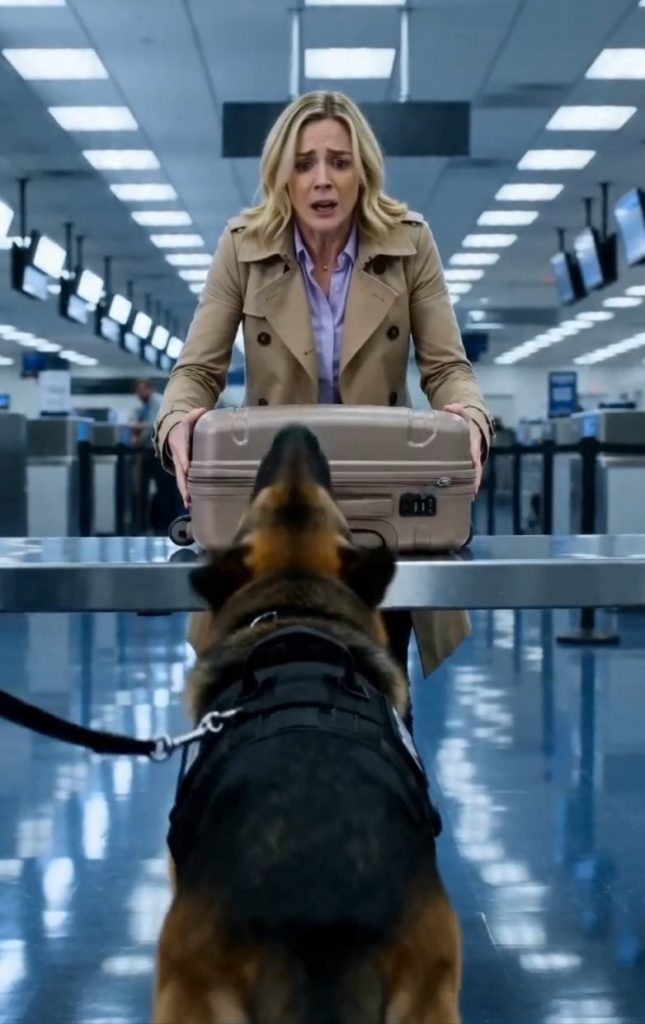
Travelers stopped near the security barriers, turning with half-lifted boarding passes and anxious eyes. The polished blue floor reflected everything: the stainless steel inspection table, the bright fluorescent lights, the German Shepherd straining against his black harness, and the woman gripping a tan suitcase as if it were the only thing keeping her upright.
Officer Daniel Martinez held the leash tight.
“Easy,” he said, but the dog did not ease.
The K9’s ears were forward, his body locked, his entire focus fixed on the suitcase beneath Sarah Whitman’s white-knuckled hands.
Sarah was in her late thirties, blonde hair tucked loosely behind her ears, tan trench coat tied too tightly around her waist. Beneath it, her lavender blouse was wrinkled from travel. Sweat glistened at her temple despite the cold air of the customs hall.
Martinez had seen fear before.
People afraid of fines. Afraid of missed flights. Afraid of questions they did not want answered.
Sarah looked afraid of the suitcase itself.
He stepped closer to the table.
“Ma’am,” he said, voice firm, “let’s open the suitcase.”
Sarah shook her head immediately.
“No.”
The dog barked again, louder.
Martinez’s eyes narrowed.
“Ma’am.”
“I can’t,” she said. Her voice cracked. “No, it’s not necessary.”
“It is now.”
She leaned over the suitcase, almost covering it with her body. Her breath came fast and shallow. Behind her, other travelers had gone silent. Someone whispered. Someone else lifted a phone until a second officer ordered it down.
Martinez placed one hand on the suitcase.
Sarah flinched.
“Please,” she whispered. “You don’t understand.”
“Then help me understand.”
Her eyes filled with tears.
“I was trying to save him.”
The words changed the air.
Martinez did not wait.
He pulled the suitcase toward him, released the latch, and lifted the tan lid.
For half a second, the dark interior looked empty.
Then a tiny pale hand reached upward from beneath a folded blanket.
Small fingers spread weakly against the light.
Martinez recoiled, his face draining of color.
The K9 stopped barking.
The whole airport seemed to stop with him.
Inside the suitcase was an infant.
Alive.
Barely moving.
And Sarah Whitman, the woman everyone thought was hiding a crime, collapsed to her knees and sobbed, “Don’t let them take him back.”
Act II
Two hours earlier, Sarah had been just another passenger in line.
That was how danger traveled best.
Ordinary coat. Ordinary suitcase. Ordinary passport. A woman blending into the exhausted river of international arrivals, keeping her head down beneath the cold glow of airport lights.
But Sarah’s life had stopped being ordinary six weeks before.
Her younger sister, Emily, had called her from a hospital in Geneva at 3:17 in the morning.
Sarah almost did not answer.
She had not spoken to Emily in nearly a year. Their last conversation had ended with Emily crying and Sarah begging her to come home, to stop trusting men who spoke softly while holding all the documents, all the money, all the exits.
Emily had married Adrian Voss, a wealthy pharmaceutical heir with houses in three countries and lawyers who seemed to arrive before questions did. He was charming in public. Devoted in photographs. Generous at charity dinners.
Behind closed doors, he was control dressed as concern.
When Emily became pregnant, he moved her overseas “for privacy.” Her calls became shorter. Her emails became careful. Then they stopped.
So when Sarah heard her sister’s voice shaking through the phone, she sat straight up in bed.
“Sarah,” Emily whispered. “He’s going to take the baby.”
Sarah’s blood went cold.
“What do you mean?”
“I found the papers. He says I’m unstable. He says I signed them, but I didn’t. There’s a clinic. A foundation. I don’t know who to trust.”
The baby cried faintly in the background.
Sarah closed her eyes.
“What is his name?”
“Noah,” Emily whispered.
Then she said the sentence Sarah would hear in her sleep for weeks.
“If anything happens to me, don’t let my son disappear like I did.”
The line went dead.
By the time Sarah reached Europe, Emily was gone.
Not dead. Not officially. Just gone.
The story Adrian told was elegant and empty. Emily had suffered a breakdown. Emily had left voluntarily. Emily needed treatment. Emily was not accepting visitors.
No hospital would confirm. No lawyer would help without payment Sarah could not afford. The embassy gave her forms and sympathy. Adrian gave her a smile at the gate of his estate and said, “Your sister has always been fragile.”
Then a nurse found Sarah outside the clinic two nights later.
Her name was Ines. She looked terrified and had a bruise-colored shadow under one eye.
“They are moving the baby tomorrow,” she whispered.
“Where?”
“I don’t know. But once he is gone, no one will find him. The records are not records. They are curtains.”
Sarah stared at her.
“Where is Emily?”
Ines shook her head, tears in her eyes.
“I don’t know. But she left something for you.”
It was a flash drive, a hospital bracelet, and a message written in Emily’s shaking hand.
Sarah, if you can get Noah to U.S. soil, ask for Martinez at customs. Daniel Martinez. He was Dad’s old partner’s son. He’ll listen if you say “Blue Lantern.”
Blue Lantern.
Their father’s old missing-child task force.
Sarah had not heard the phrase since childhood.
She spent the next thirty-six hours moving through a nightmare of hidden doors, frightened helpers, forged lies around her, and the impossible weight of an infant who had already been treated like property by men who never should have been near him.
She did not trust officials.
Not after watching Adrian’s people shake hands with them.
She did not trust airport staff.
Not after seeing two men in dark coats follow her from the clinic district to the terminal.
She made one desperate choice after another, each one worse than the last, until she stood in a customs zone with her hands locked around a suitcase and a dog screaming at the truth.
Now the truth was open.
And so was the trap.
Act III
Martinez moved fast.
“Medical team now,” he snapped. “Clear the area. No one leaves this inspection zone.”
Sarah reached toward the infant.
A second officer stopped her.
Martinez saw the look on her face and raised one hand.
“Let her stay where he can hear her,” he said. “But no one touches him until medics arrive.”
Sarah nodded through tears, pressing both hands to her mouth.
“Noah,” she whispered. “I’m here. I’m here.”
The infant’s tiny hand moved once at the sound of her voice.
Martinez’s jaw tightened.
He had a daughter at home who still slept with one fist tucked under her cheek. He forced that thought away. Emotion could wait. The child could not.
The medical team arrived within minutes, wrapping Noah in warmth, checking his breathing, speaking in controlled tones that made the horror feel briefly survivable.
Martinez turned to Sarah.
“Who is he?”
“My nephew.”
“Where is his mother?”
Sarah’s face broke.
“I don’t know.”
“Why was he in there?”
She looked around the customs hall, eyes darting toward the glass partitions, the check-in counters, the travelers being held back by security.
“They were following us.”
“Who?”
Before she could answer, the German Shepherd growled.
Not at the suitcase now.
At the far end of the inspection zone.
Martinez turned.
Two men stood near the diplomatic lane.
Dark coats. No luggage. Too still.
One lifted a phone.
The other met Sarah’s eyes.
She stopped breathing.
“That’s them,” she whispered.
Martinez spoke into his radio without looking away.
“Close the east exit. Detain the two males at diplomatic screening. Quietly.”
The men noticed the shift too late.
One tried to walk away. The other held up a credential and began speaking sharply to an officer near the barrier.
Martinez did not care what the credential said.
“Detain them,” he repeated.
Within seconds, airport police surrounded both men. One protested in a language Martinez recognized only partly. The other stayed silent, watching Sarah with a hatred so cold it made her step backward.
Martinez faced her again.
“You said you were trying to save him. From them?”
Sarah nodded.
“From my sister’s husband.”
She reached into the lining of her trench coat and pulled out a small plastic pouch.
Inside were a hospital bracelet, a flash drive, and a folded note.
Martinez opened the note.
His face changed at the first line.
If this reaches Daniel Martinez, tell him Blue Lantern was real.
He looked up slowly.
“How do you know that phrase?”
Sarah’s voice shook.
“My father knew yours.”
Martinez stared at her.
His father, Rafael Martinez, had spent the last ten years of his life chasing a child-trafficking network no one wanted to admit existed because too many wealthy names circled the edges of it. The task force had been nicknamed Blue Lantern because Rafael believed missing children needed light carried into places where institutions preferred darkness.
The task force collapsed after a scandal.
Rafael died believing he had failed.
Now a woman in a customs hall was holding proof that the old case had never truly ended.
Martinez looked toward the medics carrying Noah to a secure medical room.
Then to Sarah.
Then to the men in dark coats.
“What did your sister find?” he asked.
Sarah whispered, “The list.”
Act IV
The flash drive changed everything.
It was opened in a secure interview room under the supervision of federal agents who arrived with grim faces and no patience for airport politics. Sarah sat wrapped in a gray blanket, shaking so hard she could barely lift the cup of water in front of her.
Martinez stayed in the room because Sarah asked him to.
Not because he had authority over federal jurisdiction.
Because Emily had told her his name.
On the drive were scanned documents, payment ledgers, medical transfers, adoption authorizations, and passport records tied to several private clinics and charitable foundations across Europe and the United States.
At first, the names meant nothing to Sarah.
Then one appeared on the screen.
Voss Children’s Health Initiative.
Adrian’s foundation.
Another document opened.
There were newborns marked as emergency placements. Mothers labeled unstable. Legal signatures copied from unrelated forms. Infants moved across borders under humanitarian exemptions, then folded into private arrangements with families wealthy enough not to ask where the paperwork began.
A federal agent named Collins leaned closer to the screen.
“My God.”
Martinez felt the old anger rise in him.
Not sudden.
Inherited.
He remembered his father at the kitchen table, surrounded by files, rubbing both hands over his face while the city called him obsessed. He remembered the night Rafael said, “The rich don’t hide crimes in alleys. They hide them behind letterhead.”
Everyone had laughed at him eventually.
Not to his face.
But enough.
Now the letterhead was glowing on a federal screen.
Sarah pointed at one file.
“That’s Noah.”
The baby’s name appeared under a false surname. The transfer destination was listed as a private medical transport. The receiving guardian field was blank.
Below it was another name.
Emily Whitman Voss.
Maternal status: voluntarily relinquished due to psychiatric instability.
Sarah slammed her palm on the table.
“She did not relinquish him.”
“I believe you,” Martinez said.
She turned to him, stunned by how badly she needed to hear that.
The door opened.
Agent Collins stepped out to take a call. When he returned, his face was darker.
“Local police in Geneva found your sister.”
Sarah stood so quickly the chair fell behind her.
“Is she alive?”
Collins hesitated only a fraction of a second, but it was enough to nearly destroy her.
“She’s alive. She’s in protective custody at a hospital.”
Sarah covered her face and sobbed.
Martinez looked down, giving her privacy. His own throat tightened.
Collins continued.
“She was held under false medical orders. She’s asking for the baby.”
Sarah looked up.
“Noah?”
“He’s stable,” Martinez said. “The doctors are with him. You got him here alive.”
She pressed both hands against the table, crying harder.
“I thought I’d hurt him.”
“You saved him.”
She shook her head.
“No. Emily saved him. She knew. She left the note. She told me your name.”
Martinez looked at the words still open on the screen.
Blue Lantern.
For years, he had avoided his father’s old boxes in the garage. He told himself the past was too heavy, that obsession had eaten Rafael from the inside. Now he understood something else.
His father had not been obsessed.
He had been early.
And the case had just found its way back through a barking dog, a terrified aunt, and a tiny hand reaching out of darkness.
By evening, the two men from the diplomatic lane had been arrested. Their credentials were false. Their phones were not. Messages connected them to Adrian Voss’s legal team and a private security firm that specialized in making problems disappear politely.
But Adrian was still abroad.
Still wealthy.
Still surrounded by lawyers.
Still telling anyone who would listen that his wife was ill, his child was kidnapped, and Sarah Whitman was a criminal.
Then Martinez received a call from Geneva.
Emily wanted to speak to the officer who found her son.
Act V
Emily’s voice was weak, but clear.
“Officer Martinez?”
“Yes, ma’am.”
“Is my baby breathing?”
Martinez closed his eyes.
He had delivered death notifications. He had interviewed victims. He had stood in rooms where words had to be chosen carefully because they would live in someone’s memory forever.
This time, the answer was simple.
“Yes,” he said. “He’s breathing. He’s safe.”
On the other end of the line, Emily made a sound that was half sob, half prayer.
Sarah sat beside Martinez with both hands over her mouth.
“She did it?” Emily whispered. “My sister got him there?”
“She did.”
“Tell her I knew she would.”
Sarah broke then, folding forward over the interview table while Martinez held the phone between them.
“I’m sorry,” Sarah cried. “I’m sorry I didn’t come sooner.”
Emily’s voice trembled.
“You came.”
That was enough.
For that moment, it was enough.
The weeks that followed became a storm of agencies, courts, sealed warrants, emergency hearings, and headlines carefully softened by people who hated the word trafficking because it made expensive crimes sound as ugly as they were.
Adrian Voss was detained abroad after Emily gave sworn testimony and investigators matched her files to the flash drive. His foundation collapsed first. Then the clinics. Then the legal network around him began turning on itself, each person trying to prove they had signed documents without understanding what the documents meant.
Emily returned to the United States under protection.
She saw Noah in a hospital room with Sarah beside her and Martinez standing outside the door.
When the nurse placed the baby in her arms, Emily did not speak.
She simply held him against her chest and rocked forward, tears falling into his soft blanket.
Sarah sat on the bed beside her.
For a long time, the sisters stayed that way.
No speeches.
No grand forgiveness.
Just survival, breathing in the same room.
Martinez watched through the glass for only a moment before turning away.
Some reunions were not for witnesses.
Months later, Sarah’s charges were formally declined. The official report used careful language. Extraordinary circumstances. Imminent risk. Evidence of coercive criminal activity.
Sarah hated how clean it sounded.
Nothing about the airport had been clean.
Not the fear. Not the suitcase. Not the terrible choice she had made because every proper channel seemed already poisoned.
But Noah lived.
Emily lived.
And the list grew.
Families came forward. Mothers who had been told they signed forms they never saw. Fathers who had been shut out by foreign courts and private attorneys. Adoptive parents horrified to learn the children they loved had been placed through lies. Children old enough to ask why their names had changed.
There were no easy endings.
Every rescue created another grief.
Martinez learned that from the Blue Lantern files when he finally opened his father’s boxes.
He found notes, photographs, old maps, and a letter Rafael had written but never sent.
Daniel,
If someday this work finds you, I hope it finds you kinder than it left me. Do not let anger make you careless. These children need truth, not vengeance. Carry the light. Don’t become the fire.
Martinez sat in his garage reading it until sunrise.
Then he made a call.
A year after the airport incident, the Department of Homeland Security announced a renewed multi-agency task force focused on cross-border child identity fraud and coercive adoption networks.
Its nickname was unofficial.
Everyone used it anyway.
Blue Lantern.
Martinez did not lead it at first. He was not senior enough. But he was assigned to it, and on his first day, he placed his father’s old badge photo inside his locker.
Beside it, he taped a copy of the note Emily had sent through Sarah.
Tell him Blue Lantern was real.
The airport K9, Ranger, became famous in the department for the alert that started everything. Martinez brought him to visit Noah on his first birthday, after Emily insisted.
Noah was round-cheeked now, healthy, fascinated by the dog’s ears. Sarah held the birthday cake. Emily stood beside her sister in the park pavilion, still thinner than before, still healing, but alive in the sunlight.
Martinez watched Noah reach one tiny hand toward Ranger’s harness.
The same hand that had reached out of the suitcase.
His chest tightened.
Emily noticed.
“You okay?” she asked.
Martinez nodded.
“Just remembering.”
“So am I.”
They stood quietly while Noah laughed at the dog.
That laugh did not erase the customs hall. It did not erase the suitcase or the fear or the fact that systems built to protect people had nearly delivered a baby into the hands of those who saw him as a document to be moved.
But it proved something had survived all of it.
Years later, people would tell the story like a thriller.
The anxious woman.
The barking dog.
The officer demanding the suitcase be opened.
The tiny hand reaching from the dark.
But Martinez always corrected the ending when he could.
The dog did not uncover a crime.
He uncovered a child.
Sarah was not simply a traveler with a secret.
She was an aunt who made a terrible, desperate choice because every safer choice had been stolen before she arrived.
And Noah was not evidence, not a headline, not a symbol.
He was a baby who grew into a boy who loved dogs, hated peas, and once told Martinez very seriously that airplanes were “too loud but kind of cool.”
The world had nearly reduced him to a file.
A barking dog refused.
A terrified woman refused.
A mother refused.
And in a cold customs hall with fluorescent lights and a polished blue floor, one small hand reached upward and forced everyone to look at what powerful people had tried to keep hidden.