Act I
The first shove was small enough for everyone to pretend it did not happen.
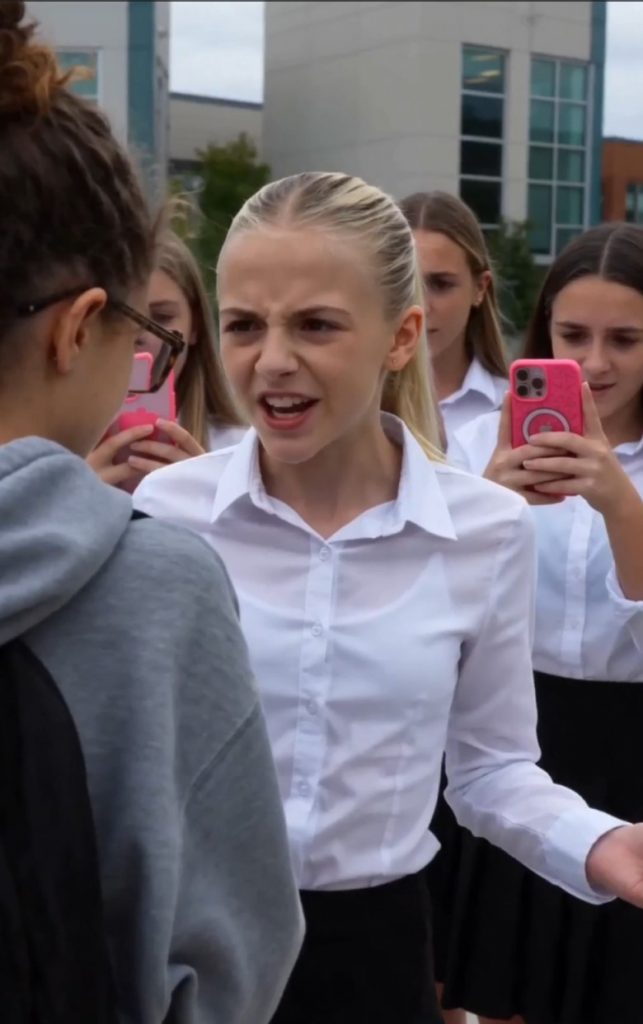
Mia stumbled half a step across the concrete courtyard, her hands tightening around the straps of her black backpack. Around her, students sat at dark blue picnic tables beneath the bright morning sky, laughing over lunches, scrolling on phones, pretending the circle of girls around Mia was just another piece of school noise.
Chloe Bennett walked beside her with a smile sharp enough to cut.
“Look at her,” Chloe said, loud enough for the nearest tables to hear. “It’s like she lives in another world.”
The girls behind her laughed.
Two of them were filming.
Mia kept her eyes on the ground. Her thick rectangular glasses slipped slightly down her nose, but she did not fix them. She had learned that any movement could become a new joke.
Chloe stepped in front of her, blocking the path.
“Seriously, her glasses are bigger than her face.” She tilted her head, pretending to study Mia like an exhibit. “Hey genius, you could at least try to have a social life.”
More laughter.
A boy at one of the picnic tables grinned, then looked away when Mia’s eyes flickered toward him. A girl in a soccer hoodie lowered her head and suddenly became very interested in her sandwich.
Mia’s lips pressed together.
Do not cry here.
That was the rule.
Not in the courtyard. Not by the glass buildings. Not where everyone could see and no one would help.
Chloe leaned closer.
“You know what’s sad?” she said. “With that face, even books must get bored of you.”
Mia tried to step around her.
Chloe shoved her.
Hard.
Mia fell forward onto the concrete, catching herself on both hands. Pain shot through her palms. Her backpack slid to one side. Her glasses flew off and skidded across the walkway, stopping near Chloe’s polished black shoes.
For a second, the courtyard went quiet.
Then one of Chloe’s friends laughed into her phone.
Mia lifted her head slowly.
Without her glasses, the world became a blur of colors and shapes. White shirts. Black skirts. Green grass. Blue tables. Faces without details. Laughter without bodies.
Her hand reached forward, trembling, searching for the frames.
Chloe looked down at her.
“Oh no,” she said with fake sweetness. “Now she can’t see her imaginary friends.”
The girls laughed again.
But Mia’s fingers found her glasses.
One lens was cracked.
The right arm hung crooked.
For the first time all morning, Mia stopped looking afraid.
She held the broken glasses in both hands, staring at them as if Chloe had not just damaged plastic and glass, but something far more dangerous.
Then a voice came from behind the crowd.
“Mia?”
The laughter stopped.
Chloe turned.
At the edge of the courtyard stood Principal Harris, two school board members, and a woman in a navy suit Mia recognized immediately.
Dr. Evelyn Ward.
The woman from the National Young Innovators Foundation.
The woman who had come to campus that morning to meet the anonymous student whose anti-bullying technology had just won a national grant.
And now she was looking at Mia’s broken glasses.
Act II
Mia Torres had not meant to become invisible.
It happened gradually.
At first, she had only been the new scholarship girl at Westlake Academy, a private school where backpacks cost more than her mother’s weekly groceries and students complained about vacations as if countries were accessories.
She arrived in September wearing shoes from a discount rack and carrying a laptop with a cracked corner. Her mother had ironed her uniform three times that morning, smoothing the same sleeve over and over because pride sometimes needed somewhere to go.
“You belong there,” her mother said.
Mia wanted to believe her.
Westlake Academy was everything the brochure promised. Glass walls. Clean hallways. Advanced science labs. A robotics wing named after a billionaire donor. Green courtyards where students ate lunch under perfect trees.
But beauty did not make a place kind.
By the second week, Chloe noticed her.
Chloe Bennett was not the loudest girl at Westlake. She was worse. She was the girl everyone watched before deciding what was funny. Her father sat on the school board. Her mother ran the annual gala. Her older sister had been student body president and homecoming queen in the same year, which Westlake treated like a bloodline achievement.
Chloe understood power early.
She rarely bullied alone. She laughed first, then let others follow. She asked questions that sounded harmless until the room tilted against the person answering.
“Is that your real backpack?”
“Do you always talk like you’re presenting a science project?”
“Wait, you actually take the bus?”
Mia tried ignoring her.
That made Chloe more creative.
She gave Mia a nickname: Professor Ghost.
Because Mia was smart.
Because Mia was quiet.
Because Mia moved through school like someone trying not to take up space.
What Chloe did not know was that Mia’s silence had a history.
Two years earlier, Mia’s older brother Daniel had left school after months of harassment that administrators described as “social conflict.” Students made fake accounts in his name. Posted edited photos. Shared videos of him having panic attacks after class. He reported it. Nothing changed.
By the time adults believed him, he had already stopped believing in them.
Mia watched her brother lose trust in the world one hallway at a time.
So when she came to Westlake and saw the same pattern wearing better uniforms, something cold and determined settled inside her.
She began building.
Not a revenge page.
Not a gossip account.
A tool.
It started as a private project called ClearView, named after the glasses her father had repaired for her before he died. The idea was simple: students being harassed often lacked clean evidence. Videos were deleted. Chats vanished. Witnesses forgot. Adults softened everything into “context.”
ClearView collected reports, timestamps, screenshots, and uploaded student videos into a protected file that could not be altered by the person who posted it. It used pattern recognition to connect repeated incidents and identify when one student appeared in multiple reports.
Mia worked on it at night in the apartment she shared with her mother and brother.
Daniel helped from the couch when he felt strong enough.
“You’re going to scare people,” he told her once.
Mia adjusted her glasses and kept typing.
“Good.”
But she did not submit the project under her name.
Not at first.
She sent it to the National Young Innovators Foundation anonymously because she wanted the idea judged before anyone judged the girl who made it.
Then ClearView won.
Dr. Evelyn Ward requested a campus visit. Principal Harris was thrilled. The school announced that a “student innovator” would be recognized after lunch in the auditorium.
Chloe heard rumors.
Everyone did.
But no one guessed Mia.
That was the way invisibility worked.
It made people comfortable enough to reveal themselves.
So when Chloe and her friends circled Mia in the courtyard with their phones raised, they thought they were creating another humiliation clip.
They had no idea they were recording the exact kind of evidence Mia had built ClearView to preserve.
And they had no idea the cracked glasses in Mia’s hand were the original prototype.
Act III
Principal Harris looked older than he had ten minutes earlier.
He stood in the courtyard with his mouth slightly open, staring at Mia on the ground, then at Chloe, then at the two phones still raised in the hands of her friends.
“Put those away,” he said.
The girls lowered the phones immediately.
Chloe recovered first.
“She tripped,” she said.
Mia slowly pushed herself upright.
Her palms stung. Her knees ached. Her glasses sat broken in her hands. Without them, Chloe was just a pale blur with a bright ponytail and a voice Mia had heard too many times.
“I didn’t trip,” Mia said.
Her voice was quiet.
That made it carry farther.
Students at the picnic tables leaned in. A few stood. The girl in the soccer hoodie finally looked up.
Chloe laughed once.
“Mia, don’t be dramatic.”
Dr. Ward stepped forward.
“No,” she said. “Let her speak.”
Chloe’s face tightened.
She was not used to adults interrupting her performance.
Mia looked down at the broken glasses.
“My father fixed these for me before he died,” she said.
The courtyard went silent.
“He used to say people show you who they are when they think you have no way to prove it.”
Chloe’s friends exchanged glances.
Mia lifted her eyes toward Principal Harris.
“They filmed it.”
One of the girls clutched her yellow phone.
“No, we didn’t.”
Mia turned her head toward the sound of her voice.
“Yes, you did.”
The girl went pale.
Chloe folded her arms.
“Everyone films everything. That doesn’t mean anything.”
“It does today,” Dr. Ward said.
Principal Harris looked at her, confused.
Dr. Ward opened the tablet she had been carrying and turned it toward him.
Mia could not see the screen clearly, but she knew what was on it.
A ClearView dashboard.
Three months of reports.
Twelve incidents involving Chloe.
Eight involving the same group of girls.
Four involving deleted videos that had already been uploaded by bystanders.
Two involving Mia.
One involving a freshman boy who stopped eating lunch in the courtyard after Chloe’s group filmed him crying.
Principal Harris’s face drained.
“When did you receive this?” he asked.
Dr. Ward looked at Mia.
“This morning. The creator gave us access when we arrived.”
Chloe’s eyes narrowed.
“The creator?”
Mia took a breath.
Then she said it.
“Me.”
No one laughed.
Not even the boys at the picnic table.
The word seemed to change the shape of the courtyard. Mia, still dusty from the fall, still holding broken glasses, suddenly became visible in a way that made everyone around her uncomfortable.
Chloe stared at her.
“You?”
Mia nodded.
“You made that?” Principal Harris asked.
“Yes.”
Dr. Ward stepped closer to Mia.
“And the prototype glasses?”
Mia held them out with both hands.
“They were designed for live note capture and emergency recording for students with visual processing issues. The camera only activates manually.”
She swallowed.
“I activated it when Chloe blocked me.”
Chloe’s face went white.
Mia’s voice shook, but did not break.
“So yes. There is video.”
The girl with the pink phone whispered, “Chloe…”
Chloe snapped, “Shut up.”
Dr. Ward heard it.
So did the principal.
So did half the courtyard.
For the first time, Chloe Bennett looked around and realized the audience had stopped belonging to her.
Act IV
They moved everyone to the auditorium.
That was Principal Harris’s first instinct: contain the scene, make it official, lower the temperature, regain control.
But control was already gone.
Students whispered as they filled the rows. Teachers stood along the walls with the stiff posture of adults who had missed something happening in front of them for too long. Chloe sat near the front with her parents on either side, her face blank with practiced innocence.
Mia sat in the second row.
Her mother had arrived in her work uniform, breathless, hair pulled back, eyes full of fear until she saw Mia stand and walk into her arms.
“Who did this?” her mother whispered.
Mia did not answer right away.
Then she said, “Everyone who watched too.”
Her mother held her tighter.
On stage, Dr. Ward connected the tablet to the projector.
Principal Harris looked as if he wanted to object but no longer knew how without making himself part of the evidence.
Dr. Ward faced the room.
“Today, I came to Westlake Academy to honor an exceptional student innovation. I did not expect the need for that innovation to demonstrate itself before the assembly.”
A murmur ran through the students.
Chloe’s father stood.
“With respect, Dr. Ward, my daughter is being publicly targeted without due process.”
Mia’s mother stiffened.
Dr. Ward remained calm.
“Your daughter is not being punished in this room. She is being witnessed.”
The screen lit up.
Not with Chloe’s face first.
With data.
Reports. Dates. Repeated names. Incident clusters. Redacted statements from students who had submitted anonymously. Patterns so clear even the people who had laughed could no longer pretend each moment stood alone.
Then Dr. Ward played Mia’s recording.
Chloe’s voice filled the auditorium.
Look at her, it’s like she lives in another world.
Laughter.
Her glasses are bigger than her face.
More laughter.
Hey genius, you could at least try to have a social life.
Then the shove.
Mia falling.
The sound of her hands hitting concrete.
The room flinched as one body.
On screen, the camera angle tilted from the fall, but it caught Chloe’s shoes near the glasses. It caught her voice.
With that face, even books must get bored of you.
The video stopped.
The silence after it was worse than the sound.
Chloe stared straight ahead.
Her mother covered her mouth.
Her father sat down slowly.
Principal Harris looked at Mia.
“I had no idea.”
Mia turned toward him.
“You had reports.”
He swallowed.
“That’s not the same—”
“It should have been.”
The sentence landed across the auditorium with the force of something simple and undeniable.
A student stood near the back.
It was the boy from the courtyard who had smiled when Chloe started.
“I laughed,” he said.
Everyone turned.
His face was red.
“I laughed because I didn’t want them to turn on me. But I saw her shove Mia. I saw it.”
Another student stood.
“She did it to me last semester.”
Then the girl in the soccer hoodie.
“I reported them in October. Nothing happened.”
A freshman boy stood with shaking hands.
“I’m in the dashboard.”
Mia looked back at him.
He was the one who had stopped eating lunch outside.
His voice cracked.
“I thought nobody cared because nobody ever asked again.”
That broke something open.
More students began standing.
Not all.
But enough.
Enough to change the air.
Chloe’s father stood again, but this time his voice had lost its certainty.
“This is becoming a mob.”
Dr. Ward looked at him.
“No. This is what happens when a system ignores individual voices until they become a chorus.”
Mia sat very still.
Her broken glasses rested in her lap.
For months, she had imagined this moment as victory.
It did not feel like victory.
It felt like grief finally had a microphone.
Act V
Chloe was suspended pending investigation.
So were two of the girls who filmed and distributed videos. The third gave investigators access to the group chat before her parents could stop her. By the end of the week, the school had more evidence than anyone expected and less excuse than it wanted.
Principal Harris sent an email to families using words like accountability, culture, and restoration.
Mia read it twice.
Then she closed the laptop.
Daniel, her brother, sat across from her at the kitchen table.
“They always write like they’re trying to apologize without admitting what happened,” he said.
Mia looked at him.
“Yeah.”
“You okay?”
She looked down at her repaired hands, the small scrapes covered in bandages.
“No.”
Daniel nodded.
“Good. Don’t rush to okay. People use okay as a broom.”
That made her smile a little.
Her mother took Mia’s broken glasses to a repair shop, but the technician said the frame could not be fully restored. Mia expected to feel devastated. Instead, she placed them in a small clear box on her desk beside her father’s old screwdriver.
Not fixed.
Kept.
There was a difference.
The National Young Innovators Foundation did not withdraw the award.
Dr. Ward called personally.
“ClearView is extraordinary,” she said. “But I want to be careful. You should not have had to become harmed evidence for people to understand your work.”
Mia sat on her bed, knees pulled to her chest.
“I know.”
“We can delay the public announcement.”
Mia looked at the clear box on her desk.
At the cracked lens.
At the frame her father’s hands had once repaired.
“No,” she said. “Announce it.”
The next month, Mia stood on the auditorium stage in front of the same students who had watched the video.
This time, she wore new glasses.
Smaller frames.
Still thick.
Still hers.
ClearView’s pilot program would expand to three district schools, not as a surveillance tool, but as a protected reporting and evidence-preservation system controlled by students and reviewed by trained adults outside the school’s social hierarchy.
Mia insisted on that.
“No student should have to prove pain to the people who benefited from ignoring it,” she said during her presentation.
Some adults shifted uncomfortably.
Good.
Chloe did not return that semester.
Rumors said her parents transferred her quietly. Rumors said she was furious. Rumors said she cried in the disciplinary meeting and said Mia had ruined her life.
Mia heard all of it.
She did not celebrate.
She knew what being publicly reduced felt like. She would not become Chloe to feel safe from Chloe.
But she also refused to feel guilty.
Chloe had not been destroyed by Mia’s truth.
She had been interrupted by it.
The school changed slowly.
Not magically.
Westlake still had rich kids, quiet kids, loud tables, invisible hierarchies, and adults who preferred problems with clean edges. But the courtyard changed first. Students began looking up when laughter turned sharp. Phones were no longer harmless props. Silence no longer felt as safe.
The freshman boy started eating outside again.
The soccer girl sat with him sometimes.
One afternoon, Mia sat at a blue picnic table working on code when the boy from the courtyard approached her.
The one who had laughed.
He stood awkwardly beside the table.
“I’m sorry,” he said.
Mia did not look up right away.
When she did, he seemed smaller than she remembered.
“For laughing?” she asked.
He nodded.
“For watching too.”
That was better.
Mia closed her laptop.
“Don’t apologize to feel better,” she said. “Do better when it costs you something.”
He nodded again.
“I’ll try.”
She believed that he meant it.
She also believed trying would be harder than saying so.
That was fine.
Hard things were still worth doing.
At the end of the year, Westlake held its innovation showcase. Parents, donors, board members, and students walked between displays in the bright gymnasium. Chloe’s father was not there. Principal Harris was, standing near the back with the careful humility of a man still learning the difference between embarrassment and reform.
Mia’s booth was simple.
A laptop.
A demo screen.
A sign that read:
ClearView: Because “I didn’t see it” should not be an excuse.
Beside the laptop sat the clear box containing her broken glasses.
People kept asking about them.
Mia answered every time.
“They’re the first prototype.”
Sometimes she added, “They’re also the reason people finally looked.”
Her mother stood nearby, crying quietly when she thought no one noticed. Daniel wore a suit jacket over a T-shirt and told anyone who would listen that he had helped debug the backend, which was true, and that Mia would be unbearable now, which was also true enough to make her roll her eyes.
Dr. Ward presented the award that evening.
Mia walked onto the stage to applause.
This time, it did not feel like the cafeteria or the courtyard or any place where sound could turn against her.
It felt steady.
When she reached the microphone, she looked out at the room.
“I used to think being seen was dangerous,” she said. “Because every time certain people noticed me, it hurt.”
The gym quieted.
“But being unseen is dangerous too. It lets cruelty repeat itself in private, then act surprised when someone finally names it.”
She glanced at the clear box beside her booth.
“My glasses broke the day ClearView became public. I wish they hadn’t. I wish people had listened before that. I wish my brother had been believed years ago. I wish a lot of things.”
Her voice trembled.
Then steadied.
“But wishing is not a system. So I built one.”
The applause came slowly at first.
Then stronger.
Mia found her mother in the crowd.
Then Daniel.
Then the freshman boy.
Then the soccer girl.
People who had known what the courtyard felt like from the ground.
Mia smiled.
Not brightly.
Not perfectly.
But enough.
Years later, people at Westlake would tell the story of the day Chloe Bennett shoved Mia Torres in the courtyard and accidentally exposed herself to the whole school.
They would mention the cracked glasses.
The video.
The assembly.
The app that changed district policy.
But Mia always remembered one smaller detail most clearly.
The moment after she fell.
Her hand reaching across the concrete.
Her vision blurred.
Her glasses broken.
The laughter still echoing.
Back then, she thought she was reaching for the thing that helped her see.
Only later did she understand.
She had been reaching for the thing that would make everyone else see too.