Act I
The mug rattled before the old man looked up.
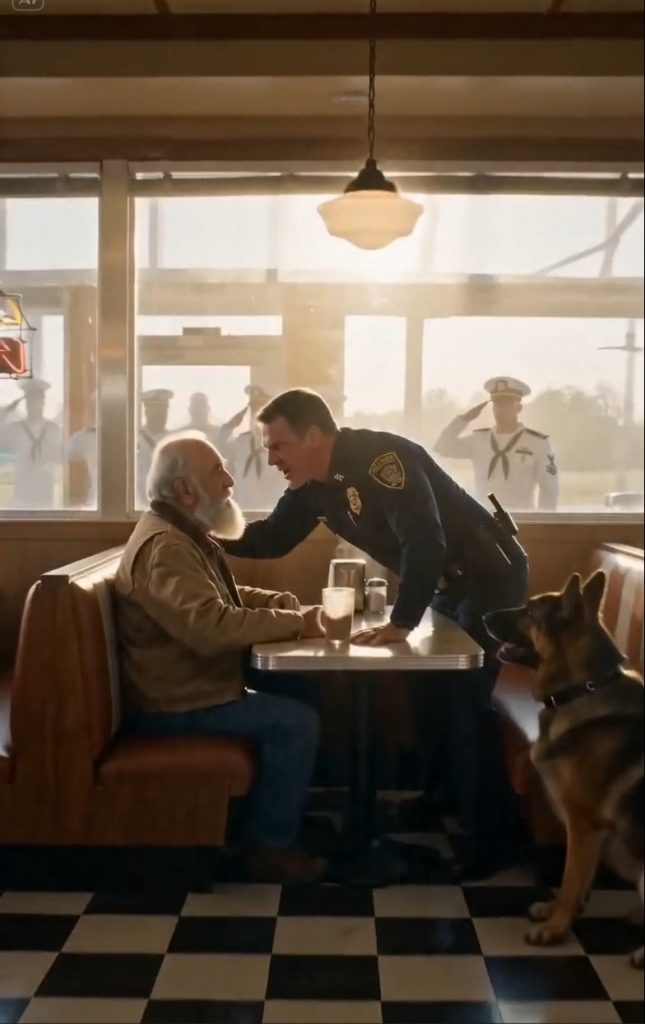
Coffee trembled across the chipped white rim, spilling in a dark crescent onto the wooden table. Around the diner, conversation died in pieces. Forks paused above pancakes. A waitress froze beside the counter with a pot of coffee in her hand. Sunlight poured through the front windows, warm and golden, touching the checkered floor as if the morning had not just turned dangerous.
Police Chief Warren Pike stood over the booth in full uniform, his gold badge bright against his navy shirt.
His hand was planted flat on the table.
His other hand gripped the old man’s shoulder.
“I told you to be gone by sunrise,” Pike said. “In this town, my word is the only law that matters.”
The old man sat still.
He had a thick white beard, a tan utility jacket, and a red plaid shirt buttoned neatly beneath it. To anyone passing by, he looked like a tired drifter who had wandered into the wrong diner with one loyal German Shepherd at his feet.
But the dog did not look lost.
He sat alert beside the booth, black-and-tan body still, eyes locked on the Chief’s hand.
The old man slowly glanced down at Pike’s fingers digging into his shoulder.
Then he looked back up.
Not afraid.
Disappointed.
“You’re making a mistake, Chief,” he said, his voice low and rough. “One you won’t be able to walk back.”
Pike leaned closer, teeth showing in a cruel smile.
“Is that so? And who’s going to stop me?”
The diner door opened behind him.
Three Navy sailors in crisp white uniforms stepped inside and stopped at once. They did not move toward the counter. They did not ask for a table.
They snapped into a sharp salute.
Then a man in a dark green dress uniform entered behind them.
A General.
His chest was lined with medals. His face was calm in a way that made the room colder. His eyes went straight to Pike’s hand on the old man’s shoulder.
And something deadly quiet moved across his expression.
Pike did not see him yet.
He yanked the old man upward, his other hand reaching toward the baton at his belt.
The German Shepherd moved first.
One bark.
One clean, controlled lunge.
The dog pinned Pike’s reaching arm against the edge of the table, holding him there with a warning growl that froze every person in the diner.
Pike gasped.
The General crossed the room in heavy, measured steps.
He stopped behind the Chief and placed one gloved hand over Pike’s holster.
“Chief,” he said, his voice cold enough to cut glass, “do you have any idea who you just touched?”
Pike turned his head.
The old man stood to his full height.
The weary curve vanished from his back. His shoulders squared. His eyes sharpened with the authority of someone who had once commanded men into storms and brought them home alive.
Pike’s face went pale.
Because the old man in the booth was not a drifter.
He was the reason the General was alive.
Act II
His name was Thomas Hale, though most of the town had only heard him called “that old man with the dog.”
He had arrived in Briar Harbor three weeks earlier on a bus from Norfolk, carrying one canvas duffel, a folded military coat, and a German Shepherd named Ranger. He took the corner booth at Mabel’s Diner every morning at 6:15, ordered black coffee, dry toast, and one scrambled egg for the dog.
Mabel pretended not to notice the egg.
Thomas paid in cash, tipped too much, and listened more than he spoke.
That was what made Pike nervous.
Chief Warren Pike liked newcomers who asked questions he could answer. Where was the motel? Where was the gas station? Was the beach road open? Those questions kept people harmless.
Thomas asked different questions.
Why had the veterans’ shelter lost its lease?
Why had the widow on Palmer Street been cited four times for property violations after refusing to sell?
Why were old Navy housing records missing from the county archive?
Why did police patrols seem to arrive faster for developers than for the families being pushed out of their homes?
People told him things because he looked like nobody.
A retired fisherman told him Pike’s cousin had bought half the old harbor district through shell companies. A waitress whispered that two former sailors had been arrested for trespassing on land their families had used for decades. A mechanic showed him bruised pride and a broken tow invoice after refusing to move a disabled veteran’s truck from a disputed lot.
Thomas wrote everything down in a little black notebook.
Pike noticed by the second week.
By the third, the Chief appeared at Mabel’s with two officers and a smile too hard to be friendly.
“Briar Harbor isn’t a charity camp,” Pike told him the first time. “You passing through?”
Thomas took a sip of coffee.
“Maybe.”
“Then pass.”
Thomas did not.
That was the problem.
The truth was that Thomas Hale had not come to Briar Harbor by accident.
Forty-eight years earlier, he had shipped out from that very harbor as a young Navy officer with more courage than sense. He survived storms, combat operations, political scandals, and the kind of commands that left men older than their years. He retired quietly with a rank people still spoke carefully around.
Admiral Thomas Hale.
But he had not returned for ceremony.
He came because of a letter.
It had been written by Mabel’s older brother, Frank, a former Navy corpsman who once served under Hale and later became the unofficial guardian of every veteran in Briar Harbor who fell through the cracks.
Admiral,
Something rotten has taken hold here. They’re pushing out the old families, especially the ones with military land claims. Police are helping. Records are disappearing. Men are afraid to talk. I’m sicker than I’ve told anyone, and I don’t trust the county.
If you still remember this town, come before there is nothing left to remember.
Frank died before Hale arrived.
The official cause was heart failure.
Thomas did not question that.
But he questioned the missing files from Frank’s desk.
He questioned the eviction notice taped to the veterans’ shelter door two days after Frank’s funeral.
Most of all, he questioned Pike’s sudden interest in making an old stranger leave town before sunrise.
That morning, Thomas knew the confrontation was coming.
He had sent one message the night before.
Not to the police.
Not to the mayor.
To a man who once owed him his life in a country neither of them liked to name aloud.
General Marcus Reed.
And Marcus Reed had not come alone.
Act III
Ranger released Pike only when Thomas gave the command.
“Stand down.”
The dog stepped back at once, still watching the Chief with disciplined attention. Pike clutched his arm against his chest, stunned more than hurt, his eyes darting between the old man, the dog, and the General standing behind him.
The sailors at the door remained in salute.
Thomas looked at them and gave a small nod.
Only then did they lower their hands.
Pike tried to recover his voice.
“This man’s dog attacked a police officer.”
General Reed’s expression did not change.
“This man’s dog prevented you from drawing a weapon on a decorated veteran inside a civilian diner.”
Pike swallowed.
“I didn’t draw—”
“Your hand was on the baton,” Mabel said from behind the counter.
Everyone turned.
Mabel was in her sixties, narrow-shouldered and fierce-eyed, wearing a blue diner apron and holding the coffee pot like she might use it if necessary.
Pike glared at her.
“Mabel, don’t get involved.”
She stepped forward.
“My brother got involved for men like you until the day he died.”
The diner went silent again.
Thomas looked at her, and for the first time that morning, his face softened.
Pike saw the shift and understood too late that the room was no longer his.
The General removed a folded document from inside his jacket and placed it on the table.
“Chief Warren Pike,” he said, “federal investigators are already reviewing complaints regarding unlawful intimidation, coerced property transfers, and destruction of military housing records tied to the Briar Harbor redevelopment project.”
Pike’s mouth opened.
No sound came.
Thomas reached into his jacket and took out the little black notebook.
“I was hoping,” he said quietly, “that Frank had exaggerated.”
Mabel’s eyes filled.
Thomas laid the notebook beside the General’s document.
“He didn’t.”
One of Pike’s officers, a young deputy near the door, shifted uneasily.
Pike snapped, “Stay where you are.”
The deputy looked at him, then at Thomas.
Then he removed his badge from his belt and placed it on the nearest table.
“I can’t,” the deputy said.
Pike stared at him.
The deputy’s voice shook, but he kept speaking.
“They made me sign the Palmer Street citations. The widow’s porch wasn’t unsafe. The shelter calls weren’t disturbances. Pike told us to build a record so the town could condemn the properties.”
A murmur rippled through the diner.
Pike’s face went red again.
“You shut your mouth.”
“No,” Thomas said.
One word.
The old Admiral’s voice did not rise.
It did not have to.
Men who once commanded destroyers through black water do not need volume to be heard.
Thomas stepped closer to Pike.
“For years, men like you have survived because decent people were too tired, too poor, or too afraid to fight paperwork backed by badges.”
His eyes narrowed.
“But you put your hand on the wrong shoulder this morning.”
Pike looked toward the door.
Two more vehicles had pulled up outside.
Black government sedans.
The General glanced through the window.
“And now,” he said, “you’re out of time.”
Act IV
The first federal agent entered without drama.
No drawn weapon. No shouting. No theater.
Just a gray suit, a leather folder, and the calm expression of a man who had already read enough.
“Chief Pike,” he said, “we need you to come with us.”
Pike laughed once.
It sounded broken.
“This is my jurisdiction.”
Thomas looked around the diner.
At the sailors near the door.
At Mabel gripping the counter.
At the deputy whose hands were trembling after finally telling the truth.
At the old men in corner booths who had spent years lowering their eyes when Pike walked in.
“No,” Thomas said. “This is your evidence.”
The agent nodded to two others behind him.
Pike stepped back.
“General, you’re making a mistake. You don’t understand local politics.”
General Reed finally moved closer.
His face was inches from Pike’s now.
“I understand power used against people who trusted a uniform. I understand chain of command. I understand cowardice wearing rank. And I understand that the man you just tried to drag out of this diner carried me two miles with a broken leg under fire.”
Pike’s expression shifted.
The diner seemed to inhale.
General Reed’s voice lowered.
“When I was twenty-three, I thought I was dead. Admiral Hale told me I was not allowed. He put me on his back and walked through smoke until medics found us.”
Thomas looked away, uncomfortable with the memory being spoken aloud.
Marcus Reed was not.
“So when I walked in here,” the General continued, “and saw your hand on him, you should be grateful I remembered I was in a diner.”
Pike went very still.
The agents took his service weapon first. Then his radio. Then the gold badge from his chest.
That was when the room changed.
Not when the dog lunged.
Not when the General spoke.
When the badge came off.
Because everyone in Briar Harbor had seen Pike use that badge like a wall. A shield for himself. A hammer for everyone else. Watching it leave his uniform made him look suddenly ordinary.
Ordinary men have to answer questions.
Pike’s eyes found Thomas one last time.
“You think this town will thank you?”
Thomas’s face was unreadable.
“No. I think some will resent me for making them admit what they tolerated.”
Mabel whispered, “Not all of us.”
Thomas looked at her.
She reached beneath the counter and pulled out a metal cash box. Inside were letters, photographs, copies of complaints, and Frank’s last notebook.
“My brother made copies,” she said. “I was too scared to know what to do with them.”
Thomas took the notebook carefully.
“You kept them safe.”
Mabel shook her head, crying.
“I kept them hidden.”
“For today,” Thomas said.
That was mercy.
She knew it.
Pike was led outside past the sailors, past the black sedans, past the people gathering on the sidewalk as the news moved through town faster than sirens.
Ranger sat beside Thomas again.
Calm.
Watchful.
His work done.
But Thomas did not sit back down.
He looked at the booth, at the spilled coffee, at the place where Pike’s hand had been.
Then he turned to the diner.
“Who else has something to say?”
One by one, people stood.
Act V
By sunset, the diner had become more than a diner.
It became a confession room.
A widow brought property notices from her purse. A fisherman brought photographs of survey markers that appeared on his land before any public hearing. A former clerk from the county archive admitted she had been ordered to remove records tied to veterans’ land grants.
The young deputy gave a formal statement.
Then another officer did.
Then a third.
Not because they were suddenly brave.
Because someone had finally made cowardice more uncomfortable than truth.
Thomas sat in the corner booth with Frank’s notebook open beside him, listening to each person as if rank had never made him too important for ordinary pain. Ranger lay at his feet. General Reed stood near the door, arms folded, making sure no one mistook quiet for weakness.
By morning, Briar Harbor had federal agents in town hall, auditors in the redevelopment office, and news vans parked near the harbor.
Pike’s allies began distancing themselves immediately.
They used words like misunderstanding, procedural concerns, isolated conduct.
Mabel went on local television and used simpler words.
“They tried to steal this town from the people who kept it alive.”
The clip spread.
So did the story of the old man in the diner.
People loved the dramatic version.
The corrupt Chief. The loyal dog. The General at the door. The secret Admiral in the booth.
Thomas hated that version.
It made the truth too neat.
The truth was that Frank had died afraid. Mabel had lived afraid. Widows had signed papers they did not understand because a badge made the threat look official. Veterans had slept in cars while developers toasted zoning changes over steak dinners.
One powerful old man arriving did not fix that.
But it cracked the door open.
After Pike was indicted, after the redevelopment project froze, after the shelter lease was restored and the missing records began reappearing in court filings, Thomas returned to Mabel’s Diner.
This time, nobody pretended not to stare.
He took the same booth.
Mabel brought coffee.
“Egg for Ranger?” she asked.
Thomas looked down at the dog.
Ranger’s ears lifted.
“One,” he said. “Don’t tell him he’s famous.”
Mabel smiled for the first time in weeks.
She poured his coffee and stood there a moment too long.
“My brother knew you’d come.”
Thomas’s expression softened.
“I should have come sooner.”
“He wouldn’t want you wasting time on that.”
“He always was better at forgiveness than I was.”
Mabel placed Frank’s notebook on the table.
“It belongs with you.”
Thomas shook his head.
“No. It belongs here.”
He looked around the diner: the counter, the booths, the checkered floor, the sunlight through the windows.
“Put it in a frame,” he said. “Let people remember who started telling the truth before the General walked in.”
So she did.
A month later, the wall near the register held a framed page from Frank’s notebook. Beneath it was a small brass plaque.
For those who spoke before it was safe.
The diner filled again after that.
Not with fear.
With arguments, laughter, coffee, sailors, widows, mechanics, veterans, children, and townspeople who had learned that law did not belong to the loudest man in uniform.
Thomas stayed in Briar Harbor through the hearings.
He testified once.
He did not mention medals. He did not mention war. He did not mention carrying General Reed through smoke until an attorney forced the record to include his rank.
When asked why he came to town pretending to be an ordinary old man, Thomas looked confused.
“I didn’t pretend,” he said. “I am an ordinary old man.”
The courtroom went quiet.
Then he added, “That should have been enough to keep a police chief from putting hands on me.”
That sentence made the front page.
Years later, people still told the diner story whenever someone new came to Briar Harbor.
They pointed to the booth. They pointed to the framed notebook. They pointed to the floor where Ranger had stood.
The story grew in the telling, as stories do.
Some said the General brought a whole convoy. Some said the dog knocked Pike across the diner. Some said Admiral Hale had planned the entire thing from the beginning like a military operation.
Thomas never corrected every detail.
But when children asked him what really happened, he gave the same answer.
“A man with power forgot that a badge is not a crown. A town forgot that silence is not safety. And one dog remembered his training better than most humans remembered their conscience.”
Then he would scratch Ranger behind the ears.
The dog would close his eyes, pleased with the only praise that mattered.
As for Chief Pike, his name became a warning in police academies and city council rooms across the state. Not because he was unusual, but because he had been exposed. That distinction mattered to Thomas.
Corruption did not begin with envelopes of cash or secret meetings.
It began when one person decided another was too small to matter.
Too old.
Too poor.
Too quiet.
Too alone.
That morning in the diner, Pike saw a frail old man in a booth and thought he was safe to humiliate.
He never understood that dignity does not disappear because power fails to recognize it.
And when General Marcus Reed stepped through the door, when sailors saluted, when the old man rose to his full height and the Chief’s face drained of color, Briar Harbor learned something it should never have forgotten.
The law is not the voice of the man who shouts the loudest.
It is the promise that even the quietest person in the room cannot be touched without consequence.