Act I
The old man did not look up when the first laugh landed.
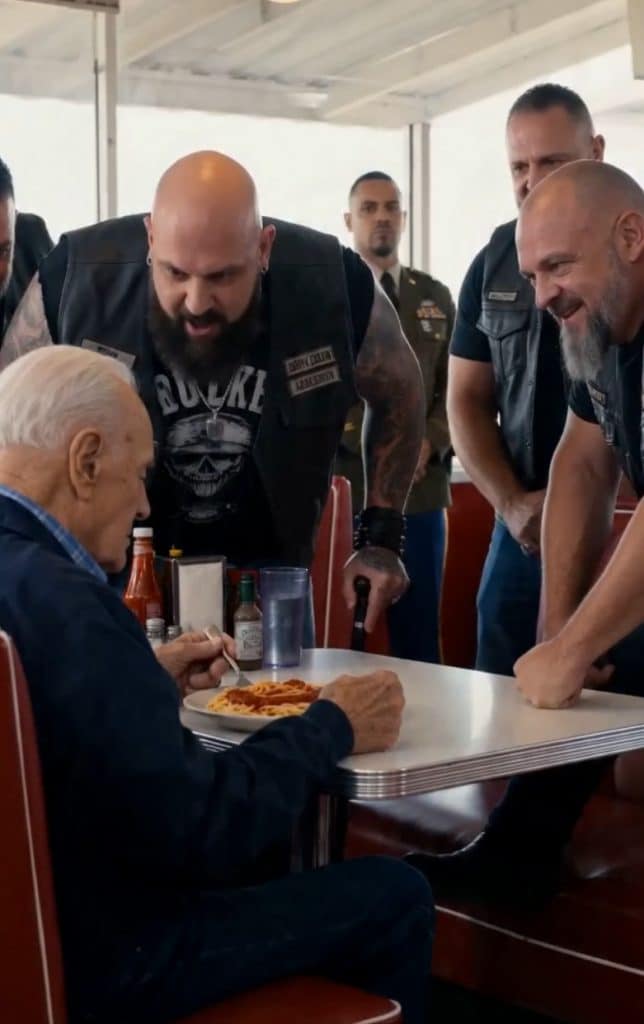
He sat alone in the corner booth of Rosie’s Diner, one hand resting beside a plate of spaghetti and meatballs, the other curled loosely around a fork. Morning light spilled through the window behind him, catching the silver ring on his finger.
It was large, old, and worn smooth around the edges.
A military ring.
The kind that looked less like jewelry and more like a piece of history someone had carried through fire and kept wearing because taking it off would feel like betrayal.
Across the diner, four bikers watched him.
They had come in loud, all leather vests, chains, boots, and swagger. Their motorcycles sat outside the window, chrome shining beneath the sun. The biggest of them was bald, bearded, and built like a locked door. He carried a black cane, though he did not need it.
He used it the way some men used laughter.
As a threat disguised as style.
He stopped beside the old man’s booth and leaned down until his face was inches away.
“Hey, old timer,” he said, raspy and loud. “Wrong place for a history lesson.”
His friends laughed.
The old man lifted a forkful of spaghetti and took a slow bite.
No reaction.
No fear.
No anger.
That bothered the biker more than any insult would have.
He tapped the cane against the checkered floor.
“Still eating like it’s army rations, huh?” he said, grinning. “This place isn’t a museum, grandpa.”
More laughter.
The waitress behind the counter tightened her grip on the coffee pot. A young couple in the next booth looked down at their plates. Nobody wanted trouble. Nobody wanted the bikers to turn their attention elsewhere.
The old man chewed, swallowed, and placed the fork down with careful precision.
Then he looked up.
His eyes were pale, tired, and absolutely steady.
The biker’s grin flickered.
Only for a moment.
Then he straightened and turned away, pretending he had won.
“Come on,” he said to his friends. “Let the fossil finish his paste.”
They started toward the door.
Then the biker stopped.
He looked back.
The old man had returned to his meal.
That calm was too much.
With one sudden sweep of his hand, the biker knocked the plate across the table. Spaghetti slid over the white surface. Sauce splattered the napkins. The fork clattered to the floor.
The diner went silent.
The old man’s hands froze in midair.
For the first time, his expression changed.
Not rage.
Not humiliation.
Something colder.
The biker smirked.
“Oops.”
Then the bell above the diner door rang.
The bikers turned toward the entrance, still smiling.
Their smiles died together.
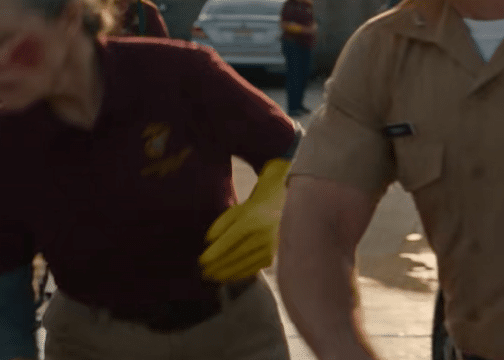
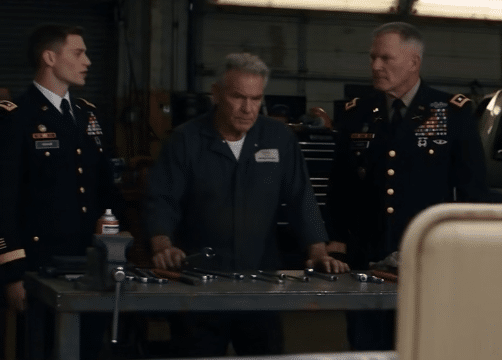
A tall man in a dark green U.S. Army Service Uniform stood in the doorway, sunlight burning around his outline. Four stars gleamed on his shoulders. Medals filled his chest. Two Military Police officers stood behind him, stone-faced and still.
The General ignored the bikers completely.
He walked straight to the old man’s booth.
Then he raised his hand in a perfect salute.
“Master Sergeant Hayes,” he said, voice deep with respect, “the President is waiting for you.”
The biker’s cane slipped from his hand and hit the floor with a hollow thud.
Act II
Master Sergeant Henry Hayes had been ignoring fools for longer than most men had been alive.
At eighty-eight, he had learned that not every insult deserved oxygen. Some men wanted a reaction because without one, their cruelty had nowhere to go. Henry had seen boys become monsters in uniform, cowards become loud in bars, and powerful men crumble when silence refused to flatter them.
So he stayed quiet.
That did not mean he was weak.
Weakness had never carried a wounded radio operator across a frozen ridge.
Weakness had never walked through smoke with three soldiers tied together by rope because visibility was gone and the evacuation point had disappeared under enemy fire.
Weakness had never written seventeen letters to seventeen mothers because command sent the official versions, but Henry believed someone should tell them what their sons had been like before fear found them.
He had served in Korea as a young man and later in Vietnam as an older one. He had trained soldiers who became officers, officers who became generals, and generals who still lowered their voices when they spoke his name.
But in Rosie’s Diner, he was just an old man in a blue plaid shirt and navy jacket.
That was how he preferred it.
He had returned to the diner because of a promise.
Fifty-nine years earlier, on the morning before his first deployment with the woman he would marry waiting beside him, Henry had eaten spaghetti at that same counter because Rosie’s mother, the original owner, refused to let a soldier ship out on an empty stomach.
His wife, Clara, had laughed at him.
“Spaghetti for breakfast,” she said. “That’s either bravery or proof you should not be trusted with choices.”
Henry told her if he made it home, they would eat it there every year.
And they did.
Every anniversary, no matter where life had taken them. Every promotion. Every hardship. Every time Clara worried the old war had crept too close to his eyes, she brought him back to Rosie’s and ordered spaghetti before noon.
Clara had died the previous winter.
This was the first time Henry came alone.
He had not told anyone.
That was why the General was late finding him.
The White House ceremony was scheduled for that afternoon. Henry was to receive the Medal of Honor upgrade that had been buried in paperwork for half a century, along with a Presidential commendation for classified actions finally released from the shadows.
He had resisted the ceremony.
“Give it to the dead,” he told the Army liaison.
The liaison, a colonel too young to argue properly, said, “Sir, most of them are dead. They asked for you.”
That was what changed his mind.
Not the medal.
The names.
Men who had followed him through impossible terrain. Men whose grandchildren wrote letters asking whether their grandfather had been brave. Men whose stories had been sealed so long their families had mistaken silence for absence.
Henry agreed to attend.
But before the convoy, before the cameras, before the President’s hand and the polished speeches, he wanted one quiet plate of spaghetti in the booth Clara loved.
No escort.
No announcement.
No fuss.
Just memory.
Then the bikers walked in.
And one of them decided an old man alone was safe to humiliate.
The General now standing beside the booth knew better than anyone how wrong that was.
His name was Marcus Bell.
Forty years earlier, Henry Hayes had found him under a collapsed wall in a village no map admitted mattered. Marcus was twenty-three then, bleeding, trapped, certain he would die with dust in his mouth and fear in his chest.
Henry had pulled him free.
When Marcus begged him to leave him behind because carrying him would slow everyone down, Henry said, “Son, I have been ignoring stupid orders all my life. Don’t make yours the first one I obey.”
Marcus Bell lived.
He became a General.
And he never forgot the sound of Master Sergeant Hayes refusing to let death make the decision.
Now he looked at the spilled spaghetti, the fallen fork, the old man’s steady hands, and the bikers frozen near the door.
His voice dropped.
“Who touched his table?”
The diner held its breath.
Act III
The biker tried to laugh.
It came out wrong.
Thin.
He glanced at the MPs, then at the General’s medals, then at Henry as if the old man had changed shape while he wasn’t looking.
“Look,” he said. “We were just messing around.”
General Bell did not turn toward him yet.
That made it worse.
Men like that biker were used to being stared at, challenged, feared. Being ignored by power was something new. It made him look suddenly smaller in his leather vest.
The waitress, Rosie’s granddaughter, stepped forward from behind the counter.
“He knocked the plate off,” she said, voice shaking. “The old man didn’t do anything.”
Henry glanced at her.
“Thank you, Annie.”
She blinked.
“You remember my name?”
Henry smiled faintly.
“I remember your grandmother yelling at me for putting hot sauce on her marinara.”
Annie’s eyes filled.
The General finally turned.
“What is your name?” he asked the biker.
The man straightened automatically, then seemed irritated with himself for doing it.
“Duke.”
“Your legal name.”
The biker’s jaw tightened.
“Darren Cole.”
One of the MPs wrote it down.
Darren’s eyes flicked to the notebook.
“Hold on. You can’t arrest me for knocking over pasta.”
“No,” General Bell said. “But local police can charge you for harassment, disorderly conduct, and destruction of property if the owner chooses to file. And considering this diner is under federal protective detail for the next two hours because of Master Sergeant Hayes’s scheduled transport, your morning may become very inconvenient.”
Darren’s face drained.
“Federal what?”
Henry sighed.
“Marcus.”
The General softened immediately.
“Yes, Sergeant?”
“I came here to eat.”
Bell looked at the table.
“I can see that.”
“I don’t need a circus.”
“No, sir.”
Henry’s eyes moved to the ruined spaghetti.
For the first time, pain crossed his face.
Not because of the food.
Because of what the meal had been.
Annie saw it and understood before anyone else did.
“I’ll make another plate,” she said quickly. “On the house.”
Henry shook his head.
“I pay my debts.”
“Then pay with a story,” she said, wiping her eyes. “Grandma always said you owed her one.”
The corner of Henry’s mouth moved.
The General looked toward the bikers.
“Sit down.”
Darren stared.
“What?”
“Sit down,” Bell said, calm and cold. “All four of you.”
The bikers looked toward the door.
The MPs shifted slightly.
The bikers sat.
Not in Henry’s booth.
At the table across from it, where they could see the mess they had made and the man they had mocked.
Darren’s voice lowered.
“This is ridiculous.”
Henry turned his ring slowly around his finger.
“It usually feels that way when consequence arrives late.”
Darren had no answer.
The diner remained quiet while Annie cleaned the table. She did it carefully, as if wiping away the sauce too roughly might insult the memory attached to it. Henry watched her with a stillness that made the whole room understand there was more happening than a ruined meal.
General Bell removed his cap and sat opposite Henry.
Only then did his voice change from command to something almost gentle.
“Sir, we’ve been looking for you for forty-seven minutes.”
Henry looked out the window at the motorcycle parked in the sun.
“I needed to come here first.”
“I know.”
“No,” Henry said quietly. “You don’t.”
The General looked down.
Henry’s voice became softer.
“She hated ceremonies.”
Bell understood then.
“Mrs. Hayes.”
Henry nodded once.
The diner, even the bikers, went perfectly still.
And the old soldier, who had ignored insults without blinking, finally looked like a man trying not to break.
Act IV
Annie brought the second plate of spaghetti with both hands.
She set it down in front of Henry like an offering.
No one joked this time.
No one moved.
The bikers sat stiffly at the next table, their earlier swagger gone. One of the younger men looked embarrassed. Another stared at the floor. Darren kept his arms crossed, but his face had lost its color.
Henry picked up the fork.
Then stopped.
He looked at the empty seat beside him.
For fifty-nine years, Clara had sat there.
She had stolen meatballs from his plate. Corrected his stories. Told young soldiers he was not nearly as frightening as he looked. Held his hand under the table during anniversaries when the memories came too close.
Now the red vinyl seat was empty.
Henry set the fork down.
General Bell reached into his uniform pocket and pulled out a small folded envelope.
“Sir,” he said. “This was given to me by your daughter. She said Mrs. Hayes wrote it before she passed. She told us to give it to you only if you tried to run from the ceremony.”
Henry closed his eyes.
“That woman.”
“She knew you well.”
Henry took the envelope.
His hands, steady through the insult and the confrontation, trembled now.
On the front was Clara’s handwriting.
Henry, stop being stubborn.
A laugh moved through the diner.
Small. Gentle.
Even Henry let out a breath that almost became one.
He opened the letter.
My love,
If Marcus is handing you this, it means you disappeared before the ceremony and everyone is pretending to be surprised.
I am not surprised.
You never liked rooms where people clap for things that cost someone else their life.
But you are going anyway.
Not for the medal. Not for the President. Not for the cameras.
For the boys who did not come home. For the wives who waited. For the children who were told nothing because the truth was locked away in government drawers. For every name you carried when your own back should have been allowed to rest.
And for me.
Because I sat beside you for fifty-nine years, and I know this much: hiding from honor does not bring back the dead. Sometimes it only hides the living from the light they earned.
Eat your spaghetti. Then go.
I love you.
Clara
Henry folded the letter slowly.
The diner blurred around him.
He wiped one eye with the back of his hand and then, as if embarrassed by the tenderness of being human, cleared his throat.
“Bossy until the end.”
General Bell smiled.
“Yes, sir.”
Henry picked up the fork again.
This time, he ate.
No one spoke while he took the first bite.
It felt less like breakfast than a salute.
Then Darren shifted in his chair.
“I didn’t know,” he muttered.
Henry looked at him.
The biker swallowed.
“I didn’t know who you were.”
The diner went cold.
Henry placed the fork down.
“That’s your apology?”
Darren’s jaw worked.
“I mean, if I’d known—”
“If you’d known I mattered?”
Darren looked away.
Henry’s voice did not rise.
“That is the disease in you, son. You think respect is owed only after rank is revealed.”
The words struck harder than any punch could have.
Darren stared at the table.
Henry continued.
“You saw an old man alone and thought he was safe to humiliate. Not because I insulted you. Not because I harmed you. Because you believed no one would make you answer for it.”
One of Darren’s friends whispered, “Duke, just apologize.”
Darren’s face tightened.
But the fight had gone out of him.
He looked at Henry.
“I’m sorry.”
Henry studied him for a long moment.
“Good,” he said. “Now you can start proving it.”
Darren frowned.
“How?”
Annie answered before Henry could.
“You can clean the table you ruined. Then the floor. Then you can pay for every meal in this diner for every veteran here today.”
Darren looked around.
At least six older men were seated in booths and at the counter, some wearing caps, some not.
General Bell added, “And after that, you can explain to the local officers arriving outside why you chose this morning to harass a protected federal honoree.”
Darren turned toward the window.
A police cruiser had pulled in beside the motorcycles.
His cane rested on the floor where he had dropped it.
For the first time, he looked like a man who understood that intimidation is fragile when no one agrees to be afraid.
Act V
Henry finished half the spaghetti.
That was all he could manage.
Annie packed the rest in a white takeout box and wrote Clara’s name on the lid without asking. When Henry saw it, he pressed his thumb over the ink for a moment and nodded.
Darren and his friends cleaned the table.
Awkwardly.
Badly at first.
Then properly when Annie corrected them with the authority of someone whose patience had limits. The younger bikers kept their heads down. Darren moved stiffly, face burning, aware of every diner patron watching him do the kind of work he had once considered beneath him.
No one mocked him.
That was the difference.
Humiliation had been his language.
Accountability did not need to speak it back.
The local police took statements outside. The MPs remained near the door. General Bell waited beside the booth while Henry put on his jacket and slipped Clara’s letter into the inner pocket, close to his heart.
When Henry finally stood, the diner rose with him.
Not all at once.
One man at the counter stood first. Then Annie. Then the young couple. Then the old veterans in the corner. Soon every person in Rosie’s Diner was on their feet.
Henry looked deeply uncomfortable.
General Bell leaned toward him.
“Let them, sir.”
Henry breathed in slowly.
Then he gave the room a small nod.
Not dramatic.
Not grand.
Enough.
Outside, the black government car waited behind the police cruiser. Beyond it, the motorcycles gleamed in the sun, suddenly looking less like symbols of power and more like machines left by boys who had mistaken noise for courage.
Darren stood near them, hands at his sides.
He looked at Henry.
“I really am sorry,” he said.
Henry paused.
The General and MPs waited.
Henry could have ignored him.
Instead, he walked closer.
“Were you ever in?” he asked.
Darren blinked.
“Military?”
Henry nodded.
“No.”
“Then stop playing soldier with frightened people.”
Darren’s face tightened, but he accepted it.
Henry looked toward the diner window, where Annie still stood watching.
“There’s a veterans’ home three miles east of town,” he said. “Roof needs work. Dining room needs paint. Men there need someone strong enough to lift things and humble enough to listen. You want to prove sorry, start there.”
Darren swallowed.
“Yes, sir.”
Henry’s eyes sharpened.
“Don’t call me sir because a General did.”
Darren nodded slowly.
“Yes, Mr. Hayes.”
Henry accepted that.
Then he got into the car.
The ride to the ceremony was quiet.
General Bell sat across from him, hands folded over his cap. For several miles, neither man spoke.
Finally, Bell said, “Clara would have enjoyed watching you make that man clean sauce off a table.”
Henry looked out the window.
“She would have made him do the windows too.”
The General laughed.
So did Henry.
Softly.
For a moment, he was not a legend on the way to the President. Not a Master Sergeant. Not a man whose records had been declassified after most of the witnesses were gone.
He was a widower with half a plate of spaghetti in a box, carrying a letter from the woman who still knew how to order him around from beyond the grave.
The ceremony that afternoon was broadcast nationally.
The President spoke of courage, sacrifice, classified missions, lives saved, and a generation that carried silence with dignity. Henry stood straight beneath the lights, thinner than he had once been, older than the country seemed ready to admit heroes could become.
When the medal was placed around his neck, he did not smile for the cameras.
He looked past them.
At the families seated in the front rows.
At the children and grandchildren of men he had served with.
At General Bell, standing rigid with tears in his eyes.
And at the empty chair reserved for Clara.
After the applause, Henry stepped to the microphone.
His speech was shorter than anyone expected.
“I accept this,” he said, “on behalf of the men who did not get to grow old enough to be mistaken for weak.”
The room went silent.
He continued.
“Getting old is not a loss of honor. Being quiet is not an absence of courage. And no person becomes small because time has bent their back or slowed their hands.”
He paused.
His fingers touched the silver ring.
“If you want to know the character of a nation, watch how it treats the people it thinks no longer have power.”
That line made the evening news.
But Henry did not care about that.
He cared about the letter in his pocket.
He cared about the names finally spoken.
He cared that, the next Saturday, Annie called him to say four bikers had shown up at the veterans’ home with paint rollers, lumber, and the terrified politeness of men trying to become better before anyone praised them for it.
Darren lasted the whole day.
Then came back the next week.
And the week after that.
Henry never called it redemption.
That word was too easy.
But he believed in beginnings.
Months later, Rosie’s Diner framed a photograph near the register.
In it, Master Sergeant Henry Hayes stood between General Marcus Bell and Annie, holding a white takeout box labeled Clara. The booth behind them was clean. Ranger, the diner dog who belonged to no one and everyone, slept near the door. Outside the window, a motorcycle leaned in the sun.
Beneath the photo was a small brass plaque.
Respect people before you know who they are.
Years later, people would still tell the story of the biker who knocked an old man’s food off the table and froze when a four-star General walked in.
They loved the twist.
The salute.
The President waiting.
The cane hitting the floor.
But Henry always believed the real story happened before the General arrived.
It happened when an old man sat quietly in a booth, carrying a lifetime no stranger could see.
It happened when a bully looked at age and mistook it for emptiness.
It happened when a ruined plate of spaghetti revealed the difference between power and honor.
Because power can crowd a booth, raise a voice, swing a hand, and make a room go silent.
But honor can sit alone, eat slowly, and wait.
And when it finally stands, even the loudest men remember how small they really are.