Act I
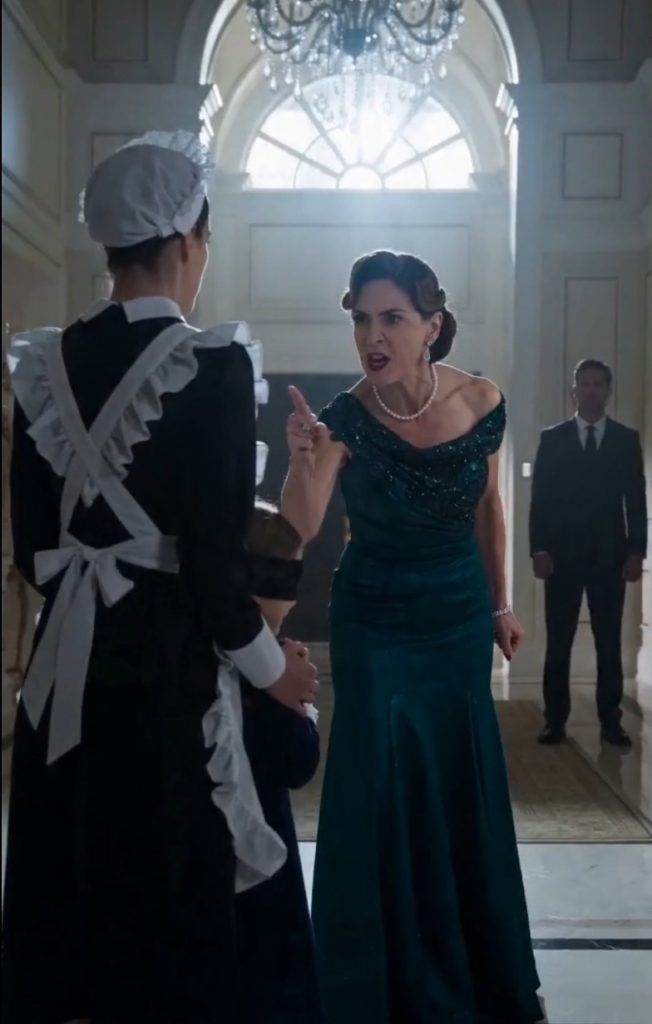
The chandelier trembled when Madame Eleanor screamed.
“Enough! Stop!”
Her voice sliced through the grand hallway, sharp enough to make the servants freeze behind half-closed doors. Sunlight poured through the arched windows and spilled across the polished marble floor, too bright and beautiful for the cruelty unfolding beneath it.
Eleanor Hawthorne stood in the center of the foyer like a queen dressed for war.
Her emerald gown shimmered with beads and sequins. Pearls circled her throat. Diamond earrings caught the light every time her head jerked forward in rage.
In front of her, Maria stood with both arms wrapped around a little girl in a navy dress.
The child was blindfolded.
Black satin covered her eyes, tied too tightly around the back of her head. Tears had soaked through the lower edge and streaked down her cheeks. Her small hands clutched Maria’s apron as if the maid were the only solid thing left in the world.
“You are nothing in this house!” Eleanor screamed. “I need to punish you! You don’t belong here!”
The child whimpered.
Maria felt the sound pass through her like a blade.
She had been taught never to raise her voice in the Hawthorne mansion. Never argue with family. Never stand too tall before guests. Never forget the invisible line between those born to command and those hired to serve.
But there are moments when fear becomes smaller than love.
Maria stepped forward.
She gently pushed the child behind her and spread both arms wide.
“Enough!” she shouted. “Leave the child alone!”
The hallway went silent.
Eleanor’s pointing hand wavered.
For one impossible second, the mansion itself seemed shocked that a maid had dared to fill it with a command.
In the shadowed doorway at the far end of the hall, Thomas Hawthorne stood motionless.
The father.
The master of the house.
The man who should have crossed the marble the moment his daughter cried.
But he did not move.
His face was pale. His black suit hung perfectly from his shoulders. His hands stayed at his sides, useless and still.
Eleanor recovered first.
Her eyes narrowed at Maria.
“How dare you.”
Maria’s heart pounded, but she did not step aside.
Behind her, little Clara Hawthorne pressed her face into Maria’s skirt, trembling so hard the lace on Maria’s apron shook.
Eleanor looked past the maid at the blindfolded child.
“That girl has ruined this family since the day she was born.”
Thomas flinched.
Only slightly.
Maria saw it.
And in that tiny movement, she understood something terrible.
He had heard it all before.
But this time, Maria would not let silence win.
Because under Clara’s collar, hidden against the child’s chest, was the key to the secret Eleanor had been trying to bury for three years.
Act II
Before Eleanor came, the mansion had not felt cold.
It had been grand, yes. Too large for a child. Too polished for ordinary life. But when Clara’s mother was alive, there had been music in the rooms and fresh flowers near the stairway.
Isabelle Hawthorne had not been like other wealthy women Maria had served.
She said thank you and meant it. She knew every maid by name. She let Clara run through the hallways in socks because she said children should leave proof they were alive.
Maria had been hired first as a junior housemaid, then as Clara’s nursery attendant.
By the time Clara was four, Maria knew the child’s moods better than anyone. Clara liked stories with brave mice, hated carrots, and slept only if someone hummed beside her door.
Then Isabelle got sick.
Not all at once. Slowly enough that people could pretend it was fatigue, then stress, then weakness from travel. The doctors came and went. Thomas grew thinner from worry. Maria often found Isabelle awake at night, writing letters at the desk in the nursery while Clara slept nearby.
One night, Isabelle called Maria close.
“If anything happens to me,” she whispered, “do not let Eleanor near my daughter.”
Maria had not understood.
Eleanor was only Isabelle’s distant cousin then. Beautiful. Helpful. Always visiting with flowers, advice, and eyes that lingered too long on the family portraits.
Two months later, Isabelle was dead.
Six months after that, Eleanor married Thomas.
People called it practical.
The child needed a mother. Thomas needed support. The Hawthorne estate needed stability.
Maria learned then that wealthy people could make betrayal sound like housekeeping.
At first, Eleanor played the role well.
She kissed Clara’s forehead in public. She wore black for the appropriate length of time. She spoke of Isabelle with a sadness so delicate guests dabbed their eyes.
But behind closed doors, she changed the nursery.
The paintings came down. The toys were boxed away. Isabelle’s piano was locked. Clara’s drawings disappeared from the hall.
“She needs discipline,” Eleanor said. “This house has been ruled by sentiment for too long.”
Thomas heard the words and said nothing.
Grief had hollowed him out. He drifted through the mansion like a man underwater. Eleanor filled the silence around him with instructions, medicines, documents, visitors, and warnings.
Clara became quieter.
Then frightened.
Then one winter morning, Maria found the child sitting in the wardrobe with a black ribbon tied around her eyes.
“Madame says I must learn darkness,” Clara whispered. “Because bad girls should not see pretty things.”
Maria untied it with shaking hands.
That was the first time Eleanor struck her across the face.
Not hard enough to leave much of a mark.
Just enough to draw the line.
“You are paid to obey,” Eleanor said. “Not to think.”
Maria obeyed after that in all the ways that kept her near Clara.
She bowed her head. She cleaned rooms. She accepted insults. She swallowed fury until it became a stone in her chest.
But she watched.
She watched Eleanor meet lawyers in the library after midnight. She watched Thomas sign papers he barely read. She watched Clara’s name vanish from family invitations and medical schedules.
Then she found Isabelle’s final letter hidden behind a loose panel in the nursery.
It named Eleanor.
It named the trust.
It named the danger.
And it said Clara was not only Thomas’s daughter.
She was the sole heir to Isabelle’s family fortune, which Eleanor could not touch unless Clara was declared mentally unfit and removed from the estate.
Maria read the letter in the dark with her hand over her mouth.
Then she understood the blindfold.
Eleanor was not punishing Clara because the child was difficult.
She was trying to make her look broken.
And tonight, in the grand hallway beneath the chandelier, Eleanor had finally gone too far.
But the letter was not the only proof Isabelle had left behind.
Act III
Eleanor moved toward Maria slowly.
Each step of her emerald gown whispered across the runner rug like a snake through grass.
“You forget yourself,” she said.
Maria held her ground.
“No, Madame. I remember exactly who I am.”
The words startled even her.
Thomas shifted in the doorway.
Eleanor’s eyes flashed toward him, then back to Maria. She hated being challenged, but she hated witnesses more.
“Thomas,” she said coldly, “tell this girl to release Clara.”
Thomas opened his mouth.
Nothing came out.
Clara heard his silence and began to cry harder.
That was what broke Maria’s last restraint.
She turned slightly, lowering her voice.
“Clara, sweetheart, give me what your mother told you to keep.”
The child froze.
Eleanor’s expression changed.
“What did you say?”
Maria ignored her.
Clara’s small fingers trembled at her collar. Beneath the white Peter Pan edge of her dress was a thin gold chain. She tugged it free.
A tiny locket slipped into her palm.
Eleanor lunged.
Maria moved faster.
She took the locket from Clara and stepped back, holding it high.
“Don’t touch her.”
Eleanor stopped, breathing hard.
Thomas finally stepped out of the shadows.
“What is that?”
Maria looked at him with anger she had carried for three years.
“Something your wife left for your daughter. Your first wife.”
Eleanor laughed sharply.
“This is absurd. The maid has been filling the child’s head with fantasies.”
Maria opened the locket.
Inside was not a portrait.
It was a folded strip of paper, impossibly small, protected beneath the gold casing.
Thomas came closer.
Eleanor’s face drained of color.
Maria unfolded the paper with careful fingers.
The writing was Isabelle’s.
Thomas, if Clara is wearing this, then Eleanor has done what I feared. Look beneath the east staircase. Do not trust the trust papers in your desk. Do not let them take my daughter.
Thomas stared at the words.
His face collapsed in stages.
First disbelief.
Then horror.
Then shame.
Eleanor made one final attempt to seize control.
“She forged that,” she snapped. “This servant forged it.”
Maria turned to her.
“Then you won’t mind if Mr. Hawthorne looks beneath the east staircase.”
For the first time that night, Eleanor had no answer.
The silence exposed her.
Thomas moved.
Not quickly at first. He walked like a man waking from years of sleep, crossing the foyer toward the east staircase. The servants had gathered now in doorways and along the balcony, watching the master of the house kneel on the marble in his perfect black suit.
Maria knew where to look because Isabelle had once shown her.
Third panel from the floor.
Left side.
The panel gave way with a soft click.
Inside was a narrow metal box.
Thomas pulled it free.
Eleanor’s voice sharpened.
“Thomas, do not open that.”
He looked back at her.
The room held its breath.
Then he opened it.
Inside were letters, medical reports, original trust documents, and a small silver recording device.
On top was a photograph of Isabelle holding Clara as a baby.
Behind it, in Isabelle’s handwriting, were five words.
Protect her from my cousin.
Thomas sat back on his heels.
The mansion that had obeyed Eleanor for years finally turned against her.
And Maria knew the worst proof had not yet been played.
Act IV
The recording began with Isabelle coughing.
Not weakly.
Angrily.
Even through the tiny speaker, her voice carried the dignity Eleanor had spent years trying to erase.
“My name is Isabelle Hawthorne,” she said. “If this box has been opened, then I am no longer able to protect Clara myself.”
Thomas covered his mouth.
Clara, still blindfolded, whispered, “Mama?”
Maria knelt beside her and gently touched her shoulder.
“Yes, sweetheart.”
The recording continued.
“I have reason to believe Eleanor has been altering my medication and pressuring Thomas through grief and fear. She has asked questions about Clara’s trust that no loving relative would ask. She has suggested, more than once, that Clara is too sensitive, too fragile, too unstable to inherit anything.”
Eleanor stood perfectly still now.
No screaming.
No performance.
Only calculation.
Thomas slowly rose.
“You told me Isabelle was paranoid.”
Eleanor’s eyes flicked to the servants watching.
“She was ill.”
“She was right.”
“She was dying.”
“And you were waiting.”
The words landed with the force of a door slamming shut.
Eleanor’s face twisted.
“You think I wanted this?” she hissed. “You were drowning in that woman’s ghost. This house was collapsing under grief. I saved it.”
Maria stood.
“You terrorized a child.”
Eleanor turned on her.
“You have no idea what it takes to preserve a name like Hawthorne.”
Maria’s voice was quiet.
“I know what it takes to preserve a soul.”
The servants lowered their eyes, not in submission this time, but because the truth had become too bright to look at directly.
Thomas walked toward Clara.
The child shrank at first.
That stopped him more effectively than any accusation.
His own daughter was afraid of footsteps in her own home.
“Clara,” he whispered.
She clutched Maria’s apron.
Thomas’s eyes filled.
He turned to Maria, voice breaking.
“May I?”
Maria looked at Clara, not him.
“It’s your father, darling. Do you want him closer?”
For a moment, Clara did not answer.
Then she nodded once.
Thomas knelt in front of her.
With trembling hands, he loosened the black satin blindfold.
Eleanor snapped, “Don’t.”
Thomas stopped.
Then he pulled the knot free.
The blindfold fell away.
Clara blinked against the light, her lashes wet, her eyes red from crying. She looked smaller without the dark band across her face, but also more real, as if the house had been forced to see the child it had been pretending not to hear.
Thomas reached for her.
She stared at him.
“Papa?”
The word broke him.
He folded forward, but did not grab her. He waited, sobbing silently, until Clara stepped into his arms.
The embrace was awkward at first.
A child afraid to trust.
A father ashamed to ask.
Then Clara’s hands curled into his jacket, and Thomas held her like a man trying to gather every lost day into one breath.
Eleanor stepped backward.
Toward the doors.
Maria saw it.
So did the butler.
So did every servant who had spent years pretending not to notice because survival in grand houses often required blindness.
This time, nobody stepped aside.
The butler closed the door.
The housekeeper moved to the phone.
Thomas lifted his head.
“Call the police,” he said.
Eleanor laughed, but it trembled.
“You would humiliate your own wife?”
Thomas looked at Clara’s tear-streaked face.
“No,” he said. “I humiliated my daughter by letting you stay.”
And with that, Eleanor’s reign in the Hawthorne mansion ended beneath the chandelier she had loved most.
Act V
The story reached the newspapers within forty-eight hours.
At first, they called it a domestic scandal.
Then the lawyers opened Isabelle’s box.
After that, scandal became investigation.
Eleanor had forged medical notes, manipulated trust documents, bribed a private doctor, and prepared papers to send Clara to a secluded institution under the claim of emotional instability. The black blindfold, she said through her attorney, had been therapeutic.
No one believed her for long.
Not after the staff testified.
Not after Isabelle’s recordings.
Not after Clara, small but steady, told a child advocate, “Madame said if I cried, people would think I was mad like Mama.”
Thomas heard that sentence from the hallway and nearly collapsed.
Maria stood beside him.
Not to comfort him.
To make sure he heard it fully.
Some grief deserved to be carried without rescue.
Eleanor was removed from the house and later from the family name. Her pearls, gowns, and portraits vanished first. Then the locked rooms opened. Isabelle’s piano was tuned. Clara’s drawings returned to the hallway.
But healing did not happen because a villain left.
That was only the beginning.
Clara still woke at night calling for Maria. She flinched when footsteps came too quickly. She refused black ribbons, black gloves, black anything. Thomas ordered every dark satin blindfold in the house burned, then stood outside in the garden watching the fire with a face like stone.
Maria watched from the window with Clara in her arms.
The child did not ask to watch.
Maria was grateful.
Thomas changed slowly.
At first, he tried to fix everything with gifts. New dolls. New dresses. A pony Clara did not want. Then Maria told him, gently but firmly, that love was not a room filled with apologies wrapped in paper.
“Then what do I do?” he asked.
“Show up,” Maria said. “Every day. Even when she does not run to you.”
So he did.
He came to breakfast. He read stories badly. He learned which songs Clara liked and which made her cry. He sat outside her room during nightmares because she asked for Maria first, and he accepted that trust could not be demanded back like a title.
One evening, weeks after Eleanor’s arrest, Thomas found Maria in the nursery folding Clara’s blankets.
He stood in the doorway, suddenly looking less like the master of a mansion and more like a man who had misplaced his entire life.
“I owe you everything,” he said.
Maria did not look up.
“You owe Clara.”
“I know.”
“She needed you.”
His face tightened.
“I know that too.”
Maria folded the last blanket.
“I am glad you know it now. But knowing late does not erase the late.”
Thomas nodded.
No defense.
That was the first decent thing he did.
In the months that followed, Maria remained in the house, but not as a maid.
Thomas offered money. She refused it at first. Then the family solicitor explained Isabelle had left a personal trust for Maria in the event she protected Clara.
Maria cried when she heard it.
Not because of the amount.
Because Isabelle had known.
She had trusted her.
Maria became Clara’s legal guardian alongside Thomas until the court was satisfied the child was safe. The newspapers found that detail strange. The household found it obvious.
On the first anniversary of Eleanor’s removal, the mansion held no gala.
Thomas had asked Clara what she wanted.
She chose sunlight.
So the staff opened every curtain in the house.
The grand foyer filled with morning brightness. The chandelier scattered tiny rainbows across the marble. Isabelle’s portrait, returned to its rightful place, watched over the hall where her daughter had once trembled behind black satin.
Clara came down the staircase in a navy dress with a white collar.
No blindfold.
Her hair was tied with a yellow ribbon.
Maria waited at the foot of the stairs.
Thomas stood beside her, hands folded, trying not to look as emotional as he felt.
Clara reached the bottom step and looked around the foyer.
For a moment, the old fear touched her face.
Then Maria held out her hand.
Clara took it.
Thomas did not reach too soon.
He waited.
After a breath, Clara reached for him too.
Together, the three of them walked across the marble floor.
No screaming.
No shadows.
No woman in emerald silk deciding who belonged.
Only a child reclaiming the space that had always been hers.
At the center of the foyer, Clara stopped beneath the chandelier and looked up.
“Can Mama hear us here?” she asked.
Thomas knelt beside her.
“I hope so.”
Maria brushed a loose strand of hair from Clara’s cheek.
“I think she heard you all along.”
Clara thought about that.
Then she smiled.
It was small, fragile, and not yet free of everything she had survived.
But it was real.
And in that great cold mansion, where silence had once protected cruelty, a child’s smile became the loudest sound in the room.