Act I
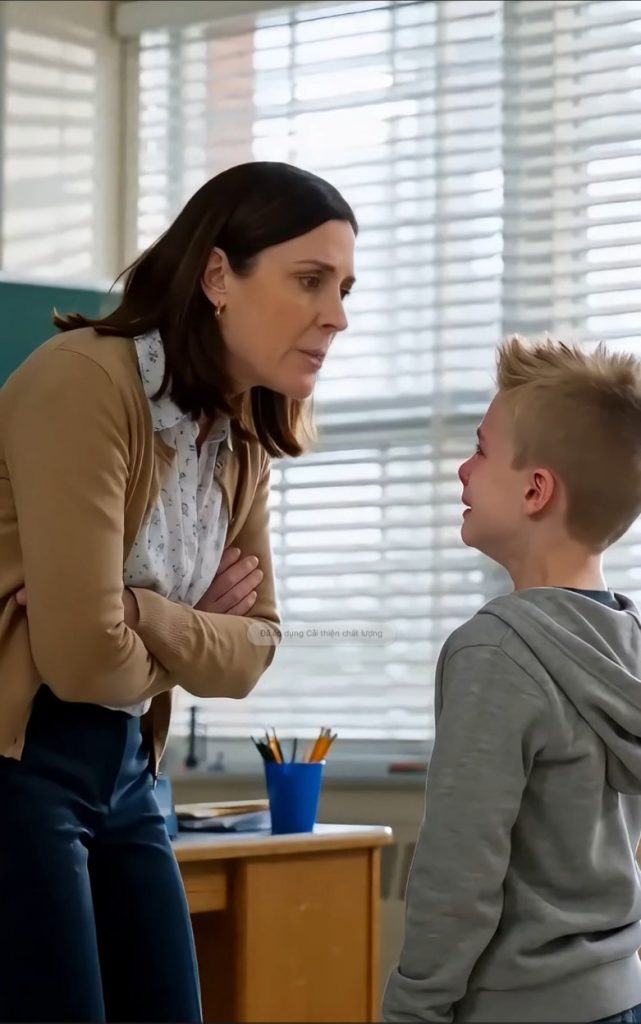
The classroom was too bright for what was happening inside it.
Sunlight poured through the white blinds, spilling across the pale tile floor and catching in the dust above the desks. A blue cup full of pencils sat untouched on the teacher’s desk. The green chalkboard behind her still carried yesterday’s math lesson, half-erased and ghostly.
Everything about the room looked safe.
Except for the way Ms. Caldwell stood over Trent Hnalusky.
“You can’t keep hiding behind excuses, Trent!” she snapped, her arms crossed tightly over her tan cardigan. “You made a mess, face it like everyone else!”
Trent did not answer.
He was eight years old, small for his age, with spiked blond hair that had fallen messy over his forehead. His gray hoodie hung loose on his shoulders. His eyes were red and swollen from crying, but he kept blinking hard, like if he tried enough, the tears might go back where they came from.
They did not.
A few students sat frozen at their desks. Nobody whispered. Nobody moved. They all watched the teacher loom over him like a storm cloud that had chosen one child and refused to pass.
On the floor beside Trent’s sneakers lay the ruined mess.
Construction paper. Glue. A tipped-over tray of markers. A torn poster that had once read “Welcome Home Heroes Day.” Blue paint streaked across the tile like a bright accusation.
Ms. Caldwell had already decided what happened.
Trent had “acted out again.”
Trent had “ruined the surprise.”
Trent had “made another excuse because his father wasn’t around to correct him.”
That last part was the one that broke him.
His mouth trembled. He lowered his chin, staring at the paint instead of her face.
“I didn’t—” he whispered.
Ms. Caldwell leaned closer.
“Enough.”
The word hit harder than shouting.
Trent flinched.
She saw it and mistook fear for guilt.
“Your classmates worked all week on this,” she said, her voice sharpening with every sentence. “They were excited. They were proud. And you destroyed it because you couldn’t stand that the day wasn’t about you.”
A chair scraped softly somewhere in the back.
Ms. Caldwell turned just enough to silence the room without taking her eyes off Trent.
“You are going to apologize,” she said. “And then you are going to clean this up while everyone watches.”
Trent’s breathing turned shaky.
He looked toward the doorway.
Not because he expected anyone to save him.
He had stopped expecting that a long time ago.
His father had been gone for nearly eleven months. First training, then deployment, then delays that kept changing the date on the calendar. His mother had taped each new date to the fridge with a smile that grew thinner every time.
“He’s coming back,” she always said.
Trent believed her.
But believing did not make the empty chair at dinner less empty.
It did not stop other kids from asking if his dad had forgotten him.
It did not stop Ms. Caldwell from sighing whenever Trent got quiet during reading time, or when he stared too long at the flag outside the window, or when he kept one folded letter in his hoodie pocket like it was something alive.
Today was supposed to be different.
Today was Heroes Day.
Parents, grandparents, firefighters, nurses, veterans, and service members had been invited to visit the classroom. Trent had not told anyone what he hoped for. He had not even told his mother, because hope felt dangerous when spoken out loud.
But he had carried his father’s last letter in his pocket all morning.
Just in case.
Now Ms. Caldwell was telling him to apologize for a mess he had not made, in front of the same class that had laughed when Mason Pike called him “deployment orphan” under his breath.
Trent’s fingers curled around the paper in his hoodie pocket.
Then he heard it.
A sound that did not belong in an elementary classroom.
Heavy boots on tile.
Slow.
Solid.
Unmistakable.
Trent’s head jerked toward the doorway.
His whole face changed before anyone understood why.
His eyes widened. His lips parted. The tears that had made him look ashamed now shone with something wild and impossible.
Hope.
“Dad!”
The word tore out of him so loudly that Ms. Caldwell stopped mid-breath.
And there, standing in the doorway in full Army uniform, was the man Trent had been waiting almost a year to see.
But what he saw next would make the entire room go silent.
Act II
Staff Sergeant Ethan Hnalusky did not move at first.
He stood in the doorway with one hand still on the frame, as if the room had struck him in the chest. His OCP uniform was crisp from the ceremony he was supposed to attend. A U.S. flag patch sat on his shoulder. His name tape, HNALUSKY, was stitched across his chest.
He had imagined this moment a hundred times.
Trent running to him.
Trent laughing.
Trent maybe crying a little, the way kids do when happiness is too big for their bodies.
He had imagined dropping his duffel bag, kneeling, opening his arms, and hearing his son say the word he had replayed in his mind during every cold night overseas.
Dad.
But he had not imagined walking in to find Trent cornered, humiliated, and trembling under an adult’s anger.
He had not imagined the torn poster on the floor.
He had not imagined Ms. Caldwell standing over his son like he was something she had caught and meant to punish.
For one terrible second, Ethan did not look like a soldier.
He looked like a father who had arrived a moment too late.
Then Trent ran.
The boy launched himself across the classroom with a sob that seemed to come from somewhere deeper than fear. Ethan dropped to both knees before Trent reached him, arms open wide, boots sliding slightly on the tile.
Trent crashed into him.
Ethan wrapped him up so tightly that the room seemed to disappear around them.
“Hey, buddy,” he whispered, his voice breaking just enough for everyone to hear it. “Hey. I’ve got you.”
Trent clutched the camouflage fabric in both fists. He pressed his face into his father’s shoulder and cried like he had been holding back every bad day at once.
Ethan closed his eyes.
His jaw tightened.
He had missed birthdays. Lost teeth. School photos. Bedtime stories over glitchy video calls. He had missed the way Trent’s voice had changed from little-boy chirps to something quieter and more careful.
But he had promised himself he would never let his absence become a weapon used against his child.
Yet here it was.
In a classroom filled with paper stars and spelling charts, someone had done exactly that.
Ms. Caldwell shifted near the front of the room.
“Mr. Hnalusky,” she began, but her voice had lost its edge. “I didn’t realize you were—”
Ethan opened his eyes.
She stopped.
He stood slowly, keeping one arm locked around Trent’s shoulders. The boy stayed pressed against his side, one hand still gripping the uniform like he was afraid his father might vanish if he let go.
Ethan looked down at him first.
“What happened?” he asked softly.
Trent swallowed hard. He tried to speak, but the words tangled in his throat.
Ms. Caldwell answered for him.
“There was an incident,” she said quickly. “Trent became emotional and destroyed the class display. I was simply asking him to take responsibility.”
Ethan did not look at her yet.
He looked at the floor.
The paint. The markers. The torn poster. The crooked footprints through the blue streaks.
Then he looked at Trent’s shoes.
Clean.
Not perfect, because no child’s sneakers ever were. But there was no blue paint on the soles. Not even a smear.
Ethan’s eyes moved across the room.
A few desks away, Mason Pike tucked one foot behind the other.
Too late.
Ethan saw the blue mark on the edge of Mason’s sneaker.
He saw the way the boy looked at Ms. Caldwell, not with fear, but with panic that someone important had noticed.
And he saw something else.
On the floor near the teacher’s desk, half-hidden beneath a crumpled sheet of paper, was Trent’s folded letter.
Ethan knew that paper.
He had written those lines in a dim barracks room at two in the morning, choosing every word carefully because he wanted his son to have something to hold when he could not hold his hand.
Trent must have brought it to school.
And someone had stepped on it.
Ethan bent down and picked it up.
A dark footprint crossed the outside fold.
He turned it over.
Blue paint.
His eyes lifted at last to Ms. Caldwell.
“You hurt my boy,” he said, his voice low and controlled, “because I wasn’t here.”
The room went so still that the buzzing lights sounded loud.
Ms. Caldwell opened her mouth, but nothing came out.
Because Ethan had not asked a question.
He had named the truth.
And the truth had only begun to surface.
Act III
The principal arrived three minutes later.
He came quickly, but not quickly enough to erase what had already happened.
Principal Darden was a neat man with silver glasses and a nervous habit of smoothing his tie when a conversation became uncomfortable. He stepped into the classroom expecting noise, maybe tears, maybe an angry parent who could be managed with a private office and careful language.
Instead, he found twenty-three silent children, one shaken teacher, and a soldier standing between his son and everyone else.
“What seems to be the problem here?” Darden asked.
Ethan looked at him.
The principal smoothed his tie.
Trent had stopped crying, but only because exhaustion had replaced panic. His cheek was pressed against his father’s sleeve. Every few seconds, he sniffled and tightened his grip.
Ms. Caldwell recovered first.
“Trent had an outburst,” she said. “He damaged the display and refused to take accountability. I was addressing it when Mr. Hnalusky arrived.”
Ethan held up the folded letter.
“This was on the floor,” he said.
Ms. Caldwell glanced at it. “I’m not sure what that has to do with—”
“It was in my son’s pocket this morning,” Ethan said. “Now it has paint on it.”
Mason Pike stared at his desk.
The principal noticed.
So did three other children.
Ethan turned toward the class. His voice softened, but it did not weaken.
“Nobody here is in trouble for telling the truth,” he said. “But someone in this room knows what happened.”
No one spoke.
Then a small girl near the windows raised her hand halfway.
Her name was Lily Tran, and she had spent most of third grade being quiet enough that adults forgot she could see everything.
Ms. Caldwell’s face tightened.
“Lily,” she warned.
Ethan’s eyes flicked toward the teacher.
The warning died there.
Lily lowered her hand but spoke anyway.
“Mason knocked it over,” she said, barely above a whisper. “He was laughing. He said Trent shouldn’t get to put his dad’s letter on the hero wall because his dad probably wasn’t coming.”
Mason’s face flushed.
“That’s a lie,” he said quickly.
Another boy spoke up.
“No, it isn’t. He grabbed the letter.”
Then another.
“He pushed Trent when Trent tried to get it back.”
A third voice came from the back.
“Ms. Caldwell saw.”
The room changed.
Not loudly.
Worse than loudly.
The air itself seemed to turn.
Principal Darden looked at Ms. Caldwell.
“Is that true?”
Her hands clenched at her sides. “The children may have misunderstood. It happened very fast.”
But Ethan was no longer watching her.
He was watching Trent.
The boy’s eyes were fixed on the floor. Shame had trained him to expect punishment even when the truth was on his side.
That was what made Ethan’s anger turn cold.
This was not one bad moment.
This was a pattern.
He reached into the inside pocket of his uniform jacket and pulled out a printed email, folded twice.
“I was told this morning that the classroom welcome ceremony had been canceled,” he said.
Principal Darden blinked. “Canceled?”
Ethan handed him the paper.
“My wife received this from the school account at 7:18 a.m. It said today’s visit was no longer appropriate because Trent had been having behavioral issues and might be embarrassed by a surprise reunion.”
Ms. Caldwell went pale.
The principal read the email.
His face changed before he finished.
Ethan continued. “My wife called the office. They said nobody knew anything about a cancellation. So I came anyway.”
Darden looked up slowly.
The email had been sent from Ms. Caldwell’s classroom login.
The room seemed to shrink around her.
She shook her head once. “I was trying to prevent disruption.”
“No,” Ethan said.
One word.
Flat.
Final.
“You were trying to prevent witnesses.”
Ms. Caldwell’s eyes flashed, but her voice trembled. “That is an outrageous accusation.”
Ethan looked toward Mason, then back at her.
“Then explain why a child with paint on his shoe is sitting quietly while my son is standing here accused. Explain why my son’s letter was taken from him. Explain why you sent an email to keep his father away from a day called Heroes Day.”
No one breathed.
Principal Darden looked as if he wanted the floor to open under him.
But Ethan had one more thing.
He unfolded the paper in his hand, the letter with the painted footprint.
“I wrote this to Trent six months ago,” he said. “He told me he read it whenever school got hard. I didn’t understand what that meant until today.”
Trent’s face crumpled.
Ethan knelt again, turning away from the adults for a moment.
“Buddy,” he said softly, “how long has this been happening?”
Trent looked at Ms. Caldwell.
Then at Mason.
Then at his father.
And finally, with his voice shaking, he answered.
“Since you left.”
That was when Ethan realized the mess on the floor was not the real damage.
Act IV
Nobody moved after Trent said it.
Even Mason looked down.
Ms. Caldwell’s face had gone stiff, not with guilt exactly, but with the fear of being seen. The kind of fear people feel when the story they have been telling about themselves begins to collapse in public.
Principal Darden cleared his throat.
“Trent,” he said carefully, “can you tell us what you mean?”
Ethan’s arm tightened around his son.
“He doesn’t have to do this in front of everyone,” he said.
But Trent surprised him.
The boy wiped his cheeks with his sleeve and looked at the floor while he spoke.
“Mason said my dad left because I was too much trouble,” he whispered. “He said soldiers don’t come back for kids who cry.”
A few children gasped.
Ms. Caldwell closed her eyes briefly.
Trent kept going, and each word seemed to cost him something.
“I told Ms. Caldwell. She said I needed to learn not to be so sensitive.”
Ethan’s face hardened.
“She said I was using Dad as an excuse when I didn’t finish my work. But sometimes I couldn’t read the words because I was worried.”
His voice cracked.
“And today Mason took the letter. He said I couldn’t put it on the wall because it wasn’t a real hero thing. I tried to get it back. He shoved the tray. The paint fell. Then Ms. Caldwell said it was my fault.”
Mason burst out, “I didn’t mean to!”
It was the first honest thing he had said.
His voice shook now too. Not because he was the victim, but because the shield around him was breaking.
Ms. Caldwell turned on him. “Mason, stop talking.”
Ethan looked at her.
“Interesting,” he said. “Now you want a child to be quiet.”
The words landed hard.
Principal Darden stepped fully into the room. His professional calm was gone.
“Ms. Caldwell,” he said, “please wait in my office.”
She stared at him. “You can’t be serious.”
“I am.”
“This is being blown out of proportion.”
Ethan stood again.
“No,” he said. “It was blown out of proportion when an adult chose to shame a child instead of protect him.”
Ms. Caldwell’s eyes darted to the students, to Mason, to Trent, to the principal.
“I have managed this classroom for eighteen years,” she said. “You do not understand what it is like when children manipulate situations for attention.”
Trent flinched.
That was enough.
Ethan took one step forward, not threatening, not loud, but with the controlled force of a man who had learned exactly when not to raise his voice.
“My son is not a situation,” he said. “He is a child.”
The silence that followed felt different from all the others.
It was not fear.
It was recognition.
Principal Darden turned to Lily. “Were there other times?”
Lily nodded.
“She made him sit alone during lunch when he cried after the Veterans Day assembly.”
Another student added, “She said he was distracting people.”
Another said, “Mason kept taking his army keychain.”
Trent reached into his hoodie pocket automatically, then stopped.
Ethan saw that too.
“Where is it?” he asked.
Trent whispered, “In her desk.”
Ms. Caldwell snapped, “I confiscated it because it was causing disruptions.”
“Open the desk,” Principal Darden said.
She did not move.
So the principal did.
The room watched as he crossed to the wooden teacher’s desk and pulled open the top drawer. Beneath attendance slips and red pens lay a small metal keychain shaped like a dog tag.
Ethan recognized it instantly.
He had given it to Trent the night before he left.
On one side was the Army crest.
On the other, engraved in small letters, were four words.
BRAVE UNTIL I’M HOME.
Principal Darden lifted it from the drawer, and for the first time, his own voice softened.
“Trent,” he said, “I’m sorry.”
But Trent was not looking at the principal.
He was looking at his father.
Ethan took the keychain and placed it gently in Trent’s palm.
The boy closed his fingers around it like someone had handed back a piece of his heart.
Then Ethan turned to Ms. Caldwell.
“You took the thing he used to feel safe,” he said. “Then punished him for being afraid.”
Her lips parted.
No defense came.
For a moment, she looked smaller than she had when the scene began. The crossed arms were gone. The towering posture was gone. The sharp voice had nowhere left to stand.
Principal Darden spoke quietly.
“Ms. Caldwell, leave the classroom.”
This time, she did.
Her shoes made small, uneven sounds on the tile as she walked past the ruined poster, past the blue paint, past the boy she had tried to blame.
At the doorway, she paused, as if she might say something.
Ethan looked at her.
She kept walking.
But justice in that room would not end with her exit.
Act V
The first thing Ethan did was not demand paperwork.
It was not threaten lawsuits.
It was not call the superintendent, though he would later.
The first thing he did was kneel beside the mess on the floor.
Then he looked at Trent.
“Want to fix it together?”
Trent blinked.
He had expected to be taken home. Expected the day to collapse into whispers and office meetings and grown-up anger behind closed doors.
But his father picked up a torn piece of construction paper and held it out.
Slowly, Trent nodded.
One by one, the other children left their seats.
Lily came first. Then the boy who had spoken up. Then two more. Soon half the class was crouched on the tile, gathering markers, wiping paint, smoothing wrinkled paper with careful hands.
Mason stayed seated.
His face was red. His shoe still showed the blue mark.
Principal Darden walked to him and said something too quiet for the rest of the class to hear. Mason’s shoulders dropped. After a long moment, he stood and crossed the room.
He stopped in front of Trent.
“I’m sorry,” he muttered.
Ethan watched his son closely.
Trent stared at Mason, his small fingers tight around the dog tag keychain.
Mason swallowed. “I shouldn’t have said that stuff about your dad.”
Trent did not forgive him right away.
And that was all right.
Children are often told to forgive quickly so adults can feel the room become comfortable again. Ethan did not push him. He did not make his son make peace before he was ready.
Trent only said, “You shouldn’t have taken my letter.”
Mason looked down.
“I know.”
Then he bent and picked up the paint tray.
It was not redemption.
Not yet.
But it was a beginning.
Principal Darden stood near the chalkboard, looking older than he had ten minutes before. He knew the school would have to answer for what had happened. He knew parents would have to be called, statements taken, records reviewed.
But more than that, he knew a child had tried to tell adults the truth and had been trained to stop trying.
That was the failure no policy could soften.
By the time the display was patched together, it no longer looked perfect.
The poster still had a tear through one corner. Some letters were crooked. A faint blue stain remained near the bottom where the paint refused to lift fully from the paper.
But somehow, it looked more honest that way.
Ethan helped Trent tape the folded letter at the center of the display.
Not on the edge.
Not hidden.
At the center.
Trent’s hands shook as he unfolded it. The blue footprint still marked the outside, but the words inside had survived.
Ethan had written:
When I am far away, I want you to remember something. Being brave does not mean you never cry. It means you keep your heart kind, even when the world feels too big. I am proud of you every day. I am coming home to you.
Trent read it silently.
Then he leaned against his father again.
Ethan rested a hand on his hair.
For the first time all morning, the classroom felt like a classroom again.
Not because everything was fixed.
Because the truth was finally allowed to stand in the open.
Later, there would be consequences.
Ms. Caldwell would be placed on leave while the school investigated her conduct. The email would become part of the record. The other students’ statements would confirm what Trent had endured for months. Mason’s parents would be called in, and for once, their influence would not make the truth disappear.
But Trent would remember something else more clearly.
He would remember the sound of boots on tile.
He would remember looking toward the doorway and seeing the impossible become real.
He would remember his father dropping to his knees, not caring who watched, not caring how strong he was supposed to look, only caring that his son had been alone for too long.
And Ethan would remember the moment he understood that coming home was not just about returning from war.
Sometimes coming home meant walking into the exact room where your child had learned to feel small and making sure he never confused silence with safety again.
Before they left, Principal Darden asked Trent if he wanted the class to continue Heroes Day another time.
Trent looked up at his father.
Ethan gave him a small nod, but no pressure.
Trent thought about it.
Then he walked to the front of the room, still holding the dog tag keychain.
His voice was quiet, but this time it did not shake.
“My dad is my hero,” he said. “Not because he wears that uniform.”
Ethan’s eyes softened.
Trent looked at the repaired poster, at the letter, at the classmates who had finally spoken up.
“He’s my hero because he came when I needed him.”
No one laughed.
No one whispered.
Then Lily began to clap.
One by one, the others joined.
The sound filled the bright classroom, gentle at first, then stronger, until it covered the place where shouting had been.
Ethan pulled Trent close.
The boy pressed his face into his father’s side, but this time he was not hiding.
He was home.