Act I
The dog yelped before anyone understood what had happened.
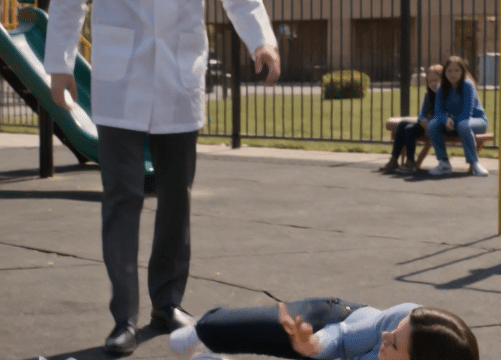
One moment, he was standing on the edge of the driveway, golden fur dusty in the sun, head lowered gently toward the little girl in the purple hoodie. The next, an older man’s leg swung forward and sent the animal tumbling off the concrete and into the grass.
The little girl gasped and stumbled back, clutching both hands to her chest.
“Grandpa!” she cried.
But Walter Briggs did not look ashamed.
He stood in the driveway with his face flushed red, one hand gripping a wooden rake, the other curled into a fist at his side. His white beard shook as he leaned toward the dog like the animal had personally insulted him.
“You useless bag of bones!” he shouted. “Get off my property!”
The neighborhood went quiet in the way quiet places do when something cruel happens too loudly.
Across the driveway, Emily Parker froze.
She had only come to pick up her daughter from Walter’s house after work. The old man was her father-in-law, though he had never once made that word feel like family. Since her husband died, every visit had felt like a negotiation with a locked door.
But this was different.
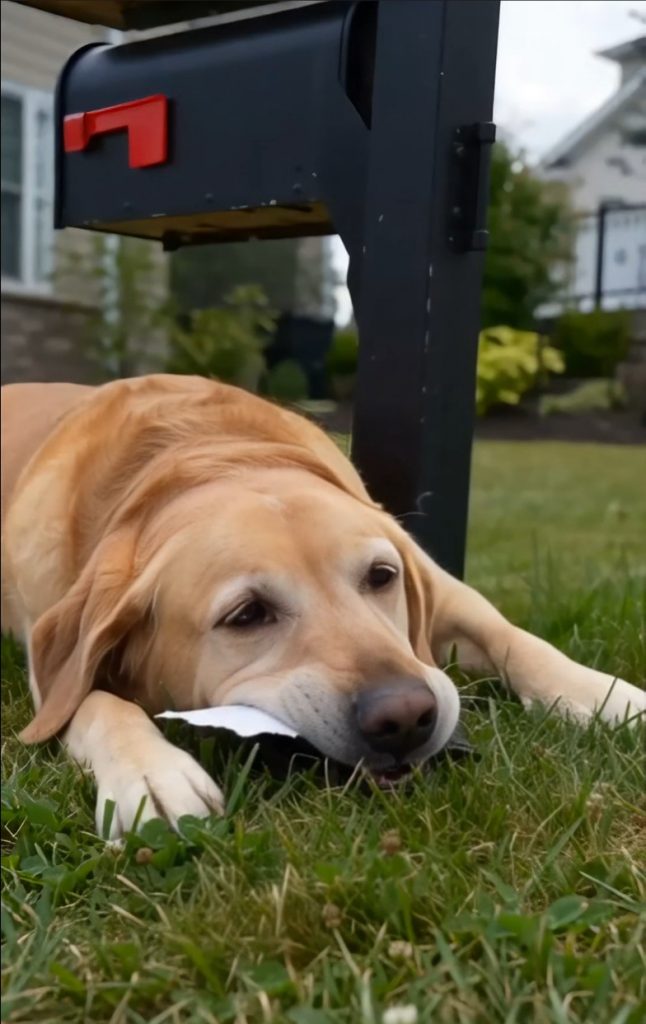
The dog lay near the black mailbox, breathing hard, his soft brown eyes blinking slowly. He was old. Too old to be a threat. His muzzle had gone pale, and his legs trembled beneath him.
Still, he did not let go of what he had carried.
A torn white photograph was clenched gently between his teeth.
Emily rushed across the lawn and dropped to her knees beside him.
“It’s okay,” she whispered, voice shaking. “Easy, boy.”
The dog whimpered but did not pull away.
Her daughter Lily knelt beside her, crying silently now, both small hands pressed to her mouth.
Emily reached carefully toward the dog’s muzzle. “Can I see that?”
The dog’s eyes met hers.
Then, as if he had carried the photo exactly for this moment, he released it into her hand.
The paper was old, creased, and torn along one edge. Rain or time had blurred parts of it, but the center remained clear.
Two young men in military uniforms stood in front of an American flag, grinning like the world had not yet learned how to break them. One had his arm slung around the other’s shoulders. A sergeant’s rank was visible on one sleeve.
Emily’s breath caught.
She knew one of the men.
Not from memory.
From the framed photo her late husband had kept in his office drawer and refused to talk about.
The man on the left was Daniel’s father.
Walter Briggs.
And the man beside him was not a friend.
It was the brother Walter had sworn was dead.
Act II
Walter Briggs had spent twenty-eight years pretending he had no brother.
In family stories, there was only silence where Samuel Briggs should have been.
If anyone asked, Walter’s answer was always the same.
“Sam died overseas.”
No date.
No details.
No grave they were allowed to visit.
Daniel had once asked his father why there were no pictures of Uncle Sam in the house. Walter had stared at him so coldly that Daniel never asked again.
But Daniel had not forgotten.
He was that kind of man. Quiet, patient, stubborn in ways that looked gentle until you tried to stop him. When Emily married him, she learned quickly that his kindness was not weakness. It was discipline.
Daniel had grown up in that beige house with the gray siding, under Walter’s strict rules and colder silences. His mother had died when he was young. His father raised him the way some men build fences: straight, hard, and meant to keep emotion out.
Then Daniel joined the Army.
Walter pretended not to care.
But Emily remembered the way the old man gripped the arms of his chair at Daniel’s deployment ceremony. She remembered the way he looked away when Daniel hugged him. She remembered thinking, even then, that Walter’s anger was not empty.
It was armor.
Daniel came home different after his second deployment.
He laughed less. Slept badly. Kept a locked metal box in the closet. Inside were letters, medals, and one torn corner of a photograph Emily had never been allowed to see fully.
He told her once, late at night, that his father had lost something in the war long before Daniel was born.
“What did he lose?” Emily had asked.
Daniel had looked toward the hallway, where Lily slept as a baby.
“His brother,” he said. “But not the way he tells it.”
Before Emily could ask more, he shut down.
Six months later, Daniel was gone.
A roadside accident during a rainstorm. A folded flag. A funeral where Walter stood dry-eyed beside Emily and said only one sentence.
“My son should have known better than to drive tired.”
Emily had never forgiven him for that.
Not because Walter did not cry.
People grieved differently.
But because he made grief sound like blame.
After Daniel died, Walter became worse. He tolerated Emily only because Lily was his blood. He let them visit on Sundays, then criticized Lily’s shoes, Emily’s job, the way Daniel’s memory was kept alive in stories instead of locked away like everything else he feared.
And now there was this dog.
This old golden dog with a torn military photograph in his mouth.
Emily looked down at the image again.
Walter, young and clean-shaven, one arm around a man with the same eyes.
Samuel Briggs.
The erased brother.
The dog whined softly.
Emily turned the photo over.
On the back, in faded handwriting, were four words.
Bring Scout to Walt.
Act III
Walter saw the back of the photograph before Emily could hide it.
His rage vanished so abruptly that it left his face looking hollow.
“Where did you get that?” he demanded.
Emily rose slowly, keeping herself between Walter and the injured dog.
“He had it.”
Walter’s eyes moved to the dog.
For the first time, he really looked at him.
Not as a nuisance.
Not as a stray.
As a messenger.
The dog lifted his head weakly.
Walter’s lips parted.
“No.”
The word was almost soundless.
Emily frowned. “You know him?”
Walter did not answer.
He stepped closer, but Lily moved instinctively toward the dog. Emily put a hand out to stop Walter before he came too near.
“You don’t touch him again.”
The old man stared at her as if he barely heard the warning.
His eyes were fixed on the dog’s collar.
Emily saw it then too.
Buried under thick golden fur was a faded leather strap with a dull metal tag. She brushed the fur aside gently.
SCOUT.
Walter’s rake slipped from his hand and clattered onto the driveway.
Lily jumped.
Walter did not.
He seemed suddenly older than he had been moments before.
“Scout,” he whispered.
The dog’s tail moved once against the grass.
One weak thump.
Walter staggered back like the sound had struck him.
Emily looked from the dog to the photograph.
“Who is Scout?”
Walter swallowed hard.
For a long moment, she thought he would lie. That had always been his talent. Not dramatic lies, not invented stories, but locked doors. Missing names. Closed drawers. Silence so firm it became history.
Then his voice broke.
“He was Sam’s dog.”
The wind moved lightly through the front yard. Somewhere down the street, a lawn mower started and then stopped. The world kept trying to be ordinary and failing.
Emily held the photograph up.
“You said Samuel died overseas.”
Walter’s jaw tightened.
“He was supposed to.”
“That doesn’t make sense.”
Walter looked down at the dog, and something like shame passed through his face.
“No,” he said. “It doesn’t.”
Emily’s daughter wiped her cheeks with the sleeve of her purple hoodie.
“Mommy,” she whispered, “is the dog going to be okay?”
Emily crouched again, stroking Scout’s neck.
“He needs a vet.”
Walter flinched at the word needs.
As if the dog’s pain had finally reached him.
Emily pulled out her phone and called the nearest animal hospital. While she spoke, Walter stood frozen in the driveway, staring at the photograph in her hand like it had risen from a grave.
When she ended the call, he was still silent.
Emily looked at him.
“You’re coming with us.”
Walter’s head snapped up.
“What?”
“If this is your brother’s dog, you’re coming.”
“I can’t.”
Emily’s voice sharpened.
“You kicked him.”
Walter closed his eyes.
For once, he had no defense.
The dog whimpered again.
Walter opened his eyes, and the cruelty that had filled them minutes earlier was gone.
In its place was terror.
Not of punishment.
Of memory.
Act IV
At the veterinary clinic, Scout refused to leave the photograph.
Even after the technician lifted him carefully onto the exam table, even after Emily wrapped an arm around Lily’s shoulders, even after Walter stood stiffly in the corner with both hands clenched at his sides, the dog kept his eyes on the torn picture.
The vet said Scout was bruised and exhausted, but nothing appeared broken.
Emily heard the words and almost cried from relief.
Lily did cry.
Walter turned toward the wall.
Not fast enough.
Emily saw his shoulders shake once.
The vet scanned Scout’s microchip.
The name that came back was not Samuel Briggs.
It was Rose Whitaker.
Address unknown.
The clinic called the registered number.
Disconnected.
But the file had an old emergency contact.
Walter Briggs.
Walter’s face drained of color when the vet read it aloud.
“You were listed,” Emily said quietly.
Walter stared at the floor.
“I didn’t know.”
“Then start knowing now.”
He looked at her, wounded by the bluntness, but Emily had run out of softness for men who hid behind pain while others paid for it.
The vet let them sit in a small consultation room while Scout rested under observation. The torn photo lay on the table between them.
Finally, Walter spoke.
“Sam didn’t die in combat.”
Emily waited.
Walter’s fingers trembled as he touched the edge of the photograph.
“We were both young. Stupid. Proud. He was the better soldier. Everybody knew it. I hated him for that, even while I loved him.”
His voice roughened.
“We were stationed together for a short time. There was an investigation after equipment went missing from supply. Black-market resale. Someone had to take the fall.”
Emily’s chest tightened.
“Samuel?”
Walter shook his head.
“Me.”
The room went still.
“I made a mistake. Not theft at first. Favors. Looking the other way. Signing forms I shouldn’t have signed. I thought I was helping a friend. By the time I understood, my name was all over the paperwork.”
He looked at the young faces in the photograph.
“Sam found out. He confronted me. I begged him not to turn it in. Told him it would ruin me.”
Emily barely breathed.
Walter’s eyes shone now.
“He took the blame.”
Lily leaned against Emily, too young to understand every word but old enough to feel the sadness in them.
Walter continued.
“Sam was discharged in disgrace. My career survived. I came home. He disappeared. My father died believing Sam had dishonored us. I let him believe it. I let everyone believe it.”
Emily felt sick.
“And Daniel?”
Walter covered his mouth for a moment.
“Daniel found old letters. He confronted me before his last deployment. Said he was going to find Sam and clear his name. I told him to leave dead things buried.”
Emily’s voice turned cold.
“So he knew.”
“Yes.”
“And after Daniel died, you blamed him too.”
Walter flinched.
“I blamed everyone. It was easier than looking at myself.”
The door opened before Emily could answer.
A clinic assistant stepped in holding an envelope.
“This was in the lining of the dog’s collar,” she said. “We found it while cleaning him up.”
The envelope was small, sealed in plastic, and addressed in shaky handwriting.
To Walt.
Walter took it like it might burn him.
Inside was a letter.
And a second photograph.
Samuel Briggs, much older, sitting in a wheelchair beside an elderly woman. Scout lay at his feet, gray around the muzzle even then.
Walter read the letter aloud only because Emily told him he had to.
Walt,
I am not writing to punish you. I did that in my head for too many years, and it changed nothing.
I am sick now. Rose is gone. Scout is all I have left, and he is too loyal to understand when a man is running out of road.
Daniel found me before he died. He came with your eyes and our mother’s stubborn heart. He knew everything. I told him not to hate you. I don’t know if he listened.
If Scout finds you, it means I am gone or close to it. He knows your scent from the old shirt Daniel brought me. I told him to bring you the picture because I was too much of a coward to come myself.
Maybe we both were.
Tell the truth before it dies with us.
Your brother,
Sam
Walter lowered the letter.
No one spoke.
Scout barked once from the next room.
Weak.
But clear.
Walter broke.
Act V
Samuel Briggs had died three days earlier in a veterans’ hospice two counties away.
Scout had escaped the morning after.
No one knew how an old dog with sore joints traveled that far, carrying a torn photograph through roads, yards, and neighborhoods until he found the house where Walter still lived behind his anger.
Emily thought about that for days.
A loyal dog carrying the truth farther than any man in the Briggs family had managed to carry it.
Walter paid Scout’s vet bill.
Then he paid for Samuel’s burial.
Not quietly.
Not secretly.
He stood at the front of a small veterans’ cemetery service with Emily on one side and Lily on the other, Scout lying on a blanket near his feet.
When it was time to speak, Walter took out the photograph.
The same one Scout had carried.
His hands shook.
“My brother Samuel was a good man,” he said. “And I let the world believe he wasn’t.”
No one moved.
Walter looked at the small gathered crowd: a few hospice workers, two veterans from Samuel’s support group, Emily, Lily, and people from the neighborhood who had come because news travels fast when shame finally becomes confession.
“He carried my mistake because I was too afraid to carry it myself. I built a life on his silence. Then I punished everyone who reminded me of what I owed.”
His eyes moved to Emily.
“To my son. To his wife. To my granddaughter.”
Lily leaned closer to Emily.
Walter’s voice cracked.
“And to the dog who came home better than I ever did.”
Scout lifted his head slightly.
Walter looked down at him.
“I’m sorry,” he whispered.
The apology did not fix the kick.
It did not erase decades.
But it was the first true thing Walter Briggs had said in years.
After the funeral, Walter brought out Daniel’s old metal box.
He gave it to Emily.
Inside were letters Daniel had written but never sent. Notes about Samuel. Records he had collected. A half-finished statement titled The Truth About My Uncle.
Emily read it at her kitchen table that night while Lily slept upstairs and Scout rested on a folded blanket beside her chair.
Daniel had known more than she realized.
He had been trying to repair what his father had broken.
Now the work was hers.
And Walter’s.
The military record review took months. Samuel’s discharge was finally corrected. His name was restored. The official letter arrived on a rainy morning, plain and bureaucratic and too late to give Samuel the life he deserved.
Walter framed it anyway.
He placed it beside the photograph in his living room.
Then, slowly, the house changed.
The silence did not vanish, but it loosened.
Walter stopped criticizing Lily for asking questions. He told her stories about Daniel as a boy, stories Emily had never heard. He showed her how to plant tomatoes. He taught her how to polish old brass buttons from Samuel’s uniform.
Scout stayed with Emily and Lily at first.
Walter did not ask for him.
Maybe he knew he had no right.
But every Sunday, when Emily brought Lily over, Scout limped up the driveway and lay beside Walter’s chair on the porch.
The first time it happened, Walter did not touch him.
He just looked down and whispered, “You came back.”
Scout rested his head on Walter’s shoe.
After that, Walter kept biscuits in his pocket.
Months later, Emily found him in the yard holding the same rake he had gripped that terrible day. For a second, her body tightened with old anger.
Then she saw what he was doing.
He was clearing a patch of grass near the mailbox.
The place where Scout had fallen.
“What is this?” she asked.
Walter did not look up.
“A garden.”
Lily ran over with a tray of small yellow flowers.
“Grandpa says it’s for Uncle Sam and Daddy.”
Emily looked at Walter.
He nodded once, eyes wet but steady.
“And for Scout,” he said.
The dog, lying in the shade nearby, thumped his tail.
The garden grew slowly.
Yellow flowers. White stones. A small flag. A flat marker with three names etched into brass.
Samuel Briggs
Daniel Briggs
Scout, Who Brought Them Home
Scout lived two more years.
Good years.
Soft beds, careful walks, Lily sneaking him toast under the table, Walter pretending not to notice. When Scout finally passed in his sleep one spring morning, Walter was the one holding him.
Emily found them on the porch.
Walter looked up with tears running into his white beard.
“He waited until I wasn’t alone,” he said.
Emily sat beside him.
For a long time, neither spoke.
Grief had changed shape in that family.
It was no longer a locked room.
It was a garden.
A photograph.
A dog’s collar hanging by the door.
A little girl who now knew the truth not as a curse, but as a promise.
Years later, Lily would remember the day Scout came to the driveway not as the day something cruel happened, though it had. She would remember it as the day a dog carried a broken piece of the past in his mouth and made the adults stop lying.
Emily would remember the yelp.
The photograph.
Walter’s face when he saw the name on the collar.
Walter would remember the kick for the rest of his life.
He should.
But he would also remember Scout’s tail moving once in the grass.
One weak thump.
The first forgiveness he had not earned, but had been given the chance to live up to.
And sometimes, in the late afternoon, when sunlight turned the driveway gold and the mailbox cast a long shadow across the lawn, Walter would sit beside the little garden and hold the torn photograph in both hands.
Two young soldiers smiling in front of a flag.
One who told the truth too late.
One who carried the blame too long.
And one old dog, long gone now, who had crossed miles with the last piece of evidence because love, unlike pride, always tries to find its way home.