Act I
The broom went under the porch first.
Its straw bristles scraped across the gravel with a dry, ugly sound, pushing into the darkness beneath the weathered wooden deck. The man holding it stayed safely out of reach, one hand gripping the long handle, the other braced against the porch rail.
From the shadows, the dog exploded.
Not forward enough to escape.
Only far enough for the chain around her neck to snap tight.
She lunged, teeth flashing, black muzzle wrinkled, tan shoulders straining against the metal links fastened to a wooden post. Her bark was not the loose, wild noise of a stray looking for a fight.
It was deeper.
Rougher.
A warning dragged up from somewhere desperate.
“Watch out,” Hank shouted. “She’s ready!”
The two waitresses standing near the gravel froze.
Martha, the older one, pressed one hand to her chest. Her teal uniform was still dusted with flour from the breakfast rush. Behind her, Jenny stood half-hidden, eyes wide, white apron twisted in both hands.
The dog snapped at the broom again.
The chain rattled so hard the post shook.
“See?” Hank muttered. “Told you she’d bite.”
From inside the diner, someone watched through the window and pulled the blinds halfway down.
Martha saw it and felt shame burn through her fear.
The dog was crouched under the porch of Miller’s Roadside Diner, a place known for cheap coffee, fried eggs, and truckers who paid in cash. She had appeared three days earlier, silent at first, tucked beneath the deck where the shade stayed cool.
Then Earl Miller, the owner, found her.
Or rather, found the chain.
Nobody knew who had put it there.
Nobody wanted to know too badly.
By noon that day, Earl had made a decision.
“Get her out before customers start complaining.”
Now the dog was growling like a monster in the dark, and everyone was pretending not to hear the fear under it.
Hank pushed the broom forward again.
The dog lunged.
Then shifted.
Only for half a second.
Just enough for the shadows behind her to open.
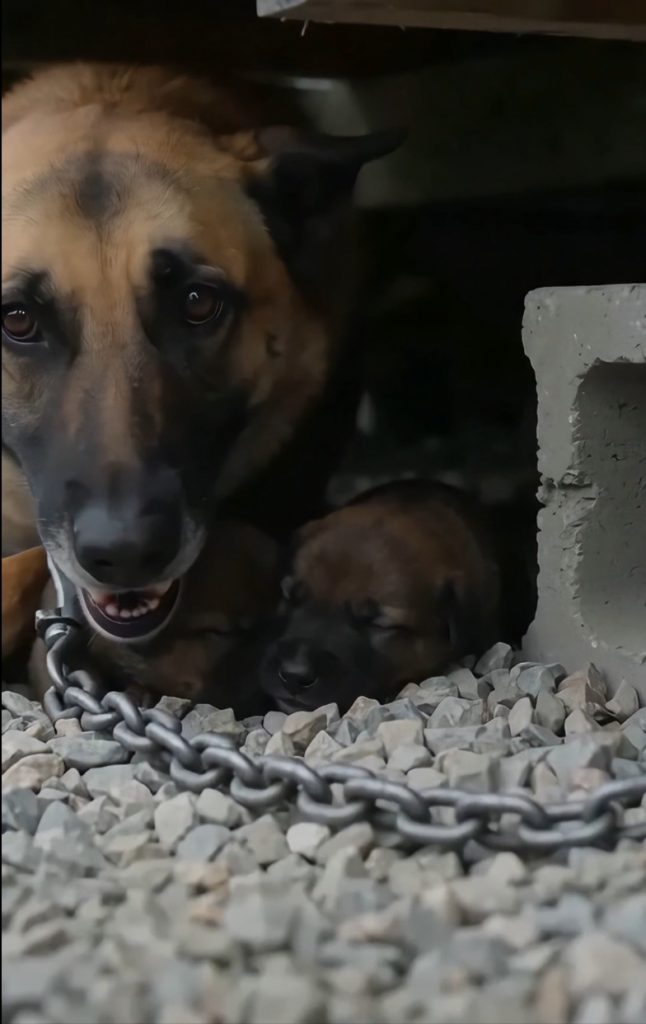
Martha saw two tiny dark shapes pressed against the concrete support block.
She stopped breathing.
“Hank,” she whispered.
He didn’t hear her.
The dog lowered her body, blocking the view again.
Martha stepped closer despite the warning growl.
This time, she saw them clearly.
Two puppies.
Tiny. Dark brown. Barely moving. Curled together under their mother’s chest like secrets the world had no right to touch.
Martha’s voice broke.
“Stop.”
Hank turned.
“What?”
She pointed beneath the porch, tears already rising.
“She’s not attacking us.”
The mother dog growled low, exhausted and trembling, her body a wall between the broom and the babies behind her.
Martha looked toward the diner window, where Earl’s shadow stood behind the blinds.
“She’s protecting them.”
Act II
The diner had been built on the belief that people passing through did not ask too many questions.
Truckers came and went. Families stopped for fries and bathroom keys. Salesmen drank coffee at the counter and lied about where they were headed. The motel cabins behind the diner rented by the night, sometimes by the hour, and Earl Miller liked customers who kept their eyes down and paid in cash.
Martha had worked there nineteen years.
Long enough to know the building had moods.
The morning mood smelled like bacon and burnt toast. Afternoon was fryer grease and tired voices. Night was cigarette smoke outside the service door and headlights sweeping across the blinds like searchlights.
She had stayed because jobs were scarce and because she had raised two sons on tips from men who called her sweetheart and never learned her name.
Jenny was newer.
Twenty-three, quiet, with a softness Martha recognized as someone who had not yet learned how expensive kindness could be. She fed stray cats behind the dumpster and apologized when customers were rude to her.
Earl hated that.
“You feed one, ten come back,” he always said.
He was talking about animals.
Sometimes Martha thought he meant people too.
The German Shepherd mix had first appeared during the Tuesday lunch shift. She stood across the gravel lot near the tree line, ribs showing faintly under her tan coat, chain dragging behind her like a punishment. Jenny saw her from the kitchen window and whispered, “Oh, honey.”
The dog did not come when called.
She only watched.
By evening, she had vanished under the porch.
The next morning, the chain had somehow wrapped around one of the support posts. Earl said it was luck.
Martha was not sure.
There had been a strange truck parked behind cabin six the night before. A man with a red cap had argued with someone near the vending machine. Then he left fast, tires throwing gravel.
The dog had barked once after that.
Only once.
A sound that made Martha look up from wiping the counter.
Earl told her to mind the register.
Now, beneath the porch, the mystery had become flesh and breath.
Two puppies.
Too small to survive long without help.
The mother dog’s aggression changed in Martha’s eyes the moment she saw them. Her bared teeth were no longer a threat. They were a plea in a language no one had bothered to translate.
Stay back.
Don’t take them.
Don’t hurt what’s left of me.
Hank lowered the broom.
Jenny wiped her cheek with the back of her hand.
“She’s chained,” she said. “Someone chained her here.”
Earl came out then, pushing through the diner door with his belly first and his temper already loaded.
“What’s the holdup?”
Martha stood between him and the porch.
“There are puppies.”
Earl’s eyes flicked toward the crawlspace.
For one second, something like annoyance crossed his face.
Not surprise.
Annoyance.
Martha saw it.
So did Jenny.
And the mother dog, still crouched in the shadows, growled again like she knew exactly which human had to be watched.
Act III
Earl folded his arms.
“So call animal control.”
Jenny stepped forward. “They need a rescue, not a catch pole.”
“They need to be gone.”
Martha turned on him.
“How long did you know?”
The question hung in the wet, dusty air beneath the porch beams.
Hank looked at Earl.
Jenny did too.
Earl’s face hardened. “Don’t start with me.”
Martha’s voice lowered.
“That chain didn’t tie itself.”
“I found her that way.”
“Where?”
“Out back.”
“When?”
Earl’s jaw worked.
The mother dog shifted again, and one of the puppies made the smallest twitch against her belly. The sound was almost nothing, but it was enough to pull Jenny down to her knees.
“Oh my God,” she whispered. “They’re newborn.”
Earl snapped, “Do not crawl under there.”
Jenny froze.
The command was too quick.
Too scared.
Martha knew Earl’s anger. This was not it. This was panic wearing its clothes.
Hank slowly set the broom down.
“Earl,” he said, “what happened?”
Earl looked toward the road, then the diner, then the porch. “Some guy dumped her. That’s all. I didn’t want her running around biting customers, so I secured her.”
Martha stared at him.
“You chained a pregnant dog under the porch?”
“I didn’t know she was pregnant.”
“She had puppies three feet from your front door.”
“I said I didn’t know.”
But he had known.
Martha could feel it now, the way truth sometimes changes the weight of a place before anyone says it aloud.
Jenny moved closer to the crawlspace, speaking softly.
“Hey, mama. It’s okay. We see them now.”
The dog’s growl lowered, but her eyes stayed sharp.
Martha noticed the chain biting into the fur at her neck. It was heavy, industrial, too thick for a household pet. On the collar beneath it, half-hidden by dirt, hung a small metal tag.
Jenny saw it too.
“She has a tag.”
Hank crouched, careful not to cross the dog’s line.
“What does it say?”
Jenny leaned lower, squinting into the dark.
The mother dog snarled.
Jenny backed off instantly.
“Sorry. Sorry.”
Martha looked at Earl.
“What was on the truck last night?”
His face went still.
“What truck?”
“The one behind cabin six.”
Earl said nothing.
Hank’s eyes narrowed.
“You rented six off the books again, didn’t you?”
“That’s none of your business.”
“It is if someone abandoned an animal here.”
Earl’s lips pressed into a thin line.
Then the diner door opened behind them.
A little boy stepped out.
Maybe eight years old. Brown hair. Backpack hanging from one shoulder. One of the motel kids, Martha realized. His family had checked into cabin four two nights ago.
He looked at the dog under the porch and began to cry.
“That’s Rosie,” he said.
Everyone turned.
The boy pointed with a trembling hand.
“That’s my neighbor’s dog.”
Act IV
His name was Caleb.
He and his mother had been staying at the motel after their car broke down on the interstate. They were waiting for a cousin to drive down from Ohio, which meant Caleb had spent two days sitting in a booth near the window, drawing trucks on napkins while his mother made phone calls she tried to keep quiet.
Caleb knew the dog because she belonged to an old woman named Mrs. Alvarez, who lived three houses down from them back home.
Rosie.
Gentle Rosie, who slept on the porch, carried newspapers in her mouth, and let neighborhood children read books to her in the summer.
“She disappeared last week,” Caleb said, wiping his face. “Mrs. Alvarez put up signs.”
Martha crouched in front of him.
“Are you sure?”
He nodded hard.
“She has one brown ear and one black toe. And she was going to have puppies.”
Jenny covered her mouth.
Martha looked beneath the porch.
One brown ear.
One black toe stretched into the gravel.
Earl swore under his breath.
Hank stood.
“What was the man’s name in cabin six?”
Earl looked trapped now.
“I don’t remember.”
Martha stepped toward him.
“You remember everyone who owes you money.”
The silence answered.
Caleb’s mother rushed out then, alarmed by her son’s crying. When she heard what he said, she pulled out her phone and found a photo from a local missing-pet post.
Rosie, female German Shepherd mix. Pregnant. Beloved companion of Elena Alvarez. Last seen near County Road 19.
The photo matched.
The number was at the bottom.
Jenny called it with shaking hands.
The woman who answered sounded old and broken.
By the time Jenny said, “We found Rosie,” the woman was already crying.
“She’s alive?” Mrs. Alvarez asked.
Jenny looked at the dog under the porch, still growling, still shielding her babies.
“Yes,” Jenny said, voice cracking. “And she had her puppies.”
The truth came in pieces after that.
Mrs. Alvarez had hired a handyman to repair her fence. He had seen Rosie, heard she was valuable because of her breed mix, and taken her when the old woman went inside to rest. He had likely planned to sell the puppies once they were born.
Something went wrong.
Maybe Rosie fought him. Maybe he got scared. Maybe he stopped at Earl’s motel, and Earl saw a chance to make a problem disappear quietly instead of calling anyone.
Earl denied everything until Hank found the cabin six registration card in the office trash.
Cash payment.
Fake name.
But the truck’s license plate had been written on the back by Jenny, who admitted she had copied it down because the man made her uncomfortable at check-in.
Earl stared at her.
“You wrote it down?”
Jenny lifted her chin.
“Yes.”
For once, he had no insult ready.
Animal control arrived with a rescue volunteer named Dana, who knew better than to rush a terrified mother. She lay flat on the gravel several feet from the porch and spoke to Rosie for nearly ten minutes before reaching toward the chain.
Rosie growled the whole time.
But she did not bite.
When the chain finally came loose from the post, Rosie did not run.
She turned, nudged both puppies closer with her nose, and looked at the humans as if daring them to prove they were different from the last ones.
Martha whispered, “We are, girl.”
Earl scoffed.
Rosie’s head snapped toward him.
And every person in the gravel lot knew the dog’s judgment was better than theirs had been.
Act V
Mrs. Alvarez arrived in a blue sedan that looked older than the diner itself.
She stepped out with a cane in one hand and a towel in the other, moving carefully across the gravel while Dana warned her not to approach too fast.
Rosie heard her voice before she saw her.
“Rosita?”
The mother dog lifted her head.
The growl stopped.
Her ears shifted forward. Her body trembled once, then again, as if hope were a thing that hurt.
Mrs. Alvarez sank slowly to her knees.
“My girl,” she sobbed. “My brave girl.”
Rosie crawled out from under the porch, still weak, still watchful, but no longer alone. She pressed her head into the old woman’s lap, and Mrs. Alvarez bent over her, crying into the fur between her ears.
The puppies squeaked behind them.
Jenny burst into tears.
Martha pretended not to, and failed.
Even Hank turned away.
Earl stood near the diner door with his arms crossed, but no one was looking to him anymore. His power had shrunk to the size of the shadow he stood in.
The police came after Mrs. Alvarez.
Then a county animal welfare officer.
Then a local reporter, because roadside diners survive on gossip, and this was the kind that traveled faster than coffee refills.
Earl tried to present himself as the man who had “contained a dangerous animal for public safety.”
Martha corrected him in front of everyone.
“You chained a stolen pregnant dog under your porch and told us to drag her out with a broom.”
The reporter’s pen stopped.
Earl’s face darkened.
But this time, the room did not belong to him.
Jenny gave the truck plate number. Caleb identified Rosie. Mrs. Alvarez showed proof of ownership. Dana documented the chain marks and the puppies’ condition. Hank admitted he should have asked more questions before picking up the broom.
That mattered too.
Not as much as Rosie.
But enough.
The man from cabin six was arrested two towns over after trying to sell dog supplies and a stolen toolbox at a flea market. Earl lost his motel license during the investigation into illegal cash rentals and failure to report animal cruelty on the property.
Miller’s Roadside Diner closed for three months.
Nobody missed Earl.
When it reopened, his niece owned it.
Martha stayed.
Jenny stayed too.
The porch was repaired, the crawlspace sealed safely, and a small sign was placed near the steps.
No animal left behind. Tell staff. We will help.
Some truckers laughed at it.
Martha told them they could eat somewhere else.
Rosie and her puppies went home with Mrs. Alvarez after veterinary care. One puppy, the smaller one with the sleepy face, was adopted by Caleb and his mother after they finally made it to Ohio. He named her Porch, which everyone agreed was a terrible name until the puppy learned it and refused to answer to anything else.
The other stayed with Rosie.
Mrs. Alvarez named him Lucky.
But Martha privately thought Rosie was the one who had made luck happen.
Not through magic.
Through refusal.
She had refused to abandon her babies. Refused to let the broom near them. Refused to trust the first hand reaching into the dark just because it belonged to a human.
That was not viciousness.
That was love with teeth.
Months later, on the first warm day of spring, Mrs. Alvarez brought Rosie back to the diner.
Not under the porch.
Through the front door.
Rosie wore a soft red collar now. Her fur had filled out. The chain marks had healed, though a faint line remained beneath her coat if you knew where to look.
Martha came around the counter and crouched carefully.
Rosie sniffed her hand.
Then licked it once.
Martha laughed and cried at the same time.
Jenny brought a bowl of water. Hank brought biscuits from the kitchen. Caleb sent a photo from Ohio of Porch asleep in a laundry basket, all paws and ears.
Mrs. Alvarez sat in the corner booth, the one by the window, and ordered coffee she barely drank because everyone kept coming over to ask about Rosie.
Outside, sunlight touched the gravel where the bucket had clanged and the chain had rattled and the broom had scraped into the dark.
The porch looked ordinary now.
That was what haunted Martha most.
How ordinary cruelty could look from the outside.
A porch.
A chain.
A dog growling.
A few people deciding the simplest story was probably true.
Dangerous animal.
Problem to remove.
Mess to clean up.
But beneath that porch had been two tiny lives and one terrified mother holding the line with everything she had left.
Martha never forgot the sound of Rosie’s growl changing when the puppies were found.
It had gone from rage to warning.
From don’t come closer to please understand.
And that, Martha thought, was the sound people missed too often.
The sound behind anger.
The wound beneath defense.
The love hidden under survival.
Whenever a stray appeared near the diner after that, nobody reached first for a broom.
They reached for water.
For food.
For a phone.
For patience.
Because the day Rosie came out from under the porch, everyone at Miller’s learned the same lesson in the hardest possible way:
Sometimes the thing you fear is not trying to hurt you.
Sometimes it is simply standing between danger and everything it has left in the world.