Act I
The room fell silent for a reason no one expected.
Hundreds of people had come to the community book fair looking for rare editions, discounted novels, and the chance to meet local writers. Between colorful shelves and crowded aisles, an elderly woman in a wheelchair quietly held a weathered hardcover close to her chest, smiling as she reread a passage that clearly meant something to her.
She wasn’t blocking anyone. She wasn’t making a scene.
She simply asked, almost apologetically, “Please let me look for one more minute.”
For most people, it was an ordinary request.
For the impeccably dressed woman standing across from her, it was apparently an unforgivable inconvenience.
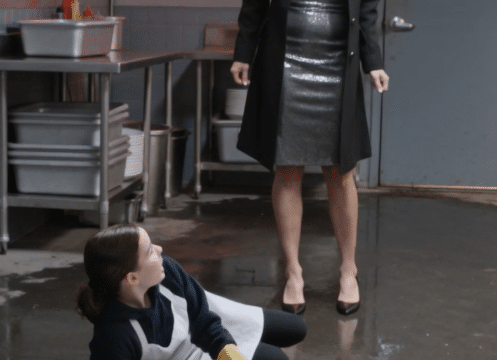
With an irritated sigh, she snatched the book away and let it fall to the floor before humiliating the elderly woman in front of everyone.
“Trash,” she said loudly enough for nearby shoppers to hear. “You’re in the way of people who matter.”
No one moved.
People exchanged uneasy glances, but nobody stepped forward.
Sometimes the loudest silence is the one filled with witnesses.
No one realized the book lying on the floor carried a history that would change everything.
Act II
The elderly woman slowly reached toward the fallen novel with trembling hands.
Years of life had taught her patience. Years of disappointment had taught her not to expect kindness from strangers.
The wealthy woman mistook that quiet dignity for weakness.
She looked around at the watching crowd as if expecting applause for putting someone “in their place.”
“Read from the floor,” she sneered.
Several people looked away.
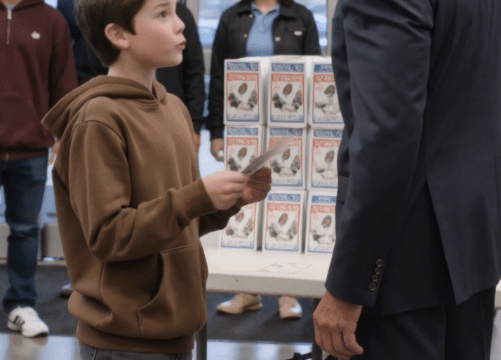
A little boy tugged at his mother’s sleeve, whispering that the old lady looked scared. His mother gently pulled him closer but remained frozen, unsure whether to intervene.
What none of them knew was that the worn book wasn’t valuable because of its age.
It was valuable because of the name hidden inside its first edition.
The author.
And that author was still alive.
The answer was only seconds away.
Act III
The sound came first.
Brakes.
Then shattered glass at the front entrance.
Heads turned as security personnel rushed inside, clearing a path through the stunned crowd.
Behind them walked a sharply dressed executive whose face was instantly recognized by every organizer at the fair.
The owner of one of the country’s largest publishing houses.
His expression changed the moment he saw the elderly woman on the floor.
He ignored everyone else.
Ignoring the expensive displays, the frightened organizers, and the wealthy woman entirely, he hurried directly to the grandmother, carefully lifted the fallen novel, brushed the dust from its cover, and gently placed it back into her hands.
Only then did he help her upright.
The crowd watched in complete silence.
The executive slowly stood, turned toward the woman who had caused the scene, and asked a single question.
“Who insulted the author of this book?”
Everything stopped.
Act IV
Confusion spread through the room.
“The… author?” someone whispered.
The executive opened the first page of the novel.
There, beneath the faded title, was a handwritten dedication dated more than forty years earlier.
Not a reproduction.
Not a copy.
The original manuscript signature.
He looked at the elderly woman with unmistakable respect.
“This woman wrote the novel that built our publishing house.”
The organizers stared in disbelief.
Employees who had been arranging tables moments earlier suddenly understood why the executive himself had rushed to the scene.
The book fair wasn’t celebrating a forgotten classic.
It was celebrating her.
The wealthy woman felt the confidence drain from her face.
Her insults echoed back inside her own mind.
People who matter.
She had no idea who had mattered all along.
Act V
Security quietly stepped between the executive and the woman who had caused the disturbance.
Nobody raised their voice.
Nobody needed to.
The weight of the truth was punishment enough.
Around the room, guests began picking up the books that had fallen during the commotion. One by one, they returned them to the shelves before turning toward the elderly author with warm applause.
Some asked if she would sign their copies.
Others simply thanked her for the stories that had shaped their childhoods.
The executive smiled gently.
“You inspired generations,” he said. “Today, it’s our turn to stand beside you.”
For the first time that afternoon, the grandmother smiled again.
Not because justice had arrived dramatically.
But because someone had finally reminded the room that dignity is never measured by age, appearance, or wealth.
Across the hall, the wealthy woman stood frozen, staring at the book she had dismissed only moments earlier.
Her lips trembled.
“She… wrote it?”