Act I
“Trash. Move that chair out of my way.”
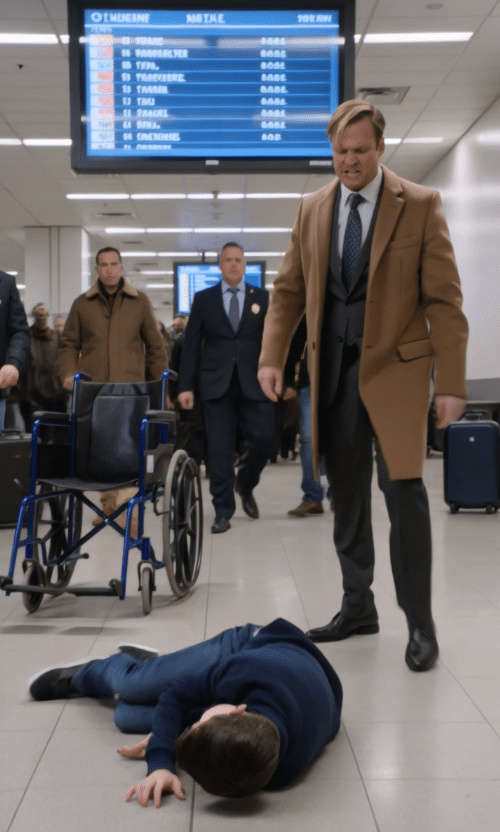
The words exploded across the crowded interstate bus terminal just before a fifteen-year-old boy hit the floor.
Passengers turned toward the sound. A suitcase tipped onto its side. Somewhere overhead, a bright electronic board announced an approaching departure, its cheerful chime cutting through the sudden gasps of the crowd.
On the ground lay a skinny teenager in an old dark-blue jacket, faded jeans, and worn shoes. His name was Noah Bennett, and a thin red mark had appeared on his knee where it scraped the polished floor.
He barely noticed.
His eyes were fixed on the elderly woman in the wheelchair beside him.
“Are you okay?” he asked, trying to push himself upright.
The woman clutched the armrests, frightened and confused. Her gray hair had come loose beneath a knitted hat, and a small brown suitcase rested across her lap. Noah had been helping her navigate the terminal when a wealthy traveler decided that their slow progress was an unforgivable inconvenience.
The traveler, a broad-shouldered man in his early forties, wore an expensive suit beneath a camel-colored coat. His leather suitcase stood beside him, and a luxury watch flashed beneath his cuff whenever he moved his hand.
His name was Richard Langley.
He had been walking toward Gate 18 when the wheelchair crossed his path. It had taken only a few seconds for the elderly woman to maneuver around a cluster of passengers and a stack of luggage.
Richard had decided those seconds were an insult.
Noah had tried to make room. He had turned the wheelchair slightly toward the passenger assistance area and asked a couple to move their bags. But the walkway was crowded, and the woman’s hands trembled when she tried to push the wheels herself.
So Noah stayed beside her.
Then Richard stepped in front of him and kicked him hard in the chest.
Noah fell backward, narrowly avoiding the wheelchair’s rear wheel. Even as he landed, he twisted his body to keep himself from knocking into the elderly passenger.
The woman gasped.
A young mother covered her mouth. Two men standing near a vending machine stopped speaking. A businessman lifted his phone but remained rooted to the spot.
Noah drew a shaky breath.
“She just needs a little space.”
He said it from the floor, one hand pressed against his chest and the other resting near his injured knee. He was not threatening Richard. He was not arguing about who had the right to use the walkway.
He was asking for a few more seconds so an elderly woman could get safely through a crowded terminal.
Richard looked down at him as if the boy had personally offended him.
“Help people after I pass.”
Then he stepped closer.
Noah tried to shield his head and keep his hand away from the wheelchair, still afraid that a sudden movement might cause it to tip. Richard kicked him again, then delivered another forceful blow before the boy could get to his feet.
A sharp gasp swept through the crowd.
The elderly woman began calling for someone to help, but the people nearest her only stepped farther away. Some stared in horror. Others looked down at their phones, apparently hoping that someone else would take responsibility.
Noah curled onto his side, struggling to breathe comfortably.
Even then, he looked toward the woman.
“Don’t try to stand,” he told her softly.
Richard heard him and gave a contemptuous laugh.
The boy was hurt, frightened, and outnumbered. Richard had a fine coat, an expensive suitcase, and the confidence of someone accustomed to having doors opened before he reached them.
He believed that made him untouchable.
Then a door burst open at the far end of the passenger assistance area.
A man in a navy suit came running from the operations office, an official terminal badge clipped to his chest. He crossed the floor with startling speed, reached Richard, and delivered one sharp punch that sent the traveler stumbling backward.
The man immediately stepped between Richard, Noah, and the wheelchair.
His expression was controlled, but his eyes were cold.
“He moved more people with kindness than you ever will.”
Richard straightened his coat and stared at the badge.
“What the hell are you?”
For the first time since the confrontation began, the wealthy traveler looked uncertain.
He had no idea that the man standing before him controlled the terminal’s operations, knew exactly how much of the incident had been recorded, and had already recognized something about the boy that Richard had completely missed.
And before the day was over, Richard would discover that the person he had treated as worthless had become the reason an entire investigation was about to begin.
Act II
Noah Bennett had learned to recognize the difference between people who needed help and people who were simply waiting for someone else to notice them.
He had started spending time at the bus terminal nearly a year earlier, after his mother lost her second job in the same winter. She worked mornings at a small diner and cleaned offices at night, but even two jobs had not been enough to keep their bills from piling up.
Noah had asked whether he could find weekend work.
His mother, Rachel, had worried about him approaching strangers. She reminded him to stay in public areas, avoid arguments, and never follow anyone into a private space. But the terminal was only a short bus ride from their apartment, and the station’s passenger assistance desk occasionally needed help moving luggage or guiding travelers toward the correct gates.
Noah began offering assistance to elderly passengers and people struggling with heavy bags. Sometimes they gave him a few dollars. Sometimes they simply thanked him.
He never demanded payment.
The money helped with groceries, but the work gave him something else, too: a feeling that he could make a difficult day easier for someone.
He had watched his mother do that for years.
Rachel remembered customers who came into the diner with trembling hands and ordered the cheapest item on the menu. She knew which elderly regulars needed their coffee brought to the table and which parents were counting coins before letting their children choose a meal.
She never called those things charity.
“They’re just people having a hard day,” she often told Noah. “You don’t need to know their whole story before you treat them kindly.”
He had carried that lesson into the terminal.
He learned which elevators were most reliable, which gates had narrow approaches, and which corners became dangerous when the morning rush collided with arriving buses. He kept a few spare tissues in his jacket and knew where to find the assistance desk when a passenger needed a staff member.
He had also learned that kindness was not always rewarded.
Some travelers waved him away. Others assumed he was trying to steal their luggage. A few dropped coins into his palm without looking at his face.
Noah endured those moments because the good ones mattered more.
An exhausted father had once thanked him for helping his little girl find a lost stuffed rabbit. A woman traveling alone had given him a handwritten note after he helped her get to the correct bus. An elderly veteran had insisted on shaking his hand before boarding, telling him that he had restored his faith in young people.
Noah kept that note folded inside his jacket pocket.
The woman in the wheelchair was named Eleanor Price.
She was seventy-eight and traveling alone to visit her sister in Pennsylvania. Her son had planned to drive her to the terminal, but a medical emergency had forced him to cancel at the last moment. Eleanor had decided she could manage the journey herself, though the crowded terminal had quickly become overwhelming.
Noah noticed her struggling near the entrance.
He offered to help her reach the passenger assistance area, where staff could arrange for a boarding attendant. She apologized repeatedly for moving slowly, and he kept telling her that there was no need to hurry.
When the crowd thickened near Gate 18, Noah guided her toward a wider passage.
That was when Richard Langley appeared behind them.
Richard had built a successful career in commercial property development. He lived in a gated community, traveled frequently for business, and considered punctuality a sign of personal discipline.
He also had a habit of treating every inconvenience as evidence that someone else was incompetent.
His flight connections were planned to the minute. His luggage was always expensive. His clothes were tailored, his calendar packed, and his expectations uncompromising.
He told himself that he had earned the right to be impatient.
In Richard’s mind, people who struggled were people who had failed to plan. People who moved slowly were wasting everyone else’s time. And a teenager in worn shoes helping an elderly woman for tips was exactly the kind of person he believed should stay out of the way.
He had not asked why Eleanor was traveling alone.
He had not noticed that her hands were shaking.
He had not considered that Noah was trying to keep her from being knocked over by the very crowd Richard was pushing through.
He had seen only an obstruction.
Now, as the terminal director stood between him and the injured boy, Richard began to realize that the situation was no longer under his control.
The director’s name was Michael Harris.
He was fifty-seven years old and had spent more than twenty years working in transportation operations. He had managed late-night emergencies, weather cancellations, medical evacuations, security incidents, and the difficult task of keeping thousands of strangers moving through one building without losing sight of the people who needed help most.
He had seen anger before.
What he could not tolerate was someone using power to make a vulnerable person feel small.
And what he had just witnessed was not a minor disagreement.
It was an assault on a child who had been doing the job of a good human being.
But Michael had another reason for reacting so quickly.
For weeks, he had been reviewing complaints about the way vulnerable passengers were treated inside the terminal.
And the footage from Gate 18 had just provided the clearest evidence yet that something needed to change.
Act III
Michael Harris did not raise his voice.
He did not need to.
He stood between Richard and Noah while two terminal security officers hurried toward them. One officer moved to secure the immediate area. The other knelt beside Noah and asked whether he could breathe comfortably.
Richard pointed at Michael’s badge.
“You assaulted me,” he said. “I want your name, your supervisor, and every camera recording in this building.”
Michael gave him his name.
“You’ll have all three.”
Richard seemed thrown by the answer.
He had expected denial, panic, or an attempt to quiet the incident before it attracted attention. Instead, Michael instructed security to preserve the recordings, requested medical assistance for Noah, and asked a staff member to remain with Eleanor.
Then he turned to the elderly woman.
“Ma’am, are you hurt?”
Eleanor shook her head, though her hands still trembled.
“The boy was helping me,” she said. “He didn’t do anything wrong.”
Michael nodded.
“I understand.”
Richard scoffed.
“You don’t understand anything. That kid blocked the walkway, and I had somewhere to be.”
Michael looked at him.
“Then you should have asked him to make room.”
“I did.”
“And he was helping a passenger.”
Richard opened his mouth, but no answer came.
Michael had already seen the security footage from the overhead cameras. He knew the wheelchair had moved slowly for several seconds. He knew Noah had tried to guide it toward the assistance area. He knew Richard had struck the boy before any meaningful exchange could have taken place.
There was no ambiguity about the sequence.
Yet the director’s concern went beyond this single incident.
For nearly two months, he had been reviewing complaints about passengers being pushed aside, mocked, or left without assistance during busy travel periods. Some complaints involved staff. Others described travelers who treated elderly passengers and people with disabilities as obstacles rather than human beings.
Michael had ordered a review of assistance procedures and begun working with the terminal’s accessibility coordinator to identify dangerous bottlenecks.
The project had been slow.
Budgets were tight. Staffing was uneven. Every improvement required coordination between multiple departments, and some managers dismissed the complaints as isolated frustrations caused by crowds.
Michael had refused to accept that explanation.
A terminal could be efficient and still be humane. In fact, he believed that true efficiency depended on protecting the people most likely to be overlooked.
Now a fifteen-year-old boy had been assaulted while doing precisely what the terminal should have been making easier.
Michael looked at Noah, who was sitting upright with a security officer beside him. The boy’s face was pale, and his breathing remained cautious. His first question to the officer had been whether Eleanor could still make her bus.
That was the detail Michael could not shake.
Noah was the one who had been kicked, yet he was still worrying about the woman he had been helping.
Richard had not asked whether she was safe.
He had not asked whether the boy needed medical attention.
He had asked for the director’s name.
Michael returned his attention to the traveler.
“You’re going to remain here while security documents the incident,” he said. “The police have been contacted.”
Richard’s face reddened.
“You can’t detain me because I had an argument with some kid.”
“This isn’t an argument.”
“You people think a badge gives you power over everyone.”
Michael glanced down at the badge on his own chest.
“No. It gives me responsibility for what happens in this building.”
That answer seemed to anger Richard more than a threat would have.
He stepped closer, but the security officers immediately positioned themselves between the two men. Michael did not move toward him again.
The director had already made one impulsive decision when he punched Richard. He knew he would have to account for it, just as Richard would have to answer for his actions. He would not turn the incident into a brawl.
Instead, he let the procedures do their work.
The first police officer arrived several minutes later. A second followed, and the witnesses were separated so their statements could be taken independently.
The terminal’s security team preserved the relevant recordings from the overhead cameras and the passenger assistance area. The videos showed the entire confrontation, including the initial delay, Noah’s attempt to guide Eleanor through the crowd, and Richard’s repeated kicks.
The footage also captured Michael’s intervention.
His punch would be reviewed separately.
Michael made no effort to hide it.
He told the officers exactly what he had done and why he had reacted, then agreed to provide a formal statement. He knew that stopping cruelty did not grant him permission to ignore the rules himself.
Richard, meanwhile, continued insisting that he was the victim of an overreaction.
He said he had been provoked. He claimed Noah had deliberately obstructed his path. He suggested that the terminal was using him as a scapegoat because of his money.
But each new statement collided with the same stubborn fact.
The cameras showed what happened.
As the police gathered evidence, Michael received a call from the terminal’s regional operations office. The incident had already been reported to senior management, and the office wanted to know whether the director intended to suspend normal operations while the investigation proceeded.
Michael looked across the assistance area.
Eleanor was speaking with a paramedic. Noah sat nearby, his jacket dusty and his knee bandaged. His eyes followed the wheelchair as a staff member carefully moved it away from the busiest part of the walkway.
“No,” Michael said into the phone. “We will keep the terminal running. But we are not going to pretend this is normal.”
He ended the call.
Then he walked over to Noah.
“What’s your name?”
“Noah.”
“I’m Michael Harris. I run this terminal.”
Noah nodded faintly.
Michael crouched so they were at eye level.
“I owe you an apology. You should never have been put in that position.”
Noah looked confused.
“You didn’t kick me.”
“No. But this is my building, and you were trying to help someone in a place that should have protected both of you.”
Noah glanced toward Eleanor.
“Is she okay?”
Michael followed his gaze.
“She will be looked after.”
Only then did Noah seem willing to relax his shoulders.
Michael stood, looking toward the long corridor of gates and departure boards. He had managed this terminal for years, but in that moment, he understood how easily the purpose of his work could be buried beneath schedules, budgets, and passenger counts.
The terminal was not merely a place where people arrived and departed.
It was where strangers depended on one another for a few minutes at a time.
And sometimes those few minutes revealed more about a person than an entire lifetime of success.
Richard still had not understood that.
But the next conversation would make it impossible for him to ignore.
Act IV
By early afternoon, the incident had become impossible to contain.
Witnesses had given statements. The security footage had been preserved. Noah had been taken for medical evaluation, and Rachel Bennett was on her way to meet him.
Richard’s departure was delayed while officers completed their initial investigation. His suitcase remained beside a security desk, its polished leather looking absurdly pristine amid the tension surrounding it.
He had called his lawyer twice.
He had also demanded to speak with the terminal’s regional director, the airport authority, and anyone else he believed might reverse the situation.
Michael refused to negotiate the evidence.
“You’ll have the opportunity to respond through the proper channels,” he told him. “But the footage will not be altered, and the witnesses will not be pressured.”
Richard laughed bitterly.
“You think this boy is some kind of hero?”
Michael looked across the room at Noah.
“No. I think he’s a boy who was trying to help someone.”
“That doesn’t make him special.”
“No,” Michael said. “It makes him decent.”
The simplicity of the answer left Richard with nowhere to go.
He had built his identity around achievement. He believed that discipline, money, and professional status separated successful people from everyone else. He had spent years telling himself that harshness was merely the price of getting things done.
But Noah had been trying to get something done, too.
He had wanted Eleanor to reach the assistance area safely.
He had not been paid to endure humiliation. He had not been appointed to manage the walkway. He had not possessed authority, influence, or any reason to believe that strangers would protect him.
He had helped anyway.
And when Richard attacked him, Noah’s first concern had remained the safety of the woman in the wheelchair.
Michael could see the contradiction clearly.
Richard had been in a hurry to reach his gate, yet his impatience had cost everyone far more time than the wheelchair ever would have.
The police continued their investigation. Richard’s actions were documented for potential criminal charges, while Michael’s punch was reviewed independently. The terminal’s management began examining whether additional assistance staff were needed at busy gates and whether the passenger walkway required clearer separation from through traffic.
The incident was no longer just a question of what one man had done to one boy.
It had become a test of whether the terminal would learn anything from it.
That evening, Michael visited Noah at the medical clinic.
Rachel sat beside her son, one hand wrapped around his. She looked exhausted and frightened, but when she saw Michael enter, she stood.
“Are you the director?”
“Yes. Michael Harris.”
“Why did nobody stop him?”
The question landed harder than any accusation Richard had made.
Michael did not try to defend the crowd.
“People froze,” he said. “Some were afraid. Some didn’t know what to do. That doesn’t make what happened acceptable.”
Rachel looked at her son.
“He’s fifteen.”
“I know.”
“He was helping an old woman.”
“I know that, too.”
For a moment, Michael could not find anything else to say.
He had spent years studying procedures, response times, staffing patterns, and safety plans. None of those things could explain away the fact that a child had been hurt while doing something kind in a public place.
Rachel eventually sat again.
Noah looked up from the clinic bed.
“Did she make her bus?”
Michael smiled faintly.
“Eleanor? Yes. We arranged assistance for her, and she boarded safely.”
Noah let out a quiet breath.
“Good.”
Rachel closed her eyes briefly, overwhelmed by relief and sadness.
Michael watched them and made a decision.
The terminal would not turn Noah into a marketing campaign. It would not parade him before cameras or use his injuries to polish its public image. He would not offer the family money in exchange for silence, and he would not make support conditional on the boy becoming a symbol.
Instead, he arranged for the terminal’s community liaison to help Rachel access the assistance available to families facing temporary financial hardship. He also asked whether Noah would be interested in a paid, age-appropriate youth program focused on passenger assistance, accessibility awareness, and safe public-service work.
The program would require parental consent, training, and clear limits. Noah would not be expected to manage dangerous situations or take responsibility for security. His role would be to learn, assist under supervision, and help the terminal understand what young volunteers and vulnerable passengers experienced on the ground.
Rachel considered the offer carefully.
She did not want her son pushed into another situation where he felt responsible for everyone around him.
Michael understood.
“He won’t be asked to do anything unsafe,” he promised. “And he doesn’t owe us a yes.”
Noah looked at his mother, then back at the director.
“I’d like to help,” he said. “But I want to know how to get someone like that to stop before it gets this bad.”
Michael nodded.
“That is exactly the kind of question we should be asking.”
In the days that followed, the terminal made several immediate changes. Staff were assigned to monitor the busiest assistance corridors during peak periods. Clearer signage directed passengers toward accessible routes, and employees received updated guidance on responding to aggressive behavior without escalating it.
The terminal also began reviewing how quickly security could reach the passenger assistance area during an emergency.
None of these measures could erase what happened to Noah.
They could, however, make it less likely that another child or vulnerable passenger would be left alone in the same situation.
Richard’s case moved through the appropriate legal process. His expensive coat and professional reputation did not exempt him from scrutiny. His employer was notified after the incident became part of the formal record, and the company opened its own review of his conduct.
For the first time in years, Richard could not control how others interpreted his behavior.
The recordings remained.
The witnesses remained.
And the boy he had called trash was no longer an anonymous teenager whose word could be dismissed.
But the most important change was not what happened to Richard.
It was what happened to Noah after he realized that helping people did not have to mean facing danger alone.
Act V
Three months later, Noah returned to the terminal wearing the same dark-blue jacket.
Rachel had offered to buy him a new one, but he insisted that the old one still had plenty of life left. She had patched the torn cuff and cleaned the scuff marks from his shoes. The small scar on his knee had faded, though he sometimes felt a tightness in his chest when he remembered the sound of Richard’s footsteps approaching him on the floor.
He had not forgotten the incident.
He had simply stopped allowing it to define every crowded hallway.
With his mother’s permission, Noah had joined the terminal’s supervised youth assistance program. He completed training on accessibility, emergency reporting, and the limits of what a volunteer could safely do. He learned when to call a staff member instead of trying to solve a problem himself.
He also learned that asking for help was not a failure of kindness.
It was part of it.
Michael checked in with the program regularly. He did not single Noah out in front of other participants, and he never described him as the boy who had been attacked. To Michael, Noah was a young person who had something valuable to contribute and deserved the same boundaries, training, and protection as anyone else.
The terminal’s new procedures were not perfect, but they were working.
Passengers who needed assistance were being directed through clearer routes. Staff responded more quickly to congestion, and the assistance area no longer depended on the goodwill of random strangers to keep vulnerable travelers safe.
Noah noticed the difference.
One morning, he saw an elderly man struggling with a rolling bag near the schedule board. Instead of immediately grabbing the handle, Noah approached, introduced himself, and asked whether the man wanted help.
The man smiled.
“I’d appreciate that.”
Noah guided him toward the assistance desk, where an employee took over.
It was a small moment.
No cameras flashed. No one applauded. No powerful stranger emerged from an office to announce the boy’s worth.
That was precisely why it mattered.
Noah was learning that kindness did not need to become a spectacle to count.
A few weeks later, Michael invited Noah and Rachel to a meeting about the terminal’s accessibility improvements. The staff had reviewed passenger feedback, identified several difficult bottlenecks, and developed a plan to keep the assistance corridors clearer during peak hours.
Noah sat quietly at the end of the table, listening as adults discussed measurements, staffing, and scheduling.
When the discussion ended, Michael turned to him.
“Is there anything we’ve missed?”
Noah thought for a moment.
“Sometimes people don’t ask for help because they don’t want to slow everybody down,” he said. “If the only sign says where to go, they might still think they’re in the way.”
The room grew quiet.
He continued, explaining how Eleanor had apologized repeatedly for moving slowly, even though she had done nothing wrong. He suggested a simple addition to the assistance area: a visible message reminding passengers that they were entitled to ask for help and that the accessible route was there for them.
The accessibility coordinator wrote it down.
Within a month, the terminal had added clearer instructions and reassurance near the passenger assistance desk. Staff were encouraged to approach people respectfully rather than wait until they looked distressed.
Noah’s suggestion became one small part of a much larger effort.
He did not receive a medal.
He received something better suited to the work he wanted to do: an invitation to continue learning, a supervisor who took his observations seriously, and the knowledge that his experience had helped improve a place used by thousands of people.
As for Richard Langley, the legal process continued separately from the terminal’s internal changes. The incident remained part of the formal record, and his employer’s review had consequences for his professional standing. Michael also answered for his own use of force, cooperating with the investigation rather than claiming his position gave him immunity.
There was no magical reversal in which one public humiliation erased another.
There were statements, evidence, decisions, and consequences.
And there was a boy who no longer had to prove his worth by enduring mistreatment.
One rainy afternoon, Eleanor Price returned to the terminal after visiting her sister. She recognized Noah almost immediately, though she needed a moment to remember his name.
“You’re the young man who helped me before,” she said.
Noah smiled.
“Yes, ma’am. How was your trip?”
“Wonderful. My sister insisted I stay an extra week.”
She laughed, then looked around the assistance area.
“It feels different here.”
“We’ve made a few changes.”
Eleanor glanced toward the sign beside the desk, then back at him.
“I hope you know what you did for me that day.”
Noah shifted uncomfortably.
“I just helped you get through the crowd.”
“No,” she said gently. “You made me feel as if I wasn’t a burden.”
For a moment, he had no answer.
He remembered how she had clutched the wheelchair’s armrests when Richard shouted. He remembered the terror in her eyes when he fell. And he remembered the shame he had felt afterward—not because he had done anything wrong, but because he had been unable to stop the violence.
Now he understood that he had given Eleanor something important before the assault ever happened.
He had treated her as a person who deserved patience.
That had been enough to change her day.
Perhaps it had even changed the way she thought about asking for help.
Eleanor reached into her handbag and offered him a small envelope. Inside was a handwritten thank-you note and a photograph of herself with her sister, both of them smiling on a porch beneath a flowering tree.
Noah thanked her and slipped it carefully into his jacket pocket beside the old note from the veteran.
Then the overhead board chimed.
A bus was boarding at Gate 18.
Passengers began moving through the terminal, pulling suitcases behind them, checking their phones, and hurrying toward their departures. The familiar rush filled the corridor again.
Noah watched the crowd for a moment.
He knew there would always be people in a hurry. There would always be someone who mistook patience for weakness and kindness for an invitation to take advantage.
He could not control every person who walked through the doors.
But he could help make sure that the next person who needed assistance would not have to face the crowd alone.
Michael stood near the operations office, observing the flow of passengers. When he saw Noah guiding a traveler toward the assistance desk, he nodded once.
The boy nodded back.
There was no grand speech between them. No promise that the world had become fair. No declaration that every cruel person would eventually receive exactly what they deserved.
There was only a busy terminal, an elderly passenger who needed help, and a teenager who had learned how to offer it safely.
On the day Richard Langley attacked him, Noah had been treated as if he were nothing.
But the truth had never depended on Richard recognizing it.
Noah had been valuable before the director arrived, before the cameras were reviewed, before the terminal changed its procedures, and before anyone outside his family learned his name.
Michael’s words had captured what Richard could not understand: Noah had moved more people with kindness than a lifetime of wealth and impatience ever could.
And every time the terminal opened its doors, that lesson had another chance to matter.
Because the measure of a person was never how quickly he could force others out of his way.
It was what he did when someone needed a little space.