Act I
“Trash. Your sidewalk art is garbage.”
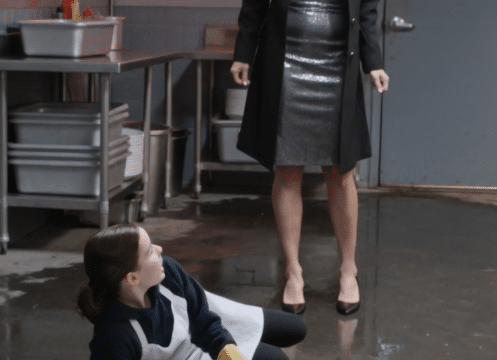
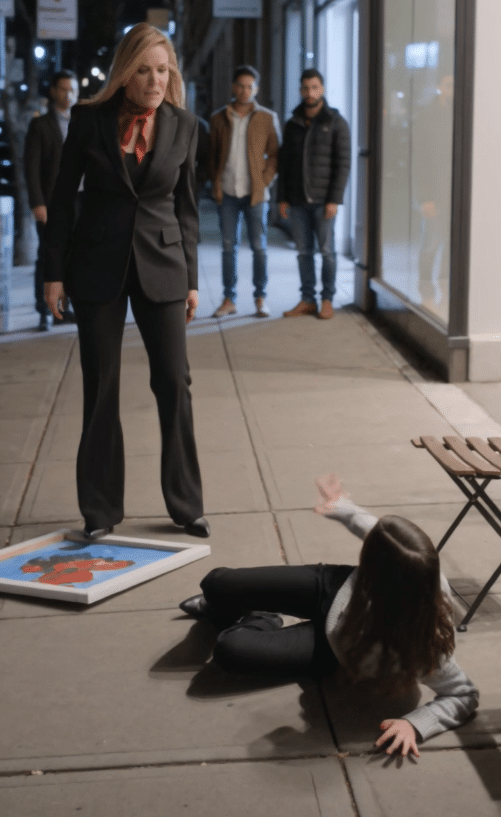
The words cut through the afternoon noise of the arts district just as a sixteen-year-old girl hit the pavement.
Her name was Evelyn Brooks. She wore an old gray sweater with fraying cuffs, black pants flecked with dried paint, and sneakers that had long ago lost their original color. Her fingers were stained blue and gold, and beside her lay a collection of small portraits she had spent weeks painting by hand.
A folding chair served as her display stand. Two more held her paintings upright, their frames uneven, their corners worn from being carried through the city every morning. Tourists stopped occasionally to look. A few bought something. Most walked past without noticing her at all.
Evelyn had learned not to take it personally.
That afternoon, however, she had made one tiny mistake.
A sudden gust of wind swept down the sidewalk, catching the corner of a small landscape painting and tilting it toward the polished heel of a woman standing nearby.
The woman was Victoria Ashford, fifty years old, impeccably dressed in a black designer suit with a red silk scarf tied at her throat. She owned one of the most exclusive galleries on the block, a glass-fronted establishment where paintings sold for more money than Evelyn’s family earned in several years.
Victoria looked down at the tilted frame as if someone had deliberately thrown garbage at her feet.
Before Evelyn could straighten it, Victoria kicked her.
The blow caught Evelyn in the chest and sent her sprawling beside her paintings. Her elbow scraped against the concrete, leaving a thin trace of blood, and one of her brushes rolled beneath a parked bicycle.
For a moment, the world seemed to lose its sound.
Then Evelyn struggled to sit up.
“I’m sorry. The wind moved it.”
Her voice trembled, but she wasn’t making excuses. She was terrified that the painting might have been damaged.
Victoria stared at her with open disgust.
“Paint somewhere people can’t see you.”
The words carried across the sidewalk. A couple near the gallery entrance stopped walking. A man holding a paper coffee cup turned around. Two teenage tourists lifted their phones, then hesitated, uncertain whether to record or intervene.
Nobody moved toward Evelyn.
Victoria took another step.
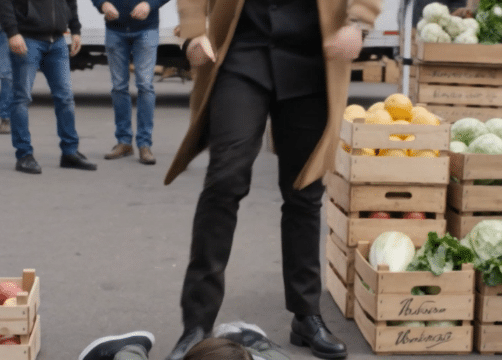
Evelyn curled protectively around the nearest painting, trying to keep its frame from being crushed beneath the woman’s heels. Victoria kicked her again, then delivered another vicious blow as Evelyn reached for the artwork.
The girl gasped and pulled her arms around the little painting.
It was not the most expensive piece she owned. It was not even the largest.
But it was the one she could not bear to lose.
Victoria looked down at her, apparently offended that the girl was still trying to protect something she considered worthless.
Then she delivered her final insult.
“Paint somewhere people can’t see you.”
A black luxury sedan had just pulled to the curb several yards away.
Its rear door opened, and a tall, silver-haired man in a long black coat stepped out. He had been on his way into Victoria’s gallery for a private appointment, carrying no entourage and making no effort to announce his arrival.
His name was Charles Whitmore.
At sixty-four, Charles was one of the most influential private art collectors in the country. Museum directors took his calls. Auction houses competed for his attention. His collection included paintings that had not been publicly exhibited in decades, and his opinion could turn an overlooked artist into the most sought-after name in the market.
But none of that mattered to him as he crossed the sidewalk.
He had seen the kicks.
He had seen the girl curl around her painting to protect it.
And he had noticed something about the small landscape lying crooked beside her chair.
Something that made him stop breathing for a moment.
Charles hurried forward. He reached Victoria just as she turned toward the sound of his footsteps and delivered one sharp slap across her face.
The crack echoed between the buildings.
Victoria stumbled half a step, one hand flying to her cheek. Her expression shifted from outrage to disbelief.
Charles didn’t look at her again.
He bent down, lifted the tilted painting, and carefully brushed dust from its frame. Then he placed himself between Victoria and Evelyn.
His voice was quiet, controlled, and far more frightening than a shout.
“You just stepped on tomorrow’s name.”
Victoria stared at him.
“Tomorrow’s name?”
For the first time that afternoon, she seemed unable to find the right words.
She had no idea that the painting in Charles’s hands was about to expose a secret that had been hidden in plain sight for sixteen years.
And the truth would threaten far more than her reputation.
Act II
Evelyn Brooks had never imagined that a painting could change her life.
For most of her childhood, art had been something she did at the kitchen table after her mother finished work. Their apartment was small, their furniture secondhand, and the heating unreliable during winter. Yet there was almost always a jar of brushes beside the sink and a stack of paper beneath Evelyn’s bed.
Her mother, Margaret, worked as a hospital laundry attendant. She left before sunrise and returned long after the evening buses grew quiet, carrying the smell of detergent on her clothes and exhaustion in her shoulders.
Evelyn’s father had died when she was four. He had been a quiet man who repaired old furniture and sketched whatever caught his attention: a crooked tree, a sleeping cat, the profile of a stranger waiting for a bus.
He had left his daughter a battered wooden paint box and a handful of drawings.
One of them showed a woman standing beside a lake beneath a pale winter sky.
On the back, in faded handwriting, were five words.
Find the beauty others miss.
Evelyn had carried those words into every painting she made.
She painted old men waiting for buses, shopkeepers closing their shutters, delivery workers eating lunch on overturned crates, and children pressing their noses against bakery windows. She painted people whom the city passed every day without learning their names.
Her portraits were not perfect. Sometimes a hand looked too large, or a shadow fell at the wrong angle. But there was a strange tenderness in them, a sense that every subject possessed a private world worth discovering.
People occasionally stopped to tell her so.
One elderly woman had purchased a portrait of her late husband and cried quietly while holding it. A construction worker had bought a painting of his daughter because it reminded him of the little girl he saw only on weekends.
Those moments kept Evelyn returning to the sidewalk.
She needed the money, too.
Margaret’s hours had recently been reduced, and the landlord had begun leaving notices beneath their door. Evelyn had secretly set aside the proceeds from her paintings to help cover the rent. She told her mother the money was for art supplies, knowing Margaret would otherwise insist that every dollar go toward groceries.
The painting Victoria had nearly destroyed was different from the others.
It showed an old woman seated beside a window, her hands resting on a closed book. Late-afternoon light crossed her face, revealing the fine lines around her eyes and the tired dignity in her expression.
Evelyn had painted it from memory.
The woman had appeared in a photograph that once belonged to her father. The photograph was faded, and Evelyn had never learned the woman’s name. Her father had kept it tucked inside his paint box, wrapped in a piece of linen as if it were something sacred.
Whenever Evelyn asked about it, he would smile sadly and say, “Some stories aren’t mine to tell.”
Then he would put the photograph away.
After his death, Evelyn searched for answers, but Margaret knew little about the woman’s identity. She only remembered that Evelyn’s father had once worked for a restoration company that handled paintings for private collectors.
The photograph had survived. The questions had survived with it.
And Evelyn, without fully understanding why, had begun painting the woman again and again.
Each version was different. In one, the woman wore a blue coat. In another, she stood beneath an archway. In the latest painting, she sat beside the window, her face illuminated by a narrow strip of gold.
Evelyn had spent three months on that final version.
She had mixed her own pigments to recreate the precise warmth of the light. She had repainted the woman’s hands four times. And when she finally finished, she felt something she had never experienced before: not pride exactly, but recognition.
It was as if the painting had been waiting for her to catch up.
She didn’t know that Charles Whitmore had spent almost two decades searching for an artist whose work had disappeared from public view.
She didn’t know that he had arrived at Victoria Ashford’s gallery that afternoon to discuss an acquisition connected to that very mystery.
And she certainly didn’t know that the woman in her painting had once been one of the most celebrated painters in America.
Her name was Eleanor Vale.
And Charles had loved her.
But the most astonishing part of the story was not who the woman had been.
It was why Evelyn could paint her face with such impossible accuracy.
Act III
Charles Whitmore had known Eleanor Vale since he was twenty-nine years old.
At the time, Eleanor was already a formidable presence in the art world, though she disliked galleries that treated paintings like financial instruments. She believed art belonged in the hands of people who could feel something when they stood before it.
Charles had been a young collector with more money than wisdom. Eleanor had once refused to sell him a painting because, as she put it, he was looking at the signature instead of the work.
He returned a week later and asked her to teach him how to look.
They became close friends.
Over the years, Charles watched Eleanor build a remarkable body of work, only to see her career derailed by a scandal involving a major exhibition. Several paintings attributed to her had been declared fraudulent after a gallery submitted conflicting provenance records. Eleanor insisted that the disputed works were genuine, but the institution responsible for the exhibition refused to reconsider its findings.
The accusations followed her everywhere.
Collectors withdrew. Dealers stopped returning calls. Invitations vanished. Eleanor retreated from public life, taking many of her paintings with her.
Charles never believed she had forged her own work.
He spent years trying to reconstruct the history of the disputed paintings, but the trail led through shuttered studios, dissolved businesses, and private estates whose owners refused to cooperate. Eleanor died before he could clear her name.
Her paintings became rarer, her reputation more complicated, and her story a quiet obsession for those who believed the art world had condemned an innocent woman.
Among those people was Charles.
He had arrived at Victoria’s gallery that afternoon because a recently discovered collection supposedly included documents connected to Eleanor’s missing works. Victoria had marketed the collection as a historic opportunity, promising access to records that could settle long-standing questions about the artist’s final years.
Charles suspected she was exaggerating.
He had not expected to find the answer standing on a sidewalk in a gray sweater.
When he lifted Evelyn’s painting, he saw it immediately.
The way the window light broke across the woman’s knuckles. The subtle green undertone beneath the gray shadows. The small, almost invisible correction in the reflection on the glass.
These were not merely similarities to Eleanor’s style.
They were choices.
Eleanor had used the same peculiar method of building warm light beneath cool shadows, a technique she had developed after years of experimenting with pigments. The details were too specific to be explained by imitation alone.
But Charles did not jump to conclusions.
He turned the painting over.
On the back, beneath the protective paper, he noticed a tiny mark beside the lower edge of the frame: a narrow crescent crossed by two short lines.
His hand tightened.
It was the private mark Eleanor had used on works she considered unfinished, or emotionally incomplete. She had never included it in catalogues. Charles had seen it only a handful of times, always on paintings she refused to exhibit.
He looked at Evelyn.
“Where did you learn to paint like this?”
The question was gentle, but the girl could barely answer. She was still struggling to breathe comfortably after the assault, and she kept glancing at Victoria as though expecting another kick.
“My dad taught me some things,” she whispered. “Mostly, I taught myself.”
Charles lowered the painting.
“What was your father’s name?”
“Daniel Brooks.”
For a moment, the street seemed to tilt beneath him.
Daniel Brooks.
Charles remembered a young restoration assistant who had worked on a private collection years earlier. Daniel had been talented, meticulous, and unusually protective of the paintings entrusted to him. He had once discovered that several works attributed to Eleanor Vale were missing from their original storage records.
Before he could finish documenting the discrepancy, he had been dismissed.
Not long afterward, Daniel had disappeared from the art world entirely.
Charles had assumed he had moved away, perhaps tired of the scandal. He had never learned that Daniel had married, become a father, and spent his remaining years repairing furniture and painting at a kitchen table.
But Charles remembered one other detail.
Daniel had once asked Eleanor for permission to photograph a portrait she kept hidden in her studio. It depicted a woman seated beside a window, her hands resting on a closed book.
Eleanor had refused to exhibit it.
She had told him it was the most personal painting she had ever made.
Charles looked down at Evelyn’s work again.
The portrait was not an exact copy of that hidden painting. It was a reconstruction from a photograph, altered through a young artist’s memory and instinct.
Yet its emotional center was unmistakable.
Evelyn had inherited more than a technique.
She had inherited a story.
Across the sidewalk, Victoria had regained some of her composure. Her cheek was flushed, and anger was beginning to replace her shock.
“You cannot seriously be making a spectacle over a child’s street painting,” she said. “This is a private gallery district. She was blocking the entrance.”
Charles finally turned toward her.
“She was sitting on a public sidewalk.”
“She was displaying unauthorized merchandise.”
“And that gives you the right to assault her?”
Victoria’s eyes flickered toward the phones raised by several witnesses.
“You struck me,” she snapped.
Charles did not deny it.
“And I will answer for that,” he said. “But you will answer for what you did to her.”
Victoria scoffed, although her voice had lost its certainty.
“You have no idea who you’re dealing with.”
Charles glanced at the painting.
“No,” he replied. “I don’t think you do.”
He reached into his coat and took out his phone.
Then he made a call that would bring the hidden history of Eleanor Vale into the open.
Act IV
Within twenty minutes, the sidewalk had changed.
A paramedic was checking Evelyn’s injuries while a police officer spoke with witnesses. Margaret had arrived in a panic after receiving a call from one of the tourists, and she knelt beside her daughter, holding her hand as if she could somehow protect her from everything that had happened.
Victoria stood near the entrance of her gallery, insisting that the confrontation had been provoked.
Her lawyer was already on the phone.
She repeated that the girl had obstructed the walkway, that Charles had attacked her without warning, and that the entire incident had been distorted by people who did not understand how difficult it was to run a serious gallery.
But the witnesses had seen the sequence clearly.
The painting tilted in the wind.
Evelyn apologized.
Victoria kicked her.
And when Evelyn tried to protect her artwork, Victoria attacked her again.
No one needed to invent anything.
Charles remained beside Margaret and Evelyn until the paramedics were satisfied that the girl could be transported for further evaluation. He did not promise that everything would be fine. He did not tell Margaret that money could fix what had happened.
He simply gave her his name and asked permission to contact them once Evelyn was safe.
Then he turned toward the gallery.
Victoria’s expression sharpened when she recognized the direction of his attention.
“You still have an appointment with me,” she said. “Perhaps we should discuss this privately.”
Charles stopped.
“No.”
She stared at him.
“The collection you invited me to examine,” he continued, “was represented as containing authenticated works and original records related to Eleanor Vale. I came here prepared to review that material.”
Victoria’s mouth tightened.
“And?”
“And I will not review anything in a gallery whose owner believes a person’s worth depends on whether she can afford a frame.”
The words were not loud, but several people nearby heard them.
Victoria lowered her voice.
“You are letting an emotional incident interfere with a major transaction.”
“No. I’m letting an important transaction wait until the facts are clear.”
Charles walked away before she could respond.
That evening, he began a formal review of the collection Victoria had offered to sell. He contacted the estate’s legal representative, an independent provenance specialist, and the conservator who had catalogued the works before they entered the market.
He also asked for Daniel Brooks’s old employment records.
The first discovery was a set of inventory sheets that had never been included in the official catalogue. Several paintings attributed to Eleanor had been transferred between storage locations without the signatures required by the institution’s own procedures.
The second discovery was more disturbing.
A handwritten note from Daniel, dated sixteen years earlier, described concerns about missing photographs, altered labels, and a discrepancy involving a portrait Eleanor had refused to exhibit.
He had not accused anyone by name.
Instead, he had written that he feared the records were being changed to make authentic paintings appear questionable while allowing disputed works to enter private collections under Eleanor’s name.
Daniel had requested an independent review.
Three days later, his contract had been terminated.
The investigation had stalled after his dismissal. The institution claimed that its remaining records were incomplete, and Daniel lacked the money to pursue a legal challenge. He had taken his knowledge with him, along with the photographs he had made before losing access to the collection.
Charles had never known the full extent of what Daniel had discovered.
Now, with the help of the independent specialist, he found a reference to a small set of photographs stored outside the gallery’s archive.
One image showed Eleanor’s hidden portrait beside a window.
The composition matched Evelyn’s painting.
The woman’s face matched the photograph Evelyn’s father had kept in his paint box.
And in the lower corner of the original photograph, barely visible beneath a shadow, was the same crescent mark Charles had seen on Evelyn’s frame.
It was not proof that Evelyn’s painting was an original work by Eleanor. The girl had painted her own interpretation, and no honest expert would confuse that with the original.
But it was proof that her work was connected to a real historical object.
More importantly, it supported Daniel’s account of the missing portrait and the irregularities surrounding Eleanor’s collection.
The investigation widened.
Victoria’s gallery had not yet been proven responsible for the earlier discrepancies, but the collection she was attempting to sell contained works whose documentation required serious examination. The transaction was suspended while independent experts reviewed the provenance records.
The consequences arrived faster than Victoria expected.
A scheduled acquisition was placed on hold. Two prospective lenders withdrew their interest in an upcoming exhibition. The gallery’s board requested a full explanation of the incident on the sidewalk, along with the status of the disputed records.
Victoria responded by calling the assault a misunderstanding.
The footage told another story.
By then, several witnesses had submitted videos showing Evelyn on the ground, Victoria standing over her, and Charles arriving moments later. The recordings captured the humiliation in full, without the flattering lighting or carefully selected angles Victoria used in her advertisements.
The gallery’s public statement could not make the images disappear.
Yet the most important development came from a small envelope discovered among Daniel’s belongings.
Margaret had kept the contents of her husband’s paint box after his death, including a few photographs and a folded letter she had never fully understood. When Charles asked whether Daniel had left anything related to Eleanor Vale, Margaret found the envelope beneath a stack of old sketches.
Inside was a letter from Eleanor herself.
It was addressed to Daniel and dated shortly before the controversy that had destroyed her public career.
Eleanor thanked him for protecting the integrity of her records. She wrote that if anything happened to the collection, she wanted him to know that the hidden portrait had never been intended for sale.
Then came a sentence that made Charles sit back in silence.
If the world ever forgets what I painted, perhaps someone who has never met me will still understand why I painted it.
The letter did not explain everything. It did not name the people responsible for the missing records, and it could not resolve every question about the disputed works.
But it revealed Eleanor’s fear that the scandal would erase more than her reputation.
She feared her paintings would be separated from the human experiences that had created them.
And somehow, without knowing the full story, Evelyn had painted that feeling.
When Charles returned to see her, she was recovering at home with Margaret. The small landscape lay on a table beside her bed, its frame cleaned and repaired.
Evelyn looked embarrassed when he asked to see it again.
“It’s not really worth all this trouble,” she said. “It’s just a painting.”
Charles studied her for a long moment.
“That is what people say when they have been taught to confuse price with value.”
He explained what he had discovered, carefully separating what the evidence proved from what remained uncertain. He told her about Eleanor, about Daniel’s records, and about the hidden portrait that had inspired the work she carried every day.
Evelyn listened without speaking.
When he finished, she looked down at her paint-stained fingers.
“My dad knew her?”
“He knew her work,” Charles replied. “And he cared enough to protect the truth about it.”
“Then why didn’t he tell me?”
“Perhaps he didn’t know how much of the story you would need to carry. Perhaps he hoped you would find your own way to it.”
Evelyn turned toward the window.
For sixteen years, she had believed her father’s unanswered questions were simply another part of losing him. Now she understood that he had left behind a trail, not because he expected her to solve it, but because he wanted the truth to survive.
Charles placed a business card on the table.
He did not offer to make her famous overnight.
He offered to arrange an independent evaluation of her work, provide access to conservators and art historians, and fund a modest scholarship so she could continue her education without sacrificing her family’s stability.
The offer had no condition attached.
She did not have to paint Eleanor Vale again.
She did not have to become a symbol of the scandal.
She only had to decide whether she wanted help learning what her own art might become.
Evelyn looked at the card.
Then she asked the question Charles had been waiting for.
“What happens to the paintings my dad tried to protect?”
Charles answered honestly.
“We keep looking.”
For the first time since the assault, Evelyn smiled.
But the final turn in the story was still waiting inside the gallery’s records.
Because one missing document could change the meaning of everything Victoria Ashford had claimed to own.
Act V
The document appeared six weeks later.
It was not hidden in a vault or discovered inside an ancient frame. It had been filed incorrectly in a storage ledger, misidentified as a routine transfer receipt, and overlooked during the first review.
Its significance became clear only when the provenance specialist compared the signature with the original inventory sheets.
The document showed that Eleanor Vale’s private portrait had been removed from the collection for safekeeping years before the scandal erupted. Daniel Brooks had signed as the receiving assistant, and Eleanor herself had authorized the transfer.
The portrait had never been sold.
It had never been abandoned.
And it had never been the property of the gallery that later claimed authority over the collection.
The record did not establish who had altered every disputed label, nor did it resolve every question about the missing works. But it undermined the central claim that the gallery’s collection had passed through an uninterrupted, properly documented chain of ownership.
The review led to further scrutiny of the disputed inventory. A museum postponed a planned exhibition, and the legal representatives for the collection began discussing the return of several works whose ownership could no longer be substantiated.
Victoria’s gallery lost the transaction that had brought Charles to her door.
The board placed her management under review. The assault investigation proceeded separately, based on witness statements and video evidence. Charles’s own decision to slap Victoria was also examined, and he cooperated rather than pretending his intervention placed him beyond the rules.
He apologized publicly for using force.
He did not apologize for stopping the attack.
Victoria eventually issued a statement acknowledging that she had assaulted Evelyn. Her lawyers called it an isolated incident, but the admission did not erase the consequences. She was required to answer for her actions, and the gallery’s professional relationships suffered as its handling of the collection came under independent scrutiny.
For a time, Evelyn watched all of it from a distance.
She did not celebrate Victoria’s humiliation. She had no desire to stand outside the gallery and watch another person suffer while strangers recorded the moment.
She wanted her paintings back in their frames.
She wanted her mother to stop worrying about the rent.
And she wanted to know whether her father had truly believed she could become an artist.
One afternoon, Charles invited Evelyn and Margaret to a small conservation studio where the recovered records were being examined. On a worktable beneath soft, even lighting sat a reproduction of Eleanor’s hidden portrait, accompanied by the original archival photograph.
Evelyn stood before it for a long time.
The woman beside the window looked almost exactly as she had appeared in Evelyn’s memory, yet the original image contained details she had never imagined. The curve of the book’s spine. The reflection of a chair in the glass. The faint shadow of another person outside the frame.
Evelyn leaned closer.
“I missed that,” she whispered.
Charles smiled.
“You saw something else.”
She looked at her own painting, which had been placed on a separate easel nearby.
For the first time, she could see the difference between the two works without feeling that one had defeated the other. Eleanor had painted the woman as she remembered her. Evelyn had painted the woman as she had imagined her through her father’s photograph, his silences, and the feelings he had left behind.
The paintings were connected.
They were not interchangeable.
And Evelyn did not need to pretend otherwise.
A month later, a small community arts center offered her a space for a student exhibition. Charles helped arrange professional guidance, but the center’s director selected the works independently. There were portraits of bus drivers, shopkeepers, nurses, and strangers Evelyn had met along the sidewalk.
Her painting of the woman beside the window hung near the entrance.
The label did not call it a lost masterpiece or suggest that Evelyn had suddenly become a famous artist. It described the work honestly as a contemporary painting inspired by an archival photograph, with a note about the connection to Eleanor Vale’s history.
People stopped in front of it.
Some asked questions. Others stood silently, seeing something of their own families in the woman’s expression.
Margaret attended the opening wearing the only blue dress she owned. She kept her hands clasped tightly in front of her, trying not to cry as visitors complimented her daughter’s work.
Evelyn found her beside the final painting of the evening: a portrait of an elderly man repairing a broken chair.
“You painted Dad,” Margaret said.
Evelyn nodded.
She had worked on it for weeks, using one of the sketches he had left behind. She had painted him not as a tragic figure or a forgotten assistant, but as a man bent over a piece of wood, concentrating on a small repair that would allow something broken to be used again.
Beside the portrait, Evelyn had written the words from his old paint box.
Find the beauty others miss.
Margaret touched the edge of the frame.
“He would have loved this.”
Evelyn swallowed hard.
“I think he knew.”
Across the room, Charles stood near the window, watching visitors move between the paintings. He had come expecting to help a talented young artist discover an opportunity.
Instead, he had watched a girl restore a piece of history without losing her own voice.
Before leaving, he approached Evelyn and handed her a small archival folder. Inside was a copy of Eleanor’s letter to Daniel, along with the newly verified transfer record.
“These belong in your family’s history,” he said. “Not because you owe the art world anything, but because your father deserves to be remembered accurately.”
Evelyn held the folder against her chest.
“Will people remember him now?”
“Some will,” Charles said. “Others may never know his name. But the truth doesn’t become less true because it takes time to be recognized.”
She considered that.
Then she looked back toward her paintings.
Outside, the arts district was settling into evening. The gallery lights glowed behind the glass, and tourists drifted along the sidewalk where Evelyn had once sat with her folding chairs and battered paint box.
She returned there the following weekend.
Not because she needed to prove anything to Victoria Ashford, who no longer controlled the story, and not because she expected Charles Whitmore to arrive in another black car.
She returned because the sidewalk was where she had learned to look closely at people.
She set out her paintings, checked each frame, and placed a small weight beside the one that had nearly been destroyed. When the wind rose, she steadied the corner with her hand.
A woman stopped to look at the portrait of the man repairing a chair.
“How much?” she asked.
Evelyn told her the price.
The woman paid without bargaining.
Then she looked at the painting of the woman beside the window.
“There’s something about her,” she said. “She looks like someone who has been waiting a very long time.”
Evelyn glanced at the portrait.
For years, she had thought the woman was waiting for someone to recognize her face. Now she understood that the painting had been waiting for a different kind of recognition: not fame, not wealth, and not permission from a gallery owner.
It had been waiting for someone to see the story inside it.
Across the street, the windows of Victoria’s gallery reflected the fading sunlight. The building was still standing, its polished doors still gleaming, but its owner could no longer decide whose work deserved to be seen.
Evelyn did not look toward it for long.
She dipped her brush into a small jar of gold paint and returned to the canvas in front of her.
The world had once tried to make her feel invisible. A wealthy woman had called her work garbage, attacked her in public, and expected everyone around them to accept that a girl in an old sweater had no right to occupy the same space as someone important.
But Evelyn had never needed Victoria’s permission to be an artist.
Charles Whitmore had not given her talent, and Eleanor Vale’s history had not made her worthy of respect. The truth had simply opened a door that other people had tried to keep shut.
And now, when strangers stopped to study her paintings, Evelyn no longer wondered whether she belonged.
She knew she did.
The next morning, a small article appeared in the local arts journal announcing the independent review of Eleanor Vale’s disputed collection. It mentioned the recovered records, Daniel Brooks’s role, and the young painter whose work had helped draw attention to the long-forgotten portrait.
The headline ended with three words:
An Artist Returns.
Evelyn read it once, folded the page, and slipped it into her paint box beside her father’s old sketches.
Then she picked up her brushes.
Tomorrow had a name, after all.
It was Evelyn Brooks.
And no one would ever have to recognize her before she deserved to be treated like a human being.