Act I
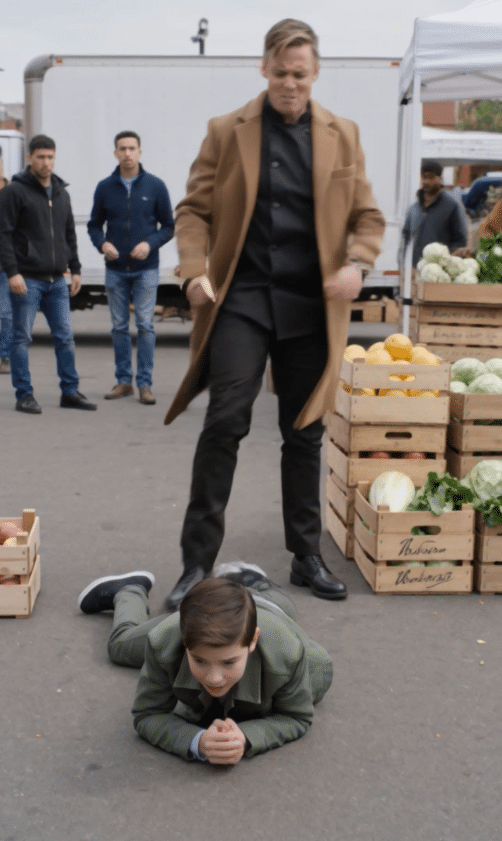
The apple crate had barely touched the ground when Richard Caldwell decided the boy deserved to be punished.
“Trash. You move like you are useless.”
The words cut through the morning noise of the farmers market. Vendors paused behind their stalls, shoppers turned from baskets of vegetables, and a restaurant buyer holding a paper coffee cup stopped mid-sip.
Fifteen-year-old Ethan Brooks stood beside a stack of apple crates, his faded green jacket damp at the shoulders and his worn work gloves darkened by the cold. He had been lowering a heavy box from a small delivery truck, moving carefully so the apples would not tumble against the wooden sides.
Richard had been waiting for less than a minute.
To him, that was already too long.
The forty-eight-year-old restaurant owner wore a camel-colored overcoat over his black chef’s jacket. His polished boots were spotless, his designer watch gleamed beneath his cuff, and his expression suggested that the entire market had been arranged for his convenience.
He had arrived expecting his produce order to be ready.
Instead, he had encountered a teenage boy who refused to drop a crate just to save him a few seconds.
“It is heavy. I am setting it down safely,” Ethan explained.
He kept his voice low. He had learned that arguing with angry adults rarely made a difficult situation easier, especially when those adults were the ones paying for the work.
Richard stepped closer.
“Do you know how much time you’re wasting?”
Ethan glanced toward the truck. There were six more crates to unload, along with leafy greens packed into shallow boxes and a delivery sheet waiting on the stall counter. He was working as quickly as he could without damaging the produce.
“My uncle’s truck is almost unloaded, sir.”
Richard’s mouth tightened.
“Don’t call me sir. Just do your job.”
Ethan looked down at the crate.
He wanted to tell the man that he was doing exactly that. He wanted to explain that a split crate meant bruised apples, that bruised apples meant a lower payment for the farmer, and that one careless movement could cost someone more than the few seconds Richard had lost.
But he said nothing.
He bent to adjust the crate’s position.
Richard’s boot struck him in the chest.
The impact knocked Ethan backward. He fell beside the stacked boxes, one arm catching the rough edge of a wooden crate before he hit the pavement. A thin streak of blood appeared along his forearm.
The crate rocked.
Several apples rolled across the ground.
For a moment, the market seemed to lose its sound. Then came a sharp gasp from somewhere behind the vegetable stalls.
Ethan tried to sit up.
Richard stepped around the crate and kicked him twice more, once against his back and once along his side. Ethan curled inward, struggling to protect himself while the cold pavement pressed against his cheek.
A woman holding a shopping basket covered her mouth.
A vendor took one step forward, then stopped.
Two restaurant buyers backed away from the delivery area, their faces pale with shock. Nobody seemed able to believe that a grown man had just attacked a child over a delay that could be measured in seconds.
Richard looked down at Ethan with open disgust.
“Carry boxes where nobody important waits.”
Ethan pressed his gloved hand against the pavement. His breath came unevenly, and the scattered apples blurred before his eyes.
He was embarrassed almost as much as he was frightened.
Not because he had done anything wrong, but because dozens of strangers had watched him fall and he could not make himself stand.
Then a black SUV stopped near the market entrance.
The driver’s door opened, and a tall man in a dark wool coat stepped into the morning light. He was fifty-six, with silver beginning to show at his temples and the composed bearing of someone accustomed to making decisions that affected hundreds of people.
He took in the overturned apples.
The boy on the ground.
The wealthy man standing over him.
Then he moved.
Within seconds, the stranger crossed the pavement and delivered one hard punch to Richard’s face, knocking him off balance. Before Richard could recover, the newcomer stepped between him and Ethan.
The market fell silent.
The stranger’s eyes remained fixed on Richard.
“That box carries more weight than your reservation ever will.”
Richard stared at him, one hand pressed against his face.
Something in the man’s voice seemed more dangerous than the punch itself. It was not the anger of someone looking for a fight. It was the certainty of someone who understood exactly what Richard stood to lose.
Richard’s expression changed.
He knew that face.
Everyone in the city’s restaurant business knew it.
The man standing between him and the boy was Daniel Mercer, founder and owner of Mercer Table Group, the celebrated restaurant company whose dining rooms had become destinations for politicians, celebrities, visiting executives, and wealthy travelers.
Richard had spent months trying to secure a coveted place at one of Daniel’s private culinary events.
He had told business partners that the invitation was practically guaranteed.
Now Daniel was standing in a farmers market, looking at him as if the invitation had never mattered.
Richard swallowed.
“My reservation?”
For the first time in years, he could not find a sentence that would save him.
And he had no idea that the boy on the ground was about to expose a truth far more damaging than a public assault.
Act II
Ethan Brooks had never imagined that unloading apples could become the most frightening moment of his life.
He had grown up around delivery trucks, produce stalls, and the early-morning rhythm of people who worked before most of the city had finished breakfast. His uncle, Michael Brooks, owned a small delivery business that supplied independent market vendors with produce from nearby farms.
It was not a glamorous operation.
The truck was old enough to rattle over potholes, and one of its rear doors needed to be lifted twice before it would close properly. Michael kept a toolbox beneath the passenger seat and carried a notebook full of handwritten orders because the company could not afford sophisticated inventory software.
But he knew his farmers by name.
He knew which orchard had lost part of its crop to an early frost, which vegetable grower needed payment before the weekend, and which market stall owner would accept slightly smaller apples if it meant a family farm could avoid wasting them.
Ethan had started helping after school when he was thirteen.
At first, Michael gave him simple tasks: sweeping the truck, checking labels, counting boxes, and carrying lighter crates to the stalls. Ethan liked the work because it had clear rules. If a box contained twelve bags of greens, there should be twelve bags. If a farmer promised crisp apples without bruising, the delivery should arrive that way.
People were depending on him.
That mattered.
His mother, Laura, worked as a nursing assistant at a rehabilitation center. Her hours varied from week to week, and some months were harder than others. Ethan’s father had left the family when Ethan was young, and although Michael had helped whenever he could, there were still bills that did not care how hard anyone worked.
Ethan’s earnings were modest.
He used most of the money to help with groceries, school supplies, and the occasional repair around the apartment. His mother always insisted that he keep some for himself, but he often slipped part of it into the jar beside the refrigerator when he thought she wasn’t looking.
She knew.
She simply chose not to embarrass him by saying so.
That morning, Michael had developed a problem with the truck’s loading mechanism. It was not dangerous, but it meant the crates had to be lowered more carefully than usual. Michael was dealing with a missing invoice at the far end of the stall, so Ethan had taken over the unloading.
Richard Caldwell’s order was supposed to be straightforward.
His restaurant, Caldwell House, had built a reputation around seasonal ingredients and carefully staged rustic elegance. Its menu featured heirloom tomatoes, local greens, roasted vegetables, and apples baked into desserts that were praised in food magazines.
Richard spoke constantly about the importance of knowing where food came from.
He also expected every person involved in getting it to his kitchen to move on command.
He had first met Michael at a regional food expo and had been impressed by the quality of the produce. After placing several orders, Richard began demanding increasingly narrow delivery windows and insisting that every crate be arranged according to his preferences.
When something arrived late, he blamed the supplier.
When something arrived early, he complained that his staff had not been ready.
When the produce was perfect, he called it the minimum standard.
Michael had tolerated the behavior because Caldwell House purchased a significant amount of produce, and losing the account would have hurt the business.
But he had warned Ethan to be careful around Richard.
“Some people think money means they don’t have to notice anybody else,” Michael had said. “You do the work properly. Don’t let their impatience make you careless.”
Ethan remembered those words when Richard began shouting.
He remembered them when the first insult came.
And he remembered them when the man kicked him to the ground.
The worst part was that Ethan’s first thought after the assault was not about revenge.
It was about the apples.
Several had rolled beneath the stall’s table, and he could see one with a split in its skin. He worried that Michael would have to pay for the damaged produce, even though the damage had happened because Richard had attacked him.
That was how thoroughly the boy had learned to take responsibility for problems he had not caused.
When Daniel Mercer intervened, Ethan did not immediately understand who he was.
He only saw a man standing between him and the person who had hurt him.
For a few seconds, that was enough.
Daniel glanced back toward Ethan and asked a nearby vendor to call emergency services. He did not attempt to pull the boy upright or force him to move. He simply stayed between Ethan and Richard, keeping the space clear while the people around them finally began to act.
A market employee brought a folded jacket to place beside Ethan.
Another shopper gathered the apples that had rolled into the walkway.
The frozen crowd began to break apart into people willing to help.
Richard, meanwhile, was trying to understand how his morning had turned into a public disaster.
He had built his business on the assumption that influence could smooth over almost anything. A complaint could be answered by an attorney. A bad review could be buried beneath a dozen better ones. A supplier who objected could be replaced.
But Daniel Mercer was not a disgruntled vendor.
He was the man whose approval Richard had spent months trying to obtain.
And Daniel had seen everything.
What Richard did not know was that Daniel had come to the farmers market for a reason that had nothing to do with him.
He had been preparing to announce a major expansion of his restaurant group’s sourcing program.
The market’s small delivery businesses were central to that plan.
And Michael Brooks’s company was one of the suppliers Daniel had come to learn more about.
Act III
Daniel Mercer had not become successful by believing the stories wealthy people told about themselves.
He had started with a single neighborhood restaurant and a kitchen that was too small for the number of meals it served. In the early years, he worked alongside cooks, washed dishes when staff members called out, and drove to farms before dawn to negotiate for ingredients he could barely afford.
He remembered farmers who extended credit when cash was short.
He remembered delivery drivers who waited while his staff unloaded late-night shipments.
He remembered a produce seller who once refused to charge him for a box of damaged peaches because the seller knew Daniel had been trying to keep his young restaurant alive.
Those people rarely appeared in restaurant profiles.
The articles talked about chefs, menus, dining rooms, and investors. They praised the person whose name was printed on the door while overlooking the people who made it possible for that door to open every morning.
As Mercer Table Group expanded, Daniel made local sourcing a central part of its business. His company purchased from small farms and regional suppliers whenever possible, not because it made for an attractive slogan but because he believed reliable partnerships produced better food and stronger communities.
He was not naive about the difficulties.
Small suppliers could struggle to meet volume requirements. Restaurants needed dependable schedules, consistent quality, and transparent pricing. A business could not survive on good intentions alone.
That was why Daniel’s sourcing team had been evaluating the delivery network serving the city’s independent farmers markets.
They were looking for companies that understood the work from the ground up.
Michael Brooks’s business had caught their attention.
The company was small, but its delivery records were unusually precise. Crates were tracked carefully, damaged goods were documented, and the farmers who supplied Michael were paid according to clear agreements. When weather disrupted a shipment, Michael called ahead rather than leaving restaurant kitchens to discover the problem for themselves.
One of Daniel’s purchasing managers had described him as dependable.
Daniel wanted to see the operation in person before deciding whether to include it in a new regional partnership.
That morning, he had arranged to visit the market and speak with several vendors. His SUV stopped near the entrance just as Richard attacked Ethan.
Daniel saw the boy fall.
He saw Richard kick him again.
And he heard the words about carrying boxes where nobody important waited.
The phrase struck him harder than he expected.
It was the kind of arrogance he had spent his career trying to keep out of his own company. The food on a restaurant’s table did not become valuable when a wealthy guest tasted it. It had value long before that, when a farmer planted a seed, when a worker lifted a crate, and when a driver kept a shipment safe over miles of rough road.
Daniel’s intervention was immediate, but he knew the punch would not resolve the situation.
It would have to be accounted for, just as Richard’s assault would.
He gave the responding officers his statement and remained available to the people assisting Ethan. He did not ask the market vendors to stay quiet, and he did not try to use his position to dictate what the police should do.
Then he turned to Richard.
“That box carries more weight than your reservation ever will.”
Richard stared at him.
“My reservation?”
Daniel understood the question.
For weeks, Richard had been contacting people in the restaurant industry, hinting that Caldwell House would soon receive special recognition from Mercer Table Group. He had told investors that an invitation to Daniel’s upcoming sourcing summit would confirm his standing among the city’s leading restaurateurs.
The invitation was not a prize for people who spent the most money.
It was a working meeting for restaurant owners who had demonstrated responsible sourcing, fair supplier relationships, and a commitment to building sustainable regional food networks.
Richard had assumed his reputation would be enough.
He had mistaken access for approval.
Daniel did not tell him that an invitation had been revoked, because no invitation had been issued in the first place. Instead, he made the facts clear: Caldwell House was not entitled to a place at the summit, and Richard’s conduct would be considered when his company evaluated any future business relationship.
That distinction mattered.
Daniel was not punishing Richard merely for embarrassing him in public. The attack had happened before witnesses, and the authorities would determine the legal consequences. Daniel’s company would make its own commercial decisions based on documented conduct and its supplier standards.
But the revelation unsettled Richard.
He had spent months telling others that his place at the summit was secured.
If Daniel refused to work with him, the people who had believed those claims would begin asking questions.
And if they learned the invitation had never existed, his carefully cultivated image of influence would collapse.
Still, Richard tried to regain control.
“This is ridiculous,” he said. “The boy was moving too slowly. I have a restaurant to run.”
Daniel looked toward the apple crate.
“Then you should understand what happens when someone handles food carelessly.”
Richard glanced at the damaged apples and seemed to think he had found a way to turn the argument back in his favor.
“Exactly. He was wasting my time.”
“No,” Daniel replied. “He was protecting the product you ordered.”
That sentence silenced Richard more effectively than another insult could have.
A market vendor who had watched the attack finally spoke up. He explained that Ethan had been lowering the crate carefully because the truck’s loading mechanism was sticking. The boy had not delayed the order through laziness. He had been trying to prevent damage.
Michael returned moments later, having heard the commotion from the other side of the stall.
When he saw Ethan on the ground, his face changed.
He rushed to his nephew’s side, then stopped himself from moving him until the medical responders arrived. His hands trembled as he asked what had happened.
Several witnesses began telling him.
The accounts matched.
Richard had attacked a child because he had been forced to wait.
And Daniel Mercer had seen it.
But the most damaging truth had yet to emerge.
When Daniel asked Michael for the delivery sheet, he discovered that Caldwell House had been ordering produce under terms that its owner had repeatedly refused to honor.
The issue was not merely a late crate.
It was a pattern.
Act IV
Michael Brooks did not enjoy confrontation.
For years, he had accepted difficult customers because he believed a small business had to be patient. A large restaurant could find another supplier quickly; a small delivery company could lose an entire week’s income from a single canceled order.
Richard knew that.
He had taken advantage of it.
Caldwell House’s invoices showed that the restaurant had repeatedly requested last-minute changes while insisting that the original delivery windows remain in place. When shipments were delayed by those changes, Richard complained about service. When farmers sent produce that met the agreed specifications but differed slightly in size, he demanded credits.
Michael had documented each dispute.
He had not planned to expose Richard. He had simply learned that memory was not enough when money was involved.
The records became important after Daniel’s sourcing team requested a sample of Michael’s business documents. They showed a consistent pattern of deliveries, adjustments, and communications. More importantly, they revealed that Michael had often absorbed extra handling costs rather than pass them to the farmers.
The small supplier had been protecting his partners.
Richard had been using the supplier’s patience as a business strategy.
Daniel asked his purchasing manager to review the records through the company’s standard vendor process. He did not announce an immediate boycott or demand that other restaurants follow his lead. He wanted the facts checked before any commercial decision was made.
The assault investigation continued independently.
Witnesses provided statements, and available video footage was preserved. Ethan received medical attention, while Michael and Laura were given information about the process for reporting any further concerns.
Richard’s attorney attempted to describe the incident as an unfortunate disagreement.
The witnesses’ accounts made that description difficult to sustain.
There had been no fight between equals. Ethan had been working beside a crate, and Richard had been angry because the unloading took longer than he wanted. The boy had tried to explain, then fallen after the first kick. The follow-up assault had continued even after he was on the ground.
No amount of polished language could turn that sequence into a reasonable response to a service delay.
At Caldwell House, staff members began hearing questions from suppliers and industry contacts. Some had witnessed the incident themselves. Others had seen the videos shared by market customers.
Richard told his managers not to discuss it.
He insisted that Daniel had overreacted and claimed the restaurant group was using the event to gain publicity.
But Daniel did not launch a public campaign against him.
He returned to the market’s business, met with vendors, and asked his team to continue evaluating suppliers according to their established criteria. He also made clear that his company would not tolerate violence or intimidation toward workers involved in its supply chain.
The sourcing summit proceeded without Richard.
No dramatic announcement was made about his absence. His name simply did not appear on the confirmed guest list, because he had never met the requirements for an invitation.
That was the part he found hardest to accept.
He had imagined that his restaurant’s expensive dining room, glossy publicity, and influential clientele made him indispensable. He had assumed Daniel would eventually welcome him because a relationship with Caldwell House would be good for business.
Instead, the review of Michael’s records showed Daniel that he could work with suppliers who honored agreements, treated people fairly, and took responsibility when something went wrong.
Caldwell House was not the only restaurant in the city.
And Richard was not the only person who knew how to serve a beautiful meal.
Over the following weeks, Mercer Table Group finalized a regional supply agreement with several small vendors. Michael’s business was included after its records, capacity, and delivery procedures were reviewed. The arrangement offered predictable order schedules, clear payment terms, and a fair process for handling damaged goods or unexpected delays.
It was not a lottery win.
Michael still had to maintain the truck, coordinate deliveries, and meet the requirements of the agreement. He would not become wealthy overnight, and Daniel did not promise him a future free of difficulty.
But the contract offered something more useful than a grand gesture.
Stability.
Michael could plan routes without guessing whether a buyer would change an order at the last moment. The farmers supplying him had clearer expectations about volume and payment. Ethan could return to helping with occasional tasks when he was ready, rather than feeling responsible for saving the business with every crate he carried.
As for Richard, the consequences came through several separate channels.
The assault was handled through the legal process, with the evidence and statements considered by the appropriate authorities. His restaurant also faced a commercial review of its supplier practices, and some vendors became unwilling to accept orders without firmer payment terms.
The results were not decided by Daniel alone.
That was precisely what made them difficult for Richard to dismiss.
There was no single enemy to charm, threaten, or accuse of jealousy. There were witnesses, documents, business agreements, and people who had finally decided that being a good customer did not mean tolerating abuse.
For the first time, Richard had to confront the difference between being powerful and being trusted.
And he had destroyed much of that trust himself.
Act V
Ethan returned to the farmers market several weeks later.
The morning was warmer, though the air still carried a winter chill. Sunlight fell across the produce stalls, catching the red and gold skins of apples stacked in wooden boxes. Vendors called out their prices, shoppers moved between tables, and the familiar sounds of delivery trucks filled the street.
For a moment, Ethan hesitated beside Michael’s truck.
He remembered the crate tipping against the pavement.
He remembered the sound of Richard’s voice and the awful instant when he realized the man intended to hurt him.
His body had recovered more quickly than his confidence.
He still found himself watching impatient adults carefully, trying to predict whether a raised voice might become something worse. Sometimes he felt embarrassed by that fear, as though surviving the assault should have made him instantly stronger.
His mother had told him that healing was not a performance.
He did not have to prove he was fine for other people.
Michael had also changed how the work was organized. He no longer allowed restaurant buyers to pressure younger helpers into rushing heavy loads, and he made sure that deliveries were scheduled with enough time for safe unloading. The new agreement with Mercer Table Group helped make those expectations possible.
Ethan’s job that morning was simple.
He would check the crate labels, count the apples, and help move lighter boxes to the stalls. Michael would handle the heaviest loads.
When the first apple crate reached the pavement, Ethan placed both hands against its sides.
He lowered it slowly.
The wood settled with a solid thud.
Nothing shifted inside.
“Perfect,” Michael said.
Ethan smiled, though only a little.
It was not the kind of praise that made headlines. It was not a stranger arriving in a black SUV to announce that the boy had been right all along.
It was something quieter and more lasting: someone who understood the work had noticed that he had done it well.
Later that morning, Daniel Mercer visited the market again.
He had come to meet with the vendors included in the sourcing agreement and to review how the new delivery schedules were working. He spoke with farmers about seasonal crops, asked Michael about the truck’s loading equipment, and listened to the market manager describe the busiest hours.
When Daniel reached Ethan, he did not treat him as a celebrity’s discovery.
He asked whether he was feeling better.
Ethan said he was.
Daniel nodded toward the crates.
“You’re back on the job?”
“Just the lighter ones,” Ethan replied. “My uncle says I don’t get to be the truck’s entire loading crew.”
Michael, standing nearby, gave a small shrug.
“He’s finally listening to me.”
Ethan laughed.
It was the first time Daniel had heard him laugh, and it eased something in the older man’s expression.
Daniel did not offer to make Ethan rich or promise him a future in the restaurant industry. He understood that grand offers made in the aftermath of a public incident could create expectations no child should have to carry.
Instead, he told Michael that the sourcing team had arranged a series of educational visits for participating suppliers and their families. The visits would allow young people interested in food, farming, logistics, or cooking to see how the business worked from the farm to the restaurant kitchen.
If Ethan wanted to attend one, he would be welcome.
Ethan glanced at his uncle.
Michael smiled.
“Let’s start with finishing today’s deliveries.”
That was the right answer.
Ethan had school to attend, family responsibilities to manage, and a life that did not need to become a public redemption story. The opportunity was there if he wanted it, but it did not come with a demand to turn his pain into inspiration for someone else.
Across the market, vendors were rebuilding their routines around the new agreements. Some had worried that working with a large restaurant group would mean losing control over their businesses. Instead, the clearer terms had helped them plan, negotiate, and understand what was expected on both sides.
The change did not solve every problem.
Small farms still faced unpredictable weather. Delivery trucks still broke down. Restaurant kitchens still had days when orders arrived late or produce failed to meet specifications.
But the new system gave people a way to address those problems without making the least powerful worker absorb every cost.
Richard Caldwell’s restaurant continued operating, though the assault and the questions about his supplier practices followed him through the industry. The legal process ran its course, and his business had to contend with the consequences of strained relationships and lost confidence.
He could argue that the market had been chaotic.
He could complain that the crate had taken too long.
He could insist that Daniel Mercer had humiliated him in front of his peers.
What he could not credibly argue was that the delay justified his actions.
The boy had been working carefully.
The man had chosen violence.
Those facts did not change because one wore a faded jacket and the other owned a celebrated restaurant.
Months later, when the first deliveries from Michael’s company reached Daniel’s kitchens under the new agreement, the chefs inspected the produce as they always did. They checked the apples for bruising, the greens for freshness, and the labels for accuracy.
Then the crates went into the kitchen.
A pastry chef selected several apples for a dessert special. A line cook washed the greens for lunch service. A manager signed the delivery sheet and sent confirmation to the supplier.
It was ordinary work.
That was the point.
Behind every polished restaurant meal were people whose names diners might never know. Farmers who had worked through bad weather. Drivers who had protected their cargo. Market vendors who had risen before dawn. Workers who had lifted the boxes and checked the labels before anyone in a dining room ever opened a menu.
Daniel had built his business by remembering them.
Richard had made the mistake of believing they were invisible.
And Ethan had learned something that no amount of humiliation should ever have been required to teach him: doing honest work did not make him less important than the person waiting for it.
The next time he lowered an apple crate, he took the same care.
He checked the label.
He steadied the box.
He set it down without bruising the fruit.
Then he straightened and reached for the next one.
No one asked him to hurry just to prove that his time mattered less than theirs.
No one told him to carry boxes where important people did not wait.
Because the work had always mattered.
The apples had mattered before they reached the market. The hands that carried them had mattered before a famous restaurant bought them. And Ethan had mattered long before Daniel Mercer stepped out of that black SUV.
Richard Caldwell had asked, “My reservation?”
He had thought a place at an exclusive table was proof of his importance.
But the truth was much simpler.
A reservation could be canceled.
A business relationship could be ended.
A reputation could be lost.
What mattered was how a person treated the people who had nothing to offer them in return.
And on that cold morning, surrounded by scattered apples and silent witnesses, Richard had revealed exactly who he was.
The boy had been moving slowly because he was trying not to damage the food.
The man had been in a hurry because he believed the world owed him obedience.
Only one of them had understood what the crate was worth.
And only one of them had understood what a human being was worth, even when nobody important was watching.