Act I
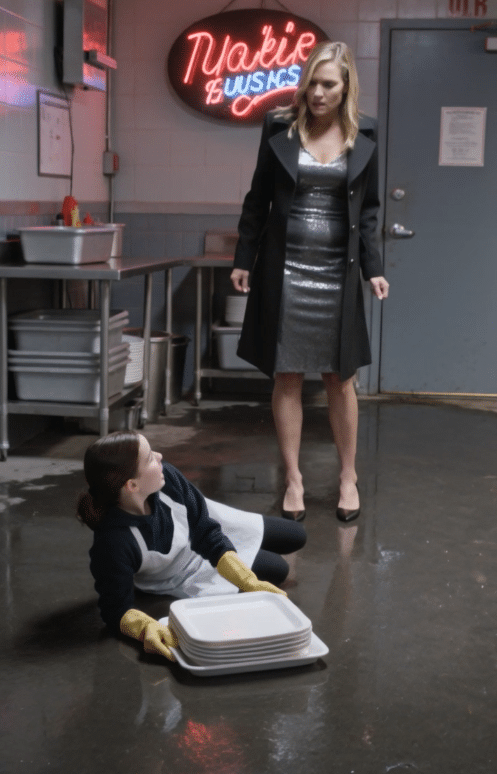
The drop of water landed beside the woman’s expensive heel.
It was barely anything. A tiny bead slipping from the edge of a dish tray, splashing onto the wet concrete behind a late-night American diner. Under the red neon sign above the back door, it shimmered for half a second before disappearing into the puddles.
But to Victoria Langford, it was an unforgivable offense.
“Are you kidding me?” she snapped, staring at the damp spot near her silver high heel.
Sixteen-year-old Hannah Miller froze with the tray balanced against her hip. Her black hoodie was stained beneath a faded diner apron, and her rubber gloves were slick from hours of washing dishes. A few strands of brown hair had escaped the tie at the back of her head.
“I am sorry. I can dry the floor,” Hannah said quickly.
She shifted the tray, trying to keep the remaining dishes from sliding. Behind her, the kitchen door swung open and shut as cooks carried out dirty plates, servers hurried toward the dining room, and the dishwasher rattled through another overloaded cycle.
Victoria did not look at any of that.
She wore a short black coat over a silver evening dress, with a diamond bracelet at her wrist and heels that looked absurdly delicate for an alley littered with puddles and discarded cardboard. She had spent the evening dining with friends at the restaurant’s best table, drinking enough wine to make her voice louder and her patience shorter.
Now, on her way to the parking area, she had encountered a teenager carrying dirty dishes.
And the teenager had inconvenienced her.
“Trash,” Victoria said. “You belong behind kitchens.”
Hannah lowered her eyes.
She had heard variations of that sentence before. Not always in those exact words, but often enough to recognize the meaning. Some customers believed that because she wore an apron and washed dishes, she was somehow less deserving of ordinary courtesy.
“I really am sorry,” she repeated. “I’ll wipe it up.”
Victoria stepped closer.
Hannah instinctively moved backward, careful not to drop the tray. She was tired enough that her arms trembled slightly. She had been on her feet since late afternoon, and the last dinner rush had left a mountain of plates, glasses, and greasy pans stacked beside the sink.
Her manager had asked her to stay late because two employees had called out.
She had agreed because she needed the extra hours.
That was all.
Victoria’s expression hardened.
“You think an apology makes you competent?”
Before Hannah could answer, the woman kicked her in the chest.
The tray flew from Hannah’s hands. Plates struck the concrete and shattered, while metal cutlery scattered beneath a dumpster. Hannah fell beside the rear kitchen door, catching herself awkwardly with one arm.
A thin line of blood appeared along her elbow.
For a moment, she could not understand why she was on the ground.
Then pain spread through her chest, and the cold pavement pressed against her cheek.
The kitchen door opened behind her.
A cook stepped outside carrying a bin of food scraps. He stopped so abruptly that the bin struck his leg. Two customers leaving through the side passage gasped, one of them raising a hand to her mouth.
Victoria looked around, irritated by the attention.
Then she stepped toward Hannah again.
Two more kicks landed against the girl’s back and side. Hannah curled inward, trying to protect herself as her apron twisted beneath her. She made no attempt to fight back.
She only tried to get away.
“Wash dishes from the pavement,” Victoria ordered.
The words echoed between the brick walls.
Hannah stared at the broken plates scattered around her. She thought about the money she had earned that week, the groceries waiting to be bought, and the electricity bill her mother had folded into a drawer because there was not enough money to pay it yet.
She had promised herself she would finish the shift.
Now she could barely draw a comfortable breath.
The people near the back door stood frozen. A server held the door open but did not step forward. Someone whispered that they should call the police, yet no one seemed certain who would be brave enough to move first.
Then headlights swept across the alley.
A dark city vehicle stopped at the entrance.
The rear door opened, and a woman in a navy official coat stepped out with a clipboard tucked beneath one arm. She took three quick strides into the alley, saw Hannah on the ground, and immediately changed direction.
Victoria turned just as the newcomer reached her.
The woman delivered one sharp slap across Victoria’s face.
The sound cracked through the narrow alley.
Victoria stumbled sideways, one hand flying to her cheek. Before she could recover, the stranger positioned herself between the wealthy woman and the injured girl.
Her eyes were furious.
“She kept the kitchen alive while you sat like royalty.”
Victoria stared at her.
The stranger’s official identification was visible against her dark coat. Her name was Evelyn Shaw, director of the city’s food-service safety division, the office responsible for overseeing restaurant inspections, food-service compliance, and several programs supporting safe working conditions in licensed kitchens.
Victoria knew the name.
Everyone who owned a restaurant, managed a food business, or depended on a city food-service license had reason to know it.
But that was not what frightened her most.
Evelyn was not looking at her as a powerful official who had just witnessed an ugly incident.
She was looking at her as if she had finally confirmed something she had suspected for months.
Victoria’s confidence faltered.
“The kitchen?” she whispered.
Evelyn did not answer immediately.
Behind her, Hannah lay beside the broken dishes, struggling to sit up. A cook finally rushed to bring a clean towel, while another employee called emergency services.
Victoria remained motionless, staring at the director.
Because she had no idea what Hannah Miller had to do with the investigation Evelyn Shaw had been conducting.
And she was about to discover that the girl she had treated as invisible had become the most important witness in a case that could threaten everything Victoria owned.
Act II
Hannah Miller had learned how to disappear without leaving a room.
At school, she sat near the back of the classroom and rarely volunteered to answer questions unless a teacher called on her directly. At work, she moved efficiently between the dish pit, the storage shelves, and the kitchen door, making herself useful without getting in anyone’s way.
She was not naturally timid.
When she was younger, she had been the sort of child who asked endless questions and laughed loudly enough that her mother sometimes had to remind her to let other people finish speaking. She had loved drawing, especially the complicated patterns of old buildings and the tiny details of storefronts.
Then her father died, and the family changed.
He had worked as a maintenance technician for a small hotel. After a sudden medical emergency, he left behind a modest life insurance policy, several unpaid bills, and a wife who had never imagined she would have to manage a household alone.
Hannah’s mother, Rachel, took extra shifts at a care facility and did everything she could to keep their apartment. She sold furniture they could live without, stopped buying anything unnecessary, and learned to stretch a week’s groceries across nine days when she had to.
Hannah noticed the sacrifices.
She also noticed that her mother had begun hiding the envelopes from creditors before Hannah came home from school.
At fifteen, Hannah asked the diner manager if she could work a few evening shifts washing dishes. The manager initially hesitated because of her age, but after confirming the permitted hours and arranging the appropriate paperwork, he gave her a limited schedule that would not interfere with school.
The work was exhausting.
The dish pit stayed hot and damp, and the constant clatter of plates could make it difficult to hear someone standing directly beside her. Her hands were almost always wrinkled from water, and the chemical smell of detergent followed her home.
But the wages helped.
Hannah paid for groceries when her mother was short, contributed to the heating bill, and kept a small amount for school supplies. She never thought of herself as a hero. She was simply doing what she believed her family needed.
The diner, called the Harbor Lantern, was an old neighborhood restaurant with cracked red booths and a neon sign that flickered during storms. Its owner, Samuel Reed, had bought the place years earlier after working as a line cook and then a kitchen manager.
He was demanding about food safety but generally fair to his employees. He believed dirty dishes could wait a few seconds if a worker needed to steady a heavy tray or avoid slipping on a wet floor.
Hannah liked that about him.
He did not pretend the work was glamorous. He also did not pretend it was unimportant.
Every plate that left the kitchen had to be clean. Every glass needed to be checked. Every pan had to be scrubbed properly, because a restaurant could not serve people safely if the people behind the scenes were rushed into mistakes.
The kitchen staff had come to rely on Hannah.
She noticed when a dishwasher hose began leaking. She remembered which storage rack wobbled if a heavy tray was placed on the upper shelf. She could identify the different stacks of plates by sight and knew which cook needed clean pans first when the dinner rush grew intense.
When the dishwasher broke down one evening, she helped organize a manual washing station while the manager arranged a repair. She kept the clean dishes moving and made sure the staff separated dirty utensils from sanitized equipment.
It had been a difficult night, but the kitchen had stayed open.
The incident had not made headlines. It had not even earned Hannah a public thank-you.
It was simply another shift.
Victoria Langford had come to the Harbor Lantern that night after attending a private business dinner nearby. She was not a regular customer, but she had heard that the diner was a convenient place to meet people who wanted an unpretentious meal after formal events.
She ordered expensive wine, asked for substitutions, and complained twice about the speed of the kitchen.
Her food arrived within a reasonable time.
She finished most of it.
Then she walked out through the rear passage because the front entrance was crowded with departing customers.
Hannah happened to be carrying a tray of dishes toward the kitchen.
One drop of water landed near Victoria’s shoe.
That was the entire trigger.
The attack that followed had nothing to do with the floor.
It came from Victoria’s belief that certain people existed to absorb her irritation. She saw the apron before she saw the girl. She saw the wet concrete before she considered the hours Hannah had spent working in the kitchen. And when Hannah apologized, Victoria interpreted the apology not as courtesy but as confirmation that the girl knew her place.
Evelyn Shaw saw something else.
She saw a teenager who had been working in a licensed food establishment, an adult customer who had assaulted her, and a kitchen staff that had been left frightened and uncertain about what to do.
She also recognized the restaurant.
The Harbor Lantern had appeared in a set of reports her office had been reviewing—not because the diner was suspected of serious wrongdoing, but because several small restaurants in the area had reported unusual pressure from a private consulting firm offering to help them navigate inspections.
The firm’s clients included a collection of restaurants owned or financially supported by Victoria.
Evelyn had not come to the alley looking for Hannah.
She had been conducting an evening compliance visit at another establishment and was returning to her vehicle when she heard the commotion.
What she discovered behind the diner would connect two matters she had believed were separate.
And the first clue was sitting on the clipboard in her hand.
Act III
Evelyn Shaw had spent twenty years learning how easily a good system could be bent by people who understood its weaknesses.
Her division inspected food-service businesses, reviewed compliance records, and coordinated with other city departments when serious violations were reported. Most cases were routine: an incorrect storage temperature, a missing training record, a pest-control issue, or equipment that needed repair.
Many restaurant owners cooperated.
Some did not.
The difficult cases often began with a complaint that seemed too small to matter. A worker who said the manager had altered a log. A restaurant owner who claimed an inspector had never visited. A contractor who submitted the same service record for two locations hundreds of miles apart.
One discrepancy could be a mistake.
A dozen similar discrepancies demanded attention.
Several months earlier, Evelyn’s office had begun receiving reports that certain restaurant operators were being pressured to purchase services from a private compliance consultancy called Meridian Hospitality Solutions.
The company advertised itself as an expert partner for restaurants that wanted to remain inspection-ready. It offered staff training, documentation systems, and help preparing for regulatory visits.
Those services were legitimate in principle.
The complaints concerned how the company obtained its clients and what it promised them.
Some owners said Meridian had implied that restaurants outside its network would face more frequent inspections. Others claimed they had been told that hiring the firm would guarantee smoother approval from city officials.
The division did not have evidence to conclude that every complaint was true. Evelyn therefore ordered a review of the communications and records submitted by the businesses involved.
Victoria Langford’s restaurant group appeared several times in the material.
Victoria owned a celebrated dining room called Silverthorne, along with two smaller establishments operated under separate business names. She had also invested in a restaurant-management company that advised independent owners on staffing, menus, and expansion.
Her businesses had good reviews and attracted affluent customers.
They also appeared to have received unusually confident assurances from Meridian.
One internal email referred to a “preferred inspection pathway.” Another suggested that certain documentation problems could be “resolved before they reach the official record.”
The phrases were vague enough to have innocent explanations.
But the timing of several revised inspection logs raised questions.
Evelyn’s office requested copies of the original records and asked the affected restaurants to preserve relevant correspondence. The matter was referred for further administrative review, and the division began checking whether the consultancy had misrepresented its relationship with the city.
Victoria responded through a lawyer.
She said her restaurants had followed the advice of a professional service provider and denied receiving any improper treatment. She also objected to what she described as a fishing expedition.
Evelyn did not treat the allegations as proof.
She had seen too many cases collapse because someone rushed to a conclusion before the evidence was complete. The consultancy might have used irresponsible language without having any influence over actual inspections. Some records might have been corrected for legitimate reasons.
The investigation had to establish what happened, not what looked suspicious.
Then the Harbor Lantern appeared in a separate set of documents.
Its owner, Samuel Reed, had contacted the city after receiving repeated messages from Meridian representatives. The firm had offered to “protect the restaurant’s inspection standing” if he signed a costly annual contract.
Samuel declined.
He had already paid a qualified technician to repair the dishwasher and had maintained the diner’s training and sanitation records for years. He saw no reason to purchase an expensive package that seemed to promise access to people who were supposed to treat every business fairly.
After he declined, the firm sent him a warning that his restaurant might be vulnerable to “avoidable compliance complications.”
A few days later, an anonymous complaint about the diner was filed with the city.
The complaint described alleged sanitation failures.
An inspector visited and found some minor issues that needed correction, but nothing that matched the dramatic claims in the report. The diner addressed the deficiencies and passed a follow-up inspection.
Samuel suspected the complaint had been retaliatory.
He could not prove it.
Evelyn’s team logged the concern and began comparing it with other reports. The timing suggested a possible pattern, but the connection between the consultancy and the complaints remained unconfirmed.
That was why Evelyn was carrying her clipboard when she arrived behind the diner.
She had been reviewing documentation from several establishments and checking the status of corrective actions. The Harbor Lantern was one of the businesses on her route.
She had intended to speak with the manager about a completed follow-up inspection.
Instead, she found Hannah on the ground.
The girl had been working in the very kitchen whose records were being examined. She had helped keep the diner operating through a difficult equipment failure, and she had done so without the authority or resources of the people who later claimed they could guarantee its compliance.
Evelyn’s words to Victoria had been personal in their force but precise in their meaning.
“She kept the kitchen alive while you sat like royalty.”
She was not saying that Hannah alone was responsible for the diner’s safety. Nor was she claiming that working hard exempted any restaurant from inspections.
She was pointing out the obvious truth Victoria had ignored: the person washing dishes was part of the system that kept the restaurant functioning.
And the woman who had enjoyed the service had treated that worker as if she were disposable.
As emergency responders arrived, Evelyn gave her account of the assault. She also made sure the appropriate officers knew that her own strike would need to be documented. Her authority did not erase the fact that she had hit Victoria, and she would cooperate with any review of that decision.
Then she turned to the clipboard.
One of the documents attached to it was a copy of the Harbor Lantern’s recent inspection summary.
At the bottom was a reference number linking the report to the broader compliance review.
Evelyn recognized the number immediately.
The diner’s case was not merely an isolated complaint about a wet floor or a broken dishwasher. It was one of the records her team had been trying to understand.
And the more she looked at the paperwork, the clearer it became that someone had tried to make a small restaurant appear less compliant than it was.
Act IV
Hannah was taken for medical evaluation while her mother, Rachel, hurried to the diner.
Rachel arrived still wearing her care-facility uniform, her hair loosely tied back and her face pale with fear. When she saw the broken dishes, the overturned tray, and the towel stained lightly near Hannah’s elbow, she stopped in the doorway.
For several seconds, she could not speak.
Hannah tried to reassure her.
“I’m okay, Mom.”
But her voice was unsteady, and Rachel could see that her daughter was hurting.
She sat beside Hannah and held her hand carefully while the medical staff checked her injuries. She did not ask why Hannah had failed to avoid the confrontation. She did not tell her to be more careful around rich customers.
She asked whether Hannah felt safe.
That question mattered more than any lecture could have.
The incident was reported to the police, and witnesses provided statements about what they had seen. The diner’s staff preserved available camera footage, while the restaurant manager supplied the shift records showing when Hannah had begun work and how the evening had unfolded.
Victoria’s lawyer soon arrived, insisting that his client had been provoked by an unsafe condition in the alley.
The evidence told a different story.
A small amount of water had landed near Victoria’s heel. Hannah had apologized and offered to clean it. The assault had followed without any meaningful threat to Victoria’s safety.
The legal process would determine the appropriate consequences, but the restaurant could not plausibly present the incident as a mutual altercation.
Victoria had attacked a teenager who was carrying dishes.
She had then insulted her while she lay on the ground.
The food-service investigation moved forward separately.
Evelyn’s office continued to examine Meridian Hospitality Solutions and its communications with restaurant owners. Officials requested original copies of inspection-related records, compared them with the city’s own logs, and asked businesses to explain discrepancies.
The investigation found several instances in which documents had been revised without a clear record of who had made the changes or why. Some messages also appeared to exaggerate Meridian’s ability to influence city processes.
Those findings warranted further scrutiny, but they did not automatically prove a coordinated scheme. Investigators had to determine whether the irregularities resulted from poor recordkeeping, misleading sales tactics, or deliberate interference.
Victoria’s businesses were among those asked to provide additional information.
She argued that she had paid for professional assistance and had no reason to believe the firm had misrepresented its services. That claim was not dismissed out of hand. Officials reviewed the agreements, invoices, and communications rather than assuming that a client’s use of a consultancy made the client responsible for every action it took.
But the records also showed that Victoria had received warnings about the wording of Meridian’s claims.
In one message, a restaurant manager had asked whether the firm truly had a special relationship with city inspectors. Victoria’s reply said the arrangement would “keep unnecessary trouble away.”
It was not a confession to wrongdoing.
It was, however, a statement investigators needed to understand.
The inquiry widened to include the way complaints had been submitted against businesses that declined Meridian’s contracts. The Harbor Lantern was not the only restaurant that had reported an abrupt inspection complaint after refusing the firm’s services.
Evelyn remained careful not to promise a dramatic outcome.
She could not order the police to prosecute Victoria. She could not decide in advance whether a business had deliberately falsified records. And she could not use the city’s authority to settle a personal score with someone who had assaulted a child in front of her.
What she could do was ensure the evidence was preserved, the complaints were reviewed, and the city’s inspection process was not treated as private property.
The assault also prompted the diner to review its procedures for employees who worked late shifts. Samuel installed a clearer camera view of the rear passage, improved the lighting, and established a process for staff to report threatening customers without fearing that they would lose hours.
He did not pretend those steps could prevent every incident.
They were simply measures the restaurant should have taken sooner.
When Hannah was ready to return, he offered her a reduced schedule while she recovered. He also made it clear that she would not be expected to clean up broken dishes from the assault or pay for the damaged tray.
Hannah had worried about that cost.
Samuel refused to let her carry it.
“You didn’t break those plates by being careless,” he told her. “You were hurt while doing your job.”
For once, she did not argue.
The city review eventually confirmed that some of Meridian’s claims about its influence over inspections were unsupported. Several restaurant owners received corrected guidance, and the city issued a clearer explanation of how inspections were assigned and how complaints were evaluated.
Disputed records were referred for further examination, and businesses were required to maintain more transparent documentation when making corrections.
The inquiry did not end with every question answered. Some allegations could not be substantiated, while others required additional review.
But the process changed.
Restaurants were reminded that no private consultancy could guarantee special treatment from city inspectors. The division established a more direct channel for owners to report pressure or misleading claims, and its staff were instructed to document communications more consistently.
Victoria’s reputation suffered, but not because Evelyn declared her guilty in a back alley.
It suffered because people began examining the facts for themselves.
Customers asked questions. Business partners reviewed their contracts. Restaurant managers reconsidered whether they wanted to associate their names with someone who treated workers so casually and relied on promises of influence that could not be verified.
The assault case proceeded through the appropriate legal channels.
The administrative review proceeded through its own.
For Victoria, the distinction offered little comfort. She could no longer dismiss every concern as a personal attack, because the concerns came from different witnesses, separate records, and independent processes.
She had believed that money could keep consequences at a distance.
Now she was learning that distance was not the same as immunity.
Act V
Hannah returned to the Harbor Lantern on a quiet Tuesday evening.
The red neon sign still buzzed above the alley, and the kitchen door still swung open whenever a server needed clean plates. The diner smelled of coffee, warm bread, and the sharp citrus cleaner used on the counters after the dinner rush.
Nothing about the place looked transformed.
The dishwasher still rattled.
The floor still became wet during busy shifts.
The cooks still called for clean pans when orders began piling up.
But Hannah noticed the new light above the rear passage and the camera mounted near the door. She noticed that the staff had been given a clearer way to report threatening behavior. She noticed, too, that the manager had arranged the late shift so she would not be working alone near closing time.
Those details made it easier to breathe.
She still felt uneasy when someone raised their voice. Sometimes the sound of a metal tray hitting the floor brought back the image of the alley and the broken plates scattered around her.
She did not pretend that the fear had disappeared.
Her mother encouraged her to take things slowly, and Hannah began speaking with a counselor through a local youth support program. She also kept her school schedule intact, even when the diner offered her additional hours.
For the first time in months, she was learning that helping her family did not mean sacrificing every part of her own life.
The city’s inquiry continued.
Meridian Hospitality Solutions faced further scrutiny over its claims and documentation practices, while the restaurants connected to the review were required to respond to the findings. The city strengthened its procedures for handling complaints and clarified that inspection decisions had to be based on evidence, not on a private firm’s promises.
Victoria’s businesses were not all treated as identical, and the investigation did not assume that every employee or restaurant owner had participated in misconduct. Some records were corrected, some claims could not be proven, and other questions were referred for additional review.
But Victoria herself could not erase what had happened behind the diner.
The police had statements from witnesses.
The restaurant had records of Hannah’s shift.
The footage had been preserved.
And the woman who had attacked a teenager could not make the event disappear simply by describing it as an unfortunate misunderstanding.
When the legal proceedings reached their conclusion, Victoria faced formal consequences for the assault. The exact outcome followed the applicable process, rather than a punishment dictated by Evelyn or the restaurant industry.
That mattered to Hannah.
She had not needed a powerful stranger to become judge and jury. She had needed someone to stop the immediate harm, call for help, and make sure the evidence did not vanish because the person responsible had money.
Evelyn’s own conduct was also reviewed. She cooperated with the inquiry and accepted that her official role did not grant her a special right to use force. The slap had been an impulsive response to seeing a child hurt, but it was not presented as a model for how public officials should handle such situations.
The intervention had stopped the confrontation.
The records and witnesses would have to carry the rest.
Months later, Evelyn visited the Harbor Lantern again as part of a scheduled compliance meeting. She met with Samuel, reviewed the restaurant’s updated procedures, and spoke with staff about reporting concerns.
Hannah was finishing a stack of clean glasses when she saw the director enter the kitchen.
For a moment, she felt the same nervousness she had experienced in the alley. Then she remembered the woman standing between her and Victoria, asking others to call for help, making sure she was not moved before medical assistance arrived.
Evelyn did not approach her as though she were a symbol of the city’s work.
She asked how she was doing.
Hannah said she was better.
It was not entirely true, but it was more true than it had been a month earlier.
Evelyn glanced around the kitchen. The clean plates were stacked neatly beside the pass-through, and a cook was checking a tray of food before sending it to a table.
“This place depends on a lot of people doing small things right,” she said.
Hannah followed her gaze.
“Most people don’t notice.”
“No,” Evelyn replied. “They usually notice only when something goes wrong.”
Hannah considered that.
She had spent so long believing that being unnoticed was part of her job that she had never questioned it. She had assumed that if she worked hard enough, stayed quiet enough, and made herself useful enough, she could avoid becoming a problem for anyone.
Now she understood that the work could be humble without making the worker insignificant.
Washing a plate was not glamorous.
Keeping a kitchen supplied with clean dishes was not glamorous.
Neither was checking temperatures, scrubbing a pan, sanitizing a surface, or staying late because the dinner rush had overwhelmed the staff.
But those tasks mattered.
A restaurant could have the finest chef in the city and still fail if no one maintained the conditions that made safe service possible. A dining room could impress every wealthy guest who entered and still depend on a teenager whose name those guests never bothered to learn.
Hannah had not kept the kitchen alive alone. The cooks, servers, manager, and other staff had all contributed. But her work had been part of that effort, and nothing about her age or her apron made it less valuable.
That evening, she finished her shift and stepped outside through the rear door.
The neon sign cast a red reflection across the pavement. The alley was damp from a recent cleaning, but the new light made the path easier to see. She pulled her hoodie tighter around herself and waited while her mother came to collect her.
Across the street, a restaurant customer laughed as he climbed into a waiting car.
Hannah watched him for a moment, then looked away.
She did not need every stranger to understand her life.
She only needed to know that she had the same right to safety and dignity as anyone walking through the front entrance in a silver dress.
Victoria had once looked at her and seen nothing but a dishwasher.
Evelyn had looked at the same girl and seen a worker whose effort mattered, a teenager who deserved protection, and a person whose treatment revealed something about the adults around her.
The difference was not that Evelyn held public office.
It was that she had been willing to look beyond the apron.
The kitchen kept running after Victoria left the city’s attention. The plates continued to move through the sink, the cooks continued to prepare meals, and the servers continued carrying food to customers who would never know how much work had happened behind the door.
Hannah returned to her station the following evening.
She pulled on her rubber gloves, checked the clean rack, and reached for the first stack of dishes.
Her hands were steady.
She was still sixteen. She was still working to help her mother. The bills had not vanished, and the future had not suddenly become simple.
But she no longer believed that a person’s worth depended on how much money they spent at a restaurant—or how little space they took up behind it.
Victoria had looked down at Hannah and said, “You belong behind kitchens.”
Evelyn’s answer had been more than a rebuke.
It was a reminder that kitchens, like every other workplace, were kept alive by people whose labor deserved respect.
And the girl Victoria had tried to humiliate was still there, doing honest work, building a future, and learning that she never had to apologize for existing.
The woman in the silver dress had believed she was royalty.
The teenager in the stained apron had known only that the dishes needed washing.
In the end, the city did not need to decide which of them looked more important.
The truth had already answered that question.