Act I
The first thing everyone heard was the washing machines.
The steady rumble echoed through the self-service laundromat as customers folded clothes, counted quarters, and waited for dryers to finish their cycles.
Then came a scream.
A sixty-year-old woman stood quietly beside the quarter machine, turning a small coin pouch in her weathered hands. The machine had jammed again, and she patiently tried to free the coins without disturbing anyone.
She never saw the younger woman coming.
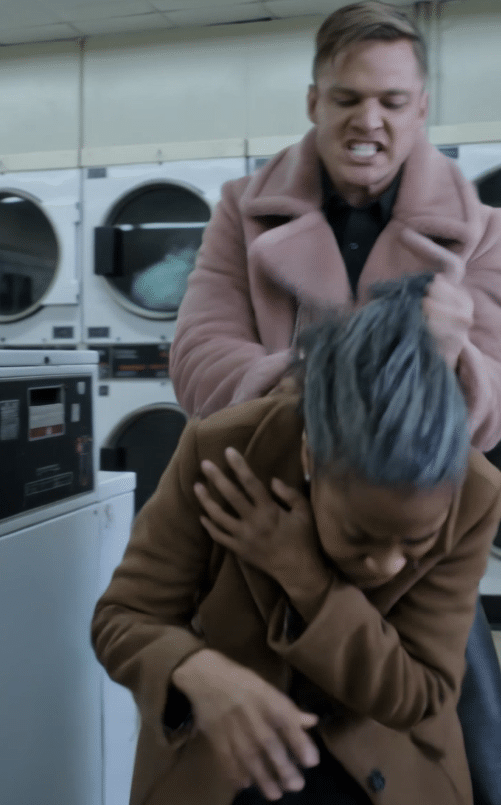
A hand shot into her hair from behind.
Her head snapped backward.
Three brutal blows landed against the side of her head before anyone could react.
The coin pouch rattled violently.
Her carefully tied hair came loose.
A thin red line appeared near her hairline as she staggered forward, struggling to stay on her feet.
Customers froze between rows of spinning washers.
Nobody understood how a minor delay at a coin machine had exploded into violence.
The younger woman looked nothing like someone waiting to wash clothes.
She wore a pink faux-fur coat over black leather pants, expensive heels clicking sharply against the tile floor. A designer handbag hung from one shoulder, and diamonds flashed from her manicured fingers.
She looked like success.
Until she opened her mouth.
Still gripping the older woman’s hair, she yanked her head back with open contempt.
“Trash.”
Her voice echoed through the laundromat.
“You can’t even use a coin machine.”
The older woman closed her eyes for only a moment.
Not from surrender.
From pain.
When she opened them again, there were no tears.
Only quiet dignity.
That calm expression made the younger woman even angrier.
And the worst part of the attack had yet to come.
Act II
The younger woman owned one of the busiest nail salons downtown.
Her customers knew her as glamorous, ambitious, and outspoken.
They never saw what happened whenever things stopped going her way.
She hated waiting.
She hated inconvenience.
Most of all, she hated people she believed were beneath her.
The elderly immigrant woman fit that picture perfectly.
An old brown coat.
Worn shoes.
Loose dark pants.
Gray-black hair tied low.
A tiny pouch filled with quarters.
To the salon owner, she looked invisible.
Someone whose time didn’t matter.
Someone who should move faster.
Someone who deserved to be shouted at.
The older woman quietly tried to explain that the machine had jammed.
She never finished.
The younger woman jerked her violently by the hair.
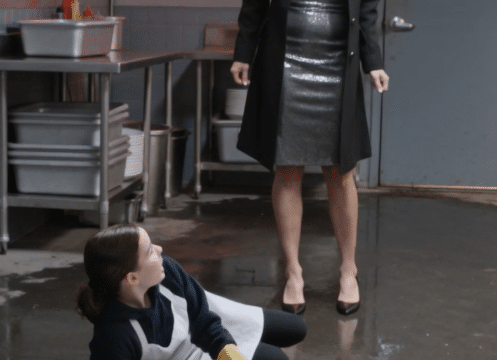
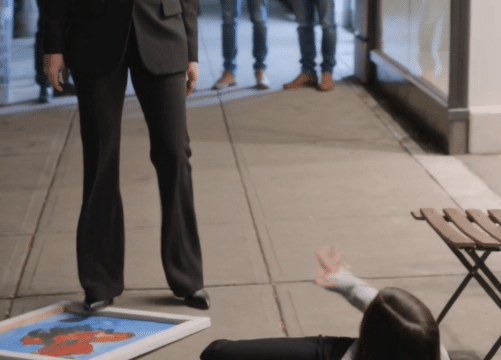
Then threw her hard across the laundromat floor beside the spinning washing machines.
The older woman’s shoulder struck the tile.
Her head bounced painfully against the floor.
The coin pouch scattered across the room as quarters rolled beneath rows of washers.
Gasps filled the laundromat.
One customer instinctively stepped forward.
Another quietly dialed 911.
The elderly woman curled slightly, one hand protecting her aching head.
She made no attempt to fight back.
She simply tried to sit up.
The salon owner stood over her with absolute satisfaction.
“Stay down.”
She adjusted her expensive handbag.
“And wash someone else’s mess.”
Several customers looked away.
Not because they approved.
Because witnessing cruelty often leaves people unsure whether to move.
Outside, however…
Something much louder than the washing machines had already arrived.
Act III
An engine roared outside the glass entrance.
Heads turned toward the street.
Before anyone could process the sound, a city service vehicle crashed through the laundromat’s front glass.
Windows exploded into thousands of glittering fragments.
The vehicle stopped just inside the entrance.
Silence swallowed the room.
The driver’s door opened.
Heavy work boots stepped onto shattered glass.
Behind them came two municipal employees wearing reflective city vests.
Then a middle-aged man in a dark blue inspection jacket climbed down from the vehicle.
Everyone recognized the city badge stitched across his chest.
He wasn’t a police officer.
He wasn’t security.
He was the city’s chief building inspector.
Instead of looking toward the damaged entrance, he rushed straight toward the elderly woman lying beside the washers.
“Ma’am…”
His voice carried genuine concern.
He carefully helped her sit upright, shielding her from the broken glass while one employee positioned himself between her and the attacker.
The older woman managed a faint smile.
“I’m alright.”
“No,” the inspector answered quietly.
“You were assaulted.”
He gently brushed dust from her old brown coat before noticing the loosened hair and the thin scrape near her hairline.
His expression hardened.
The salon owner’s confidence began to crack.
Why would a chief city inspector care so much about an elderly woman doing laundry?
The answer arrived only seconds later.
The inspector slowly stood and faced the room.
His eyes settled on the younger woman.
Then he asked one question.
“Who hit the owner of this building?”
The laundromat became so quiet that even the washing machines suddenly seemed distant.
The salon owner’s face turned pale.
But that wasn’t even the worst part.
Act IV
For years, customers had assumed the elderly woman worked there.
She swept the floors when employees were busy.
She emptied trash bins without being asked.
She helped parents carry heavy laundry baskets.
She fixed broken detergent dispensers herself whenever maintenance ran late.
Nobody realized she wasn’t an employee.
She owned the entire building.
Decades earlier, after immigrating to America with almost nothing, she had worked three jobs while saving every possible dollar.
She never chased luxury.
She bought property instead.
One laundromat became two.
Then an apartment building.
Then another commercial space.
Quietly.
Patiently.
Without ever changing the simple clothes she had always worn.
The laundromat remained her favorite place because she believed owners should never forget the people who kept their businesses alive.
The city inspector knew her well.
He had been scheduled to meet her that afternoon regarding improvements the city planned to fund for older neighborhood businesses.
Instead, he had arrived just in time to witness broken glass, terrified customers, and a respected property owner lying on the floor.
The salon owner tried to recover.
“I didn’t know.”
Nobody answered.
“I thought she worked here.”
Still silence.
“She was blocking everyone.”
The inspector took one measured step forward.
“So your excuse,” he said calmly, “is that you believed hurting someone with less money was acceptable?”
No answer came.
Because there wasn’t one.
The customers who had hesitated moments earlier finally surrounded the older woman.
One returned her scattered quarters.
Another handed back the worn coin pouch.
A young mother quietly fixed the older woman’s loosened hair.
Respect spread through the laundromat faster than fear ever had.
Only one person remained completely alone.
Act V
City employees secured the entrance while police officers arrived to collect witness statements.
Nearly every customer had recorded part of the assault.
The evidence was overwhelming.
The younger woman’s expensive appearance suddenly looked painfully empty.
Her designer handbag.
Her luxury heels.
Her flawless manicure.
None of it carried any value now.
The elderly owner slowly stood with the inspector’s support.
Her head still hurt.
A faint red scrape remained near her hairline.
Her hair was no longer neatly tied.
But she stood with the same quiet dignity she had carried long before anyone knew who she really was.
She never demanded revenge.
Never raised her voice.
Never reminded anyone that the building belonged to her.
She didn’t need to.
The truth had already spoken louder than anger ever could.
The inspector looked around the laundromat one final time.
“This building has served this neighborhood for nearly thirty years,” he said.
“Because its owner never forgot what it feels like to have nothing.”
The customers nodded silently.
Some smiled at the elderly woman with newfound respect.
Others looked down, ashamed they had waited too long to step in.
Across the room, the salon owner’s confidence had completely disappeared.
She stared at the rows of washing machines she had mocked only moments before.
Then she looked at the elderly woman.
Then at the inspector.
The realization crushed every ounce of arrogance she had left.
She hadn’t humiliated a poor immigrant.
She had assaulted the woman who owned the entire property.
The camera lingered on her face alone against the empty wall of humming washing machines.
No crowd.
No owner.
No inspector.
Only panic.
Her lips trembled as the truth finally settled into place.
“She owns… this building?”
For the first time in her life, she understood that wealth isn’t measured by designer labels or luxury handbags.
Sometimes, it wears an old brown coat… and carries a pouch full of quarters.