Act I
The room went silent before anyone understood what had just happened.
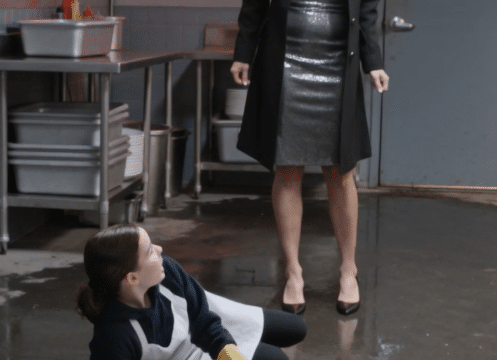
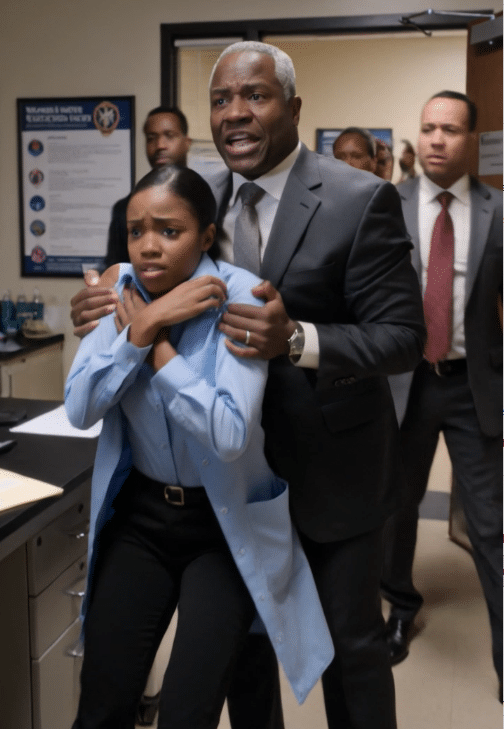
A graduate researcher had been standing beside her laptop, calmly explaining the latest data from months of work. One moment she was pointing at a graph on the large monitor. The next, she was stumbling backward after being violently shoved aside by the very professor who claimed the laboratory belonged to him.
Her shoulder struck the edge of a lab bench before she fell to the floor.
No one moved.
Dozens of eyes followed the professor as he stood over her with complete confidence, convinced that every person in the room would remain on his side.
“Trash,” he sneered.
“You don’t challenge me in my lab.”
The words hurt almost as much as the humiliation.
She didn’t scream.
She didn’t beg.
She simply looked toward the laptop that still displayed the research she had spent years building.
What everyone believed was an argument over authority was actually the beginning of something much bigger.
And the person about to walk through the faculty meeting door would change everything.
Act II
Emily Carter had earned a reputation few graduate students ever achieved.
While others chased publications, she solved problems that established researchers had quietly abandoned years before.
Her work on advanced biomedical imaging had attracted attention far beyond the university.
Federal agencies had requested updates.
Private foundations had offered funding.
Industry leaders had begun asking when her technology would be ready.
Professor Richard Hawthorne hated every minute of it.
For decades, he had ruled the laboratory without question.
Students obeyed.
Junior faculty stayed silent.
Anyone who challenged him eventually disappeared from the department.
His authority had become part of the building itself.
When Emily politely corrected one assumption in front of several visiting faculty members, something inside him snapped.
To him, this wasn’t about research.
It was about control.
He couldn’t allow the room to see that the youngest scientist understood the project better than its most senior professor.
So instead of debating the evidence, he attacked the person presenting it.
The witnesses froze.
Some lowered their eyes.
Others pretended to read notes they had already memorized.
Nobody wanted to become his next target.
Emily slowly pushed herself upright without asking for help.
Her shoulder ached.
But her expression never lost its composure.
That quiet dignity unsettled even the people watching.
Then heavy footsteps echoed from the hallway.
Act III
The faculty meeting door swung open.
Conversation stopped instantly.
Walking into the laboratory was the university president.
Behind him came members of the Board of Trustees.
The department chair followed close behind.
None of them looked at Professor Hawthorne first.
Instead, the president crossed the room directly to Emily.
He knelt beside her.
“Are you alright?”
She nodded despite the pain.
Only after helping her stand did he slowly turn toward the professor.
The entire laboratory seemed to stop breathing.
His voice was calm.
Cold.
Controlled.
“Who attacked our new project director?”
The sentence shattered the room.
Professor Hawthorne blinked.
“…Project director?”
Board members exchanged grim looks.
The department chair opened a folder.
Inside was a signed appointment bearing every required signature.
Emily Carter had officially been selected that very morning to lead the university’s largest research initiative—a multi-million-dollar interdisciplinary project expected to define the institution’s future.
Everyone in the room had been waiting for the formal announcement.
Everyone except the professor.
He had assaulted the very person the university had just placed above him on the project.
And now every witness understood exactly what they had seen.
But that wasn’t the only surprise.
Act IV
The president accepted another document from the board chair.
“This appointment was unanimous.”
Silence.
“Every department recommended her.”
Another pause.
“Even yours.”
The professor’s confidence evaporated.
He remembered the evaluation forms.
Months earlier he had dismissed them as routine paperwork.
He never imagined they would determine the future leadership of the university’s most important research program.
The board had quietly reviewed Emily’s publications.
Her grant success.
Her leadership.
Her integrity.
Even anonymous peer evaluations consistently described her with the same words:
Brilliant.
Collaborative.
Fearless.
The contrast with the professor’s record was impossible to ignore.
Years of complaints.
Reports of intimidation.
Graduate students transferring out of his lab.
Projects delayed by personal conflicts.
Everything had been documented.
Everything.
The president looked directly into his eyes.
“You believed authority came from fear.”
He gestured toward Emily.
“She earned hers through excellence.”
Security officers waiting outside entered only after being called.
Not dramatically.
Not aggressively.
Simply professionally.
For the first time in years, Professor Hawthorne realized nobody was protecting him anymore.
Act V
Emily stood quietly beside the university president.
She never demanded revenge.
She never celebrated his downfall.
Instead, she picked up the laptop that had fallen during the confrontation.
The presentation was still open.
The data still waited.
The research still mattered.
The president smiled.
“Whenever you’re ready,” he said.
“We’re here to hear your presentation.”
Faculty members slowly returned to their seats.
Board members opened notebooks.
Researchers who had spent years afraid to speak finally looked at Emily with admiration instead of caution.
Professor Hawthorne remained frozen.
The room that once revolved around him had already moved on.
Within weeks, the university announced new leadership for the research initiative.
Emily became its official director, overseeing one of the largest scientific collaborations in the institution’s history.
The professor was removed from supervisory responsibilities while the university conducted a formal investigation into his conduct.
The laboratory itself changed as well.
Students who had once worked in silence began asking questions without fear.
Collaboration replaced intimidation.
Ideas mattered more than titles.
And every person who had witnessed that unforgettable afternoon carried the same lesson with them.
Power built on fear can disappear in a single moment.
Respect earned through integrity lasts far longer than authority ever can.