Act I
The envelope was empty.
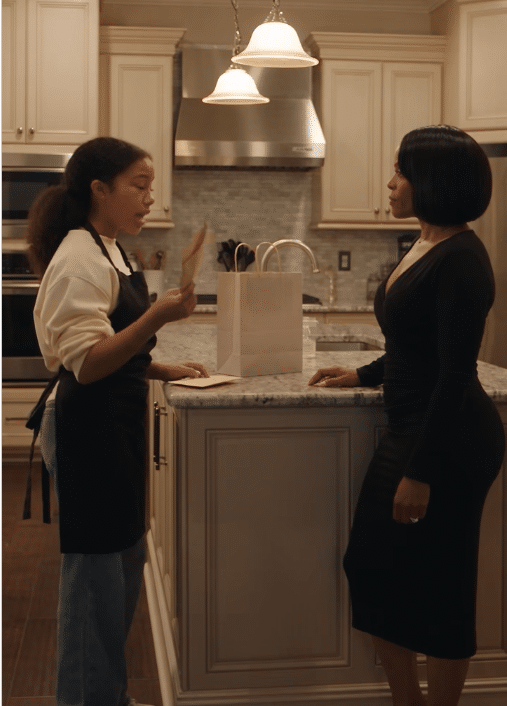
Nia stood beside the entry console, still wearing the black apron she had used while helping at the family diner that afternoon. Her feet hurt, her cream-white shirt was creased from hours of work, and all she wanted was to put away the tips she had earned before getting ready for the next day.
She opened the envelope again, tipped it upside down, and shook it gently.
Nothing fell out.
For a moment, she simply stared at the empty paper. She had counted that money more than once. Every tip mattered because every dollar brought her closer to the future she wanted.
Then she noticed the shopping bag on the kitchen counter.
Two VIP concert tickets peeked out from the top.
Nia looked at the tickets, then back at the envelope in her hand. The timing felt wrong, but she tried not to jump to conclusions. Maybe she had put the money somewhere else. Maybe someone had moved the envelope.
She turned toward her stepmother, who stood nearby looking entirely untroubled.
“What happened to the money I left here?”
Her stepmother barely glanced at the envelope.
“We share what we have in this family.”
The answer landed with the quiet finality of a door being shut.
Nia looked down at the tickets again. They were expensive seats, the kind of tickets people planned for weeks to afford. Ava’s shopping bag looked new, and the tickets appeared to have been placed inside it carefully, as though they were something precious.
Nia tightened her fingers around the empty envelope.
She had not left that money there for the household to share. She had saved it from her tips at the family diner, one shift at a time, with college in mind.
Her stepmother knew exactly what the money was for.
Nia reached for the small note where she recorded her savings. The numbers were written in her own handwriting, each amount added carefully as her envelope grew heavier.
She held it out.
“I saved those tips for college.”
Her stepmother finally looked at her, but not for long. Her gaze drifted toward Ava’s shopping bag, and her expression softened with a tenderness Nia rarely received.
“Ava’s memories matter more.”
Nia went still.
There was no apology. No suggestion that the money might be returned. No hesitation over the possibility that a fourteen-year-old girl had spent hours working to save for something important.
Her stepmother had decided that Ava deserved the concert more than Nia deserved her own savings.
And then the front door opened.
Marcus walked into the house wearing his dark-brown suit, his travel bag in hand. He took in the scene: Nia in her diner apron, the empty envelope, the handwritten savings note, and the VIP tickets sitting openly on the counter.
His eyes narrowed slightly.
He had not heard the entire conversation.
But he had arrived just in time to ask the one question his wife had not prepared an answer for.
Act II
Nia had started saving her tips because she wanted something that belonged entirely to her.
The money was not much at first. Some afternoons, she brought home only a modest amount after helping at the family diner. Other days were better, and she would count every bill with quiet satisfaction before recording the total on her savings note.
She understood that college would cost more than she could earn in a single summer. Still, saving made the goal feel less impossible.
Every tip was evidence that she was doing something about her future.
She did not expect anyone to celebrate her for it. She did not demand praise or ask her father to make up the difference. She simply wanted the chance to build toward something without having her efforts taken away.
Her stepmother had never treated that goal as particularly important.
Whenever Ava wanted something, there always seemed to be room in the household budget. A special outfit, an outing with friends, a new accessory—her requests were met with consideration, and sometimes with excitement.
Nia had learned to be careful about asking for anything.
She knew how quickly a request could become a lecture about responsibility, gratitude, or the need to put the family first. So she worked, saved, and kept her plans to herself.
The envelope on the entry console had become a small symbol of that independence.
It was not a bank account or a formal college fund. It was something more personal: money she had earned herself, protected by a simple system she trusted.
She knew how much had been there.
Now she knew it was gone.
And the tickets beside Ava’s shopping bag made the loss feel less like a mistake and more like a decision someone had made on her behalf.
Marcus stepped farther into the kitchen, setting down his things. He noticed Nia’s expression before he noticed the tickets.
She was not crying. She was not shouting. She was holding the empty envelope with the same careful restraint she used when she counted her savings.
That restraint concerned him more than an outburst might have.
He followed her gaze to the shopping bag.
Two VIP tickets were visible above its folded edge.
Marcus looked at his wife.
“Who paid for those tickets?”
For a fraction of a second, her expression changed.
Then she smiled.
“I paid for them myself.”
Her voice had become warmer, almost affectionate. The coldness she had directed at Nia moments earlier disappeared as though it had never existed.
Marcus did not immediately respond.
He had known his wife long enough to recognize when she wanted a conversation to end before it had properly begun. Her answer was polished, delivered without hesitation, and designed to make the matter seem ordinary.
But Nia was still standing beside the console with an empty envelope.
And her handwritten savings note was still in her hand.
Before Marcus could ask another question, Ava reached into her shopping bag and pulled out the tickets.
She looked pleased at first, still holding on to the belief that her mother had bought them as a special surprise. But the tension in the room was becoming impossible to ignore.
She walked toward Marcus and held the tickets out to him.
“She told me they were a gift.”
Ava glanced at Nia.
For the first time, she seemed to understand that the tickets and the missing money might not be two separate things.
Marcus took the tickets.
Then he looked toward the entry console again.
The empty envelope was not just a missing household item. It was the place where Nia had kept the money she earned through her own work.
And someone in the house knew exactly what had happened to it.
Act III
Caleb had been watching from near the kitchen.
He was ten, quiet by nature, and often noticed things other people overlooked. Earlier that afternoon, his phone had shown a notification from the doorbell camera. He remembered seeing his mother leave the house carrying an envelope.
At the time, he had not thought much about it.
Now, with Nia’s envelope empty and the concert tickets sitting in Marcus’s hand, the memory returned with a clarity that made him step forward.
He took out his phone.
“Mom took Nia’s envelope with her.”
The words changed the atmosphere in the kitchen.
Nia looked at Caleb. Marcus turned toward him, extending a hand for the phone. Across the room, their stepmother’s pleasant expression became strained.
Caleb opened the doorbell-camera clip.
The footage showed the front entrance from earlier that afternoon. His mother appeared in the frame carrying an envelope that was unmistakably the one Nia had left on the console. She walked out through the front door with it.
The clip later showed her returning.
This time, she was carrying a shopping bag.
The footage did not show every detail of what had happened while she was away. It did not reveal the conversation at the store or the moment the tickets were purchased.
But it established a sequence that was difficult to ignore.
Nia’s envelope had left the house in her stepmother’s possession.
Ava’s shopping bag had returned with her.
Marcus replayed the clip, his expression growing more serious. Then he lowered the phone and looked at the receipt that had come with the tickets.
The purchase details were printed clearly enough to compare against Nia’s handwritten savings note.
He placed the receipt beside the note.
Nia watched him compare the figures.
She had written down each amount she saved, keeping track of the total because she knew how easy it was for small sums to disappear without anyone noticing. The receipt showed the amount spent on the tickets.
The numbers matched.
Not approximately.
They matched.
Nia looked at the papers on the counter. Her savings had not vanished through a forgotten purchase or an accidental mix-up. The amount she had earned through her work at the diner had become the price of Ava’s concert tickets.
Ava stared at the receipt.
Her excitement had faded. She still held the tickets, but they no longer looked like a simple gift. She had accepted them believing her mother had paid for them herself, never knowing that Nia’s savings might have been used.
She turned toward her mother, searching her face for an explanation.
None came.
The woman who had insisted that families shared what they had was now confronted with a much more specific question: why had the money of one child been used to buy something for another?
Marcus set the receipt beside the envelope.
He looked at the doorbell-camera footage once more, then at the handwritten note recording Nia’s savings.
The evidence was simple.
The envelope had been taken.
The shopping bag had returned.
The receipt matched the missing money.
And the tickets that had been presented as a generous gift had a price Nia had already paid through her own labor.
Marcus lifted his eyes toward his wife.
The warm smile she had offered him when he first entered the kitchen was gone.
Act IV
For a few seconds, nobody moved.
Nia stood beside the console in her diner apron, looking at the papers on the counter. Her savings note was still in front of Marcus, the careful handwriting documenting the work she had done to build a future for herself.
She had spent hours at the family diner earning those tips.
She had carried trays, helped customers, and put away the money instead of spending it on herself. She had done it because she wanted to be prepared for college, even if getting there required more patience and sacrifice than it did for other children.
Now the amount she had saved was printed on a receipt for someone else’s concert tickets.
The realization hurt more than the empty envelope had.
An empty envelope could have meant a mistake. A misplaced bill could have been found. But the doorbell-camera footage showed her stepmother leaving with the envelope, and the matching figures on the receipt connected the missing money to the purchase.
The evidence had taken away every easy explanation.
Marcus examined the documents again. He did not raise his voice or make a scene. His silence was deliberate, the silence of someone checking the facts before deciding what to say.
His wife stood opposite him.
Only minutes earlier, she had spoken to Nia as if the money were hers to redistribute. She had framed the decision as a matter of family values, then dismissed Nia’s college plans by declaring that Ava’s memories mattered more.
When Marcus asked who had paid for the tickets, she had claimed that she bought them herself.
Now the camera footage and receipt sat between them.
Her explanation no longer fit the facts.
Ava looked down at the tickets she had been so excited to receive. She had not known where the money came from. She had believed the gift was an expression of her mother’s affection, not the result of taking something Nia had earned.
That discovery placed her in an uncomfortable position.
She had done nothing to take the envelope, yet she was the one holding the tickets purchased with its contents.
She looked toward Nia, who did not accuse her or demand that she give them back. Nia simply stood quietly, absorbing the realization that her stepmother had chosen to spend her college savings on a celebration for Ava.
Caleb kept the phone in his hand, the camera clip ready on its screen.
No one needed to replay it again.
The footage had shown enough.
Marcus placed the phone beside the receipt and turned toward his wife. His face remained controlled, but his eyes no longer held the uncertainty with which he had entered the kitchen.
He had seen Nia’s empty envelope.
He had heard his wife claim that she paid for the tickets herself.
He had watched the footage of her carrying the envelope out and returning with Ava’s shopping bag.
And he had compared the purchase amount against Nia’s savings note.
The story his wife had told could no longer be separated from the evidence in front of them.
Nia looked down at her apron, then back at the empty envelope. She had come home expecting to put away the money she had earned that afternoon.
Instead, she had discovered that the money she saved over time could be taken in a single afternoon and turned into someone else’s luxury.
She did not shout.
She did not plead.
She waited as Marcus picked up the receipt.
Then he turned fully toward his wife.
Act V
Marcus held the receipt in one hand and Nia’s savings note in the other.
The two pieces of paper told the story more clearly than any argument could. One recorded the money Nia had earned and saved for college. The other recorded a purchase for two VIP concert tickets.
The amounts matched.
Beside them, the empty envelope lay open on the console.
Marcus looked directly at his wife.
“You used Nia’s college savings for Ava’s tickets?”
The question was quiet, but it left no room for the answer she had given earlier.
Nia stood beside him, still wearing the apron from the diner. She looked tired, but she kept her expression composed. She had spent the afternoon working for the money that was now gone, and she was watching the adults confront what had happened to it.
Ava stood nearby with the tickets in her hand.
The gift she had accepted so happily had become something she could no longer understand in the same way. She had believed her mother paid for it herself. Now she was looking at Nia’s empty envelope and the receipt that matched the money Nia had saved.
Caleb’s phone remained on the counter, its screen showing the doorbell-camera clip.
There was no need for anyone to explain what it showed. The envelope had left with their mother. The shopping bag had returned with her. The receipt connected the missing savings to the tickets.
Marcus waited.
His wife’s smile disappeared completely.
She looked at the receipt, then at the empty envelope, and finally at Marcus. Her lips parted as though she might offer another explanation, but no words came.
The confident woman who had told Nia that families shared what they had now stood face-to-face with the consequence of that claim.
Nia said nothing.
She did not have to.
The money had been hers. She had earned it, saved it, and recorded it carefully because college mattered to her. The tickets were in Ava’s hand, and the receipt showed what they had cost.
Marcus’s question remained between them.
His wife could no longer hide behind a vague appeal to family, nor could she repeat that she had paid for the tickets herself without confronting the evidence.
Her expression faltered.
Ava stood beside Nia, holding the tickets she had once believed were an innocent gift.
And Marcus waited for an answer that never came.
Hard cut.