Act I
“Please get your child off the display car.”
The woman in the denim shirt barely had time to finish the sentence before the wealthy mother in white turned toward her with a look of pure contempt. A little boy stood on the hood of a vintage car surrounded by carefully arranged flower beds, posing for what his mother clearly expected to be the perfect photograph.
The garden worker had not shouted. She had not threatened anyone. She had simply pointed toward the small wooden sign beside the display, where the rules were printed clearly enough for anyone to read.
No climbing on the display vehicles.
The car was part of the garden’s permanent photography collection, an antique carefully restored and maintained for visitors. Its paintwork, original fittings, and fragile body panels had survived decades of weather and neglect before the garden’s owner had rescued it. It was not a playground, and the ropes surrounding the display were there for a reason.
But the woman in the white dress seemed to regard every boundary as a personal insult.
“Trash. Don’t ruin my perfect photo.”
Several visitors turned to look.
The worker, a thirty-two-year-old woman named Emily Carter, felt the familiar pressure of having an audience. She had spent years learning how to handle difficult customers without allowing their behavior to become the center of an entire afternoon. She knew how to remain polite when people ignored signs, stepped into flower beds, or treated the garden’s carefully maintained displays as disposable props.
She also knew that the little boy was not the person who needed to be embarrassed.
“Ma’am, I’m just asking you to have him step down,” Emily said. “The car isn’t designed to hold people. He could get hurt, and the display could be damaged.”
The woman removed her sunglasses just far enough to look Emily up and down.
“Do you know how much I paid to have this photo session?”
Emily did not answer. Her radio rested in one hand, and her other hand gestured toward the child, who had begun shifting his feet uncertainly on the curved metal surface.
That should have been the end of it.
Instead, the woman’s expression hardened.
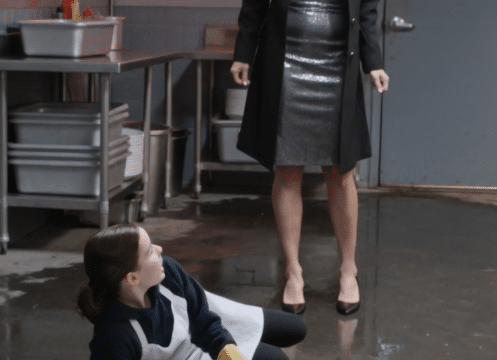
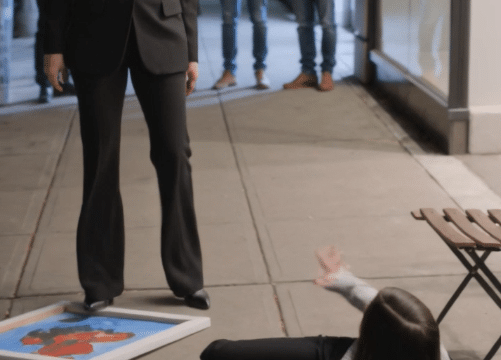
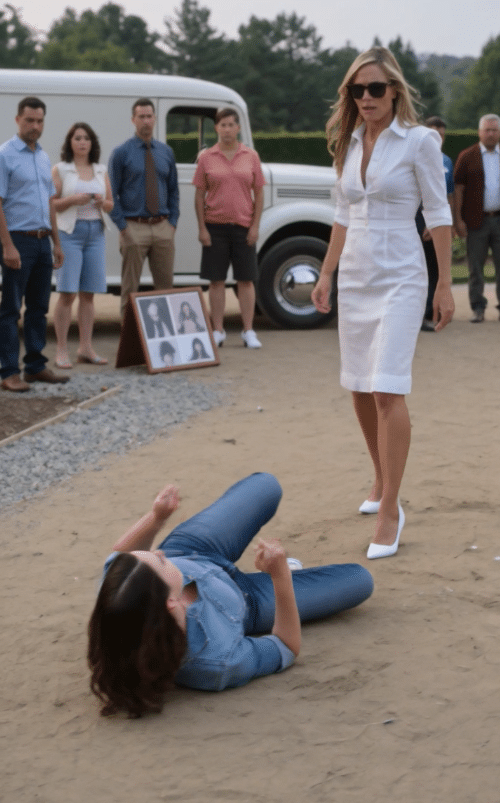
She stepped forward and kicked Emily squarely in the chest.
The impact sent Emily backward onto the dirt path between the flower rows. Her radio flew from her hand, striking the ground several feet away. A wooden sign rattled beside her as loose petals scattered across the path.
For a moment, the entire garden seemed to stop breathing.
Emily tried to sit up, but pain caught her halfway. She pressed a hand against her chest and struggled to draw a full breath. The edge of the wooden sign had scraped her forearm, leaving a thin red trace against her skin.
The woman in white stood over her.
Not horrified. Not apologetic.
Angry.
As Emily tried to point toward the child still standing on the car, the woman stepped over her and kicked her again, then a second time. Emily curled instinctively, trying to shield herself while the witnesses watched in disbelief.
Someone gasped.
A man near the flower arch raised a hand to his mouth. An older couple stepped backward. A young woman holding a camera lowered it slowly, her expression caught somewhere between fear and disbelief.
Nobody moved quickly enough.
The mother looked down at Emily as though the woman on the ground were an inconvenience that had somehow become personal.
“You’re paid to smile, not speak.”
Emily’s face tightened with pain. Her breathing came in short, uneven bursts, but even then, her eyes kept returning to the boy on the vintage car.
He was no longer smiling.
He was staring at his mother.
And suddenly, the expensive photograph that had mattered so much to her seemed to be the least important thing in the garden.
Emily reached toward her fallen radio, her fingers trembling as she tried to pull it closer.
The woman in white adjusted her dress and glanced at the camera crew, apparently expecting someone to apologize for the interruption.
Then a black SUV came screeching through the entrance.
And the woman who stepped out of it was about to turn the entire afternoon upside down.
Act II
The flower garden was called Willow Creek Gardens, a family-owned property outside a small American town where summer weekends brought photographers, couples celebrating anniversaries, and families hoping to capture memories among the blooms.
It was the sort of place that made people lower their voices without realizing it.
Rows of roses curved around a central walkway. Sunflowers stood tall beyond a white wooden fence. An old green pickup truck, a restored vintage automobile, and several antique farm props had been arranged throughout the grounds to create picturesque settings that visitors could enjoy without damaging the surrounding plants.
The garden’s owner, Margaret Whitmore, had built the business over nearly three decades.
She had not inherited a fortune or purchased a ready-made attraction. She had started with a neglected piece of farmland, a modest loan, and an unreasonable belief that people would pay to experience something beautiful that had been created with care.
They did.
Eventually, Willow Creek became one of the most popular photography destinations in the region. Margaret expanded the property, hired a small team, and introduced rules designed to protect the very things visitors came to admire.
Emily was one of the people she trusted most.
Three years earlier, Emily had arrived at Willow Creek looking for steady work after a painful divorce and a period of financial uncertainty. She had a young daughter, a mountain of bills, and very little patience left for people who confused vulnerability with weakness.
Margaret had hired her after a brief interview.
Emily had not impressed her with polished answers or a carefully rehearsed résumé. She had impressed her by noticing that a loose section of fencing near the flower beds could allow children to wander into an area where the ground dropped sharply.
Most applicants had talked about customer service.
Emily had noticed a safety problem.
Margaret remembered that.
Over time, Emily became the person who handled the difficult conversations. She could tell a family that a flower bed was closed for maintenance without making them feel unwelcome. She could calm an upset photographer, redirect a wandering toddler, or explain why a vintage vehicle could not be climbed on.
She understood that rules were not the opposite of hospitality.
They were what allowed hospitality to exist.
The woman who had attacked her that afternoon, however, had arrived with an entirely different understanding of the world.
Her name was Vanessa Caldwell, and she had booked a private photography package to celebrate her son’s seventh birthday. Her husband owned a successful regional construction company, and Vanessa had spent years cultivating a social media presence built around luxury vacations, designer clothing, elaborate parties, and photographs that suggested her life never contained a single imperfect moment.
The booking had included a photographer, a private garden section, and permission to use several designated props.
Vanessa had interpreted that permission rather generously.
She wanted her son standing on the vintage car, one foot on the hood and one hand gripping the windshield frame. The photographer had initially hesitated, but Vanessa had insisted the pose was essential to the theme.
Then Emily had intervened.
Vanessa did not see a worker trying to protect a child and a historic object. She saw an employee daring to tell her what she could not do.
To Vanessa, the uniform was an invitation to command. The radio was a prop. The woman wearing the denim shirt was someone whose job depended on keeping paying customers happy.
And paying customers, Vanessa believed, should never have to hear the word no.
What she failed to understand was that Emily was not making an arbitrary decision.
The car’s restoration had been expensive, and its structure could not safely support a child climbing across the hood. The ropes were positioned to prevent precisely the kind of accident that Emily had tried to stop.
Vanessa had been told the rules when she arrived. She had even signed the visitor agreement.
But she had barely glanced at it.
Now, as Emily lay struggling on the dirt path, those ignored rules were about to become the least of Vanessa’s problems.
Because Margaret Whitmore was not simply the owner of a flower garden.
And the black SUV that had just arrived was carrying the one person Vanessa could not intimidate.
Act III
Margaret heard the commotion before she reached the flower rows.
She had been reviewing preparations for an upcoming charity event in the garden’s administrative building when her event manager, Daniel Brooks, received an urgent radio call. A staff member reported an assault near the vintage display car.
At first, Margaret assumed someone had fallen.
Then Daniel relayed the rest.
A visitor had attacked Emily. The employee was on the ground. Several witnesses were present, and the visitor was still behaving aggressively.
Margaret was moving before he finished speaking.
The black SUV stopped near the entrance, throwing a cloud of dust across the gravel. Daniel jumped out first, followed by two security staff members. Margaret stepped onto the path and headed directly toward the disturbance.
She did not ask where the photographer was.
She did not ask whether the visitor had paid for a private session.
She asked one question.
“Where is Emily?”
A security officer pointed toward the flower rows.
Margaret hurried forward.
The crowd parted as she approached. The woman in white had begun turning toward the arrival, her expression shifting from irritation to uncertainty. She had expected a manager, perhaps someone who would explain that Emily had misunderstood her instructions.
Instead, she watched a sixty-year-old woman kneel beside the injured employee.
“Emily, can you hear me?”
Emily nodded weakly.
Margaret crouched beside her, careful not to move her unnecessarily. She told Daniel to contact emergency medical services and asked a security officer to keep the surrounding path clear.
Only after checking on Emily did Margaret stand.
Her expression had changed.
She looked at the fallen radio, the scattered petals, the wooden sign, and the vintage car. Then her eyes settled on Vanessa.
“Close the photo field. Remove her party.”
The order was quiet enough to be controlled and firm enough to carry across the entire garden.
Daniel immediately moved to lower the rope across the photography area. Security positioned themselves between Vanessa and Emily, preventing the visitor from approaching the injured worker again.
Vanessa blinked.
“Excuse me?”
Neither security officer answered.
She looked from Margaret to Daniel, apparently searching for someone who understood the difference between a paying customer and an ordinary visitor.
“Remove my party?”
Her voice rose on the final word.
“Do you know who I am?”
Margaret held her gaze.
“I know exactly what happened here.”
Vanessa gave a short, disbelieving laugh.
“No, you don’t. Your employee came over and started lecturing me in front of my child. She ruined my photo session, and then she—”
“Stop.”
Margaret did not raise her voice.
She did not need to.
For the first time since the confrontation began, Vanessa fell silent.
“You were asked to remove your child from a display that visitors are prohibited from climbing on,” Margaret said. “Instead, you assaulted an employee who was doing her job.”
Vanessa’s cheeks flushed.
“That’s an outrageous accusation.”
A man standing near the flower arch spoke before Margaret could respond.
“I saw it.”
Vanessa turned sharply toward him.
The man was middle-aged, wearing a blue polo shirt and holding his phone. He had been standing close enough to see the initial confrontation and the blows that followed.
“I saw you kick her,” he continued. “More than once.”
The young photographer who had lowered her camera stepped forward.
“So did I.”
Another witness nodded.
The silence that followed was no longer the frightened silence that had surrounded Emily on the ground. It was something different.
People were finally willing to speak.
Vanessa looked around, searching for the sympathetic audience she had expected to command. Instead, she found strangers watching her with open disapproval.
She adjusted her sunglasses, though they had not slipped.
“This is ridiculous,” she said. “I paid for a private session. You can’t just throw me out because your employee upset me.”
Margaret glanced toward the car.
“No one threw you out for being upset.”
Then she looked directly at Vanessa.
“You are being removed because you assaulted someone.”
The distinction landed harder than a shout.
But Margaret was not finished.
She turned to Daniel and asked him to preserve the booking records, the visitor agreement, and any available security footage. She instructed the security team to record the witnesses’ names and make sure the arriving medical personnel could reach Emily without interference.
Vanessa’s expression began to change.
She had expected anger to be enough. She had expected money to be enough. She had expected that, if she spoke loudly and confidently, someone would eventually decide that dealing with her was more trouble than refusing her.
That was how things had worked for years.
But Margaret was not negotiating.
And when Daniel quietly mentioned that the garden’s cameras covered the vintage display area, Vanessa looked toward the nearest pole as though she had only just noticed it.
The perfect photograph had become evidence of something else.
Her face went pale.
Then she made the mistake that would cost her more than the afternoon’s photographs.
She pointed at Margaret and said, “You can’t do this to me. My husband will make sure you regret it.”
Margaret looked at her for a long moment.
Then she answered with a single sentence.
“Your husband is welcome to explain why he believes his money gives you the right to hurt people.”
For once, Vanessa had nothing ready to say.
But Margaret knew that the confrontation was only the beginning. Before the day was over, the people who had watched Vanessa’s behavior would have to decide whether they were willing to stand behind what they had seen.
And the truth was about to reach far beyond the flower garden.
Act IV
The ambulance arrived within minutes.
By then, Emily had managed to sit upright with assistance, though every movement made her wince. The medical team assessed her injuries and prepared to take her for further evaluation.
Margaret stayed close enough for Emily to see her.
“You don’t have to worry about the garden,” she said. “We’ll take care of everything here.”
Emily looked toward the vintage car.
“The boy,” she murmured.
Margaret followed her gaze.
The child had been brought down from the display and was standing beside the photographer, his hands clasped in front of him. He looked frightened and confused, his attention fixed on the ambulance crew surrounding Emily.
“Is she going to be okay?” he asked.
No one answered immediately.
Margaret crouched to his level.
“The doctors are going to take care of her. What happened wasn’t your fault.”
The boy’s eyes filled with tears.
“My mom said she was being mean.”
Margaret felt a sharp ache in her chest.
“Sometimes adults get angry when someone tells them no,” she said gently. “That doesn’t mean the person who said no did anything wrong.”
The boy looked down at his shoes.
For a moment, the anger that had filled the garden seemed to give way to something more painful: a child beginning to recognize that the person he depended on had done something terrible.
Vanessa watched from several feet away.
“Don’t talk to my son like that,” she snapped.
A security officer stepped between them.
“You need to remain here while we complete the incident report.”
“I’m not staying anywhere. This is private property, and I’m leaving.”
“You may leave once the necessary arrangements are made,” Daniel replied. “We need your information for the report.”
Vanessa laughed bitterly.
“You people are making a huge mistake.”
She reached into her handbag for her phone.
It was a familiar gesture, one she had used countless times when a restaurant reservation went wrong, a hotel employee refused an unreasonable request, or a business owner failed to give her the treatment she expected.
She called her husband.
He answered after several rings.
“I’m having a problem,” Vanessa announced, loud enough for the people nearby to hear. “The garden staff are accusing me of assault because one of their employees decided to interfere with my son’s photos.”
She paused to listen.
“No, I’m serious. The owner is here, and she’s having security remove us. I need you to call someone and get this sorted out.”
Another pause.
Vanessa’s expression tightened.
“Because I said so. I paid them.”
Margaret did not interrupt.
She simply watched.
When Vanessa ended the call, she appeared less confident than before. Her husband had not promised to fix everything. He had asked what happened, whether anyone had witnessed it, and whether there was footage.
Those questions had unsettled her more than Margaret’s orders.
Daniel returned carrying a folder containing the signed visitor agreement and the details of the booking. He placed it on a small table beside the path.
“The agreement you signed specifically prohibits climbing on the vintage displays and states that violent behavior results in immediate removal,” he explained. “It also confirms that private bookings don’t exempt guests from the garden’s safety rules.”
Vanessa stared at the paperwork.
“I didn’t read every word.”
“That doesn’t change the agreement,” Daniel said.
“And it certainly doesn’t change what happened,” Margaret added.
A few feet away, the photographer was reviewing her camera files. She had captured the session before the confrontation, including Vanessa directing her son onto the car.
She had not intended to document an assault. She had simply kept shooting because Vanessa had demanded continuous coverage of the session.
But the images established the sequence of events: the child on the car, Emily approaching, Vanessa turning toward her, and the confrontation escalating.
The photographer handed Daniel the memory card details and agreed to preserve the original files.
Meanwhile, the witnesses who had initially stepped back were beginning to offer statements.
The man in the blue polo described the first kick. The young woman with the camera confirmed that Vanessa had continued attacking Emily after she fell. An older visitor remembered hearing Emily repeatedly ask for the child to be taken off the car.
Their accounts were consistent.
Vanessa could argue about tone. She could claim Emily had embarrassed her. She could insist that the employee had ruined her photographs.
None of those arguments explained the violence.
Then Daniel received a call from the county sheriff’s office.
He listened, answered a few questions, and looked toward Margaret before confirming the location and the availability of the witnesses.
When he ended the call, he informed Vanessa that the incident had been reported and that officers were on their way to speak with everyone involved.
Her face drained of color.
“You called the police?”
“We reported an assault,” Margaret replied. “The authorities will determine what happens next.”
Vanessa looked around desperately.
“I’m a mother. My son is right here. You can’t humiliate me in front of him like this.”
Margaret’s expression softened slightly, but her answer did not.
“You were worried about your son when Emily asked you to get him off that car. You could have listened. You could have taken his hand and walked away. Instead, you chose to hurt someone in front of him.”
The boy lowered his head.
Vanessa opened her mouth, but no words came.
For the first time, the consequences were no longer something she could push onto an employee, dismiss with a payment, or bury beneath a polished photograph.
The people around her had seen what happened.
The records were being preserved.
And the woman she had treated as powerless had an entire community willing to tell the truth.
Yet Margaret had one more decision to make, and it would determine whether Willow Creek’s rules meant anything beyond the signs posted beside its flower beds.
Act V
By early evening, the flower garden had grown quiet again.
The ambulance had taken Emily for medical evaluation. Margaret had arranged for another employee to contact Emily’s family, and Daniel had made sure that the incident report included the witnesses’ statements and the available photographs.
The vintage car stood behind the lowered rope, untouched now except for a few scattered petals near its front wheel.
Vanessa’s private session was canceled.
Her party was escorted toward the entrance, and she was informed that she would not be permitted to return to Willow Creek Gardens while the incident was being reviewed. The matter involving her assault on Emily was left to the appropriate authorities.
She had arrived expecting a collection of beautiful photographs that would make her life appear even more enviable.
She left without them.
As she walked toward the parking area, she kept looking over her shoulder, as if she expected Margaret to call her back and admit that the entire confrontation had been a misunderstanding.
Margaret never did.
The owner remained beside the ambulance crew’s former staging area until Daniel confirmed that the immediate responsibilities had been handled. Only then did she return to the administrative building.
She had spent nearly thirty years building Willow Creek into a place where families could feel safe. She knew that no policy could prevent every act of cruelty, and no sign could force someone to behave with decency.
But a business revealed its character in what it did after someone crossed a line.
If Margaret had allowed Vanessa to leave without consequence simply because she was wealthy, influential, or difficult to confront, every employee at Willow Creek would have learned something terrible.
They would have learned that the rules applied only to people who lacked the power to ignore them.
Margaret refused to teach that lesson.
Later that evening, she visited Emily after the initial medical evaluation. Emily was tired, sore, and shaken, but she was able to speak with her employer.
“I keep thinking I should have handled it differently,” Emily admitted. “Maybe if I’d let the photographer finish, or if I’d called security sooner—”
Margaret pulled a chair beside the bed.
“No.”
Emily looked at her.
“You were doing your job,” Margaret said. “You tried to protect a child. You tried to protect the car. You followed the rules we gave you, and someone chose to hurt you because she didn’t like being told no.”
Emily swallowed.
“I didn’t want everyone watching.”
“I know.”
For the first time that day, Emily’s composure broke. She turned her face away and wiped her eyes, embarrassed by the tears even though she had nothing to be embarrassed about.
Margaret waited.
Then she reached across the small space between them and took Emily’s hand.
“You don’t owe anyone an apology for what happened to you.”
The words were simple.
They were also the first words Emily had heard all day that made her feel like more than an incident report.
In the weeks that followed, the evidence gathered at Willow Creek helped establish a clear account of the confrontation. The witnesses cooperated, the original photographs were preserved, and the authorities handled the case through the appropriate legal process.
Vanessa’s husband did not erase the records. He could not make the witnesses forget what they had seen, and he could not turn the signed visitor agreement into permission to assault an employee.
The consequences extended beyond the garden.
The incident damaged Vanessa’s carefully maintained public image, and people who had once admired her photographs began asking uncomfortable questions about the person behind them. Her husband’s business remained separate from the case, but even he could not protect her from the consequences of her own decisions.
For Vanessa, the most painful revelation was not that a garden owner had ordered her party removed.
It was that the people she had expected to intimidate had finally stopped being afraid of her.
Her son, meanwhile, remembered something different.
He remembered the worker who had warned him about the car.
He remembered the moment his mother became someone he no longer recognized.
And he remembered the older woman who had knelt beside the injured employee before saying a single word to the person responsible.
Months later, when he returned to Willow Creek with his father, he found the vintage car still standing among the flowers, protected by its ropes and its small wooden sign.
He stayed behind the barrier.
Then he asked the employee at the entrance whether the woman who had been hurt was coming back.
Emily had returned to work after recovering, although she had taken time to heal both physically and emotionally. When she heard about the boy’s question, she agreed to meet him and his father near the flower rows.
The child approached cautiously.
“I’m sorry,” he said.
Emily knelt so they could speak at eye level.
“You didn’t do anything wrong by asking for a picture,” she told him. “And you don’t have to take responsibility for what another person chooses to do.”
He nodded, looking relieved.
Then he glanced toward the vintage car.
“Can I take a picture next to it?”
Emily smiled.
“Absolutely. Just keep your feet on the ground.”
For the first time since that terrible afternoon, the little boy laughed.
His father took the photograph with the car safely behind them and the flower rows stretching into the afternoon sunlight. There was no argument, no demand for special treatment, and no attempt to turn a simple memory into proof of superiority.
Just a child, a beautiful garden, and a moment that belonged to everyone who had come there to enjoy it.
Margaret watched from the nearby walkway.
She knew the incident would remain with Emily for a long time. She also knew that no dramatic arrival, security team, or decisive order could undo the fear and pain the worker had endured.
But she could make sure that Emily never had to wonder whether her employer would stand behind her again.
The garden’s rules remained in place. The vintage displays stayed protected. Staff members continued to enforce the same boundaries, whether they were speaking to a first-time visitor or someone who arrived believing that money made them untouchable.
And the little wooden sign remained beside the car.
It was not a grand monument to justice. It was not a warning written in anger.
It was a simple reminder that beauty required care, that safety required boundaries, and that no photograph was worth more than a human being.
Vanessa had believed Emily’s job was to smile and obey.
She had mistaken kindness for weakness, patience for submission, and a uniform for a lack of dignity.
The truth was far less complicated than she had imagined.
Emily had the right to do her job.
Margaret had the responsibility to protect her.
And Vanessa had never possessed the right to hurt someone simply because the world refused to arrange itself around her wishes.
That afternoon, the flower garden did not become a place where the powerful were humiliated in return.
It became a place where they were finally held to the same rules as everyone else.
And as the sunlight settled over the flowers, the vintage car stood untouched behind its rope, waiting for the next family to come and make a memory.
This time, no one had to get hurt for the picture to be perfect.