Act I
“Turn off the flash. It scares them.”
The young animal care worker had barely finished speaking when the man’s phone flashed again against the glass enclosure.
Inside, a sensitive nocturnal animal recoiled from the sudden burst of light. Its body pressed back into the shadows, and a second animal hurried toward the sheltered corner of the habitat.
The woman in the moss-green uniform stepped closer, holding her safety guide in one hand and her radio in the other.
“Sir, I’m serious. Please stop using the flash.”
The man turned toward her with an expression of open disgust. At forty-two, wearing an expensive polo shirt and a luxury watch, he looked like someone who had spent years getting his way simply by refusing to accept anything less.
“Trash. I paid for pictures.”
Several visitors on the wooden walkway looked up.
The worker, whose name was Rachel Bennett, kept her voice steady. She was twenty-nine, had worked with animals for nearly six years, and had learned that people sometimes mistook a calm explanation for an invitation to argue.
“The flash can disturb them,” she said. “The signs are right here. You need to turn it off.”
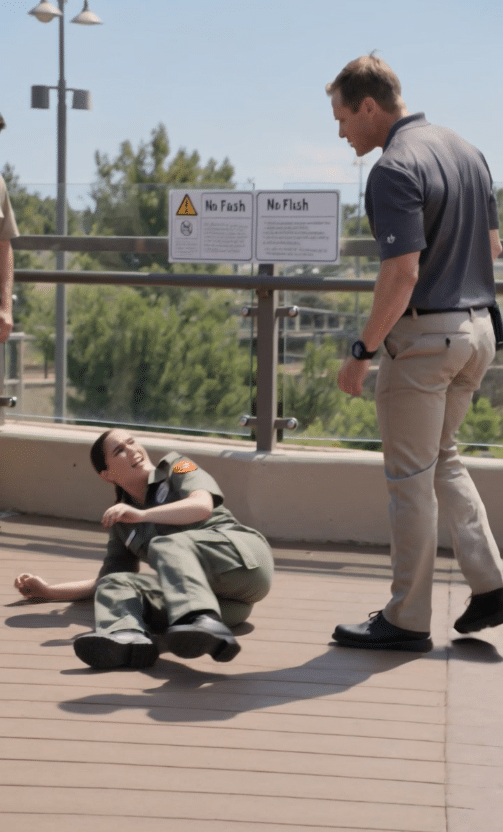
She pointed toward the large NO FLASH PHOTOGRAPHY warning mounted beside the glass.
The man glanced at it.
Then he raised his phone again.
Another flash burst across the enclosure.
Rachel stepped between him and the glass, not touching him, but making it clear that she would not allow him to continue.
“Sir, put the phone down.”
His face changed.
The irritation in his eyes hardened into something uglier. He moved toward her, jaw clenched, while his friends watched from a few feet away.
“You really think you can tell me what to do?”
“I’m asking you to follow the animal safety rules.”
That was all it took.
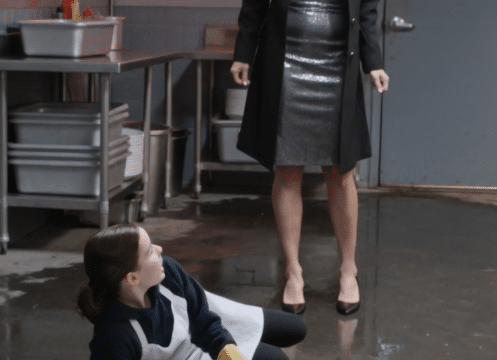
He drove a forceful kick into Rachel’s chest.
She was thrown backward onto the wooden walkway, landing hard enough to send her radio skidding across the boards. Her safety guide fell open beside her, its pages spreading across the path. As her forearm struck the edge of the walkway, a thin red scrape appeared against her skin.
A sharp gasp rippled through the visitors.
Rachel tried to pull herself upright, but pain stopped her. Her breathing turned shallow, and her face tightened as she struggled to understand what had just happened.
The man stood over her.
He did not look frightened by his own actions. He looked offended that she had made him angry.
Rachel turned her head toward the habitat.
Even from the ground, she could see the animals retreating from the exposed viewing area.
“Turn off the flash,” she managed to say. “It scares them.”
The man stared at her.
“Trash. I paid for pictures.”
Then he stepped forward and kicked her twice more, striking her back and side as she tried to curl away from him.
Rachel gasped and drew her arms close to her body. Her radio lay several feet away, and the safety guide remained open beside her. The witnesses recoiled, some covering their mouths, others frozen with their phones in their hands.
Nobody stepped forward.
The man straightened his shirt as if the interruption had been nothing more than an unpleasant exchange with an employee.
“Protect your little animals from the floor.”
Rachel looked up at him, pain and disbelief crossing her face.
She had spent years learning how to read an animal’s fear before it became panic. She knew the subtle signs of stress, the small changes in breathing and movement that most visitors never noticed.
Now she was lying on the boards, struggling to breathe, while the man who had attacked her seemed more concerned about his photographs than the living creatures behind the glass.
Then a black ranger vehicle came screeching to a stop beside the walkway.
The doors flew open.
The park director emerged with the head veterinarian and two animal security officers, all moving quickly toward the enclosure.
The director saw Rachel on the ground and changed direction immediately.
He dropped to one knee beside her before looking at the man who had attacked her.
Then he gave an order that silenced the entire walkway.
“Shut down this habitat. Emergency protocol.”
The man’s expression faltered.
“Emergency protocol?”
For the first time that afternoon, he seemed to realize that he had no idea what he had just set in motion.
And the director was only beginning to understand how much damage one man’s arrogance might have caused.
Act II
The wildlife park was called Cedar Ridge Wildlife Preserve, a family attraction nestled among wooded hills in the American Midwest.
Visitors came to see rescued animals, learn about conservation, and experience habitats designed to give the animals as much space and protection as the facility could provide. The glass viewing enclosure where Rachel worked housed several nocturnal animals whose care routines required careful control of light, noise, and visitor behavior.
The restrictions were not decorative.
They were the result of years of veterinary research, observation, and hard lessons about what happened when human entertainment took priority over animal welfare.
The NO FLASH signs had been installed after the preserve expanded its nocturnal habitat. Visitors could still take photographs in the designated viewing area, but flash photography was prohibited.
The rule was explained at the entrance, repeated on signs along the walkway, and included in the visitor information handed out at admission.
Most people followed it without complaint.
Some needed a reminder.
A very small number treated the reminder as an insult.
Rachel had become exceptionally good at handling those situations.
She had grown up in a modest household where money was often tight but animals were always welcome. Her mother had volunteered at a local rescue center, and Rachel had spent countless weekends helping clean kennels, prepare food, and comfort frightened dogs waiting for adoption.
She had originally planned to become a veterinarian.
But after a family emergency forced her to work full-time, she discovered that animal care offered another way to protect the creatures she loved. She trained as a keeper, studied animal behavior, and eventually joined Cedar Ridge.
Her supervisors trusted her because she paid attention to details that others overlooked.
She noticed when an animal stopped eating, when a familiar routine suddenly produced anxiety, and when a seemingly harmless visitor behavior threatened to become a problem.
Rachel also understood something that could not be learned from a manual.
Animals could not explain their discomfort in words.
Someone had to recognize it for them.
That responsibility was one of the reasons she took the flash rule so seriously.
The man who attacked her, however, had come to Cedar Ridge with a different idea of what the park owed its visitors.
His name was Grant Mercer. He owned a successful commercial real estate firm and frequently posted photographs from exclusive restaurants, luxury hotels, and private sporting events.
He liked being seen enjoying experiences that other people could not easily afford.
His friends had accompanied him to the preserve for an afternoon outing, and Grant had decided that photographs of himself beside the nocturnal habitat would be the highlight of the trip.
The glass reflected the afternoon sunlight, making it difficult to capture the dramatic images he wanted.
When his first photograph came out badly, he turned on the flash.
A staff member at the entrance had already warned him that flash photography was prohibited in that section. Grant had nodded impatiently and continued walking.
He assumed the rule was flexible.
When Rachel corrected him, he assumed she was being difficult.
When she corrected him again, he decided that she was challenging his authority.
That was how the confrontation escalated.
Grant did not see a trained animal care professional trying to protect a sensitive habitat. He saw a young employee standing between him and something he believed he had paid to enjoy.
He mistook the price of admission for ownership.
And because Rachel refused to move aside, he decided to punish her.
What Grant did not know was that Cedar Ridge had recently undergone a major expansion under the supervision of its director, Dr. Samuel Hayes, a wildlife conservation specialist who had spent more than twenty years working with endangered and rescued animals.
Dr. Hayes had helped establish the preserve’s emergency response system after an incident at another facility where a visitor’s reckless behavior had disrupted an animal’s recovery.
Since then, Cedar Ridge had maintained strict procedures for situations involving animal distress, habitat security, and threats to staff.
An emergency shutdown was not a theatrical punishment.
It was a protective measure that could halt public access, secure the viewing area, and allow veterinary staff to assess whether an animal’s behavior or environment had been compromised.
And when Dr. Hayes saw the frightened animals retreating from the glass, he had no intention of waiting to find out whether Grant’s behavior had caused a serious problem.
But as he knelt beside Rachel, checking whether she could respond to his questions, he realized the incident was worse than he had first feared.
The employee had been assaulted while trying to enforce a rule designed to protect animals in their care.
And the man responsible was still standing nearby, looking as though he expected someone to apologize to him.
Act III
“Rachel, stay still for me,” Dr. Hayes said.
He kept his voice calm as he assessed her condition. He asked whether she could breathe comfortably, whether she had struck her head, and where she felt the most pain.
Rachel answered in short phrases.
Her chest hurt. Her back hurt. She was frightened, and she could not stop looking toward the enclosure.
“The animals,” she whispered.
Dr. Hayes followed her gaze.
Behind the glass, one of the animals remained pressed against the sheltered area. The other had disappeared from the main viewing space.
The head veterinarian, Dr. Olivia Chen, approached the habitat with a trained keeper. She checked the monitoring system and reviewed the animals’ recent behavior while the security team closed access to the walkway.
“Clear the viewing area,” Dr. Hayes ordered. “No visitors near the glass until Olivia finishes her assessment.”
Security moved immediately.
A temporary barrier was placed across the wooden path, and the remaining visitors were directed toward an alternative route. The habitat’s public viewing section was closed while the veterinary team evaluated the situation.
Grant stared at them.
“You’re shutting down the attraction because of a photograph?”
Dr. Hayes did not answer him immediately.
He remained beside Rachel until another staff member arrived with a first-aid kit and emergency medical assistance was requested. Only after he was satisfied that she was being cared for did he stand and turn toward Grant.
“No,” he said. “We’re securing the habitat because an animal care employee has been assaulted, prohibited equipment use has continued despite repeated warnings, and our veterinary team needs to determine whether the animals have been affected.”
Grant let out a short laugh.
“This is absurd. I paid to come here.”
“And you were told the rules before entering.”
“I paid for access.”
“Access is not permission to endanger the animals or attack our staff.”
Grant’s friends had fallen silent.
One of them, a man in a gray jacket, looked toward the glass and then at the open safety guide on the walkway. The pages were covered with printed information about animal stress responses, visitor conduct, and emergency procedures.
He seemed to understand, perhaps for the first time, that the confrontation had never been about a photograph alone.
Grant had ignored a clear warning.
Then he had assaulted the person responsible for enforcing it.
Now the director was treating the matter as seriously as it deserved.
Grant pointed toward Rachel.
“She came at me. She was aggressive. I had to get her away from me.”
A woman standing near the barrier shook her head.
“I watched the whole thing,” she said. “She asked you to stop using your flash.”
Grant turned toward her.
“You don’t know what happened.”
“I heard what she said. Then I saw you kick her.”
Another visitor stepped forward.
“So did I.”
The words were quiet, but they changed the atmosphere around Grant.
Until that moment, he had behaved as if the witnesses were merely an audience whose approval could be regained by offering a sufficiently convincing explanation.
Now he was discovering that they had seen the same thing.
Dr. Hayes asked the witnesses to remain available to provide statements. Security began documenting the incident, preserving available surveillance footage, and recording the names of those who had seen the assault.
Grant watched the process with growing irritation.
“Do you have any idea who you’re dealing with?” he demanded.
Dr. Hayes looked at him.
“I know who I’m responsible for.”
He gestured toward Rachel, who was now being carefully assisted by the medical responders.
“I am responsible for our staff. I’m responsible for these animals. And I’m responsible for making sure this facility is safe for the public.”
Grant’s jaw tightened.
“You’re going to regret embarrassing me.”
Dr. Hayes barely reacted.
“Your embarrassment is not the issue.”
That answer seemed to unsettle Grant more than any threat would have.
He was accustomed to arguments that could be won through pressure. He knew how to make a restaurant manager reconsider a policy or persuade a hotel employee to offer an exception.
But Dr. Hayes was not bargaining over a room upgrade or a refund.
The director had a duty to protect living animals, trained staff, and everyone who entered the preserve. He had no reason to exchange those responsibilities for Grant’s approval.
Then Dr. Chen returned from the habitat.
Her expression was serious.
The animals had retreated from the exposed viewing area, and the veterinary team wanted to continue monitoring their behavior away from visitors. At that stage, they could not say that the flashes had caused lasting harm, but they needed time to determine whether the animals were returning to their normal patterns.
Dr. Hayes nodded.
“Keep the habitat closed until you’re satisfied.”
Grant heard the order.
He looked toward the barrier, the security officers, and the veterinary staff moving behind the glass.
For the first time, he seemed to understand that the shutdown was not a bluff.
The attraction he had paid to photograph was now closed because of the incident he had caused.
And the director had not even finished dealing with the assault.
Act IV
The medical responders helped Rachel onto a stretcher and prepared to take her for further evaluation.
As they moved her away from the enclosure, Dr. Hayes walked beside them for several steps.
“You did the right thing,” he told her.
Rachel’s eyes were wet, though she seemed determined not to cry.
“I was only trying to get him to stop.”
“I know.”
She glanced toward the habitat one more time.
“Please make sure Olivia checks them again.”
Dr. Hayes promised that the veterinary team would continue monitoring the animals. Only then did Rachel allow herself to turn away from the enclosure.
Behind them, Grant was becoming increasingly agitated.
He had called his attorney and was now demanding that the park provide him with the names of everyone involved. He insisted that the closure was excessive and that the preserve was interfering with his rights as a paying visitor.
The security officer listening to him remained professional.
“You’ll have an opportunity to provide your account of what happened,” he explained. “For now, you need to remain here while we document the incident.”
Grant looked toward Dr. Hayes.
“Tell your security people to back off.”
“They’re following procedure,” the director replied.
“I’m not some criminal.”
“Then you should have no difficulty allowing the facts to be established.”
Grant’s face reddened.
He glanced at his friends, expecting one of them to intervene. Instead, the man in the gray jacket looked down at his shoes.
Another friend had moved farther away.
Their silence seemed to offend Grant more than the director’s refusal.
“You’re all acting like I committed some terrible crime,” he said.
A visitor who had witnessed the attack answered from behind the barrier.
“You kicked a woman while she was on the ground.”
Grant spun toward him.
“Stay out of this.”
“I saw it. I’ll tell the police exactly what I saw.”
Grant stopped speaking.
The preserve had contacted law enforcement, and officers arrived to speak with the people involved. The witnesses were asked to describe the sequence of events, and the available recordings were preserved for review.
No one needed to exaggerate what had happened.
The evidence would establish what it could establish, and the authorities would determine the appropriate next steps.
Grant’s attempts to control the conversation only made the situation more difficult for him.
He repeatedly returned to the amount he had paid, the quality of the photographs he had hoped to obtain, and the way Rachel had spoken to him.
But each explanation circled back to the same uncomfortable fact.
She had asked him to turn off his flash.
He had attacked her.
Nothing he said about the price of admission changed that sequence.
Dr. Hayes then asked the security supervisor to review the preserve’s visitor agreement and document the decision to remove Grant and his party from the facility.
The agreement clearly prohibited abusive behavior toward staff and required visitors to comply with animal safety instructions. It also allowed the preserve to suspend access when behavior threatened staff safety or animal welfare.
Grant read the relevant section with a look of disbelief.
“You’re banning me over an argument?”
“You’re being removed because of your conduct,” Dr. Hayes replied. “The incident will be reviewed, and any further restrictions will be handled according to our policies.”
Grant tried one last approach.
“Do you know how much money I could put into this place? I could sponsor an entire habitat. I could make a donation that would cover what you spend on this section in a year.”
Dr. Hayes looked at him for several seconds.
Then he shook his head.
“Donations don’t purchase permission to abuse our staff.”
The words landed in the silence between them.
Grant had offered money because money had always been his preferred solution. He believed that every conflict had a price and every boundary could be negotiated if the offer was large enough.
But there was no donation that could make Rachel’s injuries disappear.
There was no sponsorship package that could turn an assault into an acceptable response to a safety warning.
And there was no amount of money that gave him ownership over the animals behind the glass.
The preserve’s emergency procedures continued until the veterinary team was satisfied that the animals could be monitored safely without public access. The habitat remained closed for the rest of the immediate incident response, and staff redirected visitors to other areas.
Grant and his party were escorted toward the exit after the necessary information had been recorded.
He walked stiffly, refusing to look at the witnesses.
At the edge of the walkway, he turned one last time toward Dr. Hayes.
“You really think you’ve won something here?”
Dr. Hayes glanced toward the closed enclosure.
“No,” he said. “I think we’ve protected what matters.”
Grant stared at him, searching for an insult he could return.
But the director had already turned away.
For the first time in years, Grant found himself in a situation where the person with authority had no interest in impressing him, appeasing him, or winning his approval.
And that left him with nothing to bargain with.
Act V
By the following morning, Cedar Ridge had resumed its normal operations in most areas of the preserve.
The affected habitat remained subject to veterinary monitoring while the staff followed their established procedures. Dr. Chen reported that the animals were being observed closely for changes in behavior, and the preserve continued to review the incident to determine whether any additional measures were needed.
Rachel was recovering from her injuries.
The medical evaluation had given her a clearer understanding of what had happened to her body, but the emotional aftermath was harder to measure. She kept remembering the moment she had fallen, the sound of the radio sliding across the boards, and the faces of the visitors who had watched without stepping forward.
She knew people sometimes froze when violence happened unexpectedly.
Still, it hurt to remember how alone she had felt.
Dr. Hayes visited her after she had received medical attention.
He brought no speeches about courage and no grand promises that everything would immediately return to normal. He simply sat beside her and explained what the preserve was doing to document the incident, support her recovery, and make sure the veterinary team had everything it needed.
Then he asked her a question.
“Is there anything you need from us right now?”
Rachel considered it.
“I just want to know the animals are okay.”
Dr. Hayes nodded.
“Olivia is monitoring them. We’ll keep doing that until we’re satisfied with their condition.”
Rachel finally released a breath she seemed to have been holding since the previous afternoon.
Only then did she begin to talk about what had happened to her.
She admitted that she had been frightened. She had wondered whether she should have called security sooner or stepped away after the first warning failed.
Dr. Hayes listened without interrupting.
“You followed the safety procedure,” he said when she finished. “The responsibility for the assault belongs to the person who chose to commit it. Not to you.”
Rachel looked down at her hands.
“I don’t want anyone thinking I made it worse by standing my ground.”
“Then we’ll make sure the record reflects what actually happened.”
That promise mattered.
The preserve retained the relevant footage and incident records, and the witnesses who had come forward were able to provide their accounts. Grant’s conduct was handled through the appropriate review and legal processes rather than being dismissed as a disagreement between a customer and an employee.
His wealth did not erase the evidence.
His friends could not change what they had seen.
And the park’s visitor policies were not rewritten to make an exception for him.
The consequences would be determined through the proper channels, but one thing had already changed at Cedar Ridge: the staff knew their director would not abandon them when a visitor became aggressive.
In the days that followed, Dr. Hayes held a staff meeting.
He did not use Rachel’s experience to frighten the employees or demand that they become more confrontational with difficult visitors. Instead, he reviewed the preserve’s safety procedures, clarified when staff should call security, and reinforced the importance of protecting employees as well as animals.
He also made a point of thanking the people who had preserved the evidence and helped keep the remaining visitors away from the affected habitat.
No one was praised for standing by while Rachel was attacked.
But the witnesses who eventually spoke up were reminded that truthful accounts could make a difference when an incident was investigated.
The lesson was not that every bystander had to know exactly what to do in a dangerous moment.
It was that the truth mattered, even when telling it was uncomfortable.
Several weeks later, Rachel returned to the preserve.
Her first shift back was deliberately quiet. She spent time reviewing the animals’ routines, checking their feeding records, and walking the perimeter of the habitat with Dr. Chen.
The enclosure had been reopened only after the veterinary team completed its assessment and the appropriate safeguards were in place.
The NO FLASH signs remained exactly where they had been.
Rachel stopped beside one and ran her fingers along the edge of the safety guide tucked beneath her arm.
For a moment, she remembered Grant standing over her, insisting that the rules were beneath him.
Then she looked through the glass.
One of the nocturnal animals emerged cautiously from its sheltered space. It paused, looked around, and began moving through the habitat again.
Rachel watched without speaking.
She had not protected the animals because she wanted to win an argument. She had not enforced the rules because she enjoyed telling people what they could not do.
She had done it because the animals depended on people like her to recognize the dangers they could not explain.
That responsibility had not changed.
And neither had her belief that a person’s dignity should never depend on how much money they possessed.
Dr. Hayes joined her at the viewing area.
“The team says their behavior has returned to its usual pattern,” he said.
Rachel smiled faintly.
“Good.”
They stood together for a moment, watching the animal disappear into the shade.
Then a family approached the viewing window. A young child raised a phone, and the parent noticed the sign before Rachel needed to say anything.
“No flash,” the parent reminded the child gently. “We want them to feel safe.”
The child lowered the phone’s flash setting and took a quiet photograph.
Rachel nodded in appreciation.
It was such a small moment that most people would have forgotten it seconds later.
But for her, it was proof that the rules did not have to be enforced through anger. A simple explanation, met with a little consideration, was enough.
The preserve had not needed to humiliate Grant in return.
It had needed to protect its staff, safeguard its animals, preserve the truth, and refuse to let money determine whose safety mattered.
Grant had arrived believing that paying for an experience made him the most important person in the room.
He left having learned that admission bought access, not ownership; that a warning was not an insult; and that a worker’s uniform did not make her dignity negotiable.
The emergency protocol he had mocked was never designed to punish a wealthy visitor.
It existed to protect vulnerable animals when something went wrong.
That day, it also ensured that the people responsible for caring for them were not left to face danger alone.
And as Rachel returned to her work beneath the late-afternoon light, the glass enclosure reflected the quiet movement of the habitat rather than the glare of a camera flash.
The animals could move without being startled.
The staff could do their jobs without being threatened.
And the signs beside the walkway remained clear enough for anyone willing to read them.
Because the most important thing Grant had failed to understand was this:
The animals were not there to serve his ego. The people caring for them were not there to serve it either.