Act I
“You need to pay before picking.”
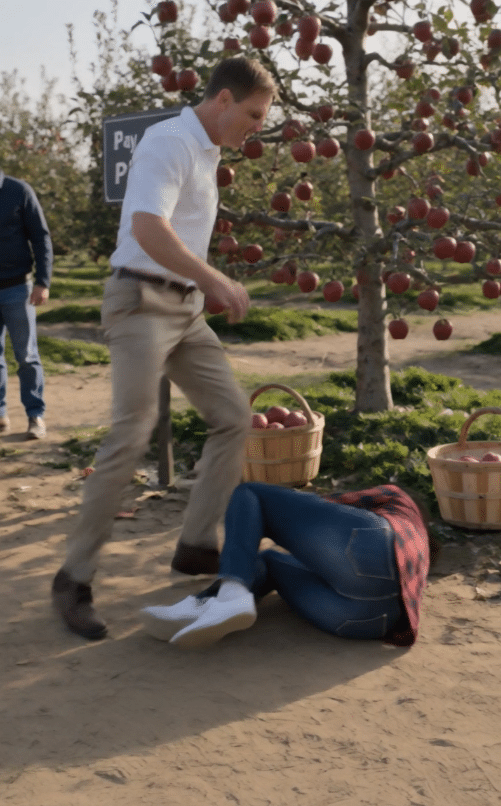
The woman in the red flannel shirt stood beneath an apple tree, her clipboard pressed against her side as she watched a man drop another handful of apples into a private bag. Behind him, a wooden sign near the orchard entrance read PAY BEFORE PICKING in large, unmistakable letters.
He barely glanced at it.
The man wore a spotless white polo, expensive sunglasses, and a watch that caught the autumn sunlight whenever he moved his wrist. His family waited a few rows away, surrounded by wooden baskets and the cheerful noise of children choosing fruit.
He looked at the woman as if she had interrupted something far more important than a simple theft.
“Excuse me?”
“You need to pay at the counter before you start picking,” she repeated. “Or you can use one of our baskets and follow the weighing procedure. We need to account for all the fruit.”
His expression hardened.
“Trash. It’s just an apple.”
The woman, whose name was Claire Bennett, had managed Miller’s Orchard for nearly seven years. At thirty-three, she had dealt with broken scales, lost children, muddy boots, and customers who insisted that the biggest apples somehow weighed less than the smaller ones.
She knew how to handle an ordinary complaint.
This was not an ordinary complaint.
“I understand it might seem like a small thing,” Claire said, keeping her voice professional. “But everyone pays for what they pick. That’s how we keep the orchard running, especially during harvest.”
The man glanced toward his family.
His wife was watching now. So were two other visitors standing near the fruit scale counter.
He noticed them noticing him.
That was when his embarrassment turned into anger.
“You’re correcting me in front of my family?”
“I’m explaining the same rule we explain to everyone.”
He stepped toward her.
Claire didn’t move. She had no reason to believe a conversation about apples would become dangerous, and she refused to turn a simple reminder into a public argument.
“Put the bag down, please,” she said. “We can sort this out at the counter.”
The man’s jaw tightened.
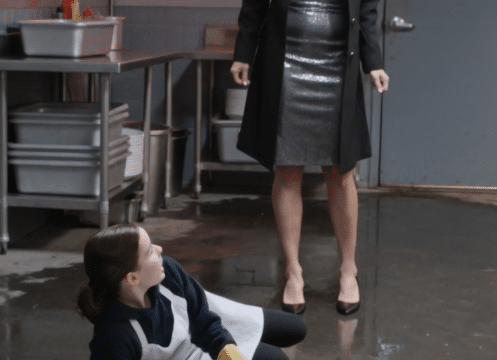
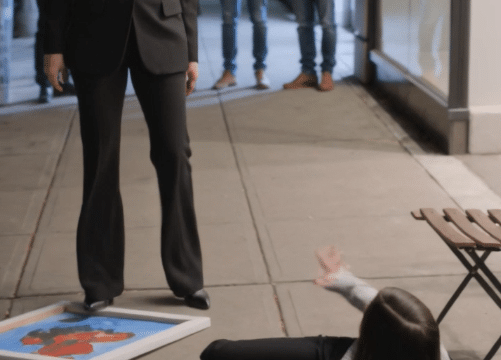
Then he kicked her.
His boot struck her chest with such force that she stumbled backward and fell beneath the apple tree. Her clipboard flew from her hand, scattering papers across the damp dirt, while several apples tumbled from his bag and rolled between the roots.
A wooden basket tipped beside her.
Claire’s forearm struck its hard edge as she landed, leaving a thin scrape. She sucked in a painful breath, her face twisting as she tried to understand what had just happened.
A child screamed.
Several adults gasped, but nobody moved toward her.
The man stood over Claire, looking less like someone who had lost control than someone who believed he had finally put an irritating employee in her place.
Claire struggled to breathe evenly. Her eyes found the fallen sign at the end of the row, and she tried to push herself upright.
“You need to pay before picking,” she managed to say.
The man’s expression became even uglier.
“Trash. It’s just an apple.”
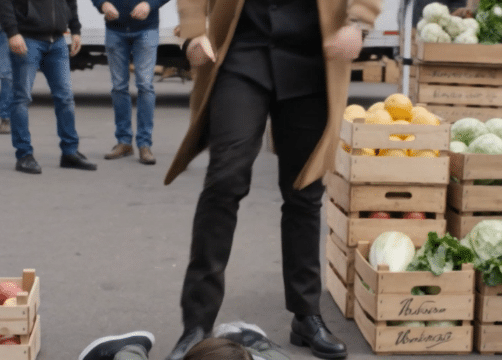
He stepped over her and delivered two more heavy kicks to her back and side.
Families hurriedly pulled their children away. A woman covered her mouth with both hands. One visitor stumbled backward into a basket, sending more apples rolling across the ground.
Claire curled against the dirt, her face tight with pain and shock.
Her clipboard lay several feet away. Her radio had slipped from her belt. Around her, red apples rested in the mud, scattered like the contents of a broken promise.
The man reached down, grabbed his bag, and began collecting the fruit again.
“Count them from the dirt,” he sneered.
He seemed to believe the worst consequence of his morning would be an uncomfortable conversation with a woman he had already decided was beneath him.
Then the roar of a black pickup truck shattered the silence.
It came to a sudden stop beside the fruit scale counter.
The driver’s door flew open.
And the man who stepped out was not coming to discuss the price of apples.
Act II
Claire had learned the orchard business from someone who believed that small rules revealed large character.
Her grandfather, Henry Miller, had purchased the original forty acres of Miller’s Orchard when the surrounding countryside was still dotted with family farms. He planted the first trees himself, worked through droughts and late frosts, and spent decades turning a modest patch of land into a destination where families returned every autumn.
When Claire was a child, he taught her to recognize the difference between a tree that looked healthy and one that was quietly struggling.
He also taught her that a farm could not survive on good intentions alone.
“People think an orchard makes money because apples grow on trees,” he once told her. “They don’t see the labor, the water, the repairs, the people we pay, or the fruit we lose to weather. If we don’t keep track of what leaves this place, we won’t have a place to share.”
Claire remembered those words whenever she had to enforce a rule that seemed insignificant to a visitor.
Miller’s Orchard operated on a simple system. Customers could pay for a picking package or weigh their harvest according to the orchard’s procedures. Staff needed to know how much fruit was collected, which rows were being harvested, and what customers owed before leaving.
It wasn’t merely about preventing theft.
The system kept prices fair, helped the orchard forecast its harvest, and ensured that the people doing the work could be paid.
Most visitors understood that.
They came with children, bought cider at the stand, filled baskets, and took photographs beneath the trees. Some left thank-you notes for the staff. Others returned year after year, remembering which corner of the orchard had the sweetest apples.
But a small number of customers treated the entire operation as though it existed solely for their entertainment.
The man in the white polo, later identified as Richard Hale, belonged to that group.
At forty-one, Richard had built a successful career in commercial real estate. He owned an impressive home, drove expensive vehicles, and moved through the world with the confidence of someone accustomed to getting his way.
He had brought his wife, Amanda, and their ten-year-old son, Ethan, to the orchard for a family outing. The plan had been simple: take photographs, collect apples, and stop for lunch before driving home.
Richard had decided that the orchard’s payment procedure was unnecessary.
He had started picking fruit before checking in, dropping apples into a bag he had brought from home. When Claire approached him, he treated her reminder as a challenge to his authority.
What he could not tolerate was the audience.
His wife had seen the exchange. Other families had turned to look. For a man who measured his standing by the impression he made on others, being corrected by an orchard manager felt like a public defeat.
He chose to answer that humiliation with violence.
And then, after attacking Claire, he made the mistake of assuming that everyone around him would continue to remain silent.
The witnesses had frozen during the assault. Some were frightened; others were shocked by how quickly an ordinary morning had turned frightening. A father had pulled his daughter behind him, while a young couple stood near the scale counter, staring at the apples rolling through the dirt.
Amanda Hale had gone pale.
Ethan stood beside her, his small hands gripping the sleeve of her coat. He was looking at his father with an expression no child should have to wear when watching a parent.
Richard noticed none of it.
He was too busy glaring at Claire.
“Next time,” he muttered, “mind your own business.”
Claire pressed a hand against her side, struggling to draw a comfortable breath.
“This is my business,” she whispered.
It was a simple statement, but it carried the truth Richard had ignored from the beginning. She wasn’t trying to control his morning. She was responsible for the orchard, the employees, the harvest, and every family that trusted the business to provide a safe place to visit.
She had been doing her job.
He had attacked her for it.
Richard bent to gather more apples, apparently determined to finish what he had started. His family remained behind him, and the visitors near the counter watched helplessly.
Then the black pickup came to a stop.
The orchard’s owner, Robert Miller, climbed out before the engine had fully settled. At sixty-two, Robert had spent most of his life working the land his father had expanded and his grandfather had first purchased.
Behind him, the farm manager hurried toward the trees with two security workers.
Robert saw the fallen clipboard first.
Then he saw Claire.
His expression changed instantly.
He didn’t ask who was responsible. He didn’t demand an explanation from the loudest person. He ran directly to the injured manager and dropped to one knee beside her.
“Claire? Can you hear me?”
She nodded, wincing.
Robert turned toward the farm manager.
“Get medical help. Keep everyone back and secure this area.”
Then he looked at the man standing over the scattered apples.
His voice became cold.
“Close her family account. Check every bag.”
Richard stared at him.
For the first time that morning, he seemed to realize that he had made a mistake far more serious than refusing to pay for his fruit.
He just hadn’t discovered how serious it was yet.
Act III
Robert Miller stayed beside Claire while one of the security workers radioed for emergency assistance.
“Don’t try to stand,” he told her. “Help is coming.”
Claire nodded, her breathing uneven. Her eyes were wet, though she seemed determined not to cry in front of the people watching.
“I’m sorry,” she whispered.
Robert frowned.
“Sorry for what?”
“The customers. The mess. The fruit.”
For a moment, Robert appeared unable to believe what he was hearing.
She had been kicked to the ground, humiliated in front of dozens of people, and left struggling to breathe. Yet she was apologizing for the inconvenience to his business.
“Claire, you have nothing to apologize for.”
He gently moved the fallen clipboard away from her and instructed the security workers to create space around her. One stayed nearby to keep Richard at a safe distance, while the other helped clear the immediate area for the medical responders.
Only when Claire was being attended to did Robert stand and face the man responsible.
Richard was already preparing his defense.
“This is a ridiculous overreaction,” he said. “Your employee started harassing me over a few apples.”
Robert looked at the fruit scattered across the ground.
“She asked you to follow the payment procedure.”
“She embarrassed me in front of my family.”
“And that gave you the right to attack her?”
Richard opened his mouth, then closed it again.
The witnesses were listening now. Their initial fear had not disappeared, but the arrival of the owner had changed the atmosphere. The people who had stood back during the assault were beginning to understand that they could safely explain what they had seen.
One woman stepped forward.
“I saw him kick her,” she said. “She didn’t touch him. She just told him to pay.”
A man near the scale counter nodded. “He kicked her again after she fell.”
Robert looked at them.
“Thank you. Please stay nearby if you’re willing to give a statement.”
Richard shook his head impatiently.
“Everyone is making this sound worse than it was.”
Then he made another mistake.
“Do you even know who I am?”
Robert’s expression barely changed.
“No,” he replied. “And it doesn’t matter.”
Richard blinked.
He was accustomed to introducing himself with the confidence of someone who expected recognition. He had spent years building relationships with people who measured one another by property portfolios, professional connections, and the size of their investments.
He had assumed that a business owner would respond to a wealthy customer differently from an ordinary visitor.
But Robert had spent decades watching people work through rain, heat, and exhausting harvest seasons. He knew the value of an employee who showed up every day and treated customers fairly.
Claire was not disposable because she wore work boots instead of expensive shoes.
And Richard was not entitled to special treatment because he could afford them.
Robert turned to the farm manager, Daniel Brooks, who had arrived carrying the orchard’s customer records.
“Document the incident. Preserve the account records, and make sure the relevant authorities receive everything they need.”
Daniel nodded and opened the customer log.
The account records showed the payment options Richard had bypassed when he began picking. Staff documented the apples in his bag and the fruit scattered on the ground, taking care to distinguish what had been collected from what had simply fallen during the confrontation.
The records would help establish the amount of fruit involved, but Robert was careful not to confuse the payment dispute with the assault investigation.
One was a matter for the orchard’s accounting procedures.
The other was far more serious.
A security worker asked Richard to step away from his bag while the situation was documented. Richard objected immediately.
“You’re not searching my belongings.”
“We’re asking you to cooperate with the orchard’s incident procedures while we document the fruit,” the worker replied. “The authorities can address any further questions.”
Robert intervened before the exchange escalated.
“Preserve the evidence. Don’t turn this into another confrontation.”
He wanted the facts established, not a spectacle created.
Richard, however, could not accept that the situation was slipping beyond his control.
He looked at the security workers, then at Daniel and the customer log. His gaze finally settled on Robert.
“You can’t just close my account.”
Robert’s reply came without hesitation.
“We can suspend your customer privileges while we review what happened. You assaulted the manager responsible for this property. You will not continue picking apples here today.”
Richard’s face flushed.
“You’re throwing away a paying customer?”
Robert glanced toward Claire, who was still receiving medical attention.
“No. I’m protecting my employee.”
The words silenced the nearby conversations.
Then Robert looked at the bag on the ground.
“Check the account and document the fruit. If there are unpaid apples, record the amount accurately. If there are other violations, document those separately.”
He turned toward Richard again.
“And nobody leaves with property that hasn’t been properly accounted for.”
Richard’s confidence began to fracture.
He had expected an argument about a few apples. Instead, there were witnesses, records, security personnel, and an injured employee whose account of the morning was supported by people standing all around them.
He had tried to make Claire feel powerless.
Now he was the one standing beneath the trees, unable to control what happened next.
But the worst moment for Richard was still ahead.
Because his wife had finally stepped forward.
Act IV
Amanda Hale had not spoken since Robert arrived.
She stood near the end of the row, one hand resting on Ethan’s shoulder. Her expression had shifted from shock to something harder to name, and when Richard looked at her, he seemed to expect her to rescue him from the embarrassment he had created.
Instead, she walked toward the fallen apples.
“Richard,” she said quietly, “what were you thinking?”
He stared at her.
“Not now, Amanda.”
“You kicked her.”
“She was provoking me.”
“She told you to pay for the apples.”
Richard glanced toward the witnesses, furious that his wife had chosen to speak in front of them.
“You’re taking her side?”
Amanda looked at Claire, who was still on the ground with a member of the medical team checking her condition.
“I’m taking the side of what happened.”
It was the first time that morning Richard had encountered someone he could not easily intimidate into silence.
He tried anyway.
“We’re leaving.”
Robert shook his head.
“You need to remain here until the immediate incident procedures are completed and the responding authorities have what they need.”
Richard scoffed.
“I have places to be.”
“So did Claire.”
The answer was quiet, but it struck the crowd harder than a shouted accusation.
Richard looked away.
For years, he had treated small inconveniences as insults and corrections as challenges. At restaurants, he complained until a manager offered a discount. At work, he interrupted people who disagreed with him. At home, Amanda had learned that challenging him in public could turn an otherwise pleasant day into hours of resentment.
She had often told herself that his temper was simply part of his personality.
Watching him stand over an injured woman, she could no longer make that excuse.
Ethan tugged gently at her sleeve.
“Mom?”
Amanda crouched beside him.
“I’m here.”
“Is she going to be okay?”
Amanda glanced toward Claire.
“We’re going to make sure she gets help.”
The boy looked down at the apples scattered around the tree.
“Dad said they were just apples.”
Amanda felt something inside her tighten.
“They’re apples,” she said. “But that doesn’t mean someone gets to hurt another person over them.”
Ethan was silent for a moment.
Then he asked the question that made Amanda’s eyes fill with tears.
“Are we supposed to do what Dad did?”
“No,” she said immediately. “No. Never.”
Richard heard her.
His face hardened, but for once he had no convincing answer. He could not explain away the fear in his son’s voice or the way the witnesses had watched him attack someone who had done nothing more than enforce a rule.
The responding officers arrived shortly afterward. They spoke with Robert, the security workers, and the witnesses who were willing to provide statements. The orchard preserved the available records and documented the incident, while medical personnel arranged for Claire to receive further evaluation.
Richard was not permitted to resume picking or continue the outing as if nothing had happened. The orchard suspended his customer privileges pending review, and the reported assault was referred to the appropriate authorities.
Robert did not announce a punishment on the spot or threaten to destroy Richard’s reputation. He understood that the formal consequences would be determined through the proper process.
But he could make one decision immediately.
Richard and his family would not continue using the orchard that day.
Daniel completed the accounting documentation, separating the fruit that could be identified from the amount that could not be established with certainty. Any payment issue would be handled through the ordinary records and applicable procedures.
The investigation into the assault would proceed independently.
Richard watched Daniel write the details into the incident log.
“Every bag?” he asked, his voice suddenly smaller.
Robert looked at him.
“Every bag that needs to be documented. Every witness who saw what happened. Every record that helps establish the facts.”
Richard’s eyes shifted toward the security worker beside his backpack.
His confidence had vanished. He no longer looked like a man who believed he could command a room through anger. He looked like someone who had finally realized that other people were allowed to tell the truth about him.
The black pickup remained parked beside the scale counter.
The autumn breeze moved through the branches, sending a few leaves drifting onto the dirt. Somewhere farther down the orchard, a child began crying, and a parent murmured softly to comfort them.
The morning had begun with families laughing beneath apple trees.
Richard had turned it into a scene his son would remember for years.
And no amount of money could make that memory disappear.
Act V
Claire spent the next several days recovering from her injuries.
The medical evaluation confirmed that she needed rest and follow-up care, and Robert made sure she was not expected to return to work before she was ready. The orchard continued operating with Daniel and the remaining staff handling the harvest, but the place felt different without Claire moving between the rows with her clipboard and radio.
Robert visited her at home after the first few days.
He brought a small basket of apples from a section of the orchard that had not yet been picked, along with a note from the staff. Nobody had signed it with a grand speech. They had written simple messages thanking her for the work she did and telling her to take the time she needed.
Claire read every one.
“I keep thinking I should have walked away,” she admitted.
Robert sat across from her at the kitchen table.
“You gave him a chance to follow the rules. He chose to hurt you. That’s on him.”
“But everyone was watching.”
“Then everyone saw what happened.”
Claire looked at the basket.
“I didn’t want the day to turn into this.”
“Neither did I,” Robert said. “But you shouldn’t have to ignore wrongdoing just to keep someone comfortable.”
He told her the orchard was reviewing its procedures for dealing with aggressive visitors. Staff would receive clearer guidance about when to call security, how to maintain distance, and when to disengage rather than attempt to resolve a dispute alone.
Claire appreciated that.
She loved the orchard, but she did not want the job to become a test of how much mistreatment she could endure. She wanted a workplace where staff could protect the business without being left vulnerable to someone else’s temper.
The investigation continued through the appropriate channels. Witnesses provided their accounts, and the available records were preserved. The orchard’s documentation established the payment issue as clearly as possible, while the assault allegations were considered separately by the authorities.
Richard’s wealth did not automatically determine the outcome. Nor did Robert’s anger.
The evidence would have to speak for itself.
But the consequences within Richard’s own family had already begun.
Amanda took Ethan to visit her sister for a few days. She told Richard she needed space to think about what had happened and what it meant for their family. She did not frame it as revenge or try to make a public spectacle of their private life.
She simply refused to pretend the incident had been an ordinary disagreement.
Ethan, meanwhile, began asking more questions about fairness. Why did some people think money allowed them to ignore rules? Why had the adults at the orchard seemed afraid to move? Why had his father become so angry over something that could have been settled at a counter?
Amanda answered as honestly as she could.
She told him that being embarrassed did not give anyone permission to hurt another person. That being wealthy did not make someone more important than the people who worked for them. And that apologizing mattered only when it was accompanied by taking responsibility.
Richard eventually had to confront a truth he had avoided for years: people could be frightened of him without respecting him.
The two feelings were not the same.
Several weeks later, Claire returned to Miller’s Orchard.
The leaves had turned a deeper shade of gold, and the morning air carried the crisp scent of fallen apples and damp earth. A few trees had already been harvested, their branches lighter than they had been at the start of the season.
Claire walked slowly past the fruit scale counter, her red flannel shirt tucked into her jeans. Her clipboard was back in her hands, though she kept her radio clipped securely at her side.
Robert met her near the first row.
“Ready?”
She looked toward the trees.
“Almost.”
They stood together for a moment, watching a family move between the branches. A little girl held up an apple, asking her father whether it was large enough to put in the basket.
He examined it with exaggerated seriousness before nodding.
The girl laughed.
Claire smiled for the first time that morning.
Then she noticed another family approaching the payment sign. The father stopped to read it, explained the procedure to his children, and led them toward the counter before picking anything.
No confrontation. No argument. No humiliation.
Just people following a simple rule because they understood that a shared place depended on everyone doing their part.
Claire watched them disappear between the trees.
“That’s what I want this place to be,” she said.
Robert nodded.
“Then that’s what we’ll keep building.”
The orchard had survived storms, late frosts, rising costs, and difficult harvests. It would survive this incident, too. The damaged apples would be counted, the records would be kept, and the work would continue.
But Claire knew the morning beneath the tree would remain with her.
She would remember the pain of hitting the ground, the fear in the witnesses’ faces, and the awful silence that followed the first kick.
She would also remember the sound of Robert’s truck pulling up, the way he checked on her before confronting anyone, and the moment the people who had stood frozen began stepping forward to tell the truth.
The lesson was not that a powerful owner had arrived to defeat a powerful customer.
It was that the rules were never supposed to depend on who was standing in front of them.
A family-owned orchard could welcome thousands of visitors without surrendering its dignity. A worker could enforce a payment procedure without deserving abuse. And a man who could afford almost anything could still be wrong about something as simple as an apple.
Near the entrance, the sign remained exactly where it had always been.
PAY BEFORE PICKING.
Most visitors would read it, follow the instructions, and forget about it by lunchtime.
Richard Hale had seen the same sign and decided it did not apply to him.
That decision cost him far more than the price of the fruit in his bag. It exposed the way he treated people when he thought he had the upper hand, frightened his son, and forced his family to reconsider what his temper had become.
And for Claire, the most important part of the story was not the moment his face went pale when Robert ordered the bags checked.
It was the morning she returned to the orchard and found families picking apples without fear, children learning to follow the rules, and coworkers who understood that protecting the people who did the work mattered just as much as protecting the harvest.
Because an apple was never just an apple.
It was the result of months of labor, a family’s livelihood, and a promise that everyone who came to the orchard would be treated fairly.
And no one—not even the wealthiest man in the field—had the right to kick that promise into the dirt.