Act I
“You must wait outside the intake area.”
Officer Emily Brooks stood directly in front of the secured door, one hand raised to stop the man charging toward it. Cold white lights reflected off the tiled floor of the police station lobby, where several civilians sat in plastic chairs, waiting quietly beneath the steady crackle of police radio traffic.
The man in the expensive gray suit looked as though he had just walked out of a boardroom and straight into a war.
His tie hung loose around his collar. His face was red with fury, and his fists tightened as he stared at the woman blocking his path.
“My son is back there,” he snapped. “Move.”
“Sir, your son has been arrested. You cannot enter the intake area. You need to wait here and speak with your attorney.”
The man’s name was Richard Lawson, a forty-six-year-old businessman who had spent most of his life believing that every problem had a price and every obstacle had a person he could pressure into moving.
Tonight, his son had been arrested after allegedly assaulting another young man outside a downtown restaurant. Richard had arrived at the station expecting to take control of the situation, speak to his son privately, and make sure the matter disappeared before it threatened the family name.
Instead, a thirty-two-year-old officer had told him to wait.
And she had done it in front of strangers.
“Do you understand who I am?” he demanded.
Emily did not flinch.
“I understand that you’re trying to enter a restricted area.”
“That’s my son behind that door!”
“And he is being processed according to procedure.”
Richard looked past her toward the intake door. He could hear muffled voices on the other side, but he could not see his son. The closed door seemed to offend him more than the arrest itself.
He stepped forward again.
Emily planted her feet.
“You must wait outside the intake area.”
Richard’s expression twisted.
“Trash. My son is not waiting behind your door.”
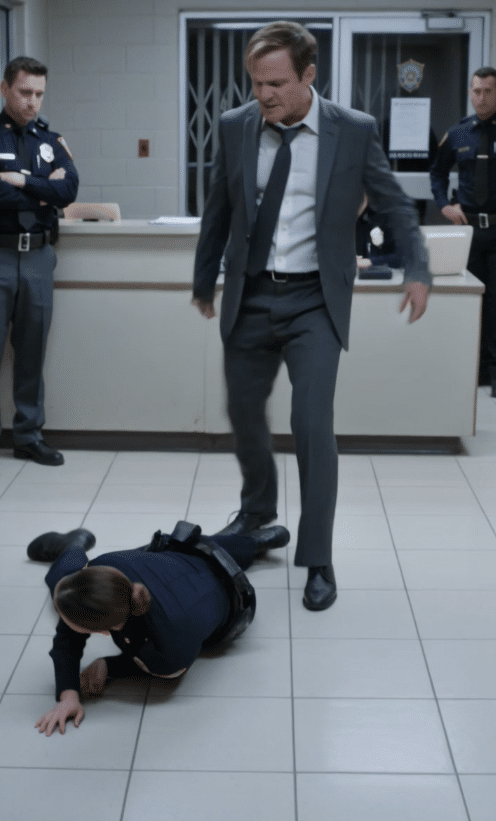
Before she could respond, he drove a forceful kick into her chest.
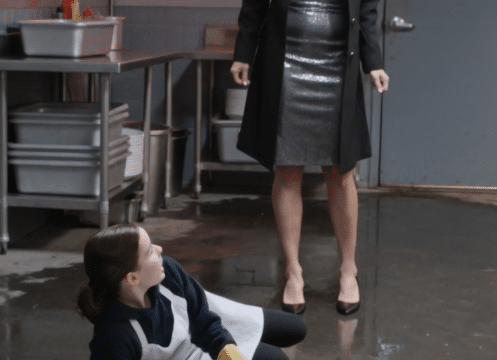
Emily was thrown backward onto the tile floor near the intake desk. Her radio tore loose from her shoulder, and her police cap skidded across the lobby. As she fell, her forearm struck the edge of the counter, leaving a thin scrape.
A woman in the waiting chairs gasped.
Someone whispered, “Oh, my God.”
Emily struggled to draw a full breath. Pain tightened her face as she reached instinctively toward the secured door, still trying to keep the entrance blocked.
Richard stepped toward her again.
He delivered two more kicks into her back and side while she was down.
The sound echoed through the lobby.
People recoiled. One man rose halfway from his chair, then froze. A mother pulled her young daughter against her chest, shielding the child’s face from the scene.
Emily curled against the floor, breathing hard, one hand gripping the tile as she tried to move away from him.
Still, she looked toward the door.
“You must wait outside the intake area,” she said, her voice strained but unmistakably clear.
Richard stared down at her with contempt.
“Open it before I walk through you.”
He had attacked a police officer inside a police station because she had refused to give him access to his arrested son.
He appeared to believe that the uniform on the floor had no more authority than an employee he could dismiss from his office.
Then the sound of tires braking sharply outside cut through the lobby.
A black police SUV stopped at the entrance.
The front doors flew open, and three figures hurried inside: the police chief, the duty captain, and a district prosecutor who had been working late on a case connected to the arrest.
The entire lobby seemed to stop breathing.
The duty captain saw Emily on the floor and immediately moved to shield her. The prosecutor opened a case file on a tablet.
The police chief looked at the injured officer first.
Then he turned toward the man in the gray suit.
“Bring me his son’s assault file.”
Richard’s face lost its color.
“My son’s file?”
For the first time that night, he understood that the situation was no longer something he could control by raising his voice.
And the file the chief wanted was about to reveal why his attempt to rescue his son might become the worst decision of his life.
Act II
Emily Brooks had never confused authority with power.
She had joined the police department at twenty-four, after watching her mother spend years working as a nurse in a busy emergency department. Her mother had taught her that people often revealed their character when they were frightened, embarrassed, or told no.
Some became quieter. Some asked for help.
Others decided that the person delivering the bad news was the enemy.
Emily had seen all three kinds of people during her years on patrol. She had learned how to calm an angry driver, help a frightened witness, and speak to someone whose entire life seemed to be collapsing in front of her.
The intake area required a different kind of discipline.
It was a secured space where officers processed arrests, recorded information, and coordinated with other staff. Family members could ask questions and seek legal assistance, but they could not simply force their way through the door because they were upset.
That separation protected detainees, officers, visitors, and the integrity of the process.
Emily had explained those boundaries to countless people.
Most eventually understood.
Richard Lawson did not believe the boundaries were meant for him.
He had built his business reputation around decisive action and relentless negotiation. He liked to tell associates that hesitation was a weakness and that the person who controlled a conversation usually controlled its outcome.
At home, that philosophy had gradually become something more troubling.
His son, twenty-one-year-old Daniel Lawson, had grown up watching his father turn arguments into contests that somebody had to win. Richard frequently intervened whenever Daniel faced consequences, whether it was a university disciplinary meeting, a dispute with a neighbor, or a complaint from someone who worked for the family business.
Each time, Richard framed his intervention as loyalty.
He was protecting his son.
He was making sure nobody took advantage of him.
He was ensuring that one mistake did not ruin a promising future.
But the protection had come with a dangerous lesson: Daniel increasingly believed that consequences were temporary inconveniences, provided his father arrived quickly enough.
That evening, Daniel had been involved in a confrontation outside a restaurant. According to the initial allegations, he had struck another man after an argument escalated. The injured man had required medical attention, and witnesses had provided statements to the responding officers.
Daniel had been arrested while investigators began documenting what happened.
Richard had received the call and driven to the station immediately.
He was not interested in waiting for an attorney, reviewing the allegations, or learning what evidence had been collected. He wanted to reach his son before anyone could question him further.
When Emily blocked the intake door, Richard saw her as the final obstacle between him and the outcome he wanted.
He did not see a woman responsible for maintaining a secure area.
He saw someone refusing to obey him.
Now, on the lobby floor, Emily was struggling to breathe while the duty captain knelt beside her. The captain, Marcus Reed, had worked with her for four years and knew her as a steady officer who rarely raised her voice.
“Emily, stay still,” he said. “Medical help is coming.”
She nodded, wincing.
“Door,” she whispered.
Marcus glanced toward the secured entrance.
“It’s secure. I’ve got it.”
Only then did Emily allow herself to stop reaching for it.
Across the lobby, Richard began speaking rapidly.
“This is completely out of control. She attacked my rights. I was trying to see my son.”
Nobody answered immediately.
The police chief, David Mitchell, had spent nearly three decades in law enforcement. He knew that an officer’s uniform did not make every decision correct, and he would not ask anyone to accept a claim merely because it came from someone in authority.
But what he could see in front of him was not complicated.
An officer was injured.
Witnesses had seen the assault.
And the man responsible was attempting to explain away his actions before anyone had even asked for his account.
Chief Mitchell turned to the lobby staff.
“Preserve the security footage. Keep the witnesses separate so their statements can be taken independently. Make sure Officer Brooks receives medical attention.”
Then he faced Richard.
“Do not approach that door again.”
Richard looked toward the chief’s uniform, apparently reassessing the room for the first time.
He had expected an argument with a young officer.
He was now standing in front of the highest-ranking official at the station, with the duty captain beside the injured officer and a prosecutor waiting to examine the circumstances surrounding his son’s arrest.
Yet Richard still believed that if he could make the right person understand his position, everything might return to normal.
He had not yet grasped that the chief was not there to negotiate away the facts.
He was there to make sure they were preserved.
And the first set of facts he intended to examine belonged to Daniel Lawson.
Act III
The district prosecutor, Helen Ward, stood near the front desk with her tablet in hand.
She had come to the station to review the developing assault case against Daniel Lawson. She had not expected to witness another alleged assault in the lobby, much less one committed against a police officer.
Chief Mitchell approached her.
“Bring me his son’s assault file.”
Helen nodded and opened the digital case record.
Richard immediately stepped forward.
“Wait. What does my son’s case have to do with this?”
The chief turned toward him.
“You came here because your son was arrested for assault. You then allegedly assaulted an officer who was performing her duties. The circumstances surrounding both incidents need to be documented.”
Richard shook his head.
“You’re making this sound like some kind of conspiracy.”
“No,” Helen said evenly. “We’re reviewing two incidents and the available evidence. That is not a conspiracy.”
She began with the information already recorded in Daniel’s case.
The original incident report described the confrontation outside the restaurant. Witnesses had reported seeing Daniel strike the other man. A nearby security camera had captured part of the altercation, and investigators were working to preserve the footage and establish the sequence of events.
The injured man had provided an initial account after receiving medical attention.
None of that alone guaranteed a particular legal outcome. The evidence still needed to be assessed, and Daniel retained the right to legal representation and due process.
But the case was not an empty accusation that Richard could erase with a phone call.
It was an active investigation.
Richard looked from Helen to the chief.
“My son made a mistake. Young men fight. It doesn’t mean his life should be destroyed.”
Helen held his gaze.
“Then let the process establish what happened.”
“He needs his family.”
“He has the right to legal counsel,” she replied. “That doesn’t give you permission to enter a secured intake area.”
Richard’s jaw tightened.
“I was trying to protect him.”
Chief Mitchell glanced toward Emily, who was being assessed by the responding medical team.
“Protecting your son does not mean attacking another person.”
The words struck Richard harder than he expected.
He looked around the lobby. The civilians who had been waiting quietly were now watching him with wary expressions. The officer who had been standing in his way was injured. His own actions had become part of the record.
And the prosecutor had opened a file that connected the night to an earlier incident involving his son.
For the first time, Richard seemed to understand that the chief was not going to let him turn the entire matter into a private family dispute.
Helen continued reviewing the documentation with the investigators. She asked for the relevant witness information and confirmation that the available security footage would be preserved. She also made clear that the reported assault on Emily would be investigated separately from Daniel’s alleged offense.
The distinction mattered.
Richard’s behavior could not prove Daniel guilty of the original assault. Daniel’s arrest could not justify Richard’s attack on Emily. Each allegation would have to stand on its own evidence.
But the two incidents had occurred within minutes of each other, and Richard’s attempt to interfere had now created a second serious matter for investigators to examine.
A station employee approached with a report that the lobby security system had recorded the confrontation.
Chief Mitchell instructed staff to preserve the footage according to department procedures. The witnesses were asked to provide statements, and the duty captain ensured that Emily’s medical needs remained the first priority.
Richard watched the process unfold.
“Are you seriously treating me like a criminal?” he demanded.
The chief answered without raising his voice.
“We are responding to what happened here.”
“I have done more for this city than you know.”
“Then you understand why the rules must be applied consistently.”
Richard’s face reddened again.
He had expected his reputation to function like a key. He had assumed that the chief would recognize his name, that the prosecutor would consider his influence, and that the officers would become more accommodating once they understood his position.
Instead, every person in the room seemed focused on the same things: the injured officer, the witnesses, the security footage, and the documented facts.
His status was not changing the procedure.
It was not opening the door.
And it was certainly not making the chief forget what he had seen.
Then Helen looked up from the tablet.
“There is one more thing we need to establish,” she said. “The full sequence of events before Daniel was arrested.”
Richard went still.
Because he knew there had been an argument before the restaurant confrontation.
And he knew his son had called him before the police arrived.
Act IV
The call had lasted less than a minute.
Daniel had contacted his father after the confrontation outside the restaurant, speaking quickly and insisting that the other man had provoked him. Richard had heard the anger in his son’s voice and immediately decided that the priority was to protect him from consequences.
He had not asked for the other man’s name.
He had not asked whether anyone was injured.
He had not suggested that Daniel remain calm and cooperate with the responding officers.
He had promised to come.
Now, in the police station lobby, Richard realized that his instinct to intervene had carried him into a situation he could not talk his way out of.
Chief Mitchell asked the duty captain to confirm that the relevant footage and reports had been secured. Helen coordinated with the investigators handling Daniel’s case, making sure that the original assault allegations and the new incident in the lobby remained properly documented.
Richard watched her work.
“You’re going to use this against my son,” he said.
Helen set the tablet down.
“We will evaluate the evidence in his case. Your actions here will be evaluated separately.”
“You know what I mean.”
“I do,” she replied. “And I am telling you that we will not change the evidence to protect anyone.”
The lobby fell silent.
Richard looked toward the intake door again. His son was somewhere behind it, being processed according to the same procedures Richard had tried to force his way around.
The door remained closed.
For years, Richard had treated his son’s problems as challenges to be managed rather than opportunities for him to learn responsibility. If Daniel had made a mistake, Richard found someone to blame. If someone complained, Richard called it unfair treatment. If an authority figure said no, Richard demanded to speak with someone more important.
He had believed he was giving his son confidence.
He had actually been teaching him that rules were negotiable when the right person became angry enough.
Now the lesson had come back to him.
A medical responder finished an initial assessment of Emily and recommended further evaluation. Marcus stayed nearby, making sure she was not pressured to return to duty.
When Emily was ready to speak briefly, the chief approached her.
“How are you feeling?”
“Hurting,” she admitted. “But I’m okay to answer a few questions later.”
“You don’t need to do that right now. Get checked out first.”
Emily looked toward the intake door.
“Did he get inside?”
“No,” Marcus said. “The door stayed secure.”
Her shoulders relaxed slightly.
It was a small reaction, but Chief Mitchell understood what it meant. Even while injured, Emily had been worried about the secured area and the people inside it.
She had continued trying to do her job after Richard knocked her to the floor.
The chief turned away, his expression hardening.
He had spent years telling officers that procedure was not an inconvenience to be abandoned whenever someone shouted loudly enough. It was the structure that prevented personal anger, favoritism, and fear from deciding what happened next.
Richard had attacked Emily because she had enforced that structure.
Now the department would have to demonstrate that the same structure applied to everyone—including the man who had attacked her.
The chief ordered the incident handled through the appropriate investigative channels. The department would preserve the security footage, collect independent witness statements, and document Emily’s injuries. Any charges arising from the incident would be determined through the applicable legal process.
Richard would not be allowed to enter the secured area, and his son’s case would continue without the special access he had demanded.
The prosecutor returned to the tablet, reviewing the available records with the investigators.
Richard’s voice grew quieter.
“What happens to my son now?”
Helen answered carefully.
“He will have access to counsel. The case will proceed based on the evidence. Nobody here can promise you a particular outcome tonight.”
Richard looked toward the door.
For the first time, he seemed less concerned with winning an argument than with understanding the consequences.
He had arrived believing that he could rescue Daniel by making enough noise. Instead, he had created a separate investigation that could carry serious consequences of its own.
His attempt to control the situation had only made it more complicated.
Then the chief stepped toward him.
“Mr. Lawson, you need to understand something. This station is not your home, your office, or a room where you can demand that people obey you. The people inside these doors are entitled to safety and due process—including your son.”
Richard stared at him.
The chief continued.
“You don’t protect your child by teaching him that violence and intimidation are acceptable ways to get what he wants.”
For once, Richard had no immediate answer.
He looked down at his loosened tie and then at the floor where Emily’s cap had skidded away.
The lobby no longer felt like a place he could dominate.
It felt like a place where everyone had seen him clearly.
And the final blow to his confidence came when the chief asked for Daniel’s assault file again—not to threaten the family, but to make sure the original case continued on its own merits, untouched by Richard’s demands.
Act V
By the time the lobby began to settle, the night had changed completely.
Emily had been taken for further medical evaluation. Her injuries required attention, and the department arranged for her to receive appropriate care before any formal interview. Marcus remained involved in making sure that the incident was documented accurately.
The witnesses were interviewed separately, and the security footage was preserved for review. Richard’s alleged assault on Emily was referred for investigation, while Daniel’s case continued through the ordinary legal process.
The chief made no promises about convictions or sentences.
He did not need to.
The evidence would be examined, the allegations would be addressed, and the appropriate authorities would determine what followed.
Richard was informed that he could not enter the intake area and that he would need to cooperate with lawful instructions while the incident was investigated. His customer-service instincts, business contacts, and financial resources did not give him the right to interfere with the processing of an arrest.
For the first time in years, he had to wait for someone else to decide what happened next.
And he had to do it without threatening, bargaining, or forcing his way through a door.
Several hours later, Richard sat alone in a consultation room, his expensive suit creased and his tie hanging loose. He stared at his phone, where messages from business associates had begun to accumulate.
He ignored them.
His mind kept returning to the moment Emily had fallen.
He remembered the sound of her radio hitting the tile. He remembered the witnesses recoiling. He remembered his own voice demanding that she open the door.
Most of all, he remembered how quickly the room had changed when the chief entered.
He had assumed that the police chief would see a powerful father trying to protect his son.
Instead, the chief had seen an injured officer and a man whose behavior needed to be investigated.
Richard had spent so long believing that influence could make consequences disappear that he had failed to notice how much damage his behavior was doing to his family.
Daniel had learned from him.
That was the truth he could no longer avoid.
The next morning, Richard’s attorney explained the importance of allowing the investigations to proceed without interference. Daniel would have legal representation, and the allegations against him would be assessed according to the evidence.
Richard’s own conduct would be examined separately.
There would be no private arrangement that erased what happened in the lobby. No conversation could turn the security footage into something else. No demand could make the witnesses forget what they had seen.
And no matter how much Richard wanted to blame Emily for standing in his way, she had not created the situation.
She had simply refused to let him cross a secured threshold.
In the days that followed, the department reviewed the incident and reinforced its procedures for handling aggressive visitors in secured areas. Staff were reminded to prioritize medical care, preserve evidence, and ensure that witnesses could provide accounts without pressure.
Emily took the time she needed to recover.
When she eventually returned to the station, Marcus met her near the front desk. Her uniform was neat, her hair tied back, and her radio secured firmly to her shoulder.
For a moment, she stood looking at the intake door.
Marcus followed her gaze.
“You don’t have to prove anything by coming back before you’re ready,” he said.
“I know.”
“Then why are you smiling?”
Emily considered the question.
“Because the door still works.”
Marcus laughed softly, and the tension between them eased.
It was a small joke, but it carried a truth that had mattered from the beginning. The door had stayed closed. The secured area had remained protected. And the man who had tried to force his way through it had not been permitted to dictate the rules simply because he was angry.
Emily returned to her duties gradually, with support from her colleagues. She did not pretend the attack had been insignificant, and she did not regard it as proof that every angry person was dangerous.
She understood that most people who entered the station were frightened, confused, or desperate for help.
Her job was to treat them with professionalism while maintaining the boundaries that kept everyone safe.
That included people like Richard Lawson.
It also included Daniel.
The law was not supposed to bend toward the most intimidating person in the room. Nor was it supposed to become harsher simply because someone had embarrassed an officer. It was supposed to work through evidence, procedure, and accountability.
Richard had tried to turn a secured doorway into a test of power.
He had expected the woman standing in front of it to move.
Instead, his own actions had become the reason investigators needed to examine him.
And the file the chief requested that night was not a weapon to be used against his son. It was a reminder that Daniel’s alleged assault would be considered on its own evidence, while Richard would have to answer for what he had done in the lobby.
The two cases were connected by one family’s choices, but neither could erase the other.
Weeks later, Richard would still remember the question that had escaped him when the chief arrived.
My son’s file?
He had asked it as if the existence of a record were a threat, as if documenting an allegation were the same thing as deciding a person’s guilt.
But the record had been there before he entered the station.
His son had been arrested because an incident had been reported and evidence needed to be examined. Emily had been standing at the intake door because secured areas had to remain secure. The chief had ordered the file brought forward because the facts mattered.
Richard had made everything worse by believing that none of those things applied to him.
The next time he looked at his son, he would have to confront a question more painful than whether Daniel might face consequences.
He would have to ask what kind of man his son was becoming—and how much of that man he had helped create.
Because a father could protect his child from immediate danger.
He could find an attorney, offer comfort, and stand beside him through a difficult legal process.
But he could not teach his son that violence was acceptable, then call it love.
And he could not kick his way through every closed door in the world.
Some doors existed to protect people.
Some rules existed because fear and anger were not reliable judges.
And sometimes, the most important thing a father could do for his son was to stop demanding that everyone else move aside—and finally allow him to face the consequences of his own choices.