Act I
“Stay behind the line. Paramedics are working.”
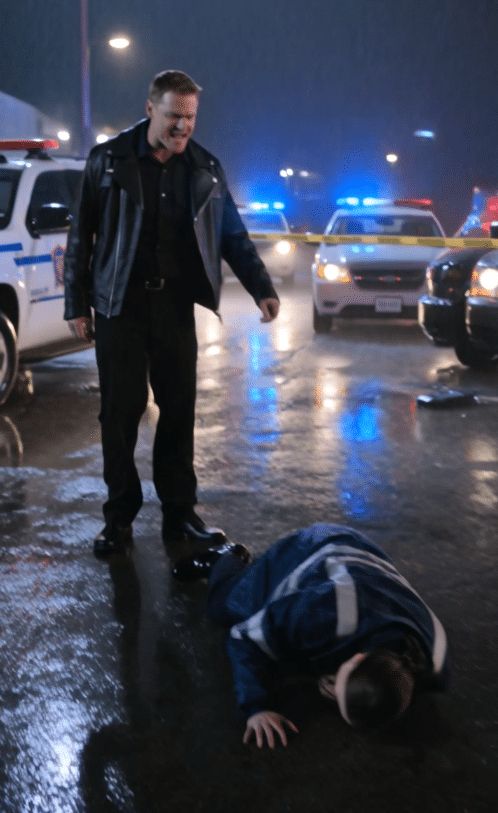
Officer Emily Brooks stood beneath the rain with one hand gripping the yellow police tape and the other holding her flashlight. Behind her, an ambulance sat with its doors open, its red lights reflecting across the wet asphalt. Paramedics moved urgently around an injured driver while another emergency worker called out measurements and instructions over the steady hiss of rain.
The man facing Emily seemed unable to hear any of it.
At forty-three, Richard Lawson had spent years learning how to make people back down. He wore an expensive black leather jacket, spoke with the confidence of someone accustomed to getting his way, and treated every refusal as a personal insult. His damaged sedan sat inside the taped-off area, its front end crushed from the collision he had caused minutes earlier.
Now he wanted to get inside it.
“My property is in that car,” Richard snapped, staring past Emily toward the wreckage.
“Sir, you cannot enter the scene.”
“Trash,” he spat. “You think you can tell me what to do?”
Emily held her position. She had dealt with angry drivers before, including people who became aggressive when they realized a collision could bring legal consequences. She knew that panic often disguised itself as arrogance, and she gave him another opportunity to step back.
“I’m asking you to move away from the tape.”
Richard looked at her uniform, then at the ambulance, then back at the officer who stood between him and whatever he believed was worth risking everything to retrieve.
His expression hardened.
“I’ll cross any line I want.”
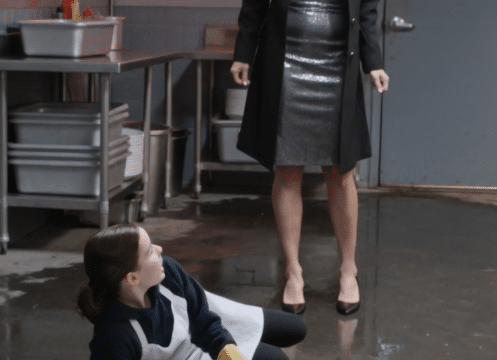
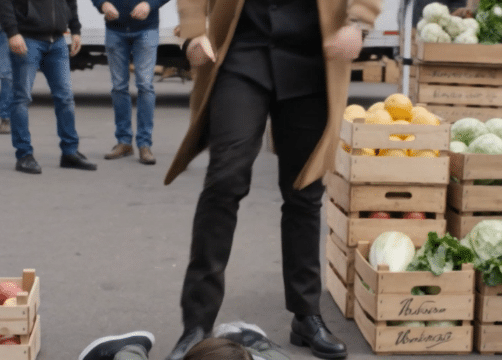
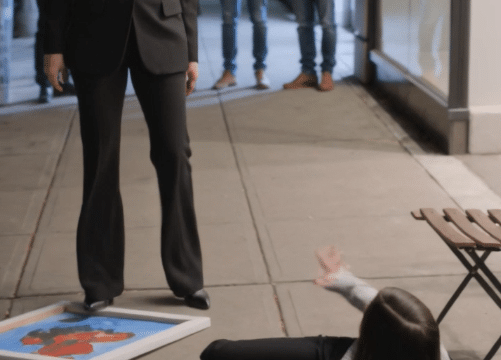
Before Emily could reach for her radio, Richard drove a violent kick straight into her chest.
She fell hard onto the rain-soaked road. Her flashlight spun away, striking the pavement before sliding beneath the edge of a parked emergency vehicle. Her radio skidded through a shallow stream of rainwater, its brief burst of static disappearing beneath the noise of the scene.
A collective gasp rose from the bystanders.
Emily struggled to draw a full breath. Pain spread through her chest as she tried to understand what had just happened. Her knee scraped against the asphalt, leaving a thin trace of blood, and her forearm stung when she planted it against the road to keep herself from sliding.
But the emergency perimeter was still there.
The tape had sagged where her hand had been holding it. Beyond it, the paramedics were still working.
Emily reached for the tape.
Richard stepped closer and kicked her again, then delivered another forceful blow to her back and side as she tried to keep the barrier from collapsing. She winced, fighting to pull air into her lungs, but she did not turn her attention away from the people working behind her.
One hand remained clenched around the yellow tape. With the other, she pointed toward the ambulance.
“Stay behind the line,” she repeated, her voice strained. “They’re working.”
Richard stood over her, rain running down his face.
“You should have stayed out of my business.”
Nobody moved.
A woman near the curb covered her mouth. A man holding an umbrella took an involuntary step backward. Several witnesses stared in disbelief, their phones hanging uselessly at their sides as the reality of what they were seeing settled over them.
Richard had not struck someone in a private argument.
He had attacked a police officer who was protecting an active emergency scene, while injured people waited for help only a few yards away.
And he still believed the only thing that mattered was what he wanted from his car.
Then, through the rain, a dark command vehicle came to a hard stop behind the ambulance.
The door opened.
A man in a command-unit jacket stepped into the storm, and the entire scene was about to change.
Act II
The commander’s name was David Mitchell, and he had spent nearly three decades responding to the moments when an ordinary night became something no one involved would ever forget.
He had seen drivers cry after causing accidents. He had seen frightened teenagers lash out at officers because they could not bear the consequences of their mistakes. He had even watched people become so overwhelmed by shock that they could barely remember their own names.
But David had learned to recognize a different kind of behavior.
Some people were not confused by a crisis. They simply believed the crisis should not apply to them.
As he stepped away from the command vehicle, he saw the damaged sedan, the ambulance, the loose section of yellow tape, and the injured officer on the ground. He also saw Richard standing over her with no sign that he intended to help or even step away.
David did not waste time asking the crowd what had happened.
“Get the medic over here,” he ordered. “Secure that vehicle and keep everyone clear.”
A crash investigator named Michael Grant hurried toward the perimeter. The lead paramedic, Laura Bennett, broke away from the ambulance crew and knelt beside Emily, carefully assessing her condition.
Richard took one look at the newcomers and seemed to decide that the situation had finally attracted someone important enough to hear his side.
“Good,” he said, raising his voice. “Tell your officer to get out of my way. My belongings are inside that car.”
David barely glanced at him.
“Step away from the vehicle.”
“You don’t understand. I need something from the glove compartment.”
“You can explain what you need after we secure the scene.”
Richard gave a disbelieving laugh. “You can’t just keep me away from my own property.”
David turned toward Michael.
“Seal his vehicle as evidence.”
The investigator immediately began expanding the perimeter around the sedan. A second officer moved to protect the entrance to the scene, while another started documenting the vehicle’s position and visible damage.
Richard stared at them.
“Evidence?”
For the first time that night, his voice had lost some of its force.
David finally faced him directly. “An officer has been assaulted. Your vehicle was involved in a serious collision. Until investigators determine what happened, you do not enter that car.”
“I didn’t do anything to her.”
Several witnesses reacted at once. One woman lowered her umbrella and stared at him as if she could not believe he had said it. Another began speaking quietly to an officer, identifying where she had been standing when the attack occurred.
Richard noticed them.
His eyes moved from one face to another, searching for the familiar signs of uncertainty, the instinctive urge people sometimes felt to avoid becoming involved.
He found no reassurance.
The witnesses had seen the kicks. They had heard Emily’s warning. They had watched Richard continue his attack while paramedics worked behind the barrier.
For once, his confidence could not make the truth disappear.
Meanwhile, Laura carefully helped Emily remain still while she checked her breathing and the injuries to her chest and side. Emily’s face had gone pale beneath the rain, but her eyes remained alert.
“Don’t try to stand yet,” Laura told her. “Let us assess you first.”
“The ambulance crew?” Emily managed.
“They’re still working. We’ve got the scene.”
Emily closed her eyes for a moment, absorbing the reassurance.
Even hurt, she had been thinking about the people behind the tape.
Richard had been thinking about his property.
David saw the difference, and it told him something important about the man standing beside the wreckage. But he still did not know what Richard had been so desperate to retrieve.
The answer would emerge only after the crash investigators began examining the vehicle.
And when they did, the collision would become far more complicated than anyone had initially suspected.
Act III
Richard Lawson had always believed that consequences could be managed.
When he was younger, his father had taught him that an apology was useful only when someone had enough leverage to demand one. Richard carried that lesson into adulthood, where money, connections, and an intimidating manner had often helped him turn uncomfortable situations into temporary inconveniences.
He had become a successful regional sales executive, owned a house in an affluent suburb, and cultivated the image of a man who was always in control.
People who worked for him described another side.
He could be charming when he wanted something and merciless when someone challenged him. He had a talent for making reasonable boundaries sound like personal attacks, then portraying himself as the victim when others refused to surrender them.
His marriage had ended after years of arguments. His former wife had once told a mutual friend that Richard could accept almost any bad news except the possibility that he might be responsible for it.
The crash had exposed that flaw in its most dangerous form.
Earlier that evening, Richard had been driving home through heavy rain after a tense meeting with a business associate. He had been impatient, distracted, and determined to make up time. Witness accounts and the physical evidence would eventually help investigators reconstruct the moments before the collision, including the decisions that had left another driver injured.
But Richard was already focused on a different problem.
Inside his sedan was a slim black document case.
He had carried it to the meeting, and he had intended to take it home. According to the account he would later give investigators, it contained confidential business paperwork and personal belongings. He insisted that the case had nothing to do with the crash.
The urgency with which he tried to retrieve it suggested that he was afraid of something more than losing a few documents.
There was a reason.
For months, Richard had been involved in a dispute over a proposed acquisition. His company was preparing to purchase a smaller transportation business, and Richard had been responsible for reviewing certain financial records before the deal closed. During that process, he had discovered discrepancies that threatened to expose serious misconduct by someone senior to him.
At first, he had convinced himself that the irregularities were merely accounting errors.
Then he found documents that did not match the explanations he had been given.
Instead of reporting the discrepancies through the proper channels, Richard had allowed himself to become entangled in the effort to contain them. He had kept copies of correspondence and draft records in the black case, partly because he feared becoming the person blamed for a scandal he had not originally created.
Now those records were in a damaged vehicle at an active crash scene.
And the longer he remained outside the car, the more he feared someone else might discover them.
He did not know whether the case had shifted during the collision. He did not know whether the documents had been scattered. Most importantly, he did not know whether anyone had noticed the small storage device he had placed inside it.
That device contained copies of emails and financial records he had recently received from a colleague who was preparing to cooperate with an internal investigation.
Richard had told himself he was protecting his own future by keeping the information close.
But he had never considered what would happen if the decision to protect himself became evidence of something far worse.
At the scene, Michael Grant began the methodical work of documenting the sedan. He photographed the exterior, recorded the vehicle’s position, and noted visible damage before anyone was allowed to disturb the interior. The car would be handled according to the applicable investigative procedures, with its condition preserved for examination.
Richard watched every movement.
“Be careful with that door,” he called out.
Michael ignored the demand and continued documenting the scene.
“I’m talking to you!”
“Sir, step back.”
Richard’s jaw tightened. He had expected anger to work. He had expected threats to work. He had even expected that mentioning his attorney would force someone to negotiate.
Instead, the investigator treated him as one more person whose demands had to wait until the evidence was secured.
Richard looked toward David.
“You have no idea who you’re dealing with.”
David’s expression did not change.
“Tonight, you’re a person at a crash scene who has been told not to enter a vehicle under investigation.”
Richard’s mouth opened, then closed.
He looked back at the sedan, where the rain slid down the crumpled metal. The windshield was fractured, and the front end had been pushed inward by the force of the collision. Through the glass, he could make out the dark shape of the document case.
For the first time, he seemed to understand that he might not get it back simply by demanding it.
Yet the worst revelation had not happened.
Because the crash investigator was about to find a reason to preserve far more than Richard’s personal belongings.
Act IV
By the time the ambulance crew had stabilized Emily enough to move her, the accident scene had become a controlled investigation.
Rain continued to fall, but the emergency lights painted the pavement in alternating bands of red and blue. The paramedics had transferred the injured driver for further treatment, and additional officers had arrived to maintain the perimeter.
Emily was placed on a stretcher.
Before the team lifted her into the ambulance, she turned her head toward David.
“Make sure nobody goes through that scene.”
David stepped closer so she could hear him over the rain.
“We’ve got it. Focus on getting checked out.”
She nodded, finally allowing the paramedics to take her away.
The sight of the stretcher passing Richard seemed to irritate him more than it unsettled him. He watched the ambulance doors close, then turned back toward David as if he had been waiting for the officer to finish dealing with what Richard considered a distraction.
“Now can we talk about my car?”
David did not answer immediately.
He had just received an initial update from Michael, who had identified details requiring further examination. Nothing had yet established the complete cause of the collision, and David was careful not to treat suspicion as proof. The vehicle would need to be inspected, relevant records preserved, and witness statements collected before investigators could reach firm conclusions.
But the circumstances justified keeping the car secured.
“Your vehicle is being held while the collision and the assault are investigated,” David said. “You will have an opportunity to provide your account through the proper process.”
Richard scoffed. “This is ridiculous. I have work in the morning. I have people waiting on me.”
“Then you should cooperate with the investigation.”
“I am cooperating.”
“You were ordered to remain outside the perimeter. You assaulted an officer. You continued after she fell.”
Richard’s eyes flashed.
“She disrespected me.”
The words escaped before he seemed to realize how they sounded.
David looked at him for a long moment.
“She was protecting paramedics who were treating an injured person.”
Richard glanced away.
For the first time, he appeared unable to construct a version of events in which he was the wronged party. Every explanation he reached for led back to the same facts: Emily had given him a lawful instruction, he had attacked her, and witnesses had seen him do it.
Michael approached with a notebook and an update about the vehicle.
“We’re preserving the scene and documenting everything before any further examination,” he told David. “There are also witness accounts that need to be collected.”
“Proceed,” David replied. “Keep the records complete.”
Richard stepped forward. “You can’t take my car apart because she got dramatic.”
A nearby officer moved between him and the tape.
“Back up, sir.”
“I want my attorney.”
“You can request legal counsel. That doesn’t give you permission to enter the scene.”
Richard’s face reddened, but he retreated a few steps.
The investigator’s work continued. Photographs were taken, measurements recorded, and the car’s condition documented. The process was deliberately careful, because the case could not be built on anger or assumptions. Any relevant material found inside would have to be handled and recorded according to the appropriate procedures.
That was what Richard had never understood about the people he was now facing.
They did not need to win an argument with him.
They needed to establish what had happened.
And evidence, once properly documented, could outlast every threat he made.
Later, at the hospital, Emily learned that her injuries required further evaluation. Her chest and side were painful, and her knee and forearm had been treated for their abrasions. Doctors kept her under observation rather than immediately clearing her to return to duty.
She hated being unable to stand beside her colleagues.
For years, she had measured herself by whether she could remain steady when everyone else was frightened. Being the person on the stretcher felt unfamiliar, almost humiliating in its own way. She kept replaying the moment when the tape slipped through her hand, wondering whether she should have anticipated Richard’s attack sooner.
A nurse noticed her staring at the ceiling.
“You know you don’t have to solve the whole night from this bed,” she said gently.
Emily let out a tired breath.
“I just keep thinking about the people behind me.”
“They were in the care of a team. And now you need to let a team take care of you.”
The words reached her in a way that commands and reassurances could not.
She closed her eyes.
For the first time since the attack, she allowed herself to stop being the officer who had to hold the line.
Across town, Richard was learning that the line had not disappeared just because he had crossed it.
His car remained secured. Investigators were collecting statements. His own actions had become a separate matter requiring its own investigation, and the collision itself would be examined independently.
His employer had also begun asking questions after learning that Richard’s vehicle had been involved in a serious incident and that he had been accused of assaulting an officer. The company did not immediately declare him guilty of anything beyond what had been established. Instead, it began preserving relevant business records and reviewing the transaction he had been involved in.
That review would bring the black document case into a much larger picture.
And when the financial records inside it were examined through the proper legal channels, Richard’s attempt to protect his property would no longer look like a desperate inconvenience.
It would look like the beginning of a trail.
Act V
The truth did not arrive in one dramatic announcement.
It emerged through interviews, records, and the slow reconstruction of events by people who understood that a serious accusation had to be supported by facts.
The collision investigation established the sequence of events leading up to the crash. Witness statements helped clarify Richard’s conduct at the perimeter, while available recordings and physical evidence were reviewed as part of the assault investigation. Each strand was handled separately, because the collision, the attack on Emily, and the material found in the car raised distinct questions.
Richard’s claim that the officer had provoked him did not survive the accounts of the people who had watched the confrontation.
They described Emily giving clear instructions. They recalled Richard insulting her. They saw him kick her to the ground and continue attacking her while she tried to keep the emergency perimeter intact.
Their statements matched one another in the details that mattered.
The witnesses who had once stepped back in fear eventually came forward to provide formal accounts. Some admitted that they had been too shocked to act in the moment. Others said they had been afraid that Richard would turn on them if they intervened.
None of them forgot the image of Emily reaching for the tape while injured.
That small detail became a defining part of their recollections.
She had been hurt, but she had still been trying to protect the people behind her.
Richard, meanwhile, had been trying to reach a document case.
As the vehicle examination progressed, investigators identified material that warranted further review. The documents were not treated as proof of criminal wrongdoing simply because they appeared suspicious. Instead, their contents were assessed, their origins examined, and relevant records preserved for the appropriate authorities.
The financial discrepancies connected to Richard’s company became part of an internal inquiry. Investigators sought to determine who had created the questionable records, who knew about them, and whether anyone had attempted to conceal misconduct.
Richard’s name surfaced repeatedly in the correspondence.
Some messages showed that he had raised concerns about the transaction. Others showed that he had continued participating after receiving information that should have prompted further questions. The evidence did not turn every suspicion into a proven offense, but it made one thing clear: the documents he had been so desperate to retrieve were potentially important, and their significance could not be settled by his own explanation.
The company placed him on leave while the review continued.
His colleagues stopped returning his calls. The associate who had once assured him that the acquisition would proceed smoothly retained counsel and began responding to investigators through formal channels. Richard discovered that the people he had spent months trying to protect—or trying to keep from exposing him—were now looking after their own interests.
For a man who had built his identity around influence, the silence was unbearable.
He had assumed that his money and position would help him control the narrative. Instead, the process moved forward without asking his permission.
The assault investigation also proceeded through the proper legal channels. Richard faced the consequences of his alleged attack on Emily, with the evidence and witness accounts determining the next steps. No one needed to exaggerate what had happened or turn the case into a spectacle. The documented facts were serious enough.
Emily, meanwhile, began the slow work of recovery.
Her injuries left her sore and exhausted, and she had to accept that returning to normal would take more than a few days of rest. At first, she tried to disguise how much the incident had shaken her. She answered questions about her recovery with short, practical statements and avoided talking about the moment she had fallen.
Then David visited her.
He did not arrive with a grand speech. He brought an update on the investigation and a quiet assurance that the department was documenting the case carefully.
“The witnesses came forward,” he told her. “The perimeter was preserved. The investigators are doing their work.”
Emily looked down at her hands.
“I couldn’t stop him.”
David pulled a chair closer.
“You were enforcing a boundary while protecting an active emergency scene. He chose to attack you. That’s his responsibility, not yours.”
She swallowed, fighting the familiar urge to turn someone else’s violence into a personal failure.
“I keep thinking about how close the paramedics were.”
“And they were able to keep working because the team secured the scene. You did your job. Then your colleagues took over when you needed help.”
For a while, Emily said nothing.
She had spent her career being the person who stepped between danger and someone who could not protect themselves. She had never imagined that accepting help would be the hardest part of the night.
Eventually, she nodded.
It was not a dramatic moment. No crowd applauded, and no camera recorded it. But for Emily, it marked the beginning of a different kind of strength: the willingness to recognize that courage did not mean remaining untouched by what happened to you.
Weeks later, when she returned to the department, her colleagues welcomed her without making her feel as though she had to prove she was unshaken. The case continued through the relevant legal and investigative processes, and the evidence concerning Richard’s conduct remained documented rather than dependent on anyone’s memory alone.
The financial inquiry also continued, with the records from the sedan helping investigators identify questions that required further examination. The full scope of any wrongdoing would be determined by evidence, not rumor, and Richard would have to answer those questions through the proper channels.
He could hire lawyers. He could dispute the accounts. He could explain what he believed the documents meant.
What he could no longer do was pretend that his anger made the rules disappear.
On the night of the crash, Richard had looked at the yellow tape and seen an obstacle between himself and his property. He had looked at Emily and seen someone he thought he could intimidate into moving aside.
He had been wrong about both.
The tape was there to protect people who were already in danger. The officer was there to make sure that the emergency workers could do their jobs. And the commander’s order to seal the vehicle had not been a theatrical punishment delivered to satisfy an angry crowd.
It was a decision to preserve evidence and let the investigation proceed.
That distinction mattered.
Because justice was not the moment Richard became frightened. It was not the silence that fell when the command vehicle arrived, or the look on his face when he realized that his demands would no longer control the scene.
Justice was what happened afterward, when witnesses spoke, records were examined, and every claim had to face the facts.
Richard had once declared that he could cross any line he wanted.
Under the flashing lights that rainy night, he had discovered the cost of believing it.
And the last question he asked—“Evidence?”—would follow him far longer than the sound of his own voice.
For the first time in his life, he was not the man deciding which rules mattered.
He was the man who would have to answer for crossing them.