Act I
“Do not touch anything inside the tape.”
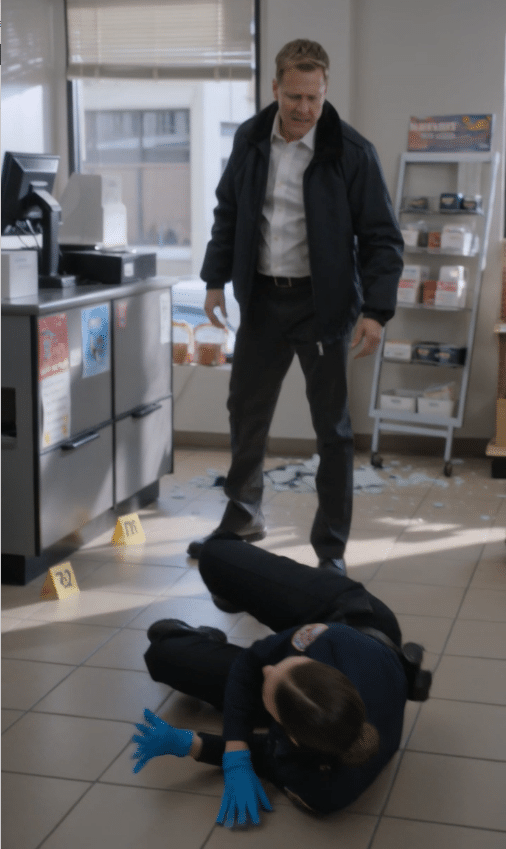
Officer Megan Carter stood beside the checkout counter, holding a small evidence bag in one gloved hand and keeping her other hand near her radio. Yellow police tape stretched across the front of the convenience store, separating the damaged register area from the rest of the shop. Broken glass glittered beneath the fluorescent lights, shelves had been knocked crooked, and numbered evidence markers identified objects investigators had not yet examined.
Across the tape, store owner Richard Hayes was reaching for a small black object near the counter.
“Sir, step back,” Megan warned. “We haven’t finished processing this area.”
Richard straightened slowly, his face twisting with contempt. At forty-seven, he was accustomed to being the person who gave orders in his store. He had spent the morning complaining about the burglary, demanding updates, and insisting that the officers work faster.
Now, apparently, he had decided that their instructions no longer applied to him.
“Trash,” he muttered. “This is my store.”
“The burglary scene needs to remain undisturbed.”
“I don’t care what you need. That belongs to me.”
Megan moved to block the opening in the tape. She was thirty-one, experienced enough to know that the aftermath of a burglary could be more complicated than it first appeared. A footprint near a broken window, a fingerprint on a counter, or an object moved a few inches could become important later.
She had no interest in arguing with Richard. She wanted to finish preserving the scene so investigators could determine who had entered the store and what they had done.
“Please step away from the counter.”
Richard looked at her as though she had just insulted him.
Then he kicked her.
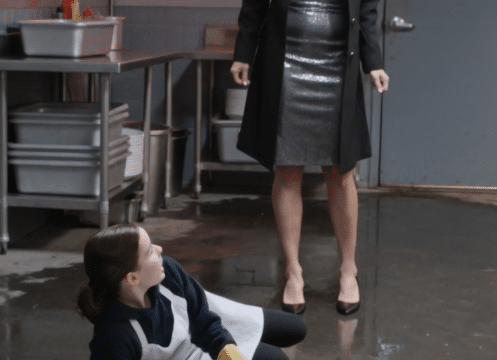
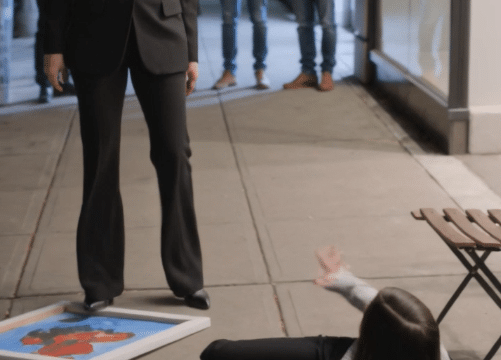
The blow struck Megan squarely in the chest and threw her backward onto the tiled floor near the checkout counter. The evidence bag slipped from her hand. Her radio skidded beneath a low shelf, crackling briefly before falling silent.
A sharp gasp swept through the store.
Megan tried to catch herself, but her forearm struck the floor. Pain flashed through her arm, and a thin trace of blood appeared where her skin had scraped against the tile.
For a moment, the fluorescent lights seemed too bright.
Richard stood over her, breathing hard, with no hint of remorse.
Megan struggled to draw a full breath. Even so, her eyes moved immediately toward the yellow tape. It had sagged where she had been standing, leaving part of the evidence area exposed.
She pointed toward it.
“Do not touch anything inside the tape,” she repeated, her voice strained.
Richard’s expression hardened further.
“You don’t get to tell me what happens in my own business.”
He stepped closer and delivered two more forceful kicks into her back and side as she tried to reach toward the fallen tape. Megan recoiled in pain, fighting to protect herself while still trying to keep the boundary from collapsing.
Behind the counter, a cashier covered her mouth. A customer near the entrance stumbled backward, staring in disbelief. Nobody moved to confront Richard as the shock of the attack held the room in a terrible silence.
Megan reached toward her radio, but it lay just beyond her fingertips.
Richard leaned over her.
“I’ll pick up whatever I own.”
He seemed to believe the words settled the matter.
Then the sound of hard braking came from outside.
An unmarked police sedan stopped in front of the store. Its doors opened, and a tall detective in a long black coat entered with a forensic team and an assistant prosecutor.
The room fell silent.
The detective took in the broken glass, the evidence markers, the fallen officer, and the man standing over her.
His expression changed.
“Get the medic over here,” he ordered. “Secure the evidence area.”
Then he looked directly at the store owner.
“Mark him as interfering with evidence.”
Richard’s anger faltered.
For the first time that morning, he seemed to understand that the police had stopped treating him as a frustrated shopkeeper.
They were looking at him as part of the investigation.
And he had no idea how much trouble he had just created for himself.
Act II
Lead Detective Daniel Mercer had spent twenty-six years investigating burglaries, robberies, fraud, and violent crimes. He had interviewed people who cried, people who lied, and people who believed their money could turn a criminal investigation into a private negotiation.
Richard Hayes reminded him of the last kind.
Daniel did not rush to judgment, but he knew the difference between a person demanding information about a crime and a person trying to control what investigators were allowed to discover.
The store had been burglarized before dawn. Someone had shattered a side window, forced their way inside, and damaged the checkout area. Several shelves had been emptied, cash was missing from the register, and the security system had recorded only fragments of the intruder’s movements.
When officers arrived, Richard had been furious.
He complained that the police were moving too slowly. He demanded to know why the register area had been sealed. He repeatedly insisted that the officers had no right to restrict his access to property he owned.
Initially, Megan had treated his behavior as frustration.
Victims of burglary sometimes felt violated in ways that were difficult to explain. A stranger had entered their private space, touched their belongings, and left behind damage that made even familiar surroundings feel unsafe.
Megan had tried to acknowledge that frustration while explaining why the scene had to remain undisturbed.
But Richard had interpreted every reasonable instruction as a challenge to his authority.
Now Daniel watched as the forensic team moved between the tape and the checkout counter. One technician immediately positioned himself to protect the restricted area while another helped ensure that Megan received medical attention.
The assistant prosecutor, Rachel Bennett, began documenting the circumstances of the incident and identifying the officers and witnesses who could provide statements.
Daniel turned to Richard.
“Step away from the evidence area.”
Richard recovered enough of his confidence to gesture angrily toward the register.
“That officer attacked me with her attitude. I own this place, and I was trying to retrieve my property.”
Daniel’s eyes narrowed.
“Her attitude did not kick you.”
A witness near the entrance let out a small, involuntary breath. Richard heard it and spun toward the customer.
“You didn’t see anything.”
The customer immediately looked at Daniel.
That reaction told the detective something, though he did not assume it established guilt by itself. He directed another officer to separate the witnesses so their accounts could be collected independently.
Richard shook his head in disbelief.
“This is absurd. I’ve been robbed, and now you’re treating me like the criminal?”
“You can explain what happened,” Daniel replied. “But you will not interfere with the scene or intimidate witnesses.”
“I wasn’t intimidating anybody.”
“Then there should be no problem with us speaking to them separately.”
Richard’s mouth tightened.
He glanced at Megan, who was being examined by a responding medic. She was conscious, but pain made it difficult for her to move comfortably. Her radio had been recovered, and another officer was preserving the area where she had fallen.
Richard did not ask whether she was all right.
Instead, he pointed toward the counter.
“That black item belongs to me. I want it back.”
Daniel followed his gaze.
The object lay near an evidence marker. It looked ordinary enough: a small black electronic device, partly obscured by debris and a fallen display card. But the forensic technician had not yet established what it was, where it had come from, or whether it had been moved during the burglary.
“Do not touch it,” Daniel said.
Richard gave a bitter laugh.
“It’s my property.”
“You can tell us about it. You cannot decide that the evidence rules stop applying because you own the building.”
Daniel had the tape reinforced and directed the team to continue documenting the scene. He also ordered that Richard’s actions be recorded separately from the original burglary investigation.
That distinction mattered.
The police still had to determine who had broken into the store. They also had to determine exactly what Richard had done to Megan and whether his conduct had compromised any evidence.
One investigation could not simply replace the other.
Rachel approached Daniel with a brief update. The assault had occurred in front of multiple witnesses, and the team would preserve any available recordings. The forensic team would also document the condition of the area before making further examinations.
Daniel nodded.
“Good. Keep everything separate and complete.”
Richard heard him.
“You’re making a federal case out of nothing.”
Daniel turned toward him.
“No. We’re documenting what happened.”
The store owner looked around for support, but the customers who had witnessed the attack were no longer looking away. One of them was speaking quietly with an officer. The cashier had moved from behind the counter and was waiting to give her account.
Richard’s authority inside the store was disappearing by the minute.
Yet Daniel had not forgotten why he had been called.
A burglary had taken place, and the person responsible might still be free.
The small black object near the register could turn out to be irrelevant. It could also become a critical piece of evidence.
Before anyone could know which, the detective needed to understand why Richard had been so desperate to get his hands on it.
Act III
Richard Hayes had not inherited the convenience store from a wealthy family. He had built it slowly, starting with a small loan, long working hours, and the kind of stubbornness that could look admirable when things were going well.
For years, he had opened the doors before sunrise and stayed until the last customer left. He knew which suppliers delivered late, which customers needed an extra day to pay, and which shelves had to be restocked before the morning rush.
He took pride in the business.
But over time, pride had become possession, and possession had become a need to control everything around him.
Employees learned not to question him in front of customers. When a delivery arrived late, he blamed the driver. When a machine broke down, he blamed the technician. If an inspector pointed out a problem, Richard accused the inspector of wasting his time.
He could be generous when people praised him.
He could be cruel when they did not.
His wife had left him two years earlier, telling him that she could no longer live with someone who treated every disagreement as an act of betrayal. Richard told everyone else that she had abandoned him when the business became difficult.
The truth was less convenient.
The store had been struggling financially for months.
A nearby supermarket had opened a late-night convenience section, taking away many of Richard’s regular customers. Utility bills had increased, and a loan he had expected to refinance had become a growing burden. He had begun delaying payments to suppliers and borrowing against the store’s future revenue.
He refused to tell his employees how serious the situation had become.
Instead, he insisted that business was fine and blamed every setback on someone else’s incompetence.
The burglary had struck at the worst possible moment.
Cash was missing, merchandise had been taken, and repairs to the broken window would cost money he could not easily spare. Richard had arrived that morning already furious, convinced that another person’s actions had pushed him closer to a financial disaster he refused to acknowledge.
But there was something else inside the store that troubled him.
Several days earlier, Richard had installed a small wireless monitoring device near the checkout area. He told his employees it was part of a security upgrade, but he had not completed the installation properly. The device had been placed near the counter, where it could capture activity around the register and connect to a storage system that Richard alone controlled.
The black object he had tried to retrieve was connected to that system.
It was not simply a piece of merchandise he had dropped.
It held information that Richard did not want examined.
Over the previous month, he had been reviewing gaps in the store’s accounts. At first, he suspected an employee of stealing small amounts of cash. Then he noticed that some transactions appeared in the system while others seemed to vanish from the daily summaries.
He had confronted his assistant manager, a woman named Lisa Morgan, and accused her of manipulating the register.
Lisa denied it.
She had worked for Richard for six years and knew the store’s accounting process better than anyone else. She had also begun keeping her own records after noticing that Richard sometimes asked her to alter inventory figures to make the business appear healthier than it was.
She had refused to falsify the reports.
Their relationship deteriorated quickly.
Richard began claiming that Lisa was responsible for the discrepancies. He told her that if the store suffered a financial loss, he would make sure she paid for it. Lisa, frightened that she might be blamed for something she had not done, quietly sought advice about how to preserve the records she had kept.
She did not know the full extent of what Richard had been doing.
But she had noticed that the monitoring device near the register recorded activity that was not reflected in the store’s official summaries.
Richard knew she had noticed.
On the morning of the burglary, he had been desperate to retrieve the device before anyone examined the area. He told himself he was protecting private business information. He also feared that an investigator might discover that the financial discrepancies had begun long before the break-in.
That did not mean the device automatically proved wrongdoing. Investigators would have to establish what it contained, how it had been used, and whether the information was relevant to the case.
But Richard’s behavior had made the question impossible to ignore.
When Daniel asked him why he wanted the object so urgently, Richard gave a vague answer about confidential store records.
“It’s a private business device,” he insisted. “It has nothing to do with the burglary.”
“Then explain what it does,” Daniel replied.
Richard hesitated.
“It’s part of my security system.”
“Who installed it?”
“I did.”
“Does it contain recordings or transaction data?”
Richard looked toward the forensic technician.
“I don’t know what you’re trying to suggest.”
“I’m asking you a question.”
Richard’s eyes hardened.
“I’m not answering another question until I speak to my lawyer.”
Daniel nodded without argument.
“That is your choice.”
He did not need Richard to keep talking. The team could document the device, preserve its condition, and determine what further steps were legally appropriate. If its contents were relevant, they could be examined through the proper process.
Richard had spent the morning believing that owning the store gave him the right to control what happened inside it.
Now the store itself was becoming a source of evidence that he could no longer control.
And the woman he had spent weeks blaming was about to give investigators a reason to look much more closely at his records.
Act IV
Lisa Morgan arrived at the store later that afternoon after learning that the police had returned to continue their work.
She had not been present during the assault. She had heard about it from a coworker, who told her that Richard had attacked an officer in front of customers. At first, Lisa thought there had to be some misunderstanding.
Then she saw the yellow tape.
The store looked smaller than she remembered, its familiar aisles interrupted by evidence markers and equipment. Richard stood near the front, speaking angrily to an officer who was maintaining the perimeter.
When he noticed Lisa, his expression changed.
“What are you doing here?”
“I came to see whether anyone needed help with the inventory.”
“You don’t work here today.”
“I know.”
“Then leave.”
Lisa stopped several feet away. She had spent years responding to Richard’s anger by making herself smaller, speaking softly, and hoping that if she did not challenge him, the moment would pass.
This time, she looked toward Daniel.
“I have information about the store’s records,” she said.
Richard went still.
Daniel approached her, keeping his voice measured.
“What kind of information?”
Lisa explained that she had maintained copies of the store’s daily register summaries and inventory reports. She had started doing so after noticing discrepancies that did not match the figures Richard asked her to submit.
She had also preserved messages in which he instructed her to change certain entries.
“I didn’t alter the numbers he wanted me to change,” she said. “I kept the original reports because I was afraid someone would blame me.”
Richard stepped toward her.
“You’re lying.”
An officer moved between them.
“Stay where you are.”
Lisa flinched, but she did not retreat.
For months, Richard had used the threat of dismissal to keep her silent. He had told her that no other business would hire someone who had been accused of mishandling money. He had insisted that the discrepancies were her responsibility, even when she had asked him to explain why his instructions did not match the original records.
Now, with investigators standing nearby, the old threats seemed smaller.
Daniel did not promise Lisa that every document would prove her account. He told her that the information would be reviewed and that she should preserve any original records she still possessed. Rachel, the assistant prosecutor, arranged for the materials to be documented and submitted through the appropriate process.
Richard watched, his face growing red.
“She stole company information,” he snapped. “She’s trying to destroy my business because I caught her.”
Lisa turned toward him.
“You never caught me doing anything.”
The words were quiet, but they landed harder than a shout.
“You kept asking me to change reports. When I refused, you blamed me for the missing money. I saved the originals because I knew one day you might say I had done it.”
Richard’s mouth tightened.
“You have no idea what you’re talking about.”
“Then let them look at the records.”
For a moment, nobody spoke.
The forensic team continued its work. The black device was preserved for examination, while the store’s records and Lisa’s materials would be assessed separately. Investigators would need to compare dates, transactions, and any relevant recordings before drawing conclusions.
Nothing about the process was instant.
But Richard could no longer dismiss the questions as a misunderstanding between an employer and an employee.
There were now independent records to examine.
Daniel looked at Richard.
“You were told not to enter the taped area. You ignored that instruction, assaulted an officer, and attempted to retrieve an object that may be relevant to an active investigation.”
“I was picking up something that belonged to me!”
“That is something you can explain through the proper process.”
Rachel stepped closer, carrying her notes.
“Your conduct at the scene will be documented separately from the burglary investigation,” she said. “Any decision about charges or additional investigative steps will be based on the available evidence.”
Richard stared at her.
“You’re all acting like I committed a crime in my own store.”
Daniel’s voice remained calm.
“Ownership does not give you permission to assault an officer or interfere with a lawful investigation.”
The words stripped away the last of Richard’s excuses.
He had treated the store as an extension of himself. He believed the shelves, the register, the records, and every person who worked there existed under his authority. If he wanted something, he expected it to be handed over. If someone resisted, he assumed they were challenging him.
But the burglary scene had exposed the weakness in that worldview.
The store belonged to Richard.
The evidence did not belong to his ego.
And the investigation would not stop simply because he disliked where the questions were leading.
As the afternoon wore on, the witnesses completed their statements. The cashier described the attack. Customers gave their accounts independently. Investigators documented Megan’s injuries and preserved the available evidence concerning the assault.
The original burglary remained under investigation as well. Police still had to determine who had entered the store, what had been taken, and whether the break-in was connected to anything else. The device and financial records might prove relevant, or they might reveal separate issues that required different investigative paths.
Daniel made sure the team did not assume more than the evidence could support.
That was precisely what Richard had failed to understand.
The truth would not be decided by who shouted loudest.
It would be established by what the evidence showed.
And for the first time, Richard Hayes had no way to guarantee that the final account would be the one he wanted people to believe.
Act V
The weeks that followed brought no single cinematic moment in which every question was answered and every consequence arrived at once.
Instead, the case advanced through the careful work Richard had spent the morning trying to disrupt.
Investigators collected the witnesses’ statements, reviewed available recordings, documented Megan’s injuries, and examined the circumstances of the assault. The evidence concerning the burglary was preserved and assessed independently. The black monitoring device and the store’s financial records were handled according to the applicable procedures, with any further examination conducted through the proper legal channels.
The witnesses’ accounts of Richard’s attack were consistent on the central facts.
Megan had instructed him not to touch anything inside the tape. He had insulted her, kicked her to the floor, and continued the assault while she tried to protect the scene.
His ownership of the store did not change what had happened.
The investigation into the original burglary continued. Detectives examined the point of entry, the damaged register area, and the items reported missing. They also considered whether the device Richard had tried to retrieve contained information relevant to the break-in.
At the same time, the financial discrepancies were reviewed using the original reports, messages, and other records Lisa had preserved.
Those materials raised serious questions about how the store’s accounts had been maintained. They did not make every suspicion a proven fact, but they provided a basis for further inquiry into the conflicting figures and Richard’s instructions to his assistant manager.
Lisa cooperated with the review and provided the records she had retained.
For the first time in months, she no longer had to defend herself using only her own memory.
Richard, meanwhile, discovered that his usual tactics were failing.
He called employees to demand updates, but they were directed to cooperate with investigators rather than discuss the case with him privately. He complained that Lisa had betrayed him. He insisted that the police had overreacted. He told acquaintances that the entire incident had begun because an officer refused to respect the owner of a small business.
But the people who had witnessed the attack knew what they had seen.
The cashier remembered Megan lying on the tile while Richard stood over her. One customer remembered the evidence bag slipping from her hand. Another recalled that the officer had continued pointing toward the tape even after she was hurt.
None of those details depended on Richard’s interpretation.
They were facts the witnesses could describe.
Megan’s recovery took time.
Her injuries required medical assessment, and she was kept away from full duty until her doctors were satisfied that she could safely return. At first, she was frustrated by the limits imposed on her. She was accustomed to responding when people needed help, not waiting for someone else to tell her when she could stand up and go back to work.
One afternoon, Daniel visited her to provide an update.
“The witnesses have given their statements,” he told her. “The evidence is being preserved. The case is moving forward.”
Megan looked down at the blanket covering her legs.
“I keep thinking I should have seen it coming.”
Daniel pulled a chair beside her.
“You gave him clear instructions. You tried to protect the scene. He chose to attack you.”
“I should have reached my radio.”
“You were dealing with someone who decided to use violence. You weren’t responsible for making his decision harmless.”
Megan remained quiet.
The hardest part had not been the pain. It was the memory of being on the floor, unable to control what happened next, while the scene she had been assigned to protect seemed to slip beyond her reach.
Daniel seemed to understand.
“The team secured the area,” he said. “The witnesses came forward. You did not have to handle the rest of it alone.”
Megan finally looked up.
She had spent years believing that professionalism meant remaining composed no matter what happened. She was beginning to understand that it also meant trusting the people who took over when she could no longer continue.
When she eventually returned to work, her colleagues welcomed her without asking her to pretend the incident had been easy. She still remembered the impact, the tile beneath her hands, and Richard’s contemptuous voice. But those memories no longer defined the entire story.
She also remembered the moment Daniel entered the store.
The tape was restored. The witnesses were heard. The evidence was protected.
The system had not worked because someone had shouted Richard down or humiliated him in front of the customers. It had worked because the team documented what happened and continued to follow the facts.
Richard’s legal situation proceeded through the appropriate channels, with the evidence concerning his conduct evaluated according to the law. Any charges or further consequences would depend on the findings and decisions of the relevant authorities. The financial inquiry likewise continued on its own merits, rather than being treated as proof of a separate offense merely because Richard had behaved aggressively.
But his world had changed.
The employees he had intimidated no longer accepted his version of every dispute without question. Lisa had preserved records that could be independently examined. The investigators had documented the attack, and the witnesses were prepared to describe what they had seen.
Richard could still argue.
He could still insist that he had been misunderstood.
What he could no longer do was make everyone else forget the morning he kicked a police officer for telling him to leave a crime scene untouched.
Months earlier, he had believed the store’s ownership gave him absolute authority over everything that happened inside it.
That morning, he had tried to prove it with violence.
Instead, his actions had brought a lead detective, a forensic team, and an assistant prosecutor into a situation he could no longer control. The phrase Daniel had used—interfering with evidence—became a reminder that a person’s own conduct could become part of the record, no matter how loudly they demanded to be treated differently.
The small black device had started as an object Richard believed he had the right to retrieve.
Now it was something investigators had to evaluate.
The store had started as the scene of a burglary.
Now it held questions about an assault, conflicting business records, and a man whose insistence on controlling the evidence had drawn attention to the very things he wanted left alone.
And the officer he had called trash had done the one thing he never expected.
She had held the line long enough for others to take over.
On the morning of the burglary, Richard had looked at the yellow tape and seen a boundary that offended him. He had looked at Megan and seen someone he believed he could force out of his way.
When Detective Mercer arrived and ordered him documented for interfering with evidence, Richard finally began to understand that the boundary was not a personal challenge.
It was there to protect the truth.
“Interfering?” he had asked, stunned.
The question had sounded almost absurd.
He had thought the entire problem was that a police officer would not let him pick up his own property.
But by the time the investigation moved forward, the question had become much larger: what had he been so desperate to keep others from examining, and what would the evidence ultimately reveal?
For once, Richard would not get to answer that question simply by declaring himself the owner.
He would have to let the facts speak.