Act I
“Sir, this lane is closed for the ambulance.”
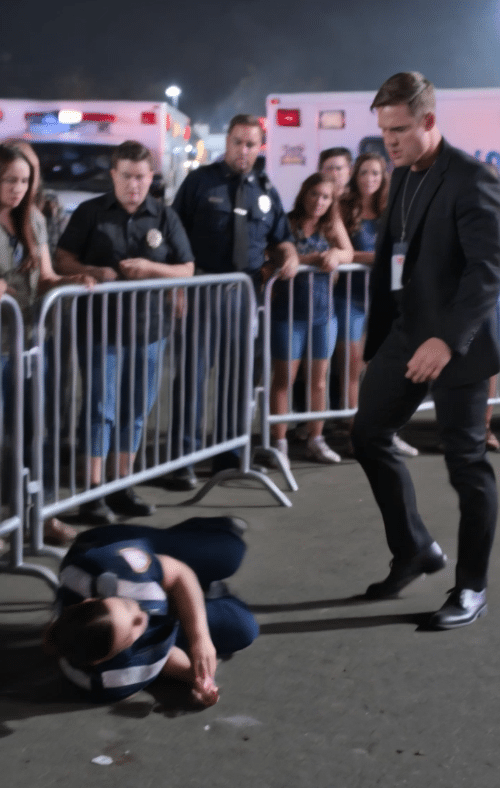
Officer Jessica Morgan stood beside a temporary barrier, her reflective vest catching the carnival lights as she held a traffic wand in one hand and her radio in the other. Behind her, festivalgoers crowded the walkways, music pulsed from the main stage, and red-blue emergency lights flashed against the metal fencing.
An ambulance siren was getting louder.
But the man standing in front of Jessica seemed to believe the entire festival had been organized around his convenience.
“I have a VIP pass,” he snapped, lifting the credential hanging from his black blazer. “Move the barrier.”
“The lane is closed for emergency access. You need to use the public route.”
The man, a forty-five-year-old investor named Gregory Walsh, stared at her as if she had just told him he was no longer important. His drink rested in one hand, and his expensive watch glittered beneath the overhead lights.
“I didn’t pay thousands of dollars to walk around with everyone else.”
Jessica kept her position.
“The ambulance is coming through. Nobody crosses this lane until it’s clear.”
Gregory gave a short, contemptuous laugh.
“Trash. VIPs don’t wait for your lane.”
A few people nearby turned to look. Some recognized Gregory from the festival’s sponsor events. He was a familiar face at charity galas, private parties, and business receptions where access was treated as a measure of personal worth.
He had built his public image around being the man who could get into any room.
Now a police officer was telling him to wait several minutes, and he could not bear it.
Jessica shifted slightly to keep the barrier secure.
“Sir, step back.”
Gregory leaned toward her, lowering his voice as though he were offering her one final opportunity to understand her mistake.
“Do you know who I am?”
“I know you’re being asked to stay out of an ambulance lane.”
His face changed.
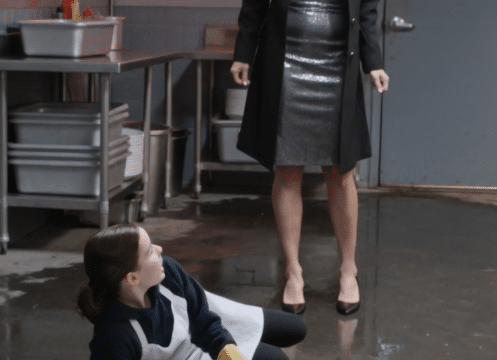
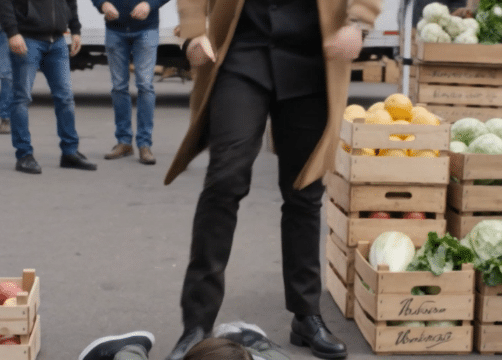
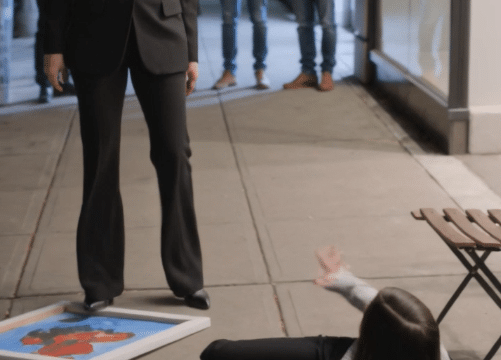
Then he drove a violent kick straight into her chest.
Jessica was thrown backward onto the pavement beside the mobile barrier. Her traffic wand clattered to the ground, its light flashing against the concrete, while her radio slid away beneath the edge of a security cone.
A gasp rose from the surrounding crowd.
Jessica struggled to breathe. Her forearm struck the pavement as she tried to catch herself, leaving a thin trace of blood where her skin scraped against the ground.
Gregory stood over her, his expression cold with anger.
“Now move.”
Jessica grimaced and reached toward the barrier. The ambulance was almost there, and the temporary lane remained partially blocked.
“Sir,” she managed, “this lane is closed for the ambulance.”
Instead of backing away, Gregory stepped closer and delivered two more forceful kicks into her back and side as she reached toward the barrier. Jessica recoiled in pain, one arm stretched toward the obstruction even as she struggled to protect herself.
Around them, festivalgoers froze.
A woman covered her mouth. A young man stepped backward, his drink trembling in his hand. Several people stared in disbelief, unable to reconcile the cheerful lights and music with the brutal scene unfolding a few feet away.
Gregory lifted his chin.
“I paid to walk where I want.”
Then the ambulance siren swelled over the music.
A black SUV braked sharply near the VIP entrance. Its doors opened, and the city mayor stepped out alongside the festival’s security director.
The security director took one look at Jessica on the ground and spoke urgently into his radio. Another officer moved to protect her while the ambulance entered the cleared portion of the lane.
The mayor’s expression hardened as he looked at Gregory.
“Cancel his VIP status citywide.”
Gregory’s eyes dropped to the pass hanging from his blazer.
For the first time that night, the badge he had been using to intimidate people looked less like a symbol of privilege and more like evidence of how badly he had misunderstood his own importance.
“Citywide?” he whispered.
He had expected an officer to move aside.
He had never imagined the entire city might close its doors to him.
And that was only the beginning of what his arrogance would cost him.
Act II
Mayor Daniel Brooks had spent six years learning that public leadership was often tested in moments no one planned.
He had attended festivals where the crowds were larger than expected, stood beside emergency crews after storms, and answered questions from angry residents who believed the city had forgotten them. He knew that a public event could look effortless from the outside only because hundreds of people worked behind the scenes to keep it safe.
The emergency lane was one of those details.
It was not a decorative strip of pavement or a shortcut reserved for people with the right credentials. It was a protected route designed to allow ambulances and other emergency vehicles to reach people who might be injured, unconscious, or in immediate danger.
Jessica had been assigned to keep it clear.
Gregory had decided that his ticket mattered more.
The festival’s security director, Marcus Reed, reached Jessica first. He crouched beside her while another officer secured the barrier and guided the ambulance through the lane. Paramedics began assessing her condition as soon as the emergency vehicle had passed the immediate obstruction.
The mayor stood nearby, watching the security team take control of the scene.
Gregory hurried toward him.
“Mayor, thank goodness you’re here. This officer has been completely unreasonable.”
Daniel turned slowly.
“An officer is receiving medical attention.”
“I understand that, but she attacked my privileges. I paid for access.”
“You can discuss your ticket after we understand what happened.”
Gregory spread his arms in disbelief.
“I was simply trying to reach the VIP entrance.”
“You were told the lane was closed for an ambulance.”
“That’s not what happened.”
Marcus approached, his radio still in hand.
“Sir, the lane was closed, and the officer instructed you to remain behind the barrier.”
Gregory stared at him.
“You work security. You know what a VIP pass means.”
“It means you have access to designated festival areas,” Marcus replied. “It does not authorize you to enter a closed emergency route.”
Gregory looked toward the gathering crowd and seemed to realize that more people were watching than before. His expression softened into the polished concern he often used when he needed an audience to believe he was reasonable.
“This is a misunderstanding. I was frustrated. She made it personal.”
Daniel glanced toward Jessica, who was now being examined by the paramedics.
“Did you kick her?”
Gregory hesitated.
“I barely touched her.”
Several witnesses reacted visibly. A woman near the barricade shook her head. A man in a festival staff jacket looked toward the officer taking statements.
Daniel noticed their reactions but did not rely on them alone.
“Marcus, preserve any available recordings. Separate the witnesses and document what they saw. Make sure the officer receives medical care.”
“Understood.”
“And suspend Gregory’s festival credentials pending review.”
Gregory’s face changed again.
“You can’t do that.”
“The security director can suspend access under the event’s safety procedures. The police will handle the assault investigation separately.”
“But I’m one of the sponsors’ guests.”
“That does not change the emergency lane.”
Gregory glanced down at his drink as if the answer might somehow be written on the cup. Around him, the festival continued, but the immediate crowd had fallen quiet. The music from the main stage seemed strangely distant.
He had spent years moving through rooms where people laughed at his jokes, accepted his invitations, and returned his calls because he was useful to know.
He had confused those responses with respect.
Now the people around him were looking at him without the usual calculation. They were not wondering how much money he had or which company he represented. They were trying to understand how a man could kick a police officer while an ambulance approached.
The mayor stepped closer.
“You may believe your pass makes you important,” Daniel said. “It does not make you more important than someone who needs emergency care.”
Gregory’s jaw tightened.
“I want to speak to the festival organizers.”
“You can do that through the appropriate process.”
“I know the people who run this event.”
“So do I.”
The mayor did not raise his voice. He did not need to.
Marcus directed an officer to escort Gregory away from the emergency route while the scene was documented. The suspension of his credentials would be recorded, and any broader restriction would be handled through the appropriate city and event procedures.
Gregory continued arguing as he was moved away from the barrier.
He insisted that he had been embarrassed. He complained that the officer had treated him like an ordinary person. He threatened to call sponsors and demand that someone be fired.
But no one moved the barrier for him.
The ambulance had passed because the emergency route was protected, and the team was determined to keep it that way.
As Jessica was taken for further medical evaluation, she looked briefly toward the mayor.
“Lane’s clear,” she said through a strained breath.
Daniel nodded.
“Your team has it. Let them take care of you now.”
She finally allowed herself to turn away from the barrier.
For Jessica, the emergency had been about keeping a path open for someone who might need help.
For Gregory, it had been about being denied a shortcut.
And the more investigators learned about his conduct, the clearer it became that this was not simply a man who had lost his temper over a ticket.
It was a man who had built his identity around the belief that other people should always make room for him.
Act III
Gregory Walsh had not started life with money.
His father had managed a small hardware store outside Cleveland, and his mother had worked as a bookkeeper. They had taught him to work hard, pay his bills, and treat people decently, even when no one important was watching.
For a while, Gregory had followed that advice.
He built a career in commercial real estate, learned how to negotiate deals, and eventually became a partner in a property investment firm. He was clever, energetic, and unusually skilled at identifying what people wanted to hear.
His first major success came when he helped secure financing for a redevelopment project that others had considered too risky. After that, invitations began arriving. He was asked to attend charity dinners, private sporting events, and exclusive receptions where business relationships were formed over expensive meals.
Gregory loved the access.
At first, he saw it as proof that his hard work had paid off. Then he began to believe the access itself was proof that he was superior to the people who had not achieved the same success.
He stopped thanking event staff. He snapped at hotel employees who made him wait. He expected restaurant managers to find tables even when the dining room was full.
When someone challenged him, he did not ask whether he was wrong.
He asked who had given them permission to challenge him.
His wife, Caroline, had watched the change with growing unease. She once told him that he treated people differently depending on whether they could do something for him. Gregory dismissed the criticism as jealousy and accused her of failing to understand the demands of his career.
Their marriage ended two years later.
Afterward, Gregory presented himself as a man who had sacrificed everything for success. He told friends that he was too busy to maintain relationships with people who could not keep up with him.
But behind the polished image, his business was becoming more fragile than he admitted.
One of his largest real estate investments had stalled after construction costs rose and financing terms changed. A second project was facing delays. Gregory had personally guaranteed part of the debt, and he was increasingly worried about how those obligations might affect his reputation.
He could not afford to look vulnerable.
So he doubled down on the image of a man whose life was always moving upward.
The festival was supposed to be another opportunity to reinforce that image.
Gregory had been invited through a corporate sponsor whose executives wanted him to help attract investors to a planned waterfront development. His VIP credentials included access to a private lounge, reserved seating, and a reception with local business leaders.
He saw the pass as more than a ticket.
It was proof that he still belonged among people whose approval could open doors.
That was why the blocked lane infuriated him so much.
The public route would have taken only a few additional minutes. But walking with the general crowd felt, to Gregory, like a visible demotion. If someone important saw him waiting behind a barrier, he feared they might interpret it as a sign that his influence was fading.
The thought was irrational, but he had spent years allowing status to become the measure of his worth.
He did not see Jessica as an officer protecting emergency access.
He saw her as an obstacle between him and the image he wanted to maintain.
And when she refused to move, he tried to restore his sense of control through violence.
That decision brought consequences he had never considered.
The festival organizers began reviewing the incident. Security personnel preserved the relevant records and identified the witnesses. The police investigated the assault, while city officials and event management examined whether Gregory should continue receiving access to municipal festivals and other restricted event areas.
The mayor’s order was not a magical decree that could erase Gregory’s access to every private venue in the country. It was a direction to review and revoke the privileges under the city’s and festival’s control, with broader restrictions subject to the applicable rules.
But even that was enough to frighten him.
Gregory had relied on a network of invitations, sponsor relationships, and special credentials. His business depended partly on being perceived as a man who could bring people together and move easily among influential circles.
If those invitations disappeared, he would have to explain why.
And this time, the explanation would not be a rumor he could dismiss.
There were witnesses.
There were recordings to review.
There was an injured officer and an ambulance that had needed the route he had tried to occupy.
Within days, the sponsor who had provided Gregory’s credentials requested a formal account of the incident. The company did not immediately declare him guilty of every allegation. It asked for the facts and began reviewing whether his conduct was compatible with its own event policies.
Gregory sent a long email describing the confrontation as a misunderstanding.
He claimed he had been provoked, that security had failed to explain the route closure, and that the mayor had overreacted after hearing only one side.
But the account left out the part that mattered most.
He did not explain why he had kicked Jessica.
And he could not explain away the people who had seen him do it.
The festival had been intended to showcase the city’s energy, generosity, and sense of community.
Instead, Gregory had given the public a different story—one in which a man with a VIP pass believed he could place himself above an ambulance route and punish the person who stopped him.
The mayor understood that the incident could not be resolved by a single dramatic announcement. The assault had to be investigated properly, and the security review had to follow the rules governing the event.
But he also understood that public access and special privileges carried responsibilities.
A person who received the benefits of an event’s trust could not demand those benefits while openly disregarding its safety requirements.
And Gregory was about to discover how quickly the doors he had spent years opening could close.
Act IV
Three days after the festival, Gregory arrived at his office wearing the same polished confidence he had always used to conduct business.
He had chosen a navy suit, a crisp white shirt, and a tie that matched the firm’s logo. He arrived early, expecting to speak with his managing partner before the rest of the staff came in.
Instead, he found an email waiting in his inbox.
The sponsor had suspended his participation in upcoming public-facing events while it reviewed the incident. The festival organizers had revoked his VIP credentials for the remainder of the season, subject to the outcome of their review. City officials were also evaluating whether he should be excluded from other city-controlled VIP programs under their applicable policies.
Gregory read the message twice.
Then he called the sponsor’s executive director.
“You cannot do this based on a single incident.”
“We are reviewing documented conduct at a public event,” the executive replied. “The emergency lane was closed, and an officer was injured.”
“She disrespected me.”
“The officer was performing a safety duty.”
“You weren’t there.”
“We have witness accounts and records to review. You will have an opportunity to respond.”
Gregory ended the call.
He stood by the window, watching traffic move below his office, and tried to convince himself that the matter would fade. Public attention moved quickly, he told himself. There would be another event, another opportunity, another person willing to overlook the confrontation in exchange for access to his business network.
Then his managing partner entered.
“We need to discuss the festival,” the partner said.
Gregory immediately launched into his explanation. He described the blocked lane, the officer’s refusal to accommodate him, and the mayor’s supposedly excessive reaction.
His partner listened without interrupting.
When Gregory finished, the man placed a printed copy of the incident summary on the desk.
“Did you kick the officer?”
Gregory stared at him.
“That’s not the point.”
“It’s the first point.”
“I was angry.”
“That isn’t an answer.”
Gregory felt the familiar heat rising in his face.
He had expected his partner to defend him, or at least to offer a strategy for managing the fallout. Instead, the conversation had become another situation in which he was being asked to account for his own behavior.
“I’ve brought this firm millions of dollars in business,” he said.
“And that is why I’m asking you to take this seriously before the damage spreads further.”
Gregory looked away.
His partner explained that the firm would cooperate with any legitimate inquiry and review whether Gregory’s public conduct had created risks for the business. No final decision had been made, but the firm’s leadership could not ignore an incident involving alleged violence at a public event.
Gregory left the office furious.
He called several people he knew through the festival’s sponsor network. One declined to speak. Another said the matter was under review and ended the call politely. A third told him that his name had become a subject of concern among event organizers.
For years, Gregory had treated his contacts as a form of protection.
Now every conversation seemed to remind him that those relationships depended on trust, not merely familiarity.
Meanwhile, Jessica was recovering.
The injuries from the assault had left her sore and shaken. Her doctors advised her to rest while they evaluated her condition, and she was temporarily unable to return to full duties.
At first, she struggled with the inactivity.
She kept thinking about the ambulance and the seconds during which the barrier had been compromised. She wondered whether she should have positioned herself differently or called for assistance sooner.
A fellow officer visited her and listened as she described the moment Gregory struck her.
“You were holding a safety perimeter,” he said. “He chose to attack you. You don’t have to turn his decision into a failure of your own.”
Jessica looked down at the bandage on her forearm.
“I keep seeing the ambulance lights.”
“That’s understandable. But the lane was cleared, and the paramedics got through. You weren’t alone out there, even when it felt that way.”
She was quiet for a long time.
Eventually, she accepted that recovery did not require her to pretend the incident had left no mark. She could be shaken by what happened and still be the same officer who had done her job.
The police investigation continued. Witnesses provided their accounts, available recordings were reviewed, and the evidence concerning the assault was handled through the proper process. Any criminal charges or other legal consequences would depend on the findings and decisions of the appropriate authorities.
The city’s review moved forward separately.
The security director documented why the lane had been closed, what Gregory had been told, and how the assault had affected the emergency operation. Festival management reviewed the terms of its VIP program and the conditions under which credentials could be suspended or revoked.
The mayor’s office did not need to announce that Gregory was forbidden from entering every private event in America. It needed to make sure that the privileges under the city’s control were not used to undermine public safety.
Marcus Reed summarized the issue during a meeting with festival officials.
“VIP access is an event benefit,” he said. “It is not permission to disregard safety rules, and it certainly isn’t permission to assault staff.”
The officials agreed that future credentials would be subject to clearer enforcement procedures. The city’s events team would review the incident before approving Gregory for any future restricted-access program under its jurisdiction.
When Gregory finally received the formal notice that his city-controlled VIP privileges had been revoked pending further review, he read it in silence.
Then he called the mayor’s office.
He was told that he could submit a written response through the designated process.
He demanded to speak directly to Daniel.
The request was declined.
For the first time in years, Gregory could not force a conversation simply by insisting that he deserved one.
His pass had not made him untouchable.
It had only made the fall more public.
Act V
The consequences unfolded over the following months, not through one grand punishment but through a series of decisions that Gregory could no longer control.
The assault investigation proceeded on the basis of the available evidence. Witness statements and recordings were evaluated, and the appropriate authorities determined the legal steps to take. Gregory had the opportunity to respond through the established process, but his claims of disrespect could not erase the evidence of what had occurred.
The festival’s review reached its own conclusion.
Gregory’s credentials were revoked under the event’s access policies, and city officials declined to restore the special access privileges they controlled. Other private organizations made their own decisions based on their rules and their assessment of the incident.
The sponsor that had originally invited him withdrew him from upcoming public events while it reassessed the relationship.
No single decision ended Gregory’s career. His business still existed, his investments still required attention, and his financial obligations did not disappear because his name had become controversial.
But the image he had carefully cultivated began to crack.
People who had once accepted his invitations without hesitation became more cautious. Event organizers asked for clarification before agreeing to future appearances. Business associates who had relied on his reputation for professionalism began asking whether his judgment could be trusted in difficult situations.
The damage was not simply that he had lost access to a private lounge.
It was that he had shown people what he did when someone told him no.
At first, Gregory blamed everyone else.
He blamed Jessica for refusing to make an exception. He blamed security for failing to accommodate him. He blamed the mayor for turning a confrontation into a public issue. He blamed the witnesses for making the incident seem worse than it was.
But the more he repeated those explanations, the less convincing they sounded.
He had not been trapped in a dangerous situation. He had not been trying to save someone. He had not been denied medical treatment or prevented from reaching an emergency.
He had been told to wait because an ambulance needed the lane.
And he had responded by attacking the officer responsible for keeping it clear.
One evening, several weeks after the festival, Gregory found the VIP pass in the pocket of the black blazer he had worn that night. The plastic card was still intact, its lettering bright beneath the kitchen light.
He held it between his fingers.
For years, he had believed that a credential like this could change how people saw him. It had granted him access to rooms where important decisions were discussed and allowed him to feel that he had moved beyond the ordinary rules everyone else had to follow.
Now the card had become a reminder of the moment he had mistaken access for authority.
He thought of Jessica on the pavement, reaching toward the barrier while the ambulance approached.
He remembered the crowd’s silence.
Most of all, he remembered the mayor’s order.
“Cancel his VIP status citywide.”
At the time, Gregory had heard those words as a threat to his reputation. He had imagined losing invitations, being turned away at entrances, and watching people who once welcomed him suddenly pretend not to recognize him.
He had been right about some of that.
But he had misunderstood the deeper meaning.
The city had not withdrawn his privileges because he had embarrassed an important official. The mayor had acted because Gregory had demonstrated that he was willing to endanger an emergency operation to preserve his own sense of status.
The restrictions were about trust.
And trust could not be purchased with a VIP ticket.
Jessica eventually returned to duty. Her recovery took patience, and the experience remained with her longer than she expected. But when she stood beside another emergency lane at a later public event, she no longer thought of that night only as the moment she had been attacked.
She remembered how the ambulance had passed.
She remembered Marcus securing the scene, the mayor arriving, and her colleagues stepping in when she needed them. She remembered that the crowd had been shocked into silence at first, but witnesses had later provided their accounts.
She had not been able to control Gregory’s actions.
She had still helped protect the route that emergency workers needed.
At the next festival, organizers reinforced the emergency-access procedures and briefed staff on how to handle restricted lanes. VIP guests were reminded that special access never superseded emergency instructions. Security teams were also given clearer guidance on documenting violations and responding when someone refused to comply.
The measures were not designed to punish every person who complained about a delay.
They were designed to ensure that the next ambulance would not have to compete with someone’s ego for a clear path.
And that was the real point of the story.
Gregory had paid for reserved seating, private entrances, and exclusive receptions. He had paid for convenience and comfort. He had mistaken those benefits for the right to demand that the world move around him.
But when the siren sounded, none of those things mattered.
The ambulance did not care about his investments. The injured person inside it did not know his name. The officer holding the barrier was not there to measure his importance.
She was there to keep the lane open.
Gregory had declared, “I paid to walk where I want.”
The answer was not that money could never buy access. The answer was that access came with limits, and those limits existed for reasons more important than his convenience.
He had wanted the city to recognize his status.
Instead, the city learned what he was willing to do when his status failed him.
And the VIP pass he once lifted like a badge of superiority became the symbol of his own undoing.
When he whispered, “Citywide?” he was finally beginning to understand the scale of what he had lost.
Not because one mayor had the power to close every door in the world.
Because every door he had once entered so confidently now came with a question he could not answer by showing a card:
Could anyone trust him to respect a boundary when he believed he was more important than the person enforcing it?
That night, under the carnival lights, the answer had been unmistakable.
And for the first time in his life, Gregory Walsh had to face a world that would not move aside just because he demanded it.