Act I
“Ma’am, doctors need this hallway clear.”
Officer Emily Carter stood directly in front of the emergency room doors, one hand raised to keep a distraught woman from pushing past her. Nurses hurried between stretchers under the cold white lights, and somewhere behind the closed doors, a team of doctors was fighting to stabilize a young man brought in after a serious traffic accident.
The woman in the expensive coat could hear the activity inside. She could see the nurses moving. None of it mattered to her.
“My son is behind that door!” she screamed. “Move!”
Emily kept her voice steady.
“I understand you’re frightened, but the medical team needs room to work. You cannot enter until the staff says it’s safe.”
The woman’s name was Victoria Hale. She was forty-one, impeccably dressed even at nearly midnight, and accustomed to getting immediate answers whenever she demanded them. She had arrived at the hospital minutes after learning that her twenty-year-old son, Ethan, had been involved in a devastating crash.
Since then, every closed door had felt like an insult.
Every unanswered question had felt like a personal betrayal.
And now, in her mind, a uniformed officer was the only thing standing between her and her child.
“You don’t understand!” Victoria snapped. “That’s my son in there!”
“I understand that, ma’am. I’m trying to keep the hallway clear so the doctors can help him.”
Victoria stepped forward.
Emily didn’t move.
For one suspended moment, the two women stood inches apart while a nurse pushed a medical cart past the far wall. The emergency doors remained closed, and a monitor beeped somewhere beyond them.
Then Victoria’s fear turned into fury.
“Trash!”
She swung a vicious slap across Emily’s face.
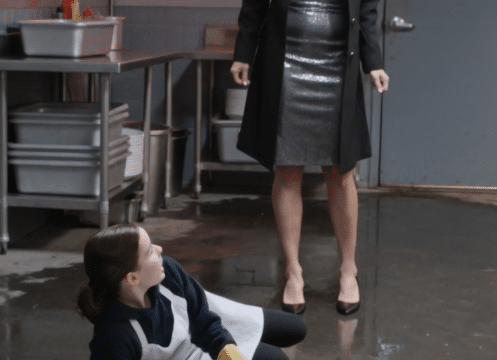
The impact snapped the officer’s head sideways. Emily staggered backward and crashed onto the hard hospital floor, her radio flying loose and skidding across the polished tiles. Her forearm struck the ground, leaving a thin trace of blood where her skin scraped against it.
A nurse stopped mid-stride.
Someone near the waiting area gasped.
Emily pressed one hand to the floor, fighting through the shock and pain. Even as she struggled to sit up, she positioned herself between Victoria and the emergency room entrance.
“Ma’am,” she said, breathing hard, “the doctors need this hallway clear.”
Victoria stared down at her.
Instead of stepping back, she moved closer and delivered two more forceful kicks into Emily’s back and side as the officer tried to brace herself near the doors. Emily recoiled, grimacing, but still reached toward the space she was supposed to protect.
“Move, or I’ll make you move!” Victoria shouted.
The hallway seemed to shrink around them.
The nurses had to keep moving. The doctors inside the emergency room still needed the corridor to remain accessible. Yet the woman responsible for the violence appeared to believe that the urgency of her son’s condition gave her permission to do whatever she wanted.
Then the emergency elevator doors burst open.
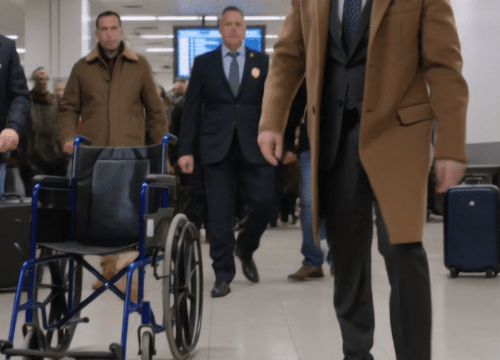
A sixty-two-year-old man in a white coat beneath a dark hospital director’s jacket stepped into the corridor, followed by the emergency department chief and a hospital security team. He had been in a surgical consultation when the alert reached him, and he had come upstairs expecting to manage a difficult night.
Instead, he saw a police officer on the floor.
He saw her fallen radio.
And he saw a woman standing over her.
The man’s expression changed instantly.
He crossed the hallway, dropped to his knees beside Emily, and turned toward the emergency department chief.
“Get her assessed. Now.”
Then he looked up at Victoria.
His voice was quiet, but the anger beneath it made the entire corridor fall silent.
“Who just touched my daughter?”
Victoria’s face drained of color.
For the first time since arriving at the hospital, she had nothing to say.
“Your daughter?” she whispered.
She had believed she was fighting an insignificant obstacle between herself and her son.
She had no idea whose life she had just changed—or how much worse the truth about her own son was about to become.
Act II
Dr. Richard Carter had spent more than three decades in medicine.
He had worked overnight shifts when the emergency department was overflowing, performed surgeries that lasted until dawn, and delivered difficult news to families who desperately wanted a different answer. As hospital director and a senior trauma surgeon, he had learned to separate fear from anger, urgency from panic, and personal emotion from the decisions that could mean the difference between life and death.
But when he saw Emily lying on the floor, that discipline nearly broke.
She was his only child.
Richard had raised her after his wife, Margaret, died from cancer when Emily was seventeen. For years, the two of them had built a quiet life around hospital cafeterias, late-night conversations, and Sunday dinners that were often interrupted by emergency calls.
He had wanted Emily to become a doctor.
She had wanted to serve in law enforcement.
They had argued about it, made compromises, and eventually accepted that they saw the world differently. Richard treated injuries after disasters; Emily tried to prevent people from being hurt in the first place.
He had never entirely stopped worrying about her.
And now she was on the floor of his own hospital, injured while protecting the very corridor where his medical teams were working.
The emergency department chief, Dr. Nina Patel, knelt beside Emily while security officers positioned themselves between her and Victoria.
“Emily, can you hear me?”
Emily nodded, though her face tightened as she tried to move.
“I’m here,” Nina said. “Don’t try to get up yet.”
Richard fought the instinct to lift his daughter himself. He knew better than anyone that she needed a proper assessment, not a frightened father’s attempt to reassure himself that she was all right.
He moved back enough to give Nina room.
Then he turned toward security.
“Secure the corridor. Keep the doors clear. Contact the responding police supervisor and document what happened.”
One of the guards acknowledged the order and guided Victoria away from the treatment entrance.
Victoria barely seemed to notice.
Her eyes remained fixed on Richard.
“I didn’t know she was your daughter.”
The words came out in a rush, as if she had discovered a defense that might erase what everyone had witnessed.
Richard looked at her for a long moment.
“Would that have made you stop?”
Victoria opened her mouth.
Nothing came out.
“I was frightened,” she finally said. “My son is in there. I haven’t been told anything. Nobody will let me see him.”
“I understand that you’re frightened,” Richard replied. “But my daughter was doing her job. And no patient’s family member is permitted to assault hospital staff or an officer because they are asked to wait.”
“I’m not just any family member.”
The sentence escaped before Victoria could reconsider it.
Richard’s expression hardened.
“No. You’re a mother whose son is receiving emergency care. That deserves compassion. It does not give you the right to hurt someone.”
Victoria glanced around the corridor.
The nurses had returned to their tasks, but their expressions were no longer merely startled. A hospital security supervisor was speaking to the responding police unit. Two witnesses were being asked to remain available to provide statements.
The room had changed.
A few minutes earlier, Victoria had imagined herself as the only person in the building who truly understood the emergency. Now everyone around her was treating the assault as something that had to be addressed in its own right.
She tried again.
“Please. I need to know if Ethan is alive.”
That question finally softened Richard’s expression—not because it excused her behavior, but because the fear behind it was real.
“His medical team is treating him,” he said. “They will provide information as soon as they can. I will not interfere with their decisions, and neither will you.”
“But I’m his mother!”
“And he is a patient. The doctors need to work without someone forcing their way into the treatment area.”
Richard glanced toward the emergency department chief.
“Can a staff member update her when the treating physician is ready?”
“Yes,” Nina replied. “We’ll make sure she receives information through the appropriate process.”
Victoria clutched the front of her coat.
She had spent the last several minutes imagining the worst possible outcome. Every second behind those doors had felt unbearable. She had been desperate to see Ethan with her own eyes, to hear someone tell her that he would survive, to make the terror stop.
But she had chosen to direct that terror at the one person standing between her and an area where medical professionals needed space to work.
Now she faced two emergencies.
One was the condition of her son.
The other was the fact that her own actions had become a separate matter for the police.
As officers arrived, Richard remained beside Emily while Nina completed her initial assessment. Emily’s radio was retrieved, and the corridor was documented before the area was returned to normal operation.
Richard did not ask for special treatment for his daughter. He did not order anyone to ignore procedure because he was the hospital director. He knew that the investigation needed to be handled independently and that his family connection could make it even more important to preserve the facts carefully.
But as he watched Emily wince while being helped onto a stretcher, one thought would not leave him.
Victoria had struck his daughter because she believed her own fear mattered more than the rules protecting everyone in that hallway.
And Richard was beginning to suspect that Victoria’s panic was only part of the story.
Act III
Ethan Hale had been brought to the hospital after a collision on a rain-slick road just outside the city.
The initial information was incomplete. Emergency crews had transported him for urgent evaluation, and the medical team was still working to determine the full extent of his injuries. Victoria had arrived with little more than a phone call, a location, and the terrifying knowledge that her son had been involved in a serious crash.
She had not yet learned what happened in the moments before the collision.
She had not asked whether anyone else had been hurt.
And she had not considered that the investigation into the crash might reveal something her son had never told her.
Ethan was twenty years old, the only child of a woman who had built a comfortable life around him. Victoria had raised him after divorcing his father, a relationship she often described as a long struggle to protect her son from a world that was too demanding and too judgmental.
She loved Ethan fiercely.
But over the years, love had become entangled with fear.
When he failed an exam, she blamed the professor. When he lost a job, she blamed an unfair manager. When a friend confronted him about a broken promise, she insisted that the friend was jealous.
Victoria told herself she was standing up for her child.
In reality, she had slowly taught him that consequences were things other people imposed unfairly—and that a strong enough argument could make them disappear.
Ethan had grown into a charming young man who knew how to sound apologetic without necessarily accepting responsibility. He could be generous when he wanted to be, and thoughtful when the situation required it. But he had also learned to avoid difficult conversations, conceal mistakes, and wait for his mother to intervene whenever trouble appeared.
A few months before the crash, Ethan had borrowed money from Victoria to cover several overdue bills. He promised to repay her after securing a new position, but he never told her that he had lost the job he was counting on.
Instead, he kept spending.
He attended parties, made plans he could not afford, and assured his mother that everything was under control. Victoria believed him because the alternative frightened her.
She did not want to think that the boy she had protected from every disappointment might be making decisions that could hurt himself—or someone else.
The crash forced that possibility into the open.
As police began documenting the collision, they gathered statements from those involved and examined the circumstances surrounding it. The process would take time, and no one could responsibly declare exactly what had happened before all the relevant facts were established.
But the early questions were serious enough to require careful investigation.
Victoria knew none of this when she attacked Emily.
She believed the only barrier between her and reassurance was an officer who refused to understand a mother’s pain.
Richard knew better than to draw conclusions about the crash before the evidence was reviewed. He also knew that his role as hospital director did not entitle him to private details about every patient, even when that patient was connected to a person involved in a separate incident.
Ethan’s care belonged to his treating team.
Emily’s assault belonged to the responding authorities.
The hospital had to protect both processes.
Later that night, a physician met Victoria in a private consultation area and explained what could be shared about Ethan’s condition. He was receiving treatment, and the team was continuing its evaluation. The doctor answered her questions within the limits of what was known and what could appropriately be disclosed.
Victoria listened, her hands clasped tightly in her lap.
“Can I see him?”
“When the team determines that a visit is safe and appropriate, we’ll explain the arrangements.”
She wanted to argue.
The words were already forming in her mouth: You don’t understand. I’m his mother. I have a right to be there.
Then she remembered Richard’s face when he asked whether she would have stopped if Emily had been someone else’s daughter.
For the first time, she could not immediately convince herself that the answer was yes.
She had not known Emily’s family. She had not known her history. She had not known that she was striking the daughter of a respected surgeon.
She had seen a uniform and decided the person wearing it was beneath her anger.
That realization unsettled her more than the security officers did.
Meanwhile, Emily was being evaluated away from the crowded corridor. Her injuries required attention, and she was advised to rest while the medical team assessed her condition. Richard remained nearby but made a point of letting the clinicians do their work.
When Emily finally had a moment to speak with him, she was pale and exhausted.
“Dad,” she said, “don’t turn this into something personal.”
Richard looked at her.
“She assaulted you.”
“I know.”
“I saw you on the floor.”
“I know that, too.”
He drew a slow breath.
“I want to make sure you’re safe.”
“Then let them treat me, and let the officers handle the investigation.”
Her words were gentle, but firm.
Richard had spent his life telling families that fear could make people act in ways they would later regret. Now his daughter was reminding him that his own fear could do the same.
He took her hand.
“All right.”
Emily squeezed his fingers.
“And don’t let anyone make this about whether I’m your daughter. I was doing my job before you came out of that elevator.”
Richard looked toward the closed door.
She was right.
If Emily had been a stranger, the assault would still have been serious. If Richard had never arrived, the facts would still have mattered. The rules were not supposed to change according to whose name was on a hospital badge or whose parent held a position of authority.
But when he returned to the corridor, Victoria was waiting for him.
And she had a question that suggested she still did not understand the difference between a consequence and a personal attack.
“Are you going to have me arrested because I was worried about my son?”
Richard stopped.
“No,” he said. “The police will determine what happens based on the evidence. My responsibility is to make sure my daughter receives care and that this hospital remains safe for everyone.”
Victoria stared at him.
For the first time, she seemed to realize that being a mother did not make her the central figure in every crisis.
But the hardest truth was still waiting behind the emergency room doors.
Act IV
By morning, the hospital corridor had returned to its familiar rhythm.
Stretchers moved between departments. Nurses checked charts and medication orders. Families waited anxiously for updates, some pacing in tight circles, others sitting perfectly still as if movement might make bad news arrive faster.
The previous night’s assault had not stopped the hospital from functioning, but it had left a mark on the people who witnessed it.
Several staff members had seen Victoria strike Emily. Their accounts were collected, and the available security footage was preserved for review. The responding officers documented the incident and began the appropriate investigative process.
Richard made one decision clear from the beginning.
No one was to alter a statement, conceal a recording, or offer Victoria special treatment because of the hospital director’s position. Nor was anyone to treat her more harshly because the injured officer was his daughter.
The facts would speak for themselves.
Victoria, meanwhile, had begun to lose the certainty that had carried her through the night.
At first, she had expected Richard to threaten her, shout at her, or use his authority to make her fear him. Such a confrontation would have allowed her to cast herself as the victim of an arrogant man protecting his family.
Instead, he spoke in measured sentences and directed her to the appropriate people.
He did not bargain.
He did not threaten to ruin her.
He did not promise that the hospital would deny Ethan care.
That last point mattered more than Victoria wanted to admit.
Despite what had happened in the corridor, Ethan continued receiving medical attention. His treatment was not made conditional on his mother’s behavior, and the clinical team remained focused on his needs.
When Victoria asked for another update, staff members followed the same process they would have followed for any family member in her circumstances.
When she asked to enter the emergency treatment area, she was told to wait for permission.
When she demanded to speak directly to Richard, she was informed that he was attending to hospital responsibilities and that the emergency department chief could help with questions about the care process.
Each answer frustrated her.
But none was unreasonable.
She began to understand that the hospital was not conspiring against her. It was functioning according to boundaries that existed for patients, staff, visitors, and officers alike.
Later, a police supervisor met with her to explain the next steps in the investigation. Victoria was informed that the assault would be assessed based on witness accounts, available recordings, and other relevant evidence. She would have an opportunity to provide her account through the proper process.
She immediately insisted that she had been terrified.
The supervisor did not argue with her feelings.
“Your concern for your son can be real,” he explained, “and the assault can still be investigated.”
Victoria looked away.
She had wanted her fear to serve as an answer to every question. Now she was being asked to accept that it explained her state of mind without erasing what she had done.
That afternoon, she was finally allowed a brief visit with Ethan under the conditions set by his medical team.
When she entered his room, the anger fell out of her face.
Ethan looked exhausted. Medical equipment surrounded him, and his voice was weaker than she expected when he greeted her.
“Mom?”
Victoria hurried to his bedside, then stopped herself from touching anything before asking the nurse whether she could sit beside him.
The nurse helped her settle into the chair.
For a few minutes, Victoria said nothing. She held her son’s hand and tried to reconcile the person in front of her with the image she had carried through the previous night: a boy who needed her to fight every obstacle between him and safety.
Then Ethan asked a question.
“What happened at the hospital?”
Victoria froze.
“Nothing you need to worry about.”
He studied her face.
“Mom.”
She looked down at their hands.
“I got into an argument with an officer.”
“What kind of argument?”
Victoria could have blamed the delay. She could have said that no one would tell her anything, that she had been overwhelmed, that the hospital had made her feel helpless.
Instead, she heard herself say, “I hit her.”
Ethan stared at her.
“You hit a police officer?”
“She wouldn’t let me through the door.”
“Because the doctors were working?”
Victoria had no answer.
The silence between them was different from the silence in the corridor. This time, there were no witnesses to impress and no official to challenge. There was only her son, who had spent years believing that his mother could fix almost anything.
She had wanted to protect him from every consequence.
Now she had to admit that she had created one herself.
Ethan closed his eyes for a moment.
“You shouldn’t have done that.”
The words hurt more than she expected.
“I was scared.”
“I know.”
“I thought you might die.”
“I know, Mom.”
He looked at her again.
“But that doesn’t make it okay.”
Victoria felt tears rise, and for once she did not immediately turn them into an argument. She could not accuse Ethan of abandoning her. She could not tell him he had no right to judge her. She had taught him to expect other people to excuse his mistakes, and now she was facing the same demand from herself.
She reached for a tissue.
“I don’t know what happens next,” she whispered.
“Neither do I.”
Outside the room, a nurse waited to ensure the visit remained consistent with Ethan’s care plan. No one rushed in to deliver a dramatic ultimatum. No one threatened to abandon the patient.
The consequences of the assault would be handled separately.
And Victoria, who had spent the night demanding control over every person around her, was finally beginning to understand what it meant to have none.
Act V
The weeks that followed did not produce the instant, theatrical punishment Victoria had imagined.
There was no single meeting where Richard Carter announced that her life was over. There was no secret authority he could invoke to erase her future. The assault was investigated through the appropriate legal process, and any charges or penalties depended on the evidence and decisions of the authorities responsible for the case.
The hospital also reviewed the incident under its safety procedures. Staff members were reminded how to respond to violent behavior, and security protocols for the emergency department were reinforced where necessary.
Richard did not intervene in the investigation.
He provided information about what he had personally witnessed, made sure Emily received the care she needed, and allowed the process to continue without trying to control its outcome.
It was harder than he expected.
There were moments when he wanted to use his position to make the consequences arrive faster. There were nights when he replayed the sight of Emily on the floor and imagined what might have happened if the elevator had opened a minute later.
But he remembered his daughter’s words.
She had been doing her job before he arrived.
She deserved justice as an officer and respect as a person—not a special result manufactured because her father ran the hospital.
Emily recovered gradually. The experience left her shaken, and returning to normal duties took patience. She spoke with colleagues she trusted and accepted the support available to her rather than pretending the assault had not affected her.
One afternoon, she visited Richard’s office after a follow-up appointment.
He looked up from his desk.
“How are you really doing?”
Emily considered the question.
“Some days are easier than others.”
“That’s honest.”
“I keep thinking about the way she looked at me. Like I was nothing.”
Richard stood and came around the desk.
“You were never nothing.”
“I know that. But in that moment, she thought she could do whatever she wanted because I was standing in her way.”
Richard nodded slowly.
“That’s what I can’t stop thinking about, either.”
Emily took a seat.
“Then don’t make this about my name. Make sure the next officer has the same protection, whether her father is a surgeon or a stranger in another city.”
Richard sat opposite her.
“I will.”
And he meant it.
The hospital reviewed its response procedures and reinforced expectations around protecting staff and maintaining clear access to emergency treatment areas. The work was practical rather than dramatic, but it mattered. A hospital could not prevent every act of aggression, yet it could make clear that violence would be documented, reported, and handled seriously.
Victoria’s life also changed, though not in the way she had feared at first.
She had to respond to the investigation and confront the possibility that her actions could carry lasting legal consequences. She could no longer rely on saying she was a frightened mother as if that phrase ended the discussion.
She also had to reckon with what Ethan had told her.
His recovery was not simple, and his medical team continued to guide his care. As the immediate crisis eased, he began facing difficult questions about his own decisions and the circumstances surrounding the crash. The investigation would establish the relevant facts, but his mother could no longer assume that protecting him meant shielding him from every uncomfortable truth.
One evening, after a visit with Ethan, Victoria sat alone in her car outside the hospital.
She remembered the corridor, the white lights, the closed doors, and the sound of her own voice demanding that someone move.
She remembered the officer on the floor, still trying to keep the entrance clear.
Most of all, she remembered the question that had changed everything.
“Who just touched my daughter?”
At first, she had heard those words as a warning from a powerful man. She had imagined that the hospital director’s position was the reason the situation had become so serious.
But over time, she understood the part she had tried hardest to avoid.
Richard had asked the question because the officer was his daughter.
The assault had mattered before he knew who she was.
Emily’s uniform had not made her less human. Her father’s title had not made her more human. The truth was that Victoria had attacked someone who was doing her job, and the revelation of their relationship had forced her to confront a cruelty she might otherwise have continued to minimize.
If Emily had been the daughter of a janitor, a bus driver, or a stranger with no powerful connections, the act would still have been wrong.
That was the lesson Victoria had missed when she first saw the uniform.
She had believed the world was divided into people who could demand things and people who were expected to obey. She had believed that fear gave her permission to cross every boundary and that love for her son could justify whatever she did in his name.
Now she was beginning to understand that love without restraint could become another form of entitlement.
She could be terrified for Ethan and still respect the people treating him.
She could demand information through the proper channels without attacking someone.
She could love her son without insisting that everyone else pay for her fear.
None of those realizations erased the assault.
They did, however, give her a choice about what kind of person she would become after it.
When Victoria next spoke with Richard, she did not ask him to make the investigation disappear. She did not demand that he persuade Emily to forgive her. She did not claim that the entire incident was a misunderstanding.
She said she was sorry.
Richard listened without offering immediate reassurance.
“I’m sorry you were frightened about your son,” he told her. “But the decision to strike Emily was yours. She gets to decide what she needs now, and the authorities will handle the case.”
Victoria nodded, tears gathering in her eyes.
For once, she did not ask him to change that answer.
She had arrived at the hospital believing that nothing mattered more than reaching her son. By the time she left, she understood that the emergency room was not a place where fear granted people unlimited authority.
It was a place where vulnerable lives depended on strangers doing difficult work under pressure.
Doctors needed clear hallways. Nurses needed room to move. Officers needed to carry out their duties without being attacked. Families needed compassion—but compassion could not mean surrendering every boundary to the loudest person in the room.
Richard returned to his work.
Emily continued rebuilding her confidence.
Ethan faced his recovery and the questions that came with it.
And Victoria had to live with a truth she could no longer push aside: the woman she had called trash had been standing between chaos and a hospital team trying to save lives.
The director’s daughter had not needed a famous father to deserve protection.
She had deserved it from the beginning.
That was why the revelation had shaken Victoria so completely. Not because she had struck the wrong person, but because she had finally discovered how wrong her entire way of seeing people had been.
She had thought power meant making others move.
In that cold hospital corridor, she learned that real authority was knowing when a boundary must hold—even when someone on the other side is frightened, furious, and certain the rules should not apply to her.
And behind the emergency room doors, the work had never stopped for either woman’s pride.
Because in a hospital, the person who shouts the loudest is not the person who matters most.
The person who needs help is.